How to Design a Scalable AI Architecture for Production in 2026

ALT: Scalable AI architecture blueprint for production systems in 2026, covering software engineering and AI solutions
Why Scalable AI Architecture Is the Most Critical Engineering Decision of 2026
Key Conclusion: In 2026, the gap between AI prototypes and production-ready systems has never been more consequential. Designing a robust AI architecture requires far more than model selection — it demands disciplined software engineering, rigorous systems thinking, and a clear roadmap for deploying AI solutions that hold up under real-world load, evolving data, and operational pressure. Get this foundation right, and everything else becomes dramatically easier to build on.
The promise of AI has never been louder, but the graveyard of failed pilots and stalled deployments has never been fuller either. Organizations that struggle most with AI aren't usually failing at the model level — they're failing at the architecture level. They haven't designed systems that can scale, adapt, or survive the complexity of production environments.
This article is a practitioner's guide: grounded in real engineering decisions, built for teams that want to ship — not just demo. Whether you're designing your first AI-powered product or re-architecting a system that's outgrown its initial design, the principles here apply directly.
Who This Guide Is For
✅ Applicable Scenarios:
- Startup founders and product teams preparing to ship an AI-powered product to real users for the first time
- Engineering leads and architects responsible for scaling an existing AI system that's hitting performance or reliability limits
- Full-stack developers stepping into AI infrastructure roles who need a clear mental model for production-grade design
❌ Not Applicable/Cautions:
- Teams still in pure research or experimentation mode with no near-term deployment timeline — the tradeoffs discussed here are optimized for production readiness, not exploratory ML work
- Organizations with highly specialized regulatory requirements (e.g., medical AI, financial risk models) without first consulting domain-specific compliance frameworks alongside this architectural guidance
The Production AI Problem Nobody Talks About Enough
Most AI architecture conversations start at the wrong layer. Engineers debate which LLM to use, which vector database is fastest, or whether to deploy on Kubernetes or serverless — before they've answered more fundamental questions: What guarantees does this system need to make? What happens when a model returns a bad result? How do you roll back a model update without downtime?
The reality is that production AI systems are distributed systems first, and AI systems second. All the traditional challenges of distributed software engineering — consistency, fault tolerance, observability, latency budgeting — apply in full force. And then you layer on top of that the unique challenges of non-deterministic model behavior, data drift, prompt injection risks, and the cost dynamics of GPU-backed inference.
Market signals confirm this shift in priority. According to research from McKinsey, the majority of organizations that have successfully scaled AI report that infrastructure and architecture decisions were more decisive than model quality in determining production outcomes. Meanwhile, cloud providers have raced to build managed AI infrastructure services precisely because the undifferentiated heavy lifting of running AI at scale is brutally complex.
The gap between "works in a notebook" and "runs reliably at scale" is where most AI projects die. Closing that gap requires an architectural mindset — and that's exactly what this guide addresses.
Designing for Production: A Step-by-Step Architectural Framework
Three Steps to Establishing Your AI Architecture Foundation
Step 1: Define Your System's Contracts Before Touching Infrastructure
Before writing a single line of infrastructure code, define what your AI system must guarantee. This means specifying latency SLOs (e.g., p95 response time targets), availability requirements, acceptable failure modes, and the boundary between AI-generated output and human-verified output. These contracts drive every downstream architectural decision — from whether you need synchronous or asynchronous inference, to whether you need a human-in-the-loop review layer. Budget roughly a full design sprint for this step; time invested here pays compounding returns.
Step 2: Separate Your Data Plane, Model Plane, and Application Plane
One of the most common architectural mistakes is collapsing these three concerns into a single service. Your data plane handles ingestion, transformation, storage, and retrieval — including vector stores, feature pipelines, and RAG (Retrieval-Augmented Generation) indexes. Your model plane handles inference, model versioning, and serving infrastructure. Your application plane handles business logic, API contracts, and user-facing behavior. Keeping these planes distinct gives you the ability to evolve each independently, which is essential in a domain that moves as fast as AI.
Step 3: Build Observability In from Day One
Observability in AI systems goes beyond standard application monitoring. You need to track not just system health metrics but model-level signals: input distribution drift, output quality degradation, token usage patterns, and latency per model version. Instrument your system to log structured traces that capture the full request lifecycle — from user input, through retrieval and inference, to final response. Teams that skip this step spend weeks debugging production incidents that could have been diagnosed in minutes with the right telemetry in place.
Comparing Core Architectural Patterns for Production AI Systems
Choosing the right architectural pattern is one of the highest-leverage decisions in your design process. The landscape in 2026 offers several mature options, each with distinct tradeoffs.
| Comparison Dimension | Monolithic AI Service | Microservices + Model Gateway | Serverless AI Pipeline |
|---|---|---|---|
| Deployment Simplicity | High — single deployable unit | Medium — multiple services to coordinate | High — managed runtime abstractions |
| Scalability | Limited — scales as a unit | High — each component scales independently | Medium — cold start latency can be a constraint |
| Model Versioning | Complex — tightly coupled | Clean — model gateway manages versions | Depends on provider implementation |
| GPU Cost Optimization | Difficult — always-on compute | Flexible — GPU nodes scale on demand | Variable — provider-dependent efficiency |
| Observability | Simpler surface area | Requires distributed tracing | Depends on provider tooling |
| Best Fit | Early-stage, low-traffic MVPs | Production systems with scale requirements | Event-driven, batch, or burst workloads |
For most teams shipping serious production AI systems in 2026, the microservices with a model gateway pattern offers the best balance of scalability, operational control, and the ability to optimize GPU usage — which has become one of the primary cost levers in AI infrastructure.
The Architecture Layers That Actually Matter in Production
Data Architecture: Your AI Is Only as Good as Its Data Pipeline
The data layer is where most production AI systems have their deepest technical debt. A well-designed data architecture for AI distinguishes between three categories of data: training data (historical, used to build models), inference data (real-time, used to serve predictions), and feedback data (post-deployment, used to monitor and retrain).
Building clean separation between these categories, with explicit schemas and validation at each boundary, prevents the cascading data quality issues that silently degrade model performance over time. For RAG-based systems — which have become the dominant pattern for enterprise AI applications — your retrieval index is a first-class infrastructure component, not an afterthought. Index staleness, chunk size strategy, and embedding model versioning all directly affect output quality in production.
Teams building on cloud-based platforms like AWS SageMaker, Google Vertex AI, or Azure Machine Learning have access to managed data pipeline primitives that significantly reduce the infrastructure burden. Evaluating which platform best fits your team's existing toolchain and workload profile is a worthwhile investment before committing to infrastructure.
Model Serving: Latency, Throughput, and the GPU Cost Equation
Model serving is where the cost structure of AI systems becomes visceral. GPUs are expensive, and inference workloads have highly variable demand patterns — which means an always-on, fixed-capacity serving layer is often a poor fit for real-world traffic.
The best ways to optimize GPU usage and cut down on AI infrastructure spending in 2026 center on a few proven strategies: dynamic batching (grouping multiple inference requests to maximize GPU utilization per compute cycle), model quantization (reducing model precision to lower memory footprint and increase throughput with acceptable quality tradeoffs), and autoscaling inference endpoints that can scale to zero during off-peak periods.
For teams using third-party model APIs rather than self-hosted models, cost optimization shifts to prompt efficiency — minimizing token counts through careful prompt engineering and caching frequent responses where the use case permits. Either way, building cost visibility into your observability stack from the start is essential.
API and Integration Layer: Designing for Reliability Under Uncertainty
Unlike deterministic APIs, AI-backed endpoints have inherently variable response characteristics. Designing your API layer with this in mind means building in circuit breakers (to gracefully degrade when the model layer is slow or unavailable), response validation (to catch malformed or unsafe model outputs before they reach users), and rate limiting (to protect both your infrastructure and your per-token budget).
Best practices for shipping products fast without sacrificing quality in the AI context often come down to this layer. A well-designed API contract with clear versioning, schema validation, and explicit error semantics lets your frontend and downstream consumers iterate independently of model changes — which dramatically accelerates the overall delivery cycle.
Deployment and CI/CD: Shipping AI Systems Safely
Shipping AI systems safely requires extending your standard CI/CD practices with AI-specific gates. A model change is a code change — it should go through the same review, testing, and staged rollout process as any other system modification.
Concrete patterns that work well in production: shadow mode deployments (running a new model version in parallel with the current version, comparing outputs without serving them to users), canary releases (routing a small percentage of live traffic to the new version before full rollout), and automated regression testing against a curated golden dataset that captures known edge cases and failure modes.
This discipline is what separates teams that ship reliably from teams that ship fast and break things — and in AI, breaking things in production can mean brand damage, compliance risk, or user trust erosion that's hard to recover from.
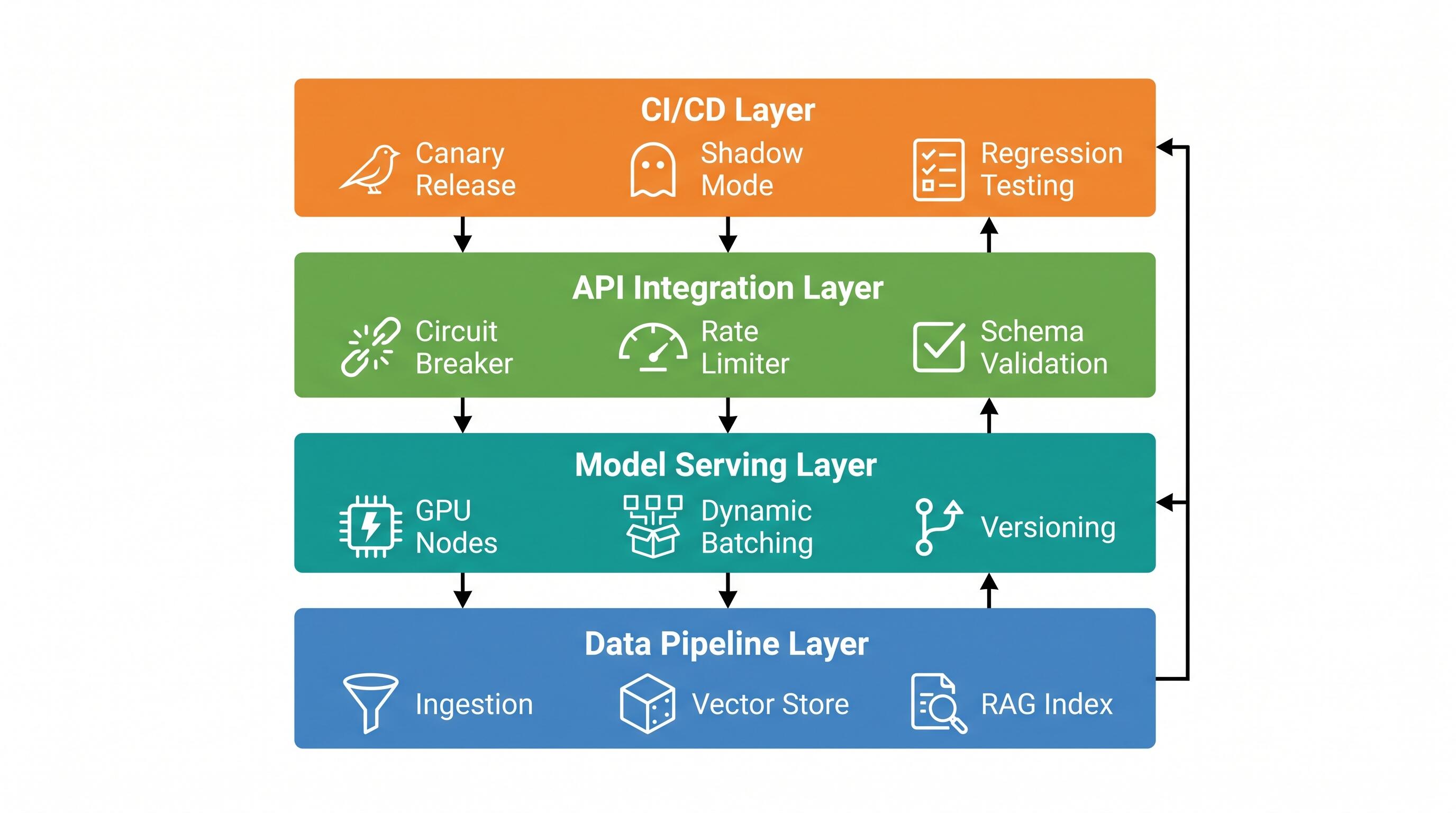
ALT: Production AI architecture layers diagram covering data pipeline, model serving, API design, and CI/CD for scalable AI software engineering
Advanced Considerations: What Separates Good Architectures from Great Ones
Handling Non-Determinism at Scale
The hardest part of operating AI systems in production is that the same input can produce different outputs — and that's by design. Great AI architectures acknowledge this explicitly and build systems that are robust to it, rather than pretending it away.
This means designing idempotency at the application layer rather than the model layer, building audit logs that capture the full context of every model call (including model version, temperature settings, and retrieved context), and designing user experiences that communicate appropriate uncertainty to end users.
A common misconception is that adding more guardrails (content filters, output validators, human review queues) is the primary solution to non-determinism. These tools help, but the more durable approach is architectural: design the system such that any individual model output failing gracefully doesn't break the broader user experience or data integrity.
Model Governance and Version Management
As AI systems mature, the number of models in production multiplies faster than most teams expect. You end up with different models for different use cases, different versions of the same model at different stages of the update cycle, and experimental models running in shadow mode. Without explicit model governance — a model registry, clear ownership, documented performance baselines, and an explicit deprecation process — this becomes unmanageable quickly.
Effective product positioning in market for AI-powered products increasingly depends on the ability to move fast on model updates without regressing on reliability or quality. Building model governance infrastructure early is a competitive differentiator, not just an operational nicety.
The Build vs. Buy Decision at Each Layer
2026 is a good year to be building on top of managed AI infrastructure because the tooling has matured significantly. The build vs. buy decision should be made layer by layer: build where your differentiation lives, buy (or use managed services) everywhere else. Very few teams have a compelling reason to build their own vector database, inference serving infrastructure, or observability platform from scratch. The opportunity cost of that work is almost always higher than the cost of the managed alternative.
Frequently Asked Questions FAQ
Q1: How do I choose between self-hosted models and third-party model APIs for a production system?
The decision depends on three factors: data sensitivity (self-hosted wins if you can't send data to third-party APIs), latency requirements (self-hosted inference gives you more control over p99 latency), and operational capacity (third-party APIs dramatically reduce infrastructure burden). For most early-stage teams, starting with third-party APIs and migrating to self-hosted inference as volume and requirements justify it is the pragmatic path. Build your architecture to make this migration possible without a full rewrite.
Q2: Is Kubernetes necessary for deploying production AI systems in 2026?
Not necessarily. Kubernetes offers powerful primitives for scaling and managing AI workloads — particularly GPU node management and autoscaling inference deployments — but it introduces significant operational complexity. Managed alternatives like cloud provider AI platforms, serverless inference endpoints, and container-based PaaS solutions have matured to the point where many production AI systems run reliably on them without a dedicated Kubernetes expertise investment. Choose based on your team's operational capabilities, not just technical capability.
Q3: How long does it realistically take to go from AI prototype to production-ready architecture?
This varies significantly based on scale requirements, team experience, and system complexity — so specific timelines require context. That said, the most common pattern is underestimating the gap. Observability, security hardening, model governance, and CI/CD pipeline work each add meaningful time. Teams that have done it before with proven architectural patterns move substantially faster than those designing from scratch. Investing in architectural guidance early is typically the highest-ROI acceleration available to a team.
Summary
Building scalable AI architecture for production in 2026 comes down to three durable principles: design contracts before infrastructure, separate your concerns across data, model, and application planes, and instrument everything from day one. These aren't novel ideas — they're software engineering fundamentals applied with discipline to a domain that has a strong pull toward shortcuts and complexity.
The teams that ship reliable AI products consistently are the ones that treat AI systems as distributed systems first, and bring the same engineering rigor to model serving and data pipelines that they bring to their core application infrastructure. The AI layer adds new challenges — non-determinism, data drift, GPU cost management, model governance — but none of them are unsolvable with the right architectural foundation.
The next step is to audit your current architecture against the patterns discussed here: Do you have clear system contracts? Are your data, model, and application planes cleanly separated? Do you have model-level observability? Each gap you identify is a risk to your production reliability — and an opportunity to build something more durable.
Call to Action
If you're looking to turn your idea into a live, running product — whether it's an AI-powered system or a full-stack application — Darius brings the architectural depth and hands-on engineering experience to make it happen. Explore real shipped projects, technical insights, and professional background at https://www.darius.wiki. Let's build something that actually ships.
References
- McKinsey & Company. "The state of AI in early 2024: Gen AI adoption spikes and starts to generate value".
https://www.mckinsey.com/capabilities/quantumblack/our-insights/the-state-of-ai-2024 - Google Cloud. "ML Engineering Best Practices: Production Machine Learning Systems".
https://developers.google.com/machine-learning/guides/rules-of-ml - Microsoft Azure. "Azure Well-Architected Framework — AI Workloads".
https://learn.microsoft.com/en-us/azure/well-architected/ - Martin Fowler. "Patterns of Distributed Systems".
https://martinfowler.com/articles/patterns-of-distributed-systems/ - NIST. "Artificial Intelligence Risk Management Framework (AI RMF 1.0)".
https://www.nist.gov/system/files/documents/2023/01/26/NIST.AI.100-1.pdf
Note: Standards may be updated, please check the latest official documents or consult professional advisors.
About the Author
Darius is an Engineering Director and AI Architect specializing in turning ideas into live, running products — with expertise spanning AI architecture, systems design, and full-stack development, backed by 3 shipped live projects. Learn more at darius.wiki.
© Darius. All rights reserved. The content in this article reflects the author's personal expertise and opinions and is intended for informational purposes only. No part of this article may be reproduced without proper attribution.