Building a RAG System That Survives Real User Data

ALT: Engineer building a production RAG system handling messy, unpredictable real user data queries
Why Most RAG Systems Break Before They Reach Production
Retrieval-Augmented Generation is a pattern that works elegantly in demos and collapses under the weight of real user behavior. A RAG system is an architecture that combines a retrieval step — pulling relevant documents from a knowledge base — with a generative model that synthesizes those documents into a response. In theory, this solves the hallucination problem and grounds LLMs in factual content. In practice, building a RAG system that survives real user data requires confronting a category of problems that never appear in tutorials: dirty corpora, adversarial queries, retrieval failures that look like successes, and answer quality that degrades in ways that are hard to measure.
In our work observing how teams move RAG from prototype to production, a pattern emerges consistently: the retrieval pipeline is usually not the core problem. The hard part is the intersection of messy data, unpredictable user intent, and an evaluation setup that wasn't designed for the edge cases that dominate real traffic. This article is a practical guide to the engineering decisions that separate a fragile RAG demo from a production-grade retrieval system — covering chunking, embedding strategy, retrieval quality, failure modes, and how to build confidence before shipping.
Who Should — and Should Not — Use This Guide
Applicable Scenarios:
- You are building a question-answering system over a proprietary knowledge base (internal docs, product manuals, support tickets, legal documents)
- You have a working RAG prototype and are encountering quality degradation when real users interact with it
- You are evaluating whether RAG is the right architecture before committing to embedding infrastructure
- You need to make architectural decisions about chunking strategy, retrieval method, or re-ranking without a clear benchmark
Not Applicable/Cautions:
- If your primary data source is highly structured (SQL tables, well-formatted JSON), a pure RAG approach may be overkill — a simpler retrieval layer or a tool-using agent may serve you better
- If your corpus changes in real time at high frequency, the pipeline complexity described here compounds — you need a separate strategy for index freshness before worrying about most of the issues below
What "Real User Data" Actually Breaks in a RAG Pipeline
The failure modes of a production RAG system are qualitatively different from what you encounter in development. When you build a RAG system in a controlled environment, you write the test queries yourself. These queries are usually clean, well-formed, and semantically close to the documents they target. Real user data is not like this.
Users ask ambiguous questions. They use abbreviations, company-internal jargon, misspellings, and multi-part questions that span multiple documents. They ask questions that have no answer in your corpus. They rephrase the same question in ways that hit different parts of the embedding space, sometimes retrieving completely different chunks. And they ask leading or adversarial questions that cause the generative model to produce confident-sounding nonsense based on marginally relevant retrieved content.
Three structural problems appear in almost every production deployment:
First, retrieval quality is invisible to the user but everything to the system. If the retriever returns the wrong chunks, the LLM has no good option — it either hallucinates to fill the gap or produces a vague, hedged answer that erodes user trust. Unlike a traditional search engine where the user can scan the results list, RAG hides the retrieval step. Retrieval failures are silent.
Second, chunk boundaries matter more than most teams expect. A document chunked at 512 tokens with a fixed sliding window will frequently split a critical fact across chunks, or bundle context that belongs to different topics. The embedding of a poorly bounded chunk is semantically blurry, and it will be recalled inconsistently depending on how the query is phrased.
Third, the evaluation problem is underinvested. Most teams instrument the generator (tracking LLM latency, cost, output length) but have no automated signal on retrieval quality. Without a retrieval evaluation loop, you are flying blind when user behavior shifts.
Building a Production RAG System: Three Core Engineering Steps
Step 1: Audit Your Corpus Before You Index It
Before choosing an embedding model or building a retrieval pipeline, spend time understanding the actual shape of your data. Corpus quality issues compound at every downstream stage — a document that is poorly formatted, heavily duplicated, or semantically thin will produce embeddings that mislead the retriever at query time. Concretely: deduplicate at the content level (not just filename), identify documents with low information density (tables of contents, navigation pages, boilerplate), and decide whether structured elements like tables need special handling. This audit typically surfaces the fact that a significant fraction of your corpus should not be indexed at all.
Step 2: Design Your Chunking Strategy Around Query Patterns, Not Document Structure
Chunking is the step that most teams underspecify. A fixed-size token window is easy to implement and frequently wrong. The right chunk size is a function of how your users ask questions and how your documents are structured. For dense technical documentation, smaller chunks with high overlap tend to produce more precise retrieval. For narrative documents (legal opinions, research summaries), larger chunks preserve context that is essential for answer quality. Consider a hybrid approach: index both a fine-grained chunk (for retrieval precision) and a coarser parent chunk (for context enrichment at generation time). This is sometimes called a parent-child chunking pattern, and it addresses the common failure where retrieved text is accurate but lacks enough surrounding context for the LLM to generate a useful answer.
Step 3: Build a Retrieval Evaluation Harness Before You Ship
The single highest-leverage investment in RAG engineering is a retrieval evaluation harness — a system that measures whether the retrieved chunks actually contain the information needed to answer the query. This requires a labeled dataset: a set of (query, expected document or passage) pairs that you can run your retriever against. Building this dataset is time-consuming, but even a few hundred labeled examples gives you a signal that is orders of magnitude more actionable than anecdotal user feedback. Use standard information retrieval metrics — Recall@K measures whether a relevant chunk appears in the top K retrieved results, and Mean Reciprocal Rank captures how high the first relevant result ranks. Without this harness, every change to your chunking strategy, embedding model, or retrieval parameters is a guess.
Retrieval Strategy Comparison: Sparse, Dense, and Hybrid
Choosing the right retrieval method is one of the most consequential architectural decisions in building a resilient RAG system. Each approach has distinct characteristics that make it more or less suited to different data distributions and query types.
| Comparison Dimension | Sparse Retrieval (BM25) | Dense Retrieval (Embedding-based) | Hybrid Retrieval |
|---|---|---|---|
| Handles exact keyword matches | Strong — optimized for lexical overlap | Weak — may miss rare terms | Strong — lexical component handles this |
| Handles semantic paraphrases | Weak — sensitive to vocabulary mismatch | Strong — captures meaning across phrasings | Strong — dense component handles this |
| Requires ML infrastructure | No — stateless, no GPU required | Yes — embedding model serving needed | Yes — requires both components |
| Index update latency | Low — incremental updates are fast | Medium — re-embedding may be required | Medium to High |
| Tuning complexity | Low | Medium | High |
| Typical failure mode | Misses semantically similar content with different phrasing | Misses rare domain terms not in training data | Ranking fusion can be miscalibrated |
In practice, a pattern we consistently see is that teams start with dense retrieval because it performs well on clean, semantically rich queries — the kind that appear in development. When they hit production, sparse retrieval's robustness on rare product names, version numbers, and internal jargon becomes apparent. Hybrid retrieval with reciprocal rank fusion is the current state of practice for production systems that need to handle both patterns, though it introduces tuning complexity that requires the evaluation harness described above to manage responsibly.
Re-Ranking, Context Window Management, and When to Give Up
Re-ranking is a second-pass retrieval step that takes the top-K chunks returned by the retriever and re-scores them using a more expensive model — typically a cross-encoder that scores (query, chunk) pairs directly rather than comparing independent embeddings. Re-ranking consistently improves precision at the top of the result list and is worth the added latency budget in most production systems.
The mechanics matter: retrieve more candidates than you need (top-20 or top-30), then re-rank and pass only the top-5 or top-8 to the generator. This approach improves answer quality without expanding the context window, which has its own failure modes — longer contexts cause many LLMs to underweight information in the middle of the window, a phenomenon documented in the academic literature as "lost in the middle."
Context window management is non-trivial at production scale. The temptation is to retrieve more chunks to hedge against retrieval errors. The result is a context that is too long, semantically diluted, and causes the LLM to produce hedged or incoherent answers. A disciplined approach is to set a context budget — a maximum token count for retrieved content — and enforce it via re-ranking rather than by naively truncating chunks.
Knowing when to return "I don't know" is a production requirement, not a nice-to-have. RAG systems that answer every query regardless of retrieval quality erode user trust faster than systems that clearly signal the limits of their knowledge. The implementation is straightforward: if the highest-scored chunk after re-ranking falls below a confidence threshold, or if no chunk passes a minimum relevance filter, the system should decline to answer or explicitly caveat its response. Calibrating this threshold requires the same labeled evaluation dataset described above.
Handling the Data Quality Failures That Accumulate Over Time
Production RAG systems face a degradation problem that development environments never surface: the corpus drifts. Documents are updated, renamed, or deleted. New documents are added that contain conflicting information. The embedding model's representation of the corpus at index time becomes misaligned with the queries that users are actually asking six months later.
A sustainable RAG architecture treats index maintenance as a first-class operational concern. Concretely this means:
- Maintaining document provenance metadata so you can trace a retrieved chunk back to its source document and detect when that source has been updated
- Running periodic re-evaluation of your retrieval harness against the live index to catch quality regressions before users do
- Versioning your chunking and embedding configuration so you know which index version a given retrieval result came from
Embedding model upgrades are a particular operational risk. A newer embedding model may perform substantially better on benchmark datasets but produce embeddings in a different vector space than your current index. Upgrading requires a full re-index and a re-run of your retrieval evaluation harness. Teams that skip the re-evaluation step routinely introduce silent regressions.
Advanced Considerations: Multi-Hop Queries, Metadata Filtering, and Security
Multi-hop queries are questions that require synthesizing information from multiple documents — "What changed in our pricing policy between version 2 and version 3 of the contract?" Standard single-pass RAG struggles here because no single chunk contains the full answer. Approaches include iterative retrieval (retrieve, generate a sub-answer, retrieve again based on the sub-answer) and explicit query decomposition before retrieval. Both add latency and complexity; neither fully solves the problem. The practical guidance is to identify multi-hop query patterns in your user data early and design retrieval flows specifically for them rather than expecting a single-pass RAG to handle them generically.
Metadata filtering is underused and highly effective. Every chunk should carry structured metadata — document type, date, source system, access control tags — and your retrieval layer should support pre-filtering on these fields before semantic scoring. A query about a specific product version should filter to chunks from documents tagged with that version before running embedding similarity. This narrows the retrieval space, reduces noise, and dramatically improves precision for structured query patterns.
A common misconception is that RAG eliminates hallucination. It reduces it — specifically, it grounds the LLM in retrieved content, which shifts the failure mode from fabrication to misinterpretation of retrieved content. The LLM can still produce incorrect answers by misreading, over-generalizing, or combining retrieved chunks in ways that are technically accurate individually but misleading in combination. The generator layer needs its own quality controls: output validation, citation grounding checks, and confidence signaling.
On security: if your RAG system serves content from a corpus with access controls (different users should see different documents), you must enforce those controls at the retrieval layer, not the generation layer. Filtering retrieved chunks before passing them to the LLM is the only reliable approach. Prompting the LLM not to reveal certain information is not a security control.
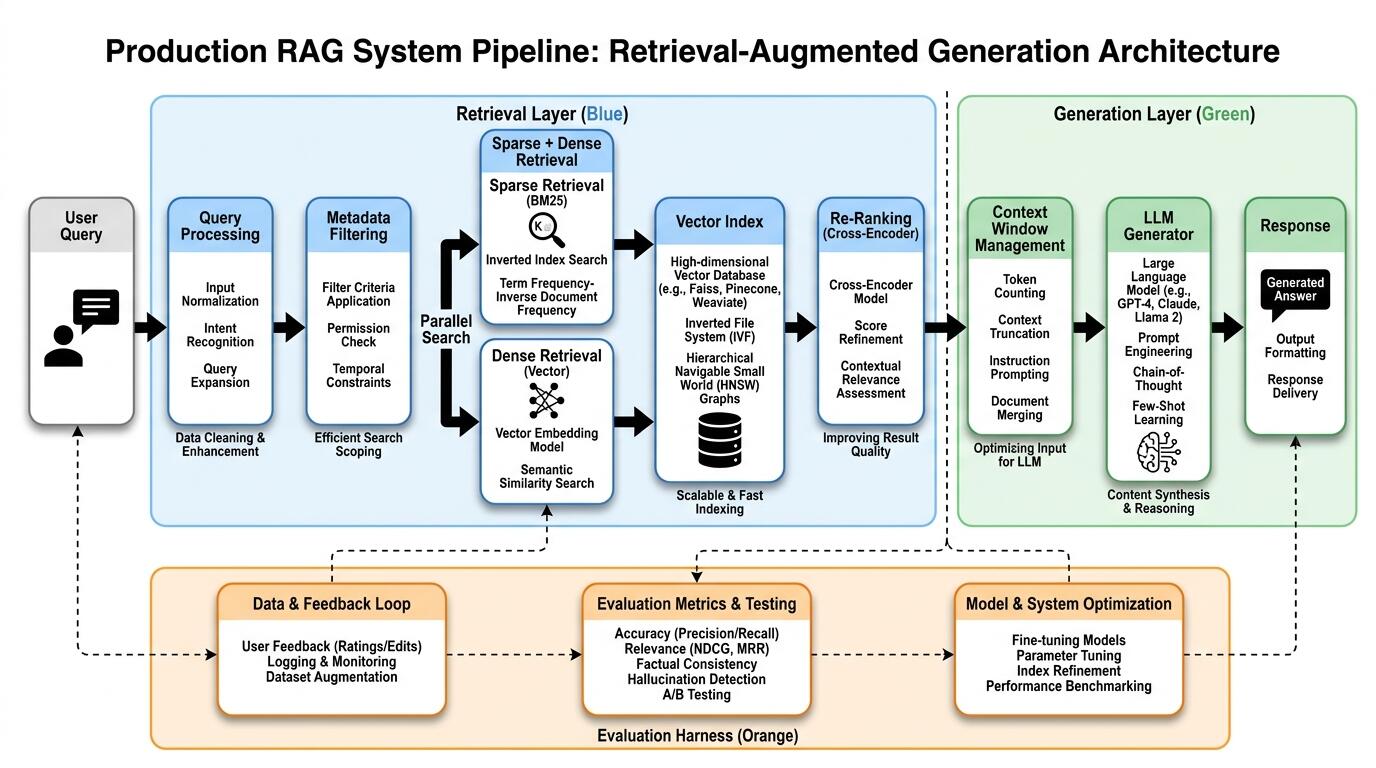
ALT: Diagram showing production RAG system components including chunking, vector index, re-ranking, and metadata filtering for real user queries
People Also Ask
Q1: How do I choose the right chunk size for a RAG system?
Chunk size selection depends on two factors: your documents' information density and your users' typical query patterns. For dense technical or legal documents, smaller chunks (roughly 256–512 tokens with overlap) tend to produce more precise retrieval because each chunk is semantically focused. For narrative content, larger chunks (512–1024 tokens) preserve context that the generator needs. The definitive answer comes from your retrieval evaluation harness — measure Recall@K at different chunk sizes against your labeled query set, and let the data choose.
Q2: Is hybrid retrieval always better than pure dense retrieval for RAG?
Hybrid retrieval outperforms pure dense retrieval specifically when your corpus contains rare terms, product identifiers, version numbers, or domain-specific jargon that is underrepresented in the embedding model's training data. For semantically rich corpora where queries are well-paraphrased, dense retrieval is often sufficient and simpler to operate. The decision should be driven by your retrieval evaluation results, not by default. If your labeled query set shows that BM25 alone recovers a meaningful fraction of cases that the dense retriever misses, hybrid is worth the operational overhead.
Q3: How long does it take to build a retrieval evaluation harness, and is it worth the investment?
Building an initial retrieval evaluation harness — a labeled set of (query, relevant chunk) pairs plus automated scoring — typically takes one to two weeks of focused engineering effort for a corpus of moderate size. The investment pays back quickly: every chunking experiment, embedding model comparison, or re-ranking tuning iteration that previously required manual inspection can be measured in minutes instead of days. In our experience observing production RAG teams, the absence of this harness is the single most common reason RAG quality regressions go undetected until users report them.
The Bottom Line
- A RAG system that works in demos fails in production primarily because of corpus quality issues, poor chunk boundaries, and silent retrieval failures — not LLM capability.
- Chunking strategy should be designed around query patterns and tested against real retrieval data, not chosen by default token window size.
- Hybrid retrieval (sparse plus dense with rank fusion) is the current production standard for corpora that contain a mix of semantic and lexical query patterns.
- A retrieval evaluation harness with labeled (query, relevant chunk) pairs is the highest-leverage engineering investment in a production RAG system — build it before you scale.
- Re-ranking, metadata filtering, and explicit "I don't know" handling are not optional refinements — they are the difference between a system users trust and one they abandon.
- Index maintenance, embedding model versioning, and corpus drift are operational concerns that must be designed for from the start, not retrofitted.
The next concrete step: before changing any component of your RAG pipeline, build or extend your retrieval evaluation harness. Every architectural decision becomes defensible once you have a quantitative signal to measure against.
If you are building AI products and need to translate fast-moving AI developments into concrete engineering decisions, the Darius newsletter is written specifically for that need — every entry filtered through the lens of engineers operating real AI systems in production. Visit Darius to subscribe to the bilingual newsletter and stay in sync with engineers who are building at the same frontier.
Sources
- daily.dev. "Building a Real-World RAG System: Lessons No One Tells You."
https://daily.dev/posts/building-a-real-world-rag-system-lessons-no-one-tells-you-hk26kzjti - IEEE (Institute of Electrical and Electronics Engineers). Information retrieval evaluation standards and practices.
https://www.ieee.org - ACM (Association for Computing Machinery). Research on retrieval-augmented generation, dense retrieval, and neural information retrieval.
https://www.acm.org
Note: Standards and research findings in this domain evolve rapidly. Verify the current state of retrieval best practices against the latest publications from the relevant technical communities.