What Happens After You Ship: Keeping Live Products Healthy

ALT: Engineering team monitoring live AI product health dashboards after successful product development launch
The Real Work Begins at Launch: Why Post-Ship Health Is the True Test of AI Solutions
Key Conclusion: Shipping a product is a milestone, not a finish line. For teams building on machine learning and ai solutions, the post-launch phase is where architecture decisions, data drift, and operational practices converge to determine long-term success. Sustainable product development demands as much rigor after go-live as it does during the build — and the teams that treat production health as a first-class discipline are the ones that compound their advantages over time.
Most engineering teams pour enormous energy into getting a product across the launch threshold. Roadmaps are groomed, sprint velocity is tracked, and demos are polished until the big day arrives. Then the product ships — and a strange silence falls over the team before reality asserts itself in the form of error spikes, unexpected user behavior, and model performance degradation.
The gap between "shipped" and "healthy" is wider than most organizations anticipate. It is in this gap that the true costs of technical debt surface, that machine learning pipelines quietly drift out of calibration, and that well-intentioned architectural shortcuts begin compounding into real business risk. Understanding what post-ship product health actually demands — and building the practices to sustain it — is the difference between a product that thrives and one that silently erodes.
Who This Guide Is For: Applicable Scenarios for Post-Launch Product Health
✅ Applicable Scenarios:
- Engineering leaders and CTOs who have recently shipped AI-powered products and are formalizing their operational runbooks
- Startup founders and product teams transitioning from build mode to sustain-and-scale mode for the first time
- Senior engineers responsible for maintaining production machine learning systems, APIs, or full-stack platforms with active user bases
- Organizations integrating ai solutions into existing products and needing governance frameworks for ongoing model and system health
❌ Not Applicable/Cautions:
- Teams still in early ideation or pre-MVP stages where production concerns are premature — focus first on validating your product idea with target customers before optimizing for operational maturity
- Projects with purely static rule-based logic and no adaptive or data-driven components, where the complexity of ML-specific operational practices may not apply
The Hidden Complexity of "Done": What Post-Launch Really Means for Modern Product Development
There is a persistent myth in technology organizations that once a product launches, the hard part is over. In the era of traditional, largely static software, this framing had some merit. Features shipped, bugs were fixed reactively, and the system was relatively stable between releases. Modern product development — especially in the context of ai solutions and machine learning systems — operates on fundamentally different dynamics.
Machine learning models are not static artifacts. They are functions of the data they were trained on, and the real world is relentlessly non-stationary. User behavior shifts seasonally and culturally. The distribution of input data changes as your product reaches new demographics. Upstream data sources evolve without warning. What this means operationally is that a model performing admirably at launch can quietly degrade over weeks or months, often without triggering any obvious error. This phenomenon — called data drift or model drift — is one of the most insidious challenges in sustaining AI-powered products.
Beyond model-specific concerns, the post-launch environment introduces a new class of operational pressures. Concurrency patterns in production rarely match what was simulated in staging. Database query plans that performed well under synthetic load can buckle under real usage distribution. Third-party API dependencies introduce external failure modes that unit and integration tests cannot fully anticipate. Security attack surfaces become active targets the moment a product is publicly reachable.
The market reflects this growing complexity. According to research widely cited in the MLOps and DevOps communities, the majority of machine learning projects that successfully reach deployment struggle to maintain consistent performance at scale over time — not because of poor initial engineering, but because of insufficient investment in the operational practices that sustain them. The analogy to physical engineering is apt: a bridge is not considered safe simply because it was well-designed; it requires ongoing inspection, load monitoring, and maintenance.
Effective post-launch product health management requires three interconnected disciplines: observability (knowing what your system is doing), resilience (recovering gracefully when things go wrong), and evolution (structured practices for improving and updating live systems safely). Teams that treat these as afterthoughts discover them the hard way, usually at the worst possible moment.
Building a Post-Ship Health Practice: From Reactive to Systematic
Three Steps to Establishing Production Health from Day One
Step 1: Instrument Everything Before Users Arrive
Before your first real user touches the system, instrumentation must already be in place. This means structured logging at service boundaries, distributed tracing across your architecture, and business-level metrics — not just infrastructure health. For machine learning systems, this includes capturing input feature distributions, prediction confidence scores, and downstream outcome signals that will allow you to detect drift before it becomes visible in user-facing metrics. Budget roughly one to two weeks of focused engineering effort for initial instrumentation on a moderately complex system.
Step 2: Define Your Health Baselines and Alerting Thresholds
Observability without baselines is noise. After your first week or two of production traffic, analyze your telemetry data to establish performance baselines: typical latency distributions, normal error rates, expected throughput patterns, and — critically for ml systems — the statistical distribution of your model's input features and output predictions. Set alerting thresholds that distinguish signal from noise, erring on the side of specificity over sensitivity in early stages to prevent alert fatigue, which is among the most dangerous patterns in production operations.
Step 3: Establish a Structured Review Cadence
A health practice without rhythm is a health practice that gets deprioritized when the team gets busy. Establish a weekly production review ritual — even a focused thirty-minute session — where your team examines key metrics trends, reviews recent incidents, and flags any drift signals for investigation. Pair this with a monthly deeper analysis of model performance and data quality for AI-powered components. This cadence transforms production health from a reactive fire-fighting exercise into a proactive quality discipline that informs your product roadmap.
Comparing Post-Launch Health Strategies: Reactive, Proactive, and Predictive
The way organizations approach production health exists on a spectrum. Understanding where your current practice sits — and where you want it to go — is essential for prioritization.
| Comparison Dimension | Reactive Approach | Proactive Approach | Predictive Approach |
|---|---|---|---|
| Incident Detection | Users report issues; alerts fire after impact | Automated monitoring catches issues before user impact | Anomaly detection and drift signals surface issues before they manifest |
| Machine Learning Model Health | Degradation discovered via user complaints | Scheduled retraining pipelines, drift monitoring dashboards | Continuous evaluation with automated retraining triggers and A/B validation |
| Team Operational Load | High; dominated by unplanned work | Moderate; planned maintenance reduces interrupts | Low unplanned load; most work is scheduled and data-driven |
| Infrastructure Cost Efficiency | Difficult to optimize without visibility | Good; over-provisioning reduced by measured baselines | Excellent; capacity planning driven by predictive traffic models |
| Appropriate Team Stage | Early-stage startups pre-product/market fit | Growth-stage teams with stable product direction | Scaled teams with significant AI/ML investment and dedicated MLOps capability |
The Five Pillars of a Healthy Live Product
Observability: You Cannot Fix What You Cannot See
Observability is the foundational capability on which all other post-launch health practices depend. At its most complete, observability means you can answer arbitrary questions about your system's behavior from the outside, using the data it emits. This is distinct from mere monitoring, which answers only the questions you thought to ask in advance.
For full-stack AI-powered products, observability spans multiple layers. At the infrastructure layer, you need visibility into compute utilization, network throughput, and storage I/O. At the application layer, request traces, error classifications, and service dependency maps provide the signal needed to isolate failures quickly. At the machine learning layer — which is often the most neglected — you need visibility into the statistical properties of the data flowing through your models.
Best practices for structuring a product development team around observability suggest embedding at least one engineer per squad with explicit ownership of the observability stack. This prevents the common failure mode where monitoring infrastructure is treated as a shared responsibility and therefore no one's concrete priority.
Resilience Engineering: Designing for Failure, Not Against It
The question is never whether your system will experience failures; it is whether it will fail gracefully or catastrophically. Resilient architectures implement patterns like circuit breakers, bulkheads, and graceful degradation explicitly — not as afterthoughts.
For AI systems specifically, resilience planning must account for the model inference layer as a failure domain. What happens to your product if your model serving infrastructure is unavailable? Can the system fall back to a rule-based heuristic? Can it serve cached predictions? These decisions need to be made architecturally, not improvised during an incident.
Circuit breakers deserve special attention in the context of third-party AI APIs, which have become common building blocks in modern product development. When an upstream LLM provider or computer vision API experiences degraded performance, your system should detect this automatically and engage fallback behavior rather than cascading the degradation to your users.
Model and Data Lifecycle Management
For products built on machine learning, sustaining performance over time requires treating model training and deployment as ongoing processes rather than one-time events. This encompasses several practices: continuous evaluation of model performance against held-out or newly labeled data, drift detection on input feature distributions, versioned model artifacts with clear rollback capabilities, and governed promotion pipelines that require performance validation before new model versions reach production.
Data quality is often the variable most overlooked by engineering teams. A high-performing model served degraded data will produce degraded outputs, and this correlation can be surprisingly difficult to diagnose when instrumentation is insufficient. Best practices for product development team communication around data quality involve establishing shared data contracts — documented agreements about the schema, semantics, and quality properties of data passed between systems — and automated validation at ingestion boundaries.
Release Safety: Shipping Changes to Live Systems
Every change to a live system is a risk surface. Mature post-launch practices treat deployments as careful, observable events rather than binary switches. Techniques like canary releases, blue-green deployments, and feature flags allow teams to expose changes to controlled user subsets, measure their impact, and roll back instantly if something goes wrong.
For machine learning models specifically, shadow deployment is a particularly valuable pattern: the new model version processes real production traffic in parallel with the existing version, but its outputs are logged rather than served to users. This allows you to compare model behavior under real conditions before committing to a promotion.
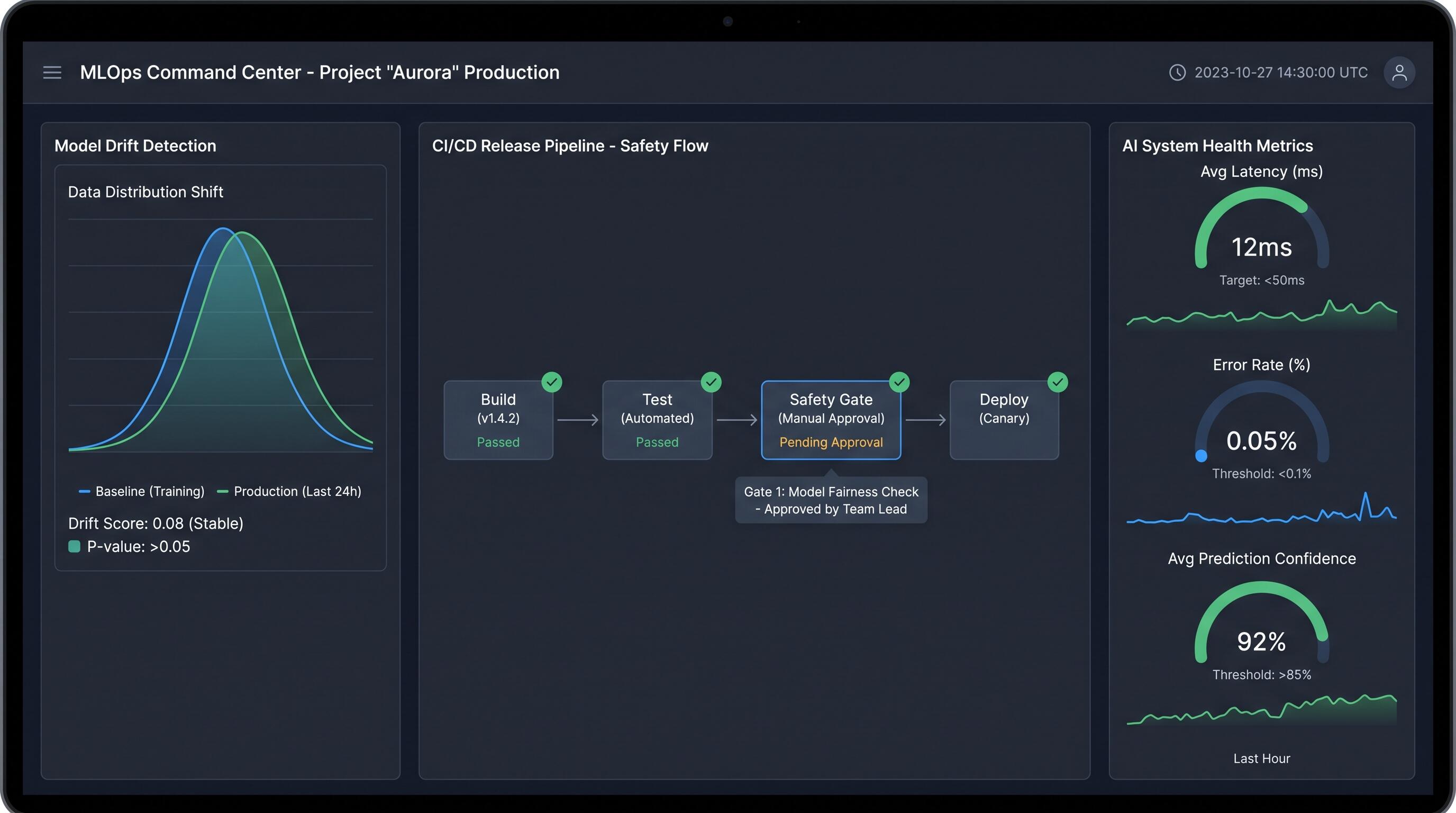
ALT: Engineering dashboard showing machine learning model drift monitoring, release pipeline safety, and AI solutions health metrics in production product development environment
Advanced Patterns: Handling Edge Cases and Common Misconceptions
Special Situations in Production AI Systems
Concept Drift vs. Data Drift: Knowing the Difference
Teams new to maintaining machine learning systems often conflate data drift (changes in the statistical distribution of input features) with concept drift (changes in the underlying relationship between inputs and the target outcome). Both degrade model performance, but they require different responses. Data drift often indicates changes in upstream data pipelines or user behavior that may be addressable without retraining. Concept drift — where the world itself has changed in ways that invalidate your model's learned relationships — requires retraining on recent, representative data.
Incident Management for AI-Specific Failures
Standard incident response playbooks often lack the tooling and vocabulary for AI-specific failure modes. When a model begins producing systematically biased or anomalous outputs, the investigation process is materially different from debugging a service timeout. Build AI-specific runbooks that cover steps for isolating whether an issue stems from model behavior, data quality, or infrastructure, and ensure that on-call rotations include engineers with ML domain familiarity.
The Misconception of "Set and Forget" AI
One of the most damaging misconceptions in enterprise AI product development is that once a machine learning model is deployed, it operates independently without human oversight. Regulatory frameworks, including emerging AI governance standards, increasingly require documented model monitoring and human-in-the-loop controls for high-stakes decisions. Beyond compliance, the engineering reality is that unmonitored models in production are an operational liability. Treat every deployed model as a live system that requires active stewardship.
Frequently Asked Questions FAQ
Q1: How do you detect model performance degradation in a live AI product?
Effective degradation detection combines multiple signal types. First, monitor prediction confidence distributions — a systematic shift toward lower confidence often precedes visible accuracy decline. Second, where labels or outcome signals are available (even with delay), track model accuracy metrics over time cohorts. Third, implement statistical drift tests (such as Population Stability Index or KL divergence measures) on input feature distributions. Together, these provide early warning signals that allow teams to intervene before degradation becomes user-visible.
Q2: Is it necessary to retrain machine learning models on a fixed schedule?
Fixed-schedule retraining is a reasonable starting point but is not optimal in most production environments. Retraining need is driven by data and concept drift, not calendar time. A model in a stable domain might remain performant for extended periods; one serving rapidly evolving user behavior may need more frequent updates. Best practice is to implement continuous drift monitoring and trigger retraining pipelines based on statistical thresholds rather than arbitrary schedules, while maintaining a minimum retraining frequency as a safety floor.
Q3: What does it cost to build a proper observability stack for an AI-powered product?
Costs vary significantly based on data volume, team size, and tooling choices. Cloud-native solutions (integrated logging, tracing, and monitoring within major cloud providers) often represent the most cost-effective starting point for early-stage teams. Purpose-built MLOps platforms add ML-specific capabilities at additional cost. More important than specific tooling costs is the engineering time investment — plan for meaningful initial instrumentation effort and ongoing maintenance. The ROI calculation is straightforward: undetected production issues cost significantly more than the observability infrastructure that would have caught them.
Summary
Shipping a product is a moment of achievement — but it is also the beginning of an ongoing operational responsibility that most teams underestimate until it bites them. The post-launch phase of product development, particularly for systems built on machine learning and ai solutions, demands three capabilities working in concert: robust observability that gives you truthful insight into system behavior, resilience engineering that ensures graceful failure modes rather than catastrophic ones, and structured model lifecycle management that sustains predictive performance as the world changes around your system.
Three core principles summarize the practical guidance in this article:
- Instrument before you need it. Production health infrastructure should be in place before your first real user arrives, not retrofitted after the first incident.
- Treat models as living systems. Machine learning components require active stewardship — monitoring, drift detection, and governed retraining pipelines — not passive deployment.
- Build operational rhythms into your team. The best practices and tooling in the world are inert without the team rituals — weekly reviews, incident retrospectives, data quality ceremonies — that turn them into sustained habits.
If your team is currently operating in reactive mode — responding to production issues as they surface rather than detecting them proactively — the path forward begins with a single focused investment: establish your observability baseline this sprint.
If you're looking to turn your next big idea into a live, production-ready product, Darius brings the end-to-end expertise in AI architecture, systems design, and full-stack development to make it happen. Explore real shipped projects, technical insights, and engineering strategies at https://www.darius.wiki. Whether you're a founder, engineer, or tech leader, Darius is ready to help you build smarter and ship faster.
References
- Google Cloud. "MLOps: Continuous delivery and automation pipelines in machine learning".
https://cloud.google.com/architecture/mlops-continuous-delivery-and-automation-pipelines-in-machine-learning - NIST. "Artificial Intelligence Risk Management Framework (AI RMF 1.0)".
https://www.nist.gov/system/files/documents/2023/01/26/AI%20RMF%201.0.pdf - The Linux Foundation. "Continuous Delivery Foundation: Best Practices for Continuous Delivery".
https://cd.foundation/ - ACM Queue. "The ML Test Score: A Rubric for ML Production Readiness and Technical Debt Reduction".
https://queue.acm.org/detail.cfm?id=3573577 - IEEE. "IEEE Standard for Software and Systems Engineering — Software Life Cycle Processes".
https://www.ieee.org/
Note: Standards and frameworks may be updated. Please verify the latest official documentation or consult qualified professional advisors for implementation guidance.
About the Author
Darius is an Engineering Director and AI Architect specializing in transforming ideas into live, running products — with proven experience across AI architecture, systems design, and full-stack development, backed by 3 shipped live projects. Learn more at darius.wiki.
© Darius. All rights reserved. The content in this article is intended for informational purposes only and reflects the author's professional opinions and experiences. Nothing herein constitutes formal engineering, legal, or business advice. Reproduction or redistribution of this content without explicit permission is prohibited.