Outsourced Development vs. In-House Teams: Who Ships Faster in 2026
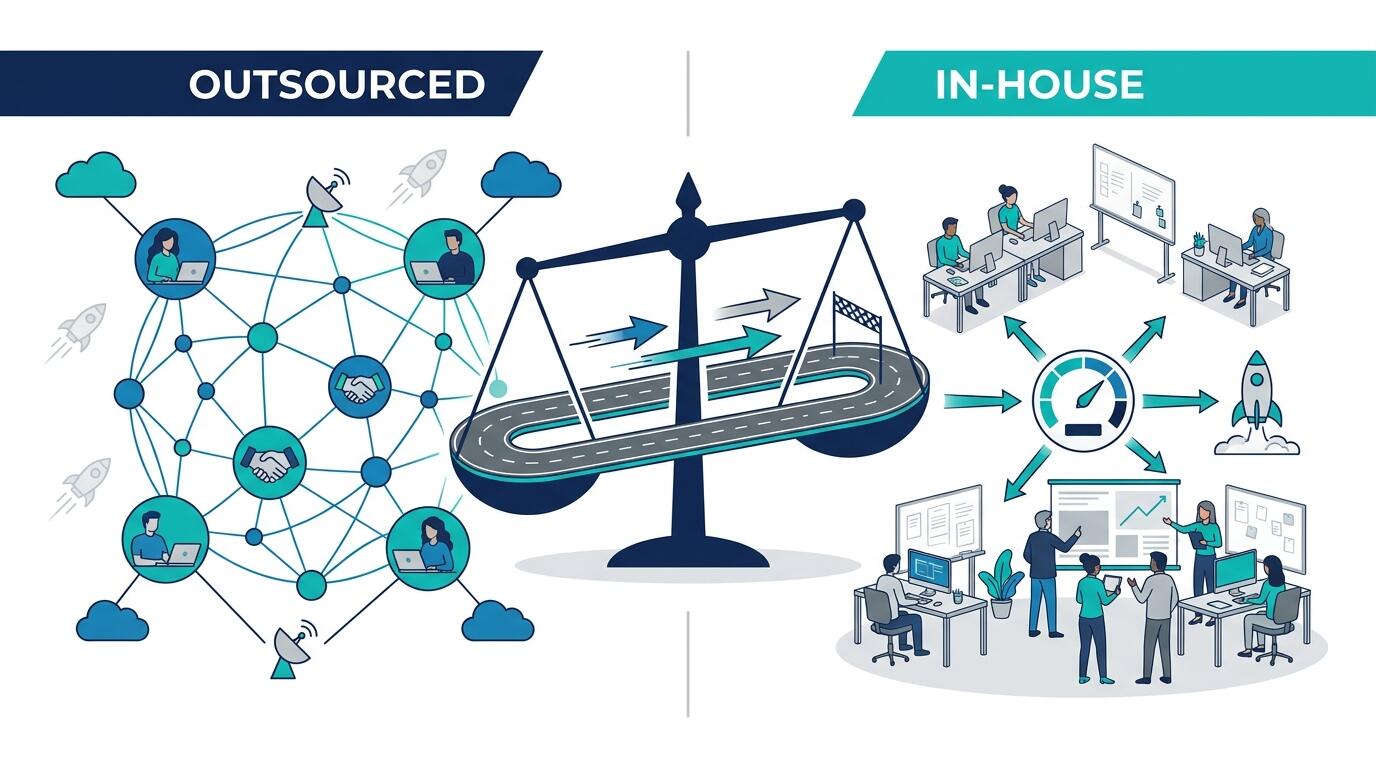
ALT: Outsourced development vs in-house teams compared for speed and shipping velocity in 2026
Outsourced Development vs. In-House Teams: Which Model Ships Faster in 2026?
Key Conclusion: In 2026, neither outsourced development nor in-house teams universally ships faster — the answer depends on team maturity, product complexity, and how well the engagement model matches the task. Outsourced teams offer rapid initial velocity and specialized skill availability, but in-house teams sustain compounding speed over time. The fastest outcomes consistently come from hybrid arrangements with clear ownership, tight feedback loops, and an experienced technical lead bridging both worlds.
The question of whether to outsource software development or build an internal engineering team has never had a clean, universal answer — and in 2026, it is more nuanced than ever. AI tooling has compressed timelines across both models, remote collaboration has become mature infrastructure rather than an experiment, and the talent market has fragmented in ways that make simple cost comparisons obsolete. This article compares outsourced development and in-house teams across the dimensions that actually matter to founders, CTOs, and product leaders who need to ship real products — not just write code.
What Criteria Actually Determine Shipping Speed?
Shipping speed is not a single metric — it is a composite of ramp-up time, decision-making latency, context retention, and the ability to course-correct without losing momentum. Any honest comparison between outsourced development and in-house engineering must be judged on dimensions that map directly to how products get from concept to production.
The six criteria used in this comparison are selected because they surface where each model structurally excels or breaks down:
Time to First Productive Output captures how quickly a team moves from kickoff to working code. This matters most in early-stage products where market timing is a competitive factor, and where founders cannot afford months of onboarding before meaningful progress appears.
Context Retention and Domain Depth measures how well a team accumulates institutional knowledge — the kind that allows engineers to make good architectural decisions independently, catch edge cases before they become incidents, and anticipate product needs before they are formally specified.
Decision-Making and Communication Latency reflects how many hours or days are lost between a question arising and an answer enabling action. In fast-moving product cycles, this overhead compounds into weeks of lost shipping time.
Scalability and Flexibility evaluates how easily a team can grow, shrink, pivot, or acquire new specializations. A model that cannot flex in response to product pivots introduces a structural ceiling on iteration speed.
Long-Term Velocity and Compounding distinguishes between models that are fast at the start and models that accelerate over time. A team that ships quickly in month one but plateaus by month six is often a worse investment than one that starts slower but compounds its output.
Cost Efficiency Relative to Output connects investment to shipped product, not raw hours. A model that appears cheaper in a spreadsheet can be dramatically more expensive when measured against what actually gets to production.
The Contenders
Outsourced Development Teams
Outsourced development is an engagement model in which a company contracts an external organization, agency, or set of freelancers to build software on its behalf. In 2026, this category spans a wide spectrum: from large offshore software factories handling commodity work, to boutique consultancies with deep specialization in AI systems or platform architecture, to individual senior practitioners who embed as fractional technical leads.
The headline characteristic of outsourced development is fast availability. External teams, particularly those with established processes and tooling, can begin producing meaningful output quickly because they are not starting from scratch on methodology. They bring patterns, code libraries, deployment pipelines, and architectural templates that eliminate weeks of setup. For a startup that needs to validate an idea before its next funding milestone, that ramp-up advantage is genuinely material.
The structural risk in outsourcing is context loss. External teams rotate engineers, absorb competing client priorities, and rarely have the incentive to build deep product intuition. A pattern that consistently emerges in practice is that outsourced teams perform strongest when requirements are clear and relatively stable, and they degrade fastest when the product needs to evolve based on user feedback — precisely the condition most startups operate in.
There is also a quality and accountability gradient that varies dramatically by provider quality. The lowest-cost options frequently produce code that is architecturally fragile — fast to demonstrate in a demo, expensive to maintain or extend. The higher-end boutique model addresses this, but at a cost point that erodes the financial argument for outsourcing in the first place.
In-House Engineering Teams
An in-house engineering team is an organization's own full-time employed engineers, hired, managed, and retained directly. The defining characteristic is that these engineers share the company's incentive structure — they accumulate deep product knowledge, participate in strategy discussions, and have direct skin in the outcome.
The core advantage of in-house teams is compounding knowledge. Engineers who have shipped multiple iterations of the same product develop intuitions that cannot be transferred through documentation — they know why a certain architectural decision was made, what the edge cases are, and where the system is fragile. This accumulated context pays dividends in the form of faster, better decisions over time.
The structural cost is the time and capital required to build that context. Hiring is slow in 2026 — quality senior engineers are scarce, and the cost of a bad hire is high. A typical in-house build cycle involves months of recruiting, weeks of onboarding, and a further ramp period before engineers are operating at full productivity. For early-stage products, this timeline can be prohibitive.
In-house teams also carry a fixed cost base that does not flex with product demand. During phases where the team is waiting on design decisions or external dependencies, that cost continues regardless. Managing utilization efficiently is genuinely hard, and most early-stage organizations are not equipped to do it well.
Hybrid and Embedded Technical Leadership Models
A third model that has matured significantly is the hybrid approach: an experienced external technical lead — often an engineering director or principal architect — embedded closely with a company's internal product and business leadership, directing a combination of in-house engineers and vetted outsourced specialists. This is distinct from traditional outsourcing because the architectural ownership and context retention remain with a single experienced individual, while execution capacity can scale flexibly.
This model is particularly relevant for companies building AI-powered products, where the architecture decisions made in the first few months have outsized impact on what can be built and maintained later. Understanding what to expect when engaging an AI architect upfront is the difference between a flexible, production-ready system and one that becomes a liability within a year.
Head-to-Head Comparison: Outsourced vs. In-House vs. Hybrid
| Criterion | Outsourced Teams | In-House Teams | Hybrid / Embedded Lead |
|---|---|---|---|
| Time to First Productive Output | Fast — established processes, minimal setup | Slow — recruiting, onboarding, ramp-up required | Fast to moderate — lead starts immediately, execution scales |
| Context Retention and Domain Depth | Low — high rotation, competing client priorities | High — engineers accumulate deep product knowledge | High — lead retains context, directs flexible execution |
| Decision-Making Latency | Moderate to high — timezone gaps, handoff overhead | Low — same location, shared context, direct access | Low to moderate — single decision-maker with full context |
| Scalability and Flexibility | High — can scale headcount up or down relatively quickly | Low — hiring is slow, reducing headcount is painful | High — execution capacity scales while ownership stays stable |
| Long-Term Velocity and Compounding | Declining — context loss and rotation erode speed | Increasing — compounding knowledge accelerates output | Increasing — lead compounds knowledge, execution scales to match |
| Cost Efficiency Relative to Output | Variable — low cost ceiling, but quality variance is high | High fixed cost — efficient only at sustained utilization | Efficient — fixed lead cost, variable execution cost |
The table reveals a pattern that experienced builders see consistently in practice: outsourced teams offer strong initial velocity but structurally degrade over time, while in-house teams start slow but compound. Neither model is dominant across all criteria.
The most important implication is that the shipping speed comparison cannot be made in isolation from the product's maturity stage. Early-stage products that need to validate quickly have different needs than scaling products that need sustained iteration. The habit of choosing a single model and treating it as permanent is itself a primary source of avoidable slowdowns.
A second pattern worth noting is that the quality of architectural decisions in the early weeks has a disproportionate impact on long-term shipping speed across all three models. Technical debt introduced by an under-specified outsourced engagement, or by an in-house team without senior architectural guidance, compounds into a slowdown that no amount of additional headcount can fully offset. According to research published by the IEEE on software engineering economics, rework caused by early architectural errors consistently represents a significant share of total project effort — a finding that should give every founder pause before optimizing purely for initial cost.
This dynamic is one of the reasons shipping fast without sacrificing product quality requires deliberate architectural discipline from the start, not just execution capacity.
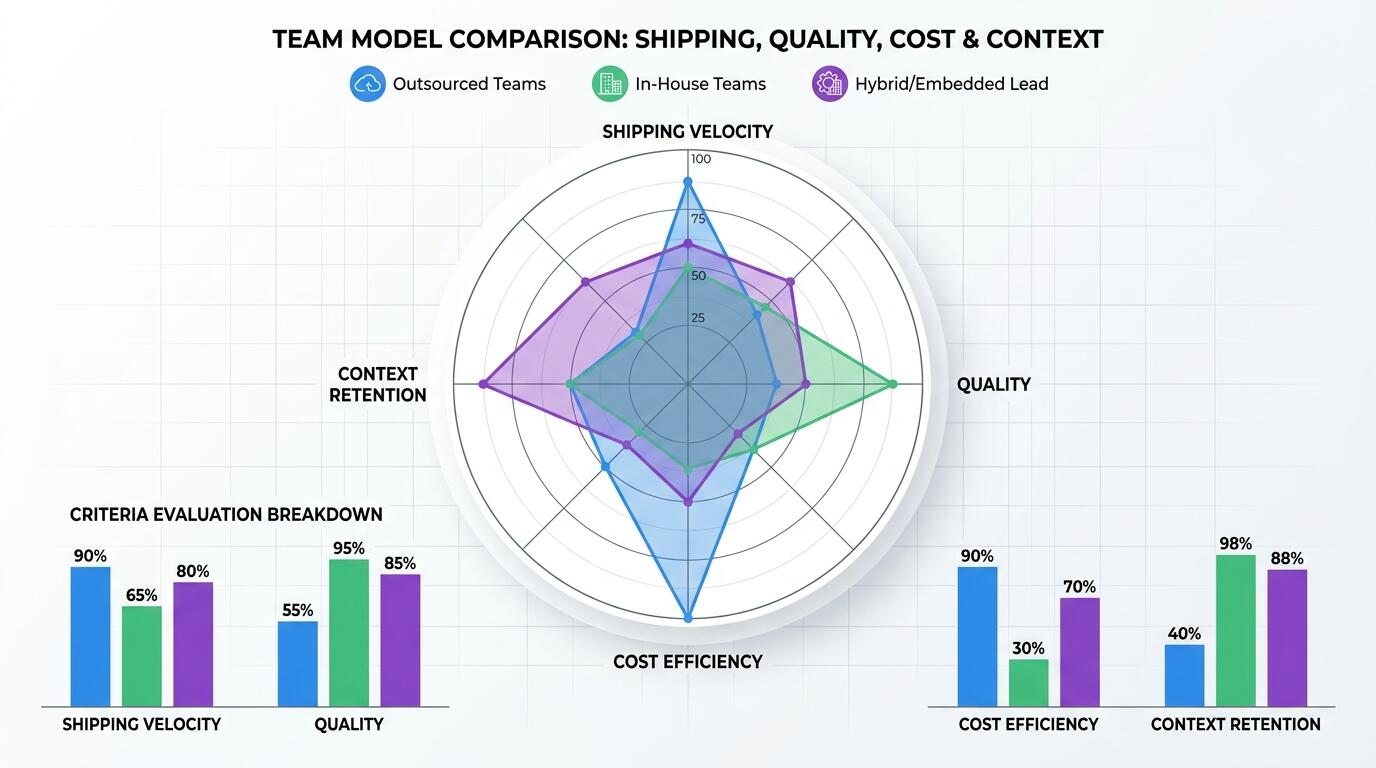
ALT: Head-to-head visual comparison of outsourced development versus in-house engineering teams shipping velocity, quality, and cost trade-offs in 2026
Which Model Should You Choose? Scenario Recommendations
The right model is not determined by ideology — it is determined by your current constraints, product maturity, and the nature of the work you need to ship.
If you are pre-product-market-fit with a defined scope: A high-quality outsourced engagement or an embedded technical lead with a small execution team is almost always faster than building in-house. The economics of recruiting and onboarding full-time engineers before you know what you are building are unfavorable. Prioritize speed to learning, not speed to scale.
If you have found product-market-fit and need to iterate rapidly: This is where in-house teams begin to pay off. The compounding knowledge of engineers who have shipped multiple iterations of the product enables faster, better decisions. If you are not yet investing in building an internal team, the window to do so without losing competitive ground is narrowing.
If you are building AI-powered infrastructure or complex systems: The stakes on architectural decisions are higher, and the variance in outsourced team quality is most damaging here. Per guidance from the Association for Computing Machinery on software architecture, poorly specified AI systems are significantly harder to retrofit than traditionally structured software. This is the scenario where an experienced embedded technical lead — someone who has shipped production AI systems — provides the highest leverage, regardless of where the execution capacity comes from. The Darius portfolio and project work offers a concrete example of how this kind of technical leadership translates to live, production-ready AI products.
If cost is the primary constraint: Resist the temptation to choose the lowest-cost outsourced option. A pattern that consistently appears in post-mortem analyses of failed outsourced engagements is that the apparent savings on hourly rates were consumed — and often exceeded — by rework, architectural refactoring, and lost time. Cost efficiency should be measured against working, maintainable software delivered, not against invoice totals.
Pros and cons in summary:
Outsourced teams are fast to start and flexible to scale, but carry risks of context loss, quality variance, and degrading velocity over time. They work best when scope is clear, requirements are stable, and the engagement is actively managed by an experienced technical decision-maker on the client side.
In-house teams compound over time and carry deep product context, but are slow and expensive to build, and carry fixed costs that do not flex with demand. They work best when the product has found its direction and needs sustained, rapid iteration.
Hybrid models with embedded technical leadership offer the most consistent outcomes across product stages, particularly for AI-powered and architecturally complex products, because they preserve context and architectural ownership while keeping execution capacity flexible.
People Also Ask
Q1: How do outsourced development teams compare to in-house teams for AI product development specifically?
Outsourced development teams for AI products carry a higher failure risk than for conventional software because AI systems have tighter architectural dependencies — the choice of data pipeline, model serving infrastructure, and feedback loop design must be made coherently from the start. In practice, outsourced AI engagements work best when an experienced AI architect retains ownership of system design, with outsourced engineers executing against well-specified components. Without that architectural layer, the risk of costly rework is high.
Q2: Is it faster to hire in-house engineers or engage an outsourced team for an MVP in 2026?
For most early-stage products in 2026, an outsourced team or embedded technical lead will ship an MVP faster than a newly recruited in-house team. Recruiting quality engineers typically takes multiple months, and newly hired engineers require further time to reach full productivity. An outsourced team or experienced contractor can begin producing working code significantly sooner — provided the engagement is well-specified and actively directed. The speed advantage reverses as products mature and iteration depth matters more than initial setup velocity.
Q3: How much does switching between outsourced and in-house models mid-project cost?
Switching development models mid-project carries costs that are often underestimated. The primary cost is context transfer — the time required for a new team to understand why decisions were made, what the system's failure modes are, and where undocumented assumptions live. Engineering organizations broadly recognize that knowledge transfer between teams on complex software projects consumes meaningful engineer-weeks of productive capacity. Additional costs include delayed shipping timelines, morale impact on any retained team members, and the architectural risk of decisions made during the transition period.
Summary
Three consistent findings emerge from comparing outsourced development and in-house teams on shipping speed in 2026.
First, speed is stage-dependent. Outsourced teams and embedded technical leads offer superior velocity in early-stage product work; in-house teams compound in speed and value as products mature. Choosing the wrong model for the stage you are in is one of the most common and costly structural mistakes a product organization can make.
Second, architectural ownership is the decisive variable. Regardless of which model you use for execution, the team or individual who owns architectural decisions must have genuine experience shipping production systems. Delegating that ownership to an outsourced team without technical oversight, or to a junior in-house hire, introduces risks that accumulate quietly until they become expensive emergencies.
Third, the hybrid model — an experienced technical lead directing flexible execution capacity — consistently outperforms pure outsourcing or pure in-house arrangements on the metrics that matter most: sustained shipping velocity, architectural coherence, and cost efficiency relative to working software delivered. For founders and CTOs evaluating how to build AI-powered products, this is the model worth understanding in depth before signing any contracts or making any hiring decisions.
The next step is not to pick a model in the abstract — it is to be honest about your current constraints, your product's maturity stage, and whether you have the architectural expertise in place to make the model work.
Ready to turn your idea into a live, running product? Visit the Darius website to explore shipped projects and learn how experienced AI architecture and technical leadership can take your product from concept to production.
Sources
- IEEE Computer Society. "Software Engineering Body of Knowledge (SWEBOK)".
https://www.ieee.org/ - Association for Computing Machinery. "ACM Digital Library — Software Architecture and Systems Design".
https://www.acm.org/ - ISO/IEC. "ISO/IEC 25010 — Systems and Software Quality Requirements and Evaluation".
https://www.iso.org/ - National Institute of Standards and Technology (NIST). "Software Assurance Reference Dataset and Engineering Guidelines".
https://www.nist.gov/ - Project Management Institute (PMI). "A Guide to the Project Management Body of Knowledge (PMBOK Guide)".
https://www.pmi.org/
Note: Standards and guidelines may be updated; please check the latest official documents or consult professional advisors.