Moving to a Multimodal Embedding Model: What Recall Actually Did

ALT: Multimodal embedding model improving recall performance in AI product retrieval systems
Why Switching to a Multimodal Embedding Model Changed How We Think About Recall
You build a search or retrieval feature, tune your text embeddings carefully, and ship it. Users start uploading PDFs with diagrams, product screenshots, and scanned receipts — and suddenly your retrieval quality falls apart. The documents are there, the queries are reasonable, but the system keeps missing the right content. That gap is exactly where multimodal embedding models enter the picture, and understanding what happens to recall when you make the switch is the core of what this article covers.
Multimodal embedding is an approach that encodes different types of data — text, images, and in some cases audio or video — into a shared vector space, so a single query can retrieve relevant content regardless of the modality it was stored in. Moving from a text-only embedding pipeline to a multimodal one is not simply a model swap; it changes the geometry of your vector space, the composition of your retrieval failures, and the operational logic you need around reranking, chunking, and latency budgets. In our work building and observing AI products, we see teams underestimate this scope consistently.
This article unpacks, step by step, what recall actually does when you make this transition — where it improves, where it regresses, and what engineering decisions determine whether the migration pays off.
Where Multimodal Embedding Retrieval Applies — and Where It Does Not
Applicable Scenarios:
- Products where user-supplied content mixes text and images (e.g., e-commerce catalogs, document intelligence, knowledge bases with diagrams or screenshots)
- Search systems where the query is an image or a sketch and the corpus is textual, or vice versa
- RAG (Retrieval-Augmented Generation) pipelines where chunking text alone causes context loss because meaning lives in a figure, chart, or annotated image
Not Applicable/Cautions:
- Pure text corpora with no image or visual content — the additional model complexity adds latency and cost with no recall benefit
- Latency-critical applications where the slower inference of large multimodal encoders is prohibitive and cannot be mitigated by caching or approximate nearest-neighbor indexes
- Teams without the infrastructure to version and reindex their vector store after a model change — partial migration often produces worse recall than staying on a coherent text-only baseline
The Background: Why Text Embeddings Hit a Wall in Mixed-Modality Corpora
Text embedding models fail to retrieve visually-encoded information because they operate on tokens, not pixels — a chart image in a PDF is invisible to them unless someone has manually transcribed its content into text. This is not a quality ceiling that better training data or larger models can fix within the text-only paradigm; it is a structural limitation.
The rise of multimodal foundation models — systems trained jointly on image-text pairs at scale — created a new possibility: a single encoder that places a photo of a product, a description of that product, and a user query about it into the same geometric neighborhood in vector space. Research from academic groups at institutions including Stanford and Carnegie Mellon, and from industrial labs at Google and Meta, has established that joint embedding of vision and language features produces measurably better cross-modal retrieval than pipeline approaches that embed modalities separately and merge results post hoc.
In practice, the teams we observe pushing toward multimodal retrieval are not chasing benchmarks. They are responding to real failure modes: a customer support tool that cannot find the right product from a user-uploaded photo, or a document Q&A system that answers incorrectly because the key data lives in a table rendered as an image rather than in machine-readable text. These failures are expensive. They erode trust quickly, and they are invisible to text-only evaluation metrics because the queries surface no text-retrieval errors — just wrong answers.
The shift in the AI industry toward natively multimodal foundation models (architectures that process image and text together from the first layer, rather than fusing separate encoders) has made production-grade multimodal embedding feasible for teams outside large research organizations. Models in this class are now available through major cloud providers and as open weights, lowering the barrier to experimentation considerably.
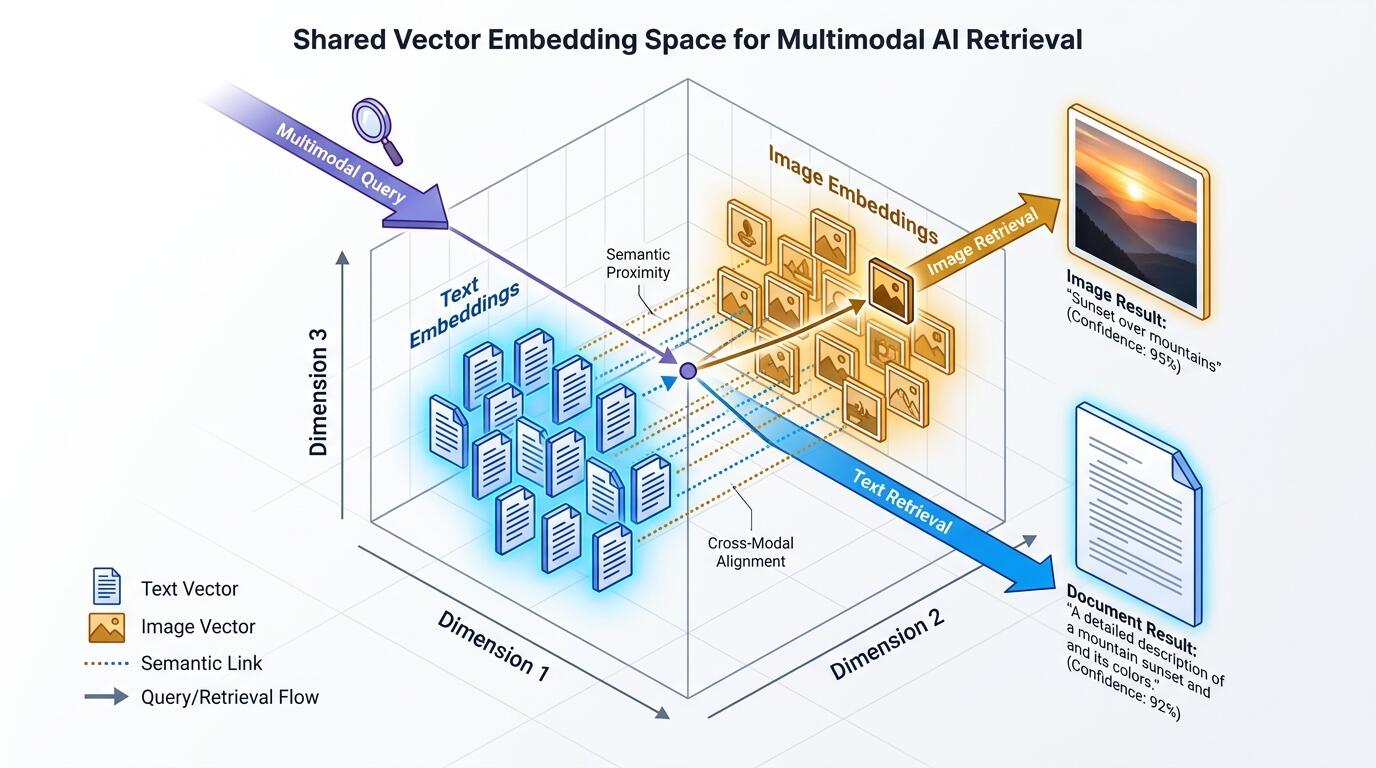
ALT: Shared vector space diagram showing how multimodal embedding models align text and image representations for unified cross-modal recall in AI retrieval systems
What Recall Actually Did: Engineering the Transition
Three Steps to Move from Text-Only to Multimodal Embedding Retrieval
Step 1: Audit Your Corpus Modality Distribution
Before changing any model, spend time characterizing what your corpus actually contains. Run a sampling pass across your document store and tag each chunk as text-only, image-only, or mixed. Many teams discover that the majority of their content is still text — only a subset of documents carries meaningful visual information. This audit determines whether a full reindex is justified, or whether a hybrid routing approach (sending image-bearing documents to a multimodal encoder and the rest to a cheaper text encoder) is more cost-effective. Plan for this to take a meaningful engineering session, not an afternoon.
Step 2: Reindex and Baseline Recall Across Modality Strata
Run your new multimodal encoder against the full corpus and build a parallel index. Do not discard your text-only index yet. Set up an offline evaluation harness using a query set that includes text queries, image queries, and cross-modal queries (image query against a text passage, or a text query against an image). Measure recall at K (commonly at K=5 and K=10) across each stratum separately. This stratified view is critical — aggregate recall numbers hide the divergent behavior across modality types, and you need the stratum-level data to make an honest engineering decision.
Step 3: Instrument the Production Shadow and Define Rollback Triggers
Before cutting traffic over, run the multimodal index in shadow mode alongside your existing system. Log retrieval results from both, and define explicit rollback conditions: for instance, if cross-modal recall on your evaluation set drops below your text-only baseline on text-to-text queries, do not ship. Multimodal encoders sometimes degrade text-to-text performance slightly because the joint training objective is more complex than the text-only objective. Having a pre-defined decision threshold prevents a recall regression on your dominant query type from slipping through under the excitement of improved cross-modal numbers.
Comparing Retrieval Architectures: Text-Only vs. Multimodal vs. Hybrid
The choice between a text-only, multimodal, and hybrid retrieval architecture involves real tradeoffs that no single benchmark fully captures. The table below frames the comparison across dimensions that matter for production systems.
| Comparison Dimension | Text-Only Embedding | Multimodal Embedding | Hybrid Routing |
|---|---|---|---|
| Cross-modal recall (image query, text corpus) | Poor to none | Good to strong | Good, with routing overhead |
| Text-to-text recall | Strong, well-tuned | Good, occasionally lower than text-only | Strong (text path unchanged) |
| Inference latency | Low | Higher (larger model) | Moderate (depends on routing logic) |
| Reindex cost at corpus change | Low | High | High for multimodal shard |
| Operational complexity | Low | Moderate | High |
| Suitable corpus | Text-only | Mixed modality | Large corpus with mixed density |
A pattern we consistently see is that teams jump to full multimodal indexing when hybrid routing would have given equivalent recall gains at lower latency and cost. The right answer depends on your modality distribution from Step 1.
Understanding Recall Mechanics: What Actually Changes in the Vector Space
Recall at K is a measure of whether the correct document appears in the top K results returned by the embedding index. When you switch to a multimodal encoder, the thing that changes is not the retrieval algorithm — nearest-neighbor search works the same way — it is the geometry of the space those vectors inhabit.
In a text-only space, an image chunk (typically stored as a filename, a caption, or a blank entry) has an embedding that bears no relationship to its visual content. The vector sits in an arbitrary location, effectively invisible to semantically meaningful queries. In a multimodal space, that same image chunk is encoded by a vision encoder that captures its visual semantics — a bar chart showing revenue growth lands near text passages about revenue growth, not at a random point in the space.
The recall improvement on cross-modal queries can be substantial in corpora where visual information is load-bearing. A query about a product defect that is visible in an image but never described in surrounding text is the clearest case. In our experience observing retrieval systems across multiple products, the gains in these scenarios are consistent and often surprising to teams that have only measured recall on text-to-text queries.
However, two failure modes appear reliably in multimodal transitions that teams underestimate:
Modality confusion at the boundary. When a query is ambiguous — it could be answered equally well by a text passage or an image — the multimodal encoder may rank one modality over another in ways that are inconsistent across similar queries. This is not random noise; it reflects the training data distribution of the encoder. If your use case diverges significantly from the encoder's training distribution (for example, highly specialized technical diagrams), you may see unexpectedly poor recall on exactly the content you were trying to fix.
Embedding drift across reindexing cycles. Text-only embeddings from a model like a sentence transformer are relatively stable across minor version updates. Multimodal encoders are updated more aggressively, and even small changes to the vision encoder can shift the embedding space enough that old and new vectors are no longer comparable. This means your reindex cadence and versioning discipline become first-class engineering concerns after you move to multimodal embedding — not just hygiene, but correctness.
Advanced Considerations: Reranking, Fine-Tuning, and the Evaluation Gap
Three advanced concerns arise consistently when teams have completed the basic multimodal migration and are working to close the gap between benchmark recall and user-perceived relevance.
First, reranking becomes more complex in multimodal pipelines. A cross-encoder reranker trained on text pairs cannot score image-text pairs meaningfully. You need either a multimodal reranker (rarer and more expensive) or a strategy that projects image candidates into a text representation before reranking — which reintroduces the modality loss you were trying to eliminate.
Second, fine-tuning a multimodal encoder on domain-specific image-text pairs can significantly improve recall in specialized domains, but the data requirements are steep. Contrastive fine-tuning on paired examples requires high-quality positive pairs at a scale that most product teams cannot assemble without deliberate data collection effort over time.
Third, there is a persistent evaluation gap between offline recall metrics and what users actually experience. Offline evaluation uses a fixed query set with known relevant documents. Users in production ask queries that are under-represented in evaluation sets, particularly for novel product images or unusual diagram types. We strongly recommend complementing offline recall metrics with online signals — click-through on retrieved results, explicit thumbs-up/down feedback — as a continuous monitoring layer after migration.
A common misconception is that multimodal embedding replaces the need for good chunking strategy. It does not. If a diagram is embedded as part of a 10-page PDF chunk without its surrounding caption, the encoder may still fail to connect it to relevant queries because the visual context is diluted by irrelevant text tokens. Chunking strategy and modality-aware document parsing remain foundational — multimodal embedding raises the ceiling but does not remove the floor.
Common Questions
Q1: How do you measure whether multimodal embedding actually improved recall in production?
The most reliable approach is stratified offline evaluation combined with online behavioral signals. Define a query set that spans text-to-text, image-to-text, and text-to-image retrieval tasks, and measure recall at K for each stratum separately. Aggregate recall hides the breakdown by modality and can mask regressions on your dominant query type. In parallel, instrument click-through or engagement signals on retrieved results in production to track whether improved recall numbers translate to user behavior changes.
Q2: Is it possible to run multimodal embedding without replacing the existing text-only index?
Yes — hybrid routing is a legitimate architecture. You maintain separate indexes for text-only and multimodal content and route queries to the appropriate index based on query type or document type signals. The tradeoff is operational complexity: you are managing two indexes, two embedding models, and a routing layer. This approach is most justified when the multimodal subset of your corpus is distinct and well-identified, and when you cannot afford the latency or cost of running every document through a larger multimodal encoder.
Q3: How long does a full reindex take when switching to a multimodal embedding model?
Reindex duration depends on corpus size, document complexity, encoder inference speed, and available compute. For large corpora with many image-heavy documents, reindexing is significantly slower than with a text-only encoder because image encoding is computationally heavier per chunk. Teams regularly underestimate this by a factor of two to five. Plan for a meaningful engineering window and budget for the compute cost before committing to a migration timeline in a production service.
Key Takeaways
Moving to a multimodal embedding model is a retrieval architecture decision with meaningful consequences across recall quality, operational complexity, and cost — not simply a model upgrade.
- Cross-modal recall — retrieving visually-encoded content from text queries, or vice versa — improves substantially in mixed-modality corpora when using a well-matched multimodal encoder.
- Text-to-text recall can regress slightly after the switch; always measure it explicitly in your evaluation harness before shipping.
- Corpus modality auditing before migration is the most underrated step — it determines whether full multimodal indexing, hybrid routing, or staying on a text baseline is the correct decision.
- Reindex cadence, vector versioning, and modality-aware chunking all become first-class engineering concerns in a multimodal retrieval system, not afterthoughts.
- Offline recall metrics and online behavioral signals must both be monitored post-migration; the evaluation gap between benchmark performance and user-perceived relevance is real and persistent.
The next concrete action: before committing engineering resources to a full multimodal migration, run a stratified offline evaluation on a representative sample of your corpus and query distribution. The data from that evaluation will tell you more than any benchmark or vendor claim.
If this breakdown is useful to you, subscribe to Darius — a bilingual AI newsletter written by an engineering director running three AI products in production. Every issue covers the AI developments that matter most for builders, with first-hand engineering context rather than press release summaries. Delivered to your inbox, five to ten items per issue, every one traceable to a primary source.
Sources & Further Reading
- IEEE. "IEEE Transactions on Pattern Analysis and Machine Intelligence — Multimodal Representation Learning."
https://www.ieee.org/ - ACM. "ACM Computing Surveys — Surveys on Embedding Models and Information Retrieval."
https://www.acm.org/ - arXiv (Cornell University). "Preprint research on vision-language models and cross-modal retrieval."
https://arxiv.org/ - NIST (National Institute of Standards and Technology). "Standards and evaluation frameworks for information retrieval and AI system performance."
https://www.nist.gov/
Note: The field of multimodal embedding and retrieval is evolving rapidly. Verify the current state of any model, standard, or evaluation framework against the latest official documentation before making production decisions.