Model Routing: Cutting AI Costs Without Cutting Output Quality
ALT: Model routing strategy comparing AI models to cut costs while maintaining output quality
Model Routing vs. Single-Model Pipelines: Which Approach Actually Saves Money Without Breaking Your Product?
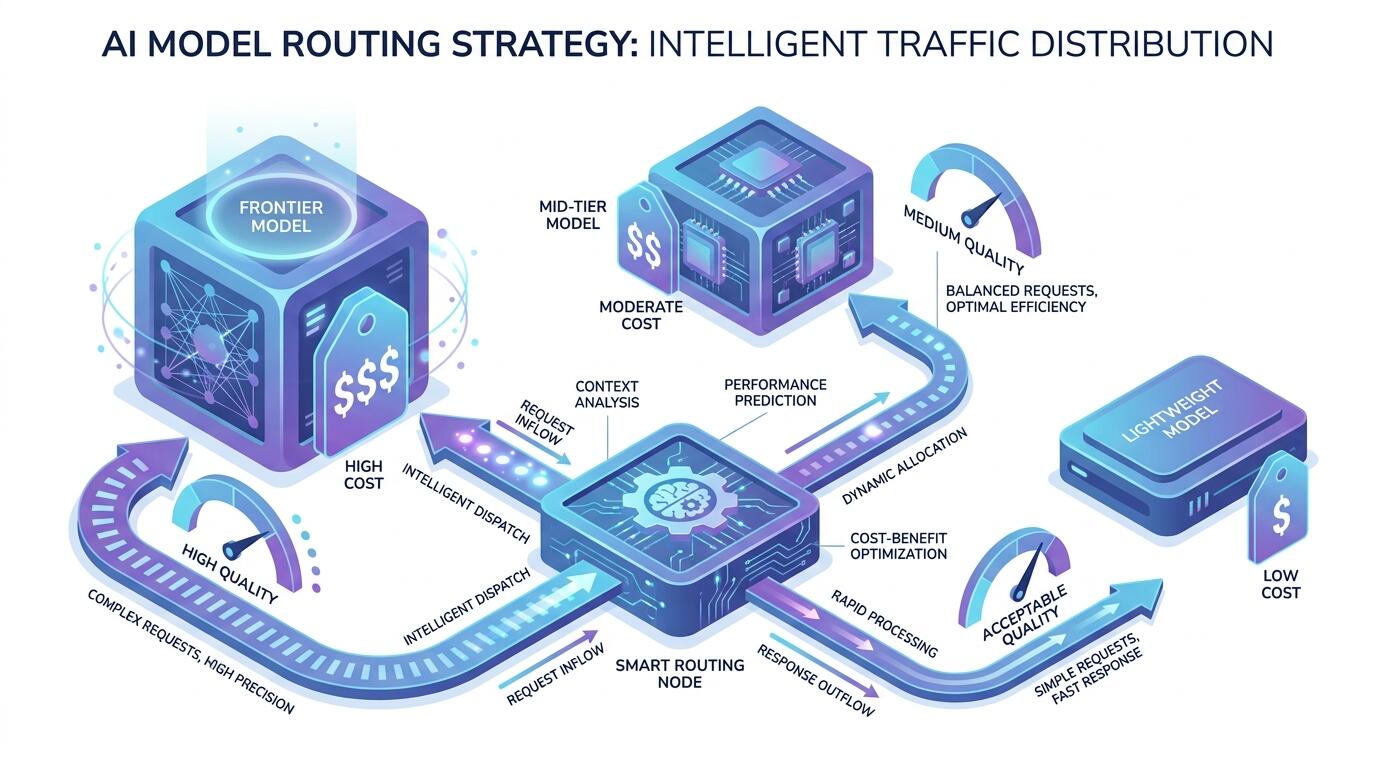
Model routing is the practice of dynamically dispatching each inference request to the most cost-appropriate language model that can handle it, rather than sending every query to your most capable — and most expensive — model. As AI inference costs accumulate at production scale, the difference between routing intelligently and routing lazily often determines whether a product is economically sustainable or quietly bleeding margin.
The comparison here is straightforward: single-model pipelines (where you pick one model and route everything to it) versus dynamic model routing architectures (where you match each request to the cheapest model that can satisfy the quality bar). The criteria are cost efficiency, output quality consistency, operational complexity, latency, and risk exposure. My view, after running three AI products in production simultaneously, is that routing wins on economics — but only when implemented with discipline. Done carelessly, it introduces quality regressions and debugging nightmares that eat the savings you were chasing.
The Criteria That Actually Matter for Routing Decisions
Evaluating model routing against single-model deployment requires a framework grounded in production realities, not benchmarks from research papers.
Cost efficiency is the most obvious dimension. Inference costs vary dramatically across models — frontier models are substantially more expensive per token than smaller, task-specialized alternatives. A routing layer that correctly identifies which requests need frontier capability and which do not can materially reduce your monthly inference bill without visible quality degradation.
Output quality consistency is the criterion that makes or breaks routing in practice. The risk is not that you route some requests to cheaper models — the risk is that you route the wrong requests. Quality regressions on edge cases, ambiguous prompts, or domain-specific inputs can be invisible in aggregate metrics while causing real user-facing failures. Any routing system must be evaluated on worst-case quality, not average quality.
Operational complexity matters because routing adds an abstraction layer. You now maintain prompt compatibility across multiple model APIs, handle differing context window limits, manage version drift when providers update models, and debug failures that may originate in the router's classification logic rather than the underlying model. This overhead is real and should not be underestimated.
Latency is a second-order effect worth tracking. Routing decisions take time, and if your router itself calls a model (a common pattern), you are adding a round-trip before the actual inference. For latency-sensitive applications, this tradeoff needs explicit measurement.
Risk exposure encompasses vendor dependency, model deprecation cycles, and the cascading failure modes that emerge when a routing rule hits an unexpected input distribution. Single-model pipelines have simpler failure modes; routing architectures have more failure modes, each individually less catastrophic but collectively harder to anticipate.
The Contenders: Routing Architectures and Their Characteristics
Single-Model Pipeline: Simplicity as a Feature
A single-model pipeline routes all inference traffic to one model — typically the most capable one available at the time of product launch. It is simple to reason about, easy to debug, and produces predictable quality. The operational surface area is small: one API contract, one set of prompt constraints, one latency profile.
The fundamental problem is that a frontier model's capabilities are wasted on simple requests. When a user asks a factual lookup question, a classification task, or a templated summarization, they are receiving the same compute investment as a user asking for nuanced multi-step reasoning. You pay frontier prices for commodity-grade tasks, and at production scale that asymmetry compounds into significant unnecessary spend.
Single-model pipelines also create fragile vendor dependency. If your chosen model is deprecated, price-adjusted, or rate-limited, your entire product is affected simultaneously. There is no fallback layer and no distribution of risk.
Classifier-Based Routing: Explicit Rule Logic
Classifier-based routing assigns each incoming request to a model tier based on features of the request itself — length, detected intent, topic category, detected complexity signals, or explicit user-specified parameters. The classifier is typically a lightweight model or a rule engine that runs before the primary inference call.
This approach makes routing decisions transparent and auditable. When a request is misrouted, you can inspect the classifier's output and understand why. The cost of the classification step is predictable and generally low relative to the cost of the inference it governs.
The pitfall is distribution shift. Classifiers trained on one request distribution degrade when the production input distribution drifts — and it always drifts, especially after product changes, marketing campaigns, or user growth into new segments. A classifier-based router requires ongoing monitoring and periodic retraining, which is often underestimated at design time.
Cascading / Confidence-Based Routing: Quality-Gated Escalation
Cascading routing starts each request on a cheaper model and escalates to a more capable model only when the initial response fails a confidence or quality check. The quality check might be a separate model evaluation, a rule-based heuristic, or a self-consistency check across multiple cheap-model samples.
Cascading is appealing because it uses cheap models as the default and reserves expensive ones for demonstrated need. In practice, the quality gate is the hard part. Confidence scores from language models are notoriously unreliable as proxies for response quality, and rule-based gates are easy to fool by confident-sounding wrong answers. A cascade that escalates too rarely saves money but degrades quality silently; one that escalates too readily loses most of the cost benefit.
Semantic Embedding Routing: Query-Space Clustering
Semantic routing maps incoming queries into an embedding space and routes based on query similarity to known clusters associated with particular model capabilities. Queries that are semantically similar to a cluster of tasks where a smaller model performs well get routed there; queries near clusters of demonstrated hard cases go to the frontier model.
This approach can generalize better than keyword-based classifiers to novel phrasing of known task types. The downside is infrastructure complexity — you need a maintained embedding index, a similarity search layer, and ongoing cluster management as your product evolves. It also inherits the cold-start problem: clusters are only meaningful once you have enough production traffic to build them from.
Head-to-Head Comparison: Model Routing Architectures Across Key Criteria
| Criterion | Single-Model Pipeline | Classifier-Based Routing | Cascading Routing | Semantic Embedding Routing |
|---|---|---|---|---|
| Cost Efficiency | Low — pays frontier prices for all requests | High — separates cheap and expensive tasks explicitly | High — uses cheap models by default | High — routes semantically similar cheap tasks to smaller models |
| Output Quality Consistency | High — uniform model behavior | Medium — depends on classifier accuracy | Medium — depends on quality gate reliability | Medium — depends on cluster maintenance quality |
| Operational Complexity | Low | Medium — requires classifier maintenance | High — requires quality gate design and calibration | High — requires embedding infrastructure and cluster management |
| Latency | Predictable, single round-trip | Low overhead — classifier is fast | Higher — potential double inference on escalation | Medium — embedding lookup adds overhead |
| Risk Exposure | High vendor concentration | Medium — routing logic can fail silently | Medium — cascade failure modes are subtle | Medium — cold-start and drift risks |
| Debuggability | High | High — classifier decisions are inspectable | Medium — escalation triggers can be opaque | Low — embedding cluster logic is hard to interpret |
The table above surfaces several non-obvious tradeoffs. Single-model pipelines score highest on simplicity and debuggability, which is not a trivial advantage — when something breaks in production at 2 AM, you want a short diagnostic path. The routing approaches all trade some operational cleanliness for cost efficiency, but they do so differently.
Classifier-based routing is the most debuggable of the routing options. When a customer reports a bad response, you can inspect the classifier's decision, understand the routing path, and fix a specific rule. Cascading routing, by contrast, produces failure modes that are harder to isolate — was the problem in the initial cheap-model response, in the quality gate's failure to trigger escalation, or in the frontier model's response after escalation? The answer matters for remediation, and the cascade makes it harder to find.
Semantic embedding routing offers the best generalization potential but pays for it in interpretability debt. Clusters drift as your product evolves, embedding models get updated, and the relationship between cluster membership and actual quality becomes harder to audit over time. Teams that choose semantic routing should budget explicitly for ongoing cluster health monitoring, or they will find themselves unable to explain routing decisions six months into production.
Which Approach Should You Choose? Scenario-Based Recommendations
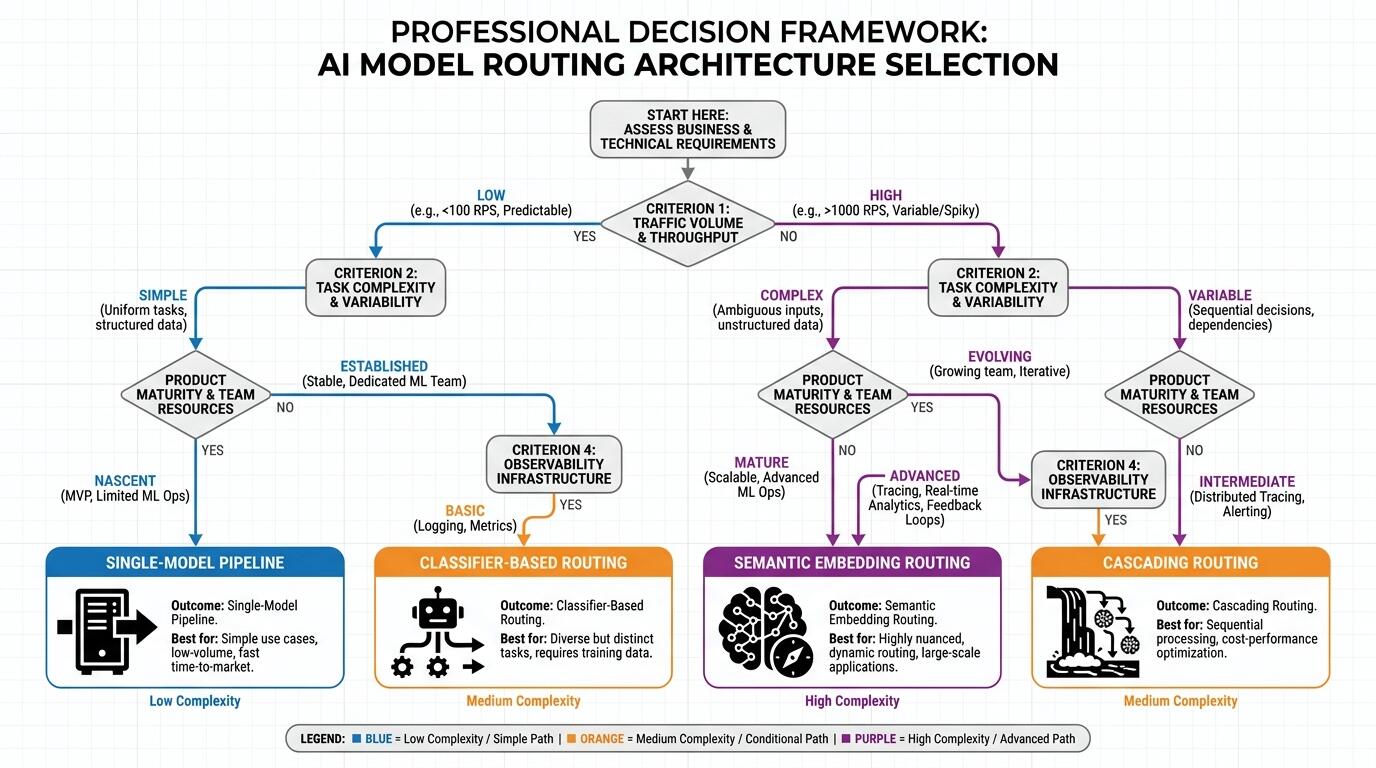
If you are running a high-volume, cost-sensitive application with a clearly bounded task taxonomy — document classification, templated summarization, intent detection — classifier-based routing is the right starting point. The tasks are well-defined enough that a classifier can be built and validated with reasonable confidence, and the cost savings on high-volume cheap tasks are substantial. Start with a simple rule-based classifier before reaching for an ML-based one; rule systems are far easier to audit and adjust.
If you are in early-stage product development with limited traffic and an evolving feature set, stay on a single-model pipeline until your request distribution stabilizes. Routing infrastructure built on an immature request distribution will need to be rebuilt as your product changes. The cost of premature optimization here is not just engineering time — it is the operational burden of maintaining a routing layer that keeps breaking as your product evolves.
If your application has a wide range of task complexity — from simple factual queries to multi-step reasoning — and you cannot easily classify requests in advance, cascading routing is worth serious evaluation. The key discipline is investing in a rigorous quality gate before deploying the cascade, not after. A cascade without a reliable quality gate is worse than no routing at all: it gives you the complexity costs of routing without the quality guarantees of a single good model.
If you have significant production traffic and solid observability infrastructure, semantic embedding routing becomes viable. It works best as a second-generation routing strategy — built on data collected from an earlier classifier-based or cascading system — rather than a first-generation bet.
Pros and cons summary:
- Single-model pipeline: easy to build, easy to debug, expensive at scale, high vendor risk.
- Classifier-based routing: cost-effective, auditable, requires ongoing classifier maintenance, vulnerable to distribution shift.
- Cascading routing: cost-effective default, complex failure modes, quality gate calibration is genuinely hard.
- Semantic embedding routing: generalizes well, interpretability is poor, infrastructure overhead is significant.
ALT: Decision framework diagram for choosing between single-model pipelines and dynamic AI model routing strategies based on cost and quality tradeoffs
Frequently Asked Questions FAQ
Q1: How do I measure whether my model routing is actually maintaining output quality?
Measuring routing quality requires two distinct signal types: automated metrics and human evaluation. Automated metrics — such as task-specific accuracy scores, format compliance rates, and self-consistency checks — give you coverage at scale but miss subtler quality regressions. A structured human evaluation sample, drawn specifically from traffic that was routed to cheaper models, is the only reliable way to catch the edge cases that automated metrics miss. Run this evaluation continuously, not just at deployment.
Q2: Is classifier-based routing reliable enough for production use in high-stakes applications?
Classifier-based routing is production-ready for well-bounded task domains, but it carries meaningful risk in high-stakes contexts where misclassification has serious consequences. The classifier's reliability degrades with input distribution drift — a common occurrence after product updates or user growth. For high-stakes applications, add a conservative escalation bias: when classifier confidence is below a threshold, route to the more capable model. Cost savings from routing should never be achieved by reducing the floor on output quality for consequential tasks.
Q3: How much operational overhead does implementing model routing actually add?
The operational overhead of model routing depends heavily on the approach chosen. Classifier-based routing adds moderate overhead — primarily in maintaining classifier accuracy as your request distribution evolves. Cascading routing adds higher overhead because the quality gate requires ongoing calibration. Semantic embedding routing adds the most, requiring embedding infrastructure, cluster maintenance, and interpretability tooling. Teams consistently underestimate this overhead at design time. Budget for ongoing routing maintenance as a recurring engineering cost, not a one-time implementation project.
Summary
Model routing is a legitimate and powerful strategy for reducing AI inference costs at production scale, but it is not a free optimization. The core tradeoff is consistent across all routing approaches: you gain cost efficiency and lose some combination of simplicity, debuggability, and quality consistency guarantees.
Three points to carry forward from this analysis:
First, routing quality is only as good as its worst-case behavior. Average-quality metrics will flatter a poorly calibrated router. Build evaluation infrastructure that specifically surfaces edge cases routed to cheaper models, or you will miss the regressions that matter.
Second, match your routing architecture to your product maturity. Semantic embedding routing built on thin early-stage traffic is fragile. Classifier-based routing on a task taxonomy that is still evolving will require constant rework. The cheapest routing system is the one that does not need to be rebuilt.
Third, debuggability is a production cost, not a nice-to-have. Every hour spent tracing a quality failure through an opaque cascade or an uninterpretable embedding cluster is an hour not spent building product. Simpler routing architectures pay dividends in incident response time.
The next step is to audit your current inference spend by task type. Map what fraction of your requests are genuinely frontier-model tasks versus tasks a smaller model could handle. That gap is your routing opportunity — and it is almost always larger than it looks before you measure it.
If you are building AI products and want a concise, practitioner-grounded signal on developments like model routing — curated from first-hand production experience rather than editorial aggregation — visit the Darius newsletter, subscribe to the bilingual briefing, and get 5–10 carefully selected items per issue with the context that actually matters for builders.
References
- Not Diamond. "Not Diamond: Cut AI Costs with Smart LLM Routing".
https://www.youtube.com/watch?v=m5Ro5jQqf0M - Robin Banner. "Three Ways to Handle AI Model Routing in 2026 (And the Trade-offs Nobody Talks About)".
https://dev.to/robinbanner/three-ways-to-handle-ai-model-routing-in-2026-and-the-trade-offs-nobody-talks-about-4opa - Pondhouse Data. "Saving Costs with LLM Routing: The Art of Using the Right Model".
https://www.pondhouse-data.com/blog/saving-costs-with-llm-routing - IEEE. Institute of Electrical and Electronics Engineers — standards and publications on AI systems engineering and machine learning infrastructure.
https://www.ieee.org/