The Minimum Viable Architecture: Building Just Enough to Ship
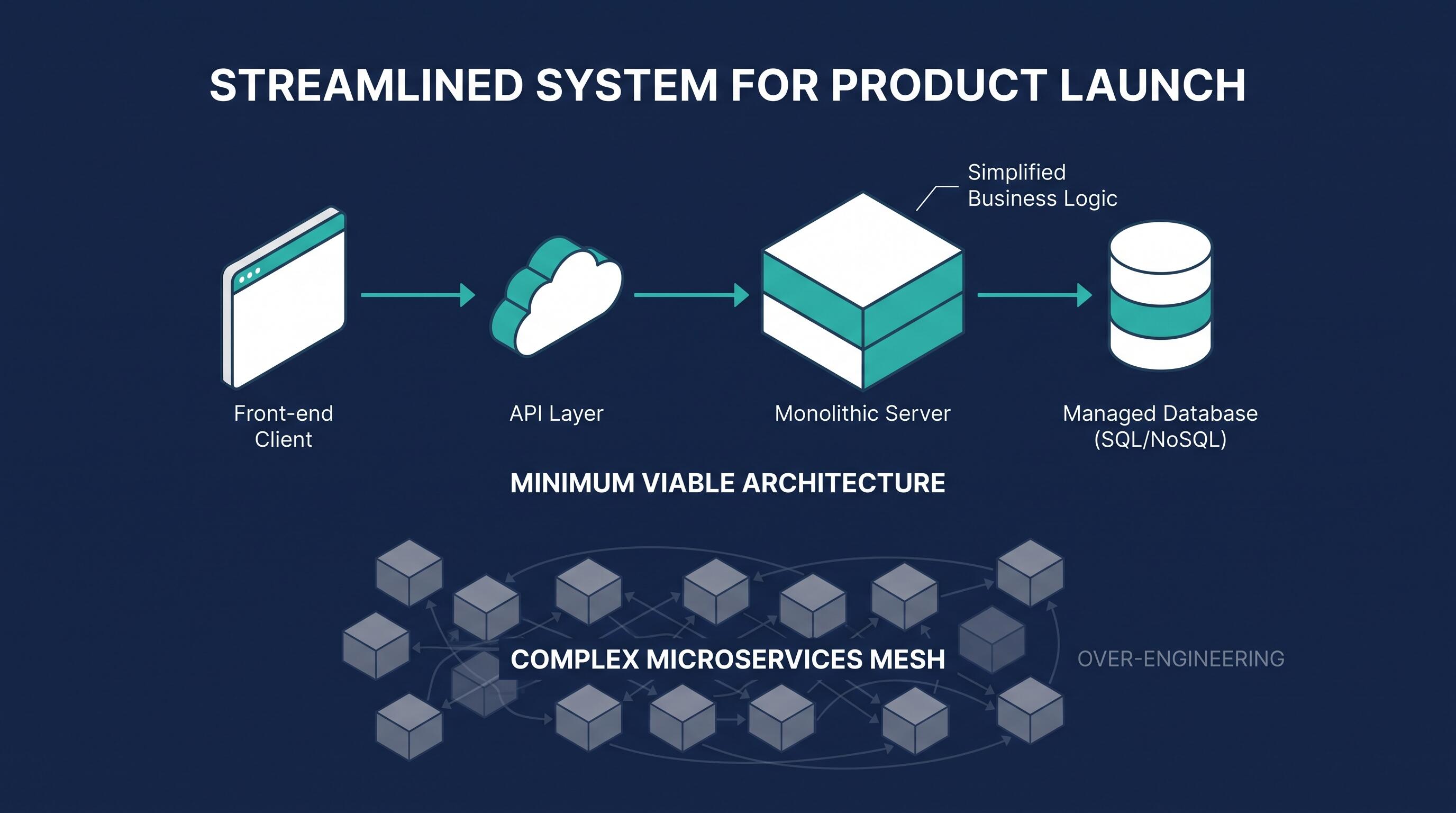
ALT: Minimum viable architecture diagram for full-stack development and systems design product launch
Why "Just Enough" Architecture Is the Smartest Engineering Decision You Can Make
Key Conclusion: In the race from idea to live product, engineering teams consistently over-architect before validating a single assumption. The principle of minimum viable architecture challenges this tendency by applying disciplined restraint to full-stack development and systems design — building only what the product actually needs to ship, learn, and iterate. This approach compresses time-to-market, reduces wasted engineering effort, and creates a foundation that scales intelligently as real user data arrives. Smart product development starts not with the most elegant system, but with the most honest one.
There is a quiet but costly illusion that haunts engineering teams at every stage of growth: the belief that a more elaborate architecture is a safer architecture. Teams spend weeks debating microservices boundaries before writing a single user-facing feature. Database schemas get normalized to third normal form for a product that hasn't yet acquired its first hundred users. Infrastructure gets provisioned for traffic volumes that may never materialize.
The minimum viable architecture (MVA) is a direct counter to this pattern. It is not about cutting corners or shipping broken software — it is about applying the same hypothesis-driven thinking that governs good product management to the discipline of systems design. You build what you need, you validate it, and you evolve deliberately. This article unpacks how to execute that in practice, across the full spectrum of technical and leadership decisions.
Where This Approach Applies — and Where It Doesn't
✅ Applicable Scenarios:
- Early-stage startups or new product lines where market fit is still being validated and engineering resources are finite
- Internal tooling or enterprise MVPs where a proof-of-concept must demonstrate value to stakeholders before receiving full funding
- AI-powered product launches where the model behavior, user interaction patterns, and data pipelines all need real-world validation before hardening the underlying architecture
❌ Not Applicable/Cautions:
- Regulated industries (healthcare, fintech, defense) where compliance requirements mandate a minimum level of architectural maturity from day one — security, auditability, and data residency cannot be deferred
- Products with genuinely predictable, high-volume traffic from launch (e.g., a new service for an existing platform with millions of users) where under-provisioning carries significant reputational and financial risk
The Problem With Over-Engineering Before You've Earned It
Software engineering culture has a complicated relationship with complexity. On one hand, experienced engineers know that hasty decisions create lasting technical debt. On the other hand, the instinct to "do it right from the start" frequently translates into systems that are far more complex than the current problem demands — and the current problem is almost never the one you imagined it would be.
The lean startup movement, popularized by Eric Ries, introduced the concept of the minimum viable product (MVP) to product management. The core insight was deceptively simple: build the smallest thing that lets you test your riskiest assumption. The same logic applies to architecture. Your riskiest assumption as an engineering team is almost never about whether your system can handle ten million concurrent users. It is almost always about whether users want the thing you are building at all, and whether the workflows you have designed actually match how they behave.
The market has reinforced this reality with consistent force. Startups that raised large rounds, hired substantial engineering teams, and built sophisticated distributed systems before launching have repeatedly lost to leaner competitors who shipped earlier, learned faster, and iterated with discipline. The companies that survived and scaled were not the ones with the best initial architecture — they were the ones with the best feedback loops.
From a systems design perspective, the cost of over-engineering is not just the time spent building unnecessary infrastructure. It is the rigidity that complexity introduces. A system with seventeen independently deployed services is harder to refactor than a well-structured monolith. When you discover — as you almost certainly will — that your initial product assumptions were partially or substantially wrong, a simpler architecture bends. A complex one breaks.
This is the foundation on which minimum viable architecture is built: not laziness, but intellectual honesty about what you actually know versus what you are assuming.
How to Build a Minimum Viable Architecture: A Practical Framework
Three Steps to Getting Your System to Ship
Step 1: Map Your Riskiest Assumptions to Architectural Decisions
Before writing a single line of infrastructure code, articulate the three to five assumptions your product depends on most critically. For each assumption, ask: what is the simplest architectural decision that lets us test this without foreclosing future options? Document these explicitly. This exercise typically takes one to two focused working sessions and prevents weeks of misdirected engineering effort.
Step 2: Choose a Deployment Topology That Matches Your Validation Stage
For most early-stage products, a well-structured monolith deployed on managed infrastructure offers the fastest path to a functional, observable system. Choose your primary programming language based on team fluency and ecosystem fit — for AI-heavy products, Python's ecosystem (FastAPI, LangChain, Hugging Face) is often the pragmatic choice, while TypeScript suits full-stack web products requiring rapid iteration. For prototyping and user testing, tools like Vercel, Railway, and Supabase dramatically compress the time between code and running system. The goal is to eliminate operational overhead that does not yet create value.
Step 3: Define Your Architectural Upgrade Triggers Before You Need Them
The most dangerous moment in an MVA lifecycle is success without a plan. Decide in advance what observable signals — specific load thresholds, user scale milestones, or specific feature requirements — will trigger architectural evolution. Write these down as engineering team agreements. This prevents both premature optimization and reactive firefighting when growth actually arrives.
Comparing Architectural Approaches for Early-Stage Products
Different teams arrive at different answers based on team size, product type, and technical context. The following comparison captures the most common patterns:
| Comparison Dimension | Structured Monolith | Modular Monolith | Lightweight Microservices |
|---|---|---|---|
| Time to first deployment | Fastest | Moderate | Slowest |
| Operational complexity | Low | Low-to-moderate | High |
| Scalability ceiling | Moderate | Moderate-to-high | High |
| Refactoring cost when wrong | Low | Moderate | High |
| Team size sweet spot | One to five engineers | Five to fifteen engineers | Fifteen-plus engineers |
| Best fit for AI products | Strong (single model serving) | Strong (multi-model pipelines) | Situational (heavy inference workloads) |
| Go-to-market speed | Fastest | Moderate | Slower |
The most common mistake teams make is selecting an architecture based on where they want to be in three years rather than what they need to validate in the next three months. A structured monolith with clear internal module boundaries is not a failure of ambition — it is a deliberate choice that preserves optionality while moving fast.
The Five Architectural Principles That Make MVA Work
Principle 1: Defer Distribution Until You Have a Reason
The microservices pattern solves real problems — independent deployability, technology heterogeneity, isolated failure domains. But it creates real costs — network latency, distributed tracing complexity, inter-service authentication, and the operational burden of running many independent processes. For a team shipping its first version, these costs almost never pay off. Start with a single deployable unit, draw clear internal boundaries using modules or packages, and extract services only when a specific, measurable problem demands it.
Principle 2: Use Managed Infrastructure Aggressively
One of the most underappreciated shifts in modern full-stack development is how much operational capability is now available as a managed service. Databases, queues, object storage, authentication, search, and now AI inference — all of these can be consumed as services rather than operated as infrastructure. For an early-stage product, this means your engineering capacity goes entirely into product logic. The gap in control is almost always worth the gain in speed. Platforms like AWS RDS, Google Cloud SQL, Supabase, and similar services eliminate entire categories of operational work that would otherwise consume significant engineering bandwidth.
Principle 3: Design for Observability from Day One
Minimum viable does not mean observable later. Logging, basic metrics, and error tracking are not luxuries — they are the instruments that tell you whether your architecture is working and where users are encountering friction. The best practices for product development team communication extend beyond Slack and standups: your systems need to communicate their own state to you through structured logs and dashboards. Tools in this space are increasingly low-friction to integrate. Skipping them in the name of speed is one of the most reliably expensive shortcuts a team can take.
Principle 4: Make Your Data Model Your Most Conservative Decision
You can refactor application code with relative ease. Migrating production data models is painful, risky, and time-consuming. This means your data schema deserves more careful upfront thought than almost any other architectural decision. Not over-engineered — but genuinely considered. Spend time on your entity model before your first sprint. Use database migrations from the start. Document your schema decisions and the reasoning behind them. This is the one area where investing slightly more than feels necessary in the MVP phase reliably pays off.
Principle 5: Align Your Architecture With Your Team's Communication Structure
Conway's Law — the observation that systems tend to mirror the communication structure of the organizations that build them — is not just an academic curiosity. It is a predictable force that shapes architecture in ways teams often fail to anticipate. If you have a single team of engineers who talk to each other continuously, a unified codebase with clear module boundaries will serve you far better than a distributed system that fragments ownership and creates coordination overhead. As your team grows and specializes, your architecture can evolve to match. This is one of the most important best practices for managing software development teams at any scale, remote or co-located.
Practical Context: An AI Product Launch
Consider a team building an AI-powered document analysis product. The natural instinct, influenced by the sophistication of the underlying models, is to build a complex pipeline: a dedicated ingestion service, a separate embedding service, a vector database cluster, an LLM orchestration layer, and a front-end served from a CDN. Each of these components is defensible in isolation.
But what does the team actually need to validate? They need to confirm that users will upload real documents, that the AI outputs are useful enough to change user behavior, and that the core workflow is intuitive. None of these questions require a distributed system to answer. A single-server deployment with a managed database, a straightforward vector store like pgvector running inside Postgres, and a clean API layer can answer all of them — and can be built in a fraction of the time.
When the product finds traction and specific bottlenecks emerge — maybe the embedding generation is too slow for large documents, or the inference costs are unpredictable at scale — those are real signals that warrant architectural investment. Building the complexity before those signals arrive is speculation dressed as engineering.
The best tools for prototyping and user testing in this context are often the simplest: a hosted front-end, a single backend process, managed storage, and direct integration with an AI provider API. Speed of learning beats elegance of architecture at this stage.
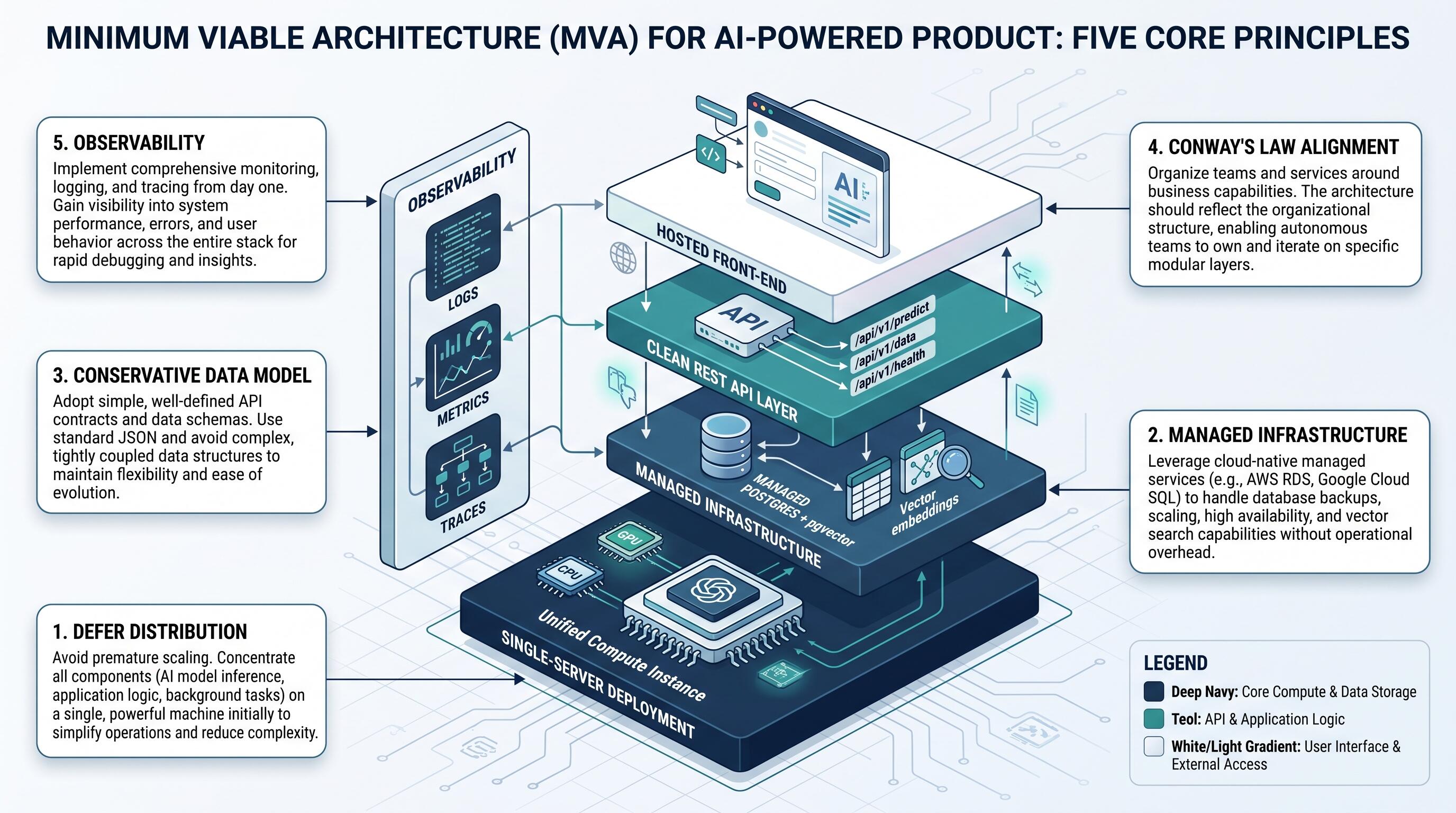
ALT: Diagram illustrating minimum viable architecture principles for AI-powered full-stack product development and systems design
Advanced Considerations: When MVA Gets Complicated
Handling Security and Compliance Without Over-Engineering
Security is frequently cited as the reason teams need more architecture from the start. The reality is more nuanced. For most consumer products and internal tools, a modest but deliberately applied security posture — HTTPS everywhere, parameterized queries, input validation, dependency scanning, and a clear authentication boundary — provides meaningful protection without architectural complexity. The trap is conflating "secure" with "complex." A well-implemented monolith with proper authentication is categorically more secure than a hastily assembled microservices mesh with poorly configured service-to-service trust.
The Common Misconception About Technical Debt
MVA is sometimes dismissed as a license to accumulate technical debt. This misunderstands what technical debt actually is. Technical debt is not simplicity — it is a mismatch between what your system does and what it needs to do. A clean, simple codebase that serves current needs is not in debt. A complex, tangled system that nobody fully understands — regardless of how sophisticated it appears — is deeply indebted. The minimum viable architecture, executed with discipline, produces less technical debt than premature optimization in almost every real-world case.
Relationship to AI Architecture Specifically
For teams building AI-powered products, the MVA principle has an additional layer of importance. AI systems carry a specific form of architectural uncertainty: you often cannot know in advance whether a given model, embedding strategy, or retrieval approach will produce acceptable results for your users. This means the architecture must support rapid experimentation — swapping models, adjusting prompts, changing retrieval strategies — without requiring significant re-engineering. A modular, testable AI pipeline with clear interfaces between components enables this in a way that tightly coupled systems cannot. Building that modularity in does not violate MVA principles — it is how MVA principles apply to the specific constraints of AI product development.
Frequently Asked Questions FAQ
Q1: How do I know when my minimum viable architecture needs to evolve?
The clearest signals are specific and measurable: response times that degrade under real user load, deployment processes that take so long they slow iteration, or team coordination failures caused by a shared codebase that has genuinely outgrown its structure. The key is distinguishing genuine architectural pain — which has observable, business-impacting symptoms — from theoretical discomfort about a system that feels too simple. If your users are not affected and your team is not blocked, the architecture is working. Evolve when reality demands it, not when it feels overdue.
Q2: Is a monolith always the right starting point for early-stage products?
Not always, but it is right far more often than engineering culture tends to acknowledge. The cases where a distributed architecture makes sense from day one are specific: teams that are genuinely large enough to benefit from independent deployability, products with clearly separate bounded contexts that require different technology stacks, or situations where regulatory requirements mandate strict data isolation between components. For the majority of early-stage products — including most AI-powered applications — a well-structured monolith delivers faster iteration, simpler debugging, and lower operational overhead at the stage where speed of learning matters most.
Q3: How long does it typically take to build and ship a minimum viable architecture?
This depends on team size, product complexity, and infrastructure choices, but the right framing is not calendar time alone — it is the ratio of shipping time to learning value. Teams that commit to MVA principles and use managed infrastructure aggressively can often move from architectural decisions to a deployed, observable system within a matter of weeks rather than months. The goal is not to minimize engineering time as an end in itself, but to maximize how quickly real user data can inform the next set of decisions. That compression of the feedback loop is where the real value of minimum viable architecture lives.
Summary
The minimum viable architecture is not a compromise — it is a strategy. It applies the intellectual honesty of hypothesis-driven product thinking to the discipline of systems design and full-stack development, with three durable outcomes:
First, it compresses the time between idea and real-world signal. Every week spent building infrastructure that does not yet need to exist is a week in which you are not learning from users. MVA eliminates that waste systematically.
Second, it preserves architectural optionality. Simple systems are easier to change than complex ones. When your initial product assumptions prove partially wrong — and they will — a minimum viable architecture lets you adapt without paying the full cost of distributed system refactoring.
Third, it aligns engineering effort with business value. At the earliest stage of any product's life, the most valuable thing an engineering team can produce is validated learning. MVA is the architectural philosophy that makes that possible.
The discipline required to ship just enough — and no more — is harder than it sounds. It demands that experienced engineers resist their instinct toward completeness. It requires teams to make architectural decisions under genuine uncertainty without hiding behind premature abstraction. But the teams that master it ship faster, learn more, and build systems that scale because they understand what they are scaling — not because they guessed.
Call to Action
If you're looking to turn your next big idea into a live, production-ready product, Darius brings the end-to-end expertise in AI architecture, systems design, and full-stack development to make it happen. Explore real shipped projects, technical insights, and engineering strategies at https://www.darius.wiki. Whether you're a founder, engineer, or tech leader, Darius is ready to help you build smarter and ship faster.
References
- Fowler, Martin. "MonolithFirst".
https://martinfowler.com/bliki/MonolithFirst.html - Ries, Eric. "The Lean Startup: Validated Learning and the Build-Measure-Learn Feedback Loop". Harvard Business Review.
https://hbr.org/2013/05/why-the-lean-start-up-changes-everything - IEEE Software Engineering Body of Knowledge (SWEBOK). "Software Architecture Fundamentals".
https://www.computer.org/education/bodies-of-knowledge/software-engineering - ThoughtWorks Technology Radar. "Architectural Patterns and Platform Engineering".
https://www.thoughtworks.com/radar - NIST. "Cybersecurity Framework: Integrating Security into Software Development".
https://www.nist.gov/cyberframework
Note: Standards and best practices in software architecture evolve continuously. Please verify the latest guidance from official sources or consult qualified technical advisors for decisions specific to your product context.
About the Author
Darius is an Engineering Director and AI Architect specializing in transforming ideas into live, running products — with proven experience across AI architecture, systems design, and full-stack development, backed by 3 shipped live projects. Learn more at darius.wiki.
© Darius. All rights reserved. The content in this article is intended for informational purposes only and reflects the author's professional opinions and experiences. Nothing herein constitutes formal engineering, legal, or business advice. Reproduction or redistribution of this content without explicit permission is prohibited.