Meeting Regulatory Requirements in Product Design Without Slowing Delivery

ALT: Engineering team navigating regulatory requirements in product design while maintaining fast delivery timelines
How to Meet Regulatory Requirements in Product Design Without Grinding Delivery to a Halt
You have a product roadmap, a shipping deadline, and a compliance checklist that feels like it was written to stop you from doing either. This tension is not hypothetical — it is the operating reality for teams building anything in healthcare software, fintech, AI-driven platforms, or any market where regulators have an opinion about what you ship. The good news is that regulatory compliance and delivery velocity are not fundamentally at odds. The bad news is that most teams treat them as if they are, and that misframing is what causes the real delays.
This article lays out the concrete strategies that allow engineering teams to meet compliance obligations without turning every release into a months-long audit exercise. The items below were selected based on recurring patterns observed in practice — the kinds of situations that come up repeatedly when working across technically complex, regulated, and deadline-sensitive product builds. Whether you are a founder defining your first compliance posture, a product manager trying to unblock a release, or a senior engineer being asked to make the architecture "audit-ready," these approaches translate directly into work you can do starting this week.
Strategies for Meeting Compliance in Product Design Without Slowing Delivery
Treat Compliance as a Design Constraint, Not a Post-Build Checklist
Compliance built into the design phase costs a fraction of what it costs to retrofit after the fact. Regulatory requirements — whether they come from frameworks like HIPAA, GDPR, the EU AI Act, or sector-specific standards — almost always have architectural implications: where data lives, how it flows, who can access it, and how decisions are logged. Teams that defer these questions until a compliance review late in the cycle consistently discover that the answers require rearchitecting systems that are already partially built.
The practical shift is to treat regulatory constraints the same way you treat performance or security requirements: as hard inputs to system design, not optional annotations you will deal with later. During early architecture sessions, map each relevant regulatory obligation to a specific design decision. What data residency rule applies? What does the logging requirement look like at the API layer? Does this feature require an explainability mechanism under the EU AI Act's high-risk classification rules? Answering these in the design phase adds minimal overhead and eliminates expensive late-stage rework.
Best for: Teams starting a new product or undertaking a significant architectural revision where compliance scope is known early.
Watch out: This approach requires that someone on the team — or a consultant engaged at the right stage — actually understands the regulatory landscape well enough to translate obligations into design decisions. Vague compliance intent does not survive contact with an auditor.
Build a Compliance-Aware CI/CD Pipeline
A compliance-aware CI/CD (Continuous Integration / Continuous Delivery) pipeline is a delivery workflow that embeds automated checks for regulatory requirements — such as data handling rules, access controls, and audit log integrity — directly into the software build and release process. Rather than running compliance checks as a separate gate before each release, the pipeline flags issues continuously, as code is written and merged.
In practice, this means integrating tools that check for secrets exposure, validate data classification tags on new data stores, enforce encryption standards, and verify that audit logging is wired up correctly — all as automated steps in the same pipeline that runs your unit tests. When a developer introduces a change that would, say, write personally identifiable information to an unencrypted log, the pipeline catches it before it reaches production. The compliance signal is immediate, not discovered during a quarterly audit.
A pattern that appears consistently in high-compliance engineering environments is the use of policy-as-code tools — where compliance rules are expressed as versioned code artifacts, reviewed and tested the same way application code is. Frameworks like Open Policy Agent (OPA) are purpose-built for this. The regulatory obligation becomes a test that either passes or fails, and the team knows immediately which way it went.
Best for: Teams with established CI/CD practices who are scaling compliance coverage without scaling headcount.
Watch out: Automated checks catch structural and syntactic violations well, but they cannot replace expert judgment on ambiguous regulatory interpretations. Use them to catch the obvious gaps, not as a substitute for compliance expertise.
Document Decisions in Real Time, Not Retrospectively
Regulatory auditors and certification bodies consistently ask the same kinds of questions: Why was this architectural choice made? What alternatives were considered? Who approved this data handling approach? Teams that reconstruct these answers after the fact — searching through old Slack threads and meeting notes — produce documentation that reads like it was reconstructed after the fact, because it was. Auditors notice.
The operational fix is to make decision documentation a part of the definition of done for significant design and implementation choices, not a project phase that happens at the end. Architecture Decision Records (ADRs) — short, structured documents that capture the context, decision, and consequences of a significant technical choice — are a lightweight and effective tool for this. They live in version control alongside the code they describe, they accumulate naturally over the life of a project, and they produce exactly the kind of traceable, reasoned record that compliance reviews and certification audits look for.
This is not about bureaucracy for its own sake. Well-maintained decision records also benefit the engineering team: they prevent teams from relitigating settled decisions, help onboard new engineers quickly, and make it possible to explain to a non-technical stakeholder — or a regulator — why the system works the way it does.
Best for: Any team building in a regulated domain where design decisions will eventually need to be explained to an auditor, a customer, or a board.
Watch out: ADRs only work if the team actually maintains them. Establish a lightweight template and make writing one a normal part of technical work, not an exceptional event.
Adopt a Risk-Tiered Approach to Feature Compliance
Not every feature in your product carries the same regulatory risk, and treating them all identically wastes time on low-risk features while potentially underinvesting where it matters most. A risk-tiered compliance approach means classifying features by the regulatory obligations they trigger and calibrating the rigor of compliance controls accordingly.
For example, a settings page that controls notification preferences carries different compliance weight than a module that processes medical records or makes lending decisions. A tiered framework might define three levels — informational, sensitive, and regulated — and specify what controls, reviews, and documentation are required at each level. High-risk features get architecture review, security assessment, and detailed documentation. Low-risk features get automated checks and a lighter process.
This kind of tiering is consistent with the risk-based approach that most regulatory frameworks themselves endorse. The EU AI Act explicitly classifies AI systems by risk level and calibrates its requirements accordingly. GDPR's data protection impact assessment (DPIA) requirement is triggered only for high-risk processing activities. Working within the framework's own logic — rather than applying maximum compliance effort to everything — is both efficient and defensible.
Best for: Product teams managing large, mixed-risk feature sets who need to focus compliance investment where it matters most.
Watch out: Risk classification decisions need to be made by people with genuine regulatory literacy. Misclassifying a high-risk feature as low-risk is the kind of error that shows up at exactly the wrong moment.
Engage Regulators and Standards Bodies Early
Engaging regulators and standards bodies early in product development — rather than submitting for approval at the end — is a strategy that consistently reduces total compliance cycle time, even though it feels counterintuitive to teams accustomed to building first and seeking approval later. Many regulatory bodies offer pre-submission meetings, sandbox programs, or consultation processes specifically designed to provide guidance before a formal submission.
The FDA's Pre-Submission Program for medical device software, the FCA's regulatory sandbox in the UK financial services context, and equivalent mechanisms in other jurisdictions exist precisely because regulators understand that early engagement produces better-compliant products faster than sequential build-then-review cycles. Teams that use these mechanisms get clarity on what the regulator actually requires — which is often different from what a team assumes based on reading guidance documents alone — before making irreversible architectural commitments.
Per team extension research on cross-border regulatory compliance, one of the most common causes of compliance-related delivery delays is discovering late that a regulatory body interprets a requirement differently than the product team assumed. Early engagement is the structural fix for that class of problem.
Best for: Products requiring formal regulatory approval — medical devices, financial services platforms, AI systems subject to sector-specific regulation — where a late-stage requirement change is expensive.
Watch out: Early engagement takes calendar time that teams building fast may resist spending. The calculus almost always favors it, but it requires planning headroom early in the development timeline.
Use Modular Architecture to Isolate Compliance-Sensitive Components
Modular architecture is a system design approach that structures a product as a set of well-defined, independently deployable components with explicit interfaces between them. For compliance purposes, modular design allows teams to isolate the components that carry regulatory obligations — data stores, processing pipelines, audit logging systems — and apply rigorous controls to those components without imposing the same overhead on the rest of the system.
In a monolithic architecture, a change to a low-risk UI component and a change to a sensitive data processing module both go through the same release process. In a modular system, each component has its own deployment boundary, and compliance controls can be scoped accordingly. The sensitive module gets the full compliance treatment; the low-risk component ships on a faster cycle. Delivery velocity for the product as a whole improves because only the highest-compliance components are subject to the highest-compliance process.
This architectural pattern also simplifies the compliance story for auditors. When you can point to a specific, bounded service and say "all personal data processing happens here, and here is the access log, the encryption configuration, and the data retention policy for this service," the audit conversation is far more tractable than when the auditor has to understand the entire system to answer a question about a single data handling practice.
Shipping fast without sacrificing product quality depends on exactly this kind of architectural discipline — the ability to move quickly on low-risk components while applying appropriate rigor to the parts of the system that actually need it.
Best for: Teams building multi-component platforms where compliance obligations are concentrated in specific areas of the system.
Watch out: Modular architecture introduces its own complexity in inter-service communication, distributed tracing, and operational overhead. The compliance benefits are real, but modular design is not free — it requires deliberate investment in the supporting infrastructure.
Invest in Compliance Literacy Across the Engineering Team
Compliance literacy means ensuring that engineers, product managers, and architects understand — at a working level — the regulatory obligations that apply to the product they are building. This is different from hiring a compliance team and treating compliance as their problem. In high-velocity product organizations, compliance decisions happen continuously at the level of individual code commits, API design choices, and data model decisions. If the people making those decisions do not understand the regulatory context, no amount of after-the-fact review will catch all the gaps.
A pattern observed consistently across high-compliance engineering environments is that the teams with the fewest late-stage compliance surprises are the ones where regulatory context is treated as domain knowledge — something engineers are expected to understand, the same way they are expected to understand the performance characteristics of the systems they build. This does not mean turning every engineer into a regulatory lawyer. It means ensuring that the team understands which data is sensitive, why it is sensitive, what the system is required to do with it, and what the consequences are of getting it wrong.
According to research on MedTech regulatory compliance, organizations that embed compliance knowledge at the engineering level — through training, documentation, and cross-functional pairing with compliance specialists — consistently outperform those that treat compliance as a separate organizational function operating in parallel. The investment in literacy pays back in fewer rework cycles and faster regulatory reviews.
Best for: Teams scaling quickly where the ratio of engineers to compliance specialists is high, and where compliance-related decisions are distributed across the team.
Watch out: Compliance literacy programs require ongoing maintenance as regulations evolve. A one-time training session becomes stale quickly in a regulatory landscape that is actively changing, particularly in AI governance.
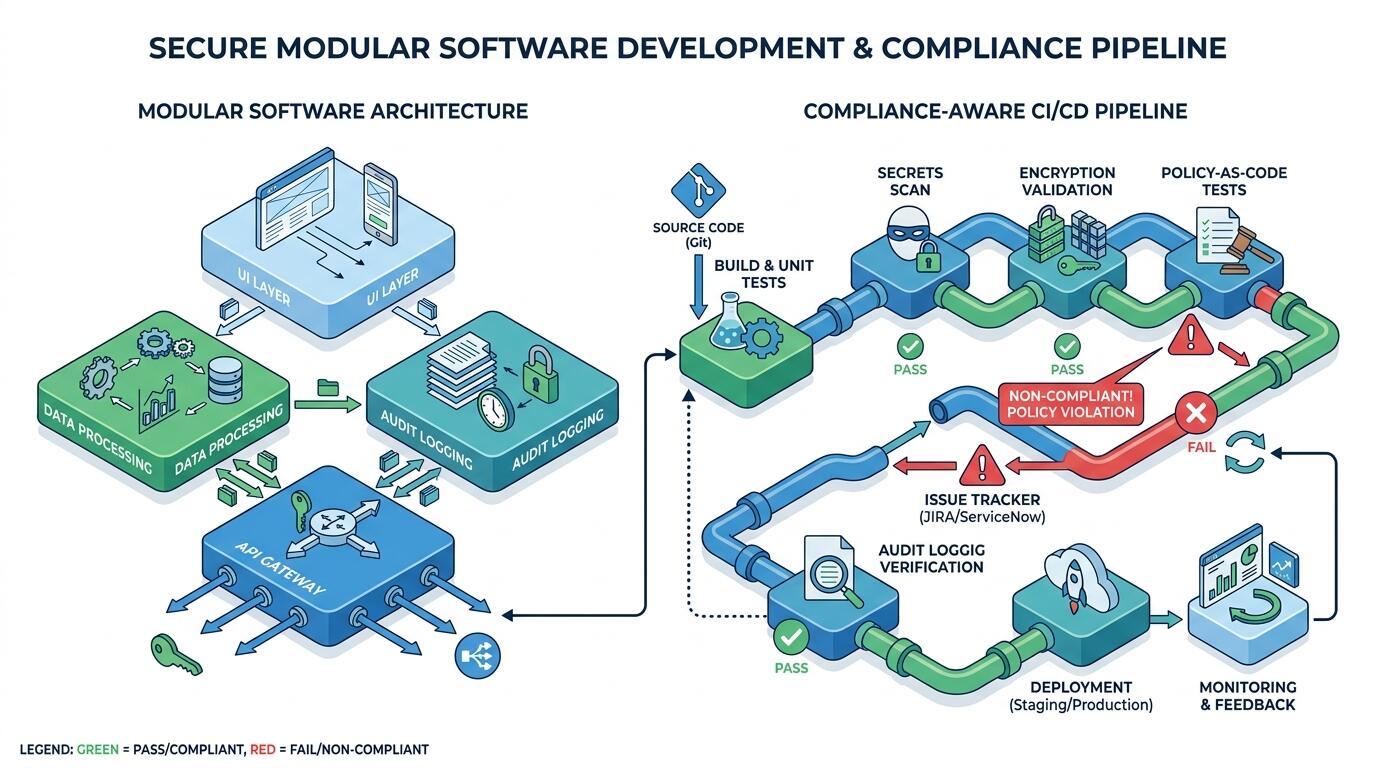
ALT: Diagram showing modular architecture and compliance pipeline strategies for meeting regulatory requirements in product design while maintaining delivery speed
Quick Comparison at a Glance
| Strategy | Best For | Key Strength | Limitation |
|---|---|---|---|
| Compliance as Design Constraint | New builds with known regulatory scope | Prevents expensive late-stage rework | Requires regulatory expertise at design time |
| Compliance-Aware CI/CD Pipeline | Teams with mature DevOps practices | Continuous, automated compliance signaling | Cannot catch ambiguous regulatory interpretations |
| Real-Time Decision Documentation | Any regulated product environment | Produces audit-ready records naturally | Requires sustained team discipline to maintain |
| Risk-Tiered Feature Compliance | Large, mixed-risk feature portfolios | Focuses effort where it matters most | Misclassification risk if regulatory literacy is low |
| Early Regulator Engagement | Products requiring formal approval | Eliminates late-stage interpretation surprises | Requires planning headroom early in the timeline |
| Modular Architecture for Isolation | Multi-component platforms | Enables component-level compliance scoping | Adds operational complexity to the overall system |
| Compliance Literacy Across the Team | Fast-scaling engineering organizations | Reduces distributed compliance errors | Requires ongoing maintenance as regulations evolve |
How to Choose the Right Approach for Your Situation
The right starting point depends on where you are in your product lifecycle and what kind of regulatory pressure you are facing.
If you are early in a new build, the highest-leverage move is treating compliance as a design constraint from the first architecture session. Combine this with early regulator engagement if your product is in a domain — medical devices, financial services, high-risk AI — that requires formal approval. Getting the architecture right before you have written significant code is almost always faster than getting it wrong and fixing it later. For practical guidance on what that kind of engagement looks like from the start, understanding what to expect from an AI architecture engagement is a useful frame.
If you are mid-build with an existing codebase, the compliance-aware CI/CD pipeline and real-time decision documentation give you the most immediate lift. They do not require rearchitecting anything — they layer compliance signals and record-keeping on top of processes you likely already have.
If you are scaling a team quickly, compliance literacy and risk-tiered approaches are where the leverage is. As the team grows, compliance decisions get more distributed, and the risk of individual contributors making uninformed choices increases. Tiering your compliance process ensures that growth in team size and feature volume does not translate linearly into compliance risk.
A common misconception worth addressing directly: many teams believe that moving fast on compliance means taking shortcuts. In practice, the teams that move fastest on compliance are the ones that have made compliance decisions cheap and routine — through automation, good architecture, and shared team understanding — rather than the ones that defer those decisions. The shortcut is not skipping compliance work; it is doing the compliance work in the right place at the right time.
Questions & Answers
Q1: How can engineering teams automate regulatory compliance checks without creating bottlenecks in the release process?
Automation works best when compliance checks are expressed as code artifacts — using tools like Open Policy Agent or similar policy-as-code frameworks — and integrated directly into the CI/CD pipeline as automated test steps. This means compliance violations surface at the same time as failing unit tests, before a release ever reaches a human review stage. The key is starting with the highest-frequency, most clearly defined checks and expanding coverage iteratively. Automated checks reduce the manual review burden on each release without eliminating expert judgment for ambiguous cases.
Q2: Are modular architectures actually more compliant than monolithic ones, or is it just a design preference?
Modular architectures are not inherently more compliant, but they are structurally better suited to applying compliance controls precisely where they are needed. In a monolith, compliance controls are harder to scope to specific data flows and processing boundaries — everything is entangled. In a modular system, a compliance-sensitive service can be isolated, audited, and controlled independently. This precision makes both the engineering work and the audit conversation significantly more tractable. The trade-off is real operational complexity, which is why modular design should be a deliberate architectural choice, not a default.
Q3: How much additional time does embedding compliance from the start of a product build typically add to the development timeline?
The honest answer is that front-loading compliance work adds some overhead in the design and early build phases — primarily the time needed to map regulatory obligations to architectural decisions and set up automated compliance checks. In practice, teams that do this consistently report that the total timeline, including any regulatory review, is shorter than for teams that defer compliance work. The front-loaded investment avoids the rework cycles and late-stage surprises that are the actual source of compliance-related delivery delays. The overhead is real but front-loaded; the savings are larger and come later.
Key Takeaways
- Regulatory compliance and delivery speed are compatible — the teams that achieve both treat compliance as a design input, not a post-build review.
- Automation through compliance-aware CI/CD pipelines and policy-as-code is the most scalable way to maintain compliance coverage as teams and codebases grow.
- Modular architecture allows compliance controls to be applied precisely to the components that need them, without imposing the same overhead on the entire system.
- Real-time decision documentation — through practices like Architecture Decision Records — produces audit-ready evidence naturally, without the pain of retrospective reconstruction.
- Compliance literacy distributed across the engineering team reduces the frequency of compliance errors at their source, rather than catching them late through review.
The single most actionable next step for most teams reading this: map your current product's regulatory obligations to your existing architecture in a single session. Identify where the obligations and the design are misaligned, and you will have a prioritized list of the highest-leverage compliance investments you can make right now.
Explore the portfolio and thinking behind shipped, production-grade builds at Darius — and reach out if you are navigating a complex compliance-sensitive product build and need an engineering partner who has done this before.
References
- Waracle. "The Value for Money delay is an opportunity to establish agility through product-led teams."
https://waracle.com/insights/financial-services/the-value-for-money-delay-is-an-opportunity-to-establish-agility-through-product-led-teams/ - Team Extension. "Solving Cross-border Regulatory Compliance Without Slowing Delivery."
https://teamextension.blog/2026/02/09/solving-cross%E2%80%91border-regulatory-compliance-without-slowing-delivery/ - PTC. "MedTech Regulatory Compliance Technology Handbook."
https://www.ptc.com/en/resources/medtech/ebook/medtech-compliance-technology-handbook-ceros
Note: Standards and regulatory guidance may be updated; please check the latest official documents or consult professional advisors before making compliance decisions.