How to Manage a Distributed Engineering Team Without Losing Velocity This Fall

ALT: Engineering director managing distributed team velocity during fall planning and remote collaboration
What You'll Actually Achieve by Managing Your Distributed Team for Sustained Velocity
How do you keep a distributed engineering team moving at full speed when fall brings shifting timelines, holiday disruptions, and the natural slowdown that creeps into remote teams? The answer lies in proactive structural choices — not reactive firefighting — made before the quarter gets away from you.
This guide is for tech founders, CTOs, and senior engineering leaders who are running distributed teams and watching velocity dip in ways that feel hard to pinpoint. If your standups have become status theater, your sprint reviews are producing polite silence, and your engineers are shipping less while appearing busier than ever, this framework is built for you. By the end, you'll have a repeatable operating system for distributed team management that protects throughput across the fall quarter and beyond.
Before You Start: Prerequisites and Preparation for Distributed Team Management
Managing a distributed engineering team without losing velocity is not primarily a tooling problem. It is a systems design problem applied to human coordination — and like any systems design challenge, the quality of your output depends heavily on the quality of your inputs and preconditions.
Before implementing the steps in this guide, you need an honest assessment of where your team stands. That means understanding your current deployment of async-first communication norms, your sprint cadence health, and whether your engineers have documented clarity on priorities. Without this baseline, you will be layering process onto dysfunction rather than optimizing a functional system.
What you need before starting:
- A written team topology: who owns what, who reports to whom, and which time zones are represented across your distributed workforce
- A functioning incident and code review process, even if imperfect — you cannot optimize velocity without first having a baseline delivery pipeline
- Access to your team's historical velocity data, even qualitatively (are sprints consistently over-planned? Under-delivered? Are blockers surfacing late?)
- A shared task management or project tracking system that your team actually uses day-to-day, not just for reporting upward
- Documented priorities from product or stakeholders — if your engineers don't know what "done" looks like for the quarter, no amount of process will help
- At least one synchronous touchpoint per week per team cluster, even across time zones
The time investment to work through this guide — setting up the cadences, drafting the norms, running the first calibrated sprint — is meaningful but not excessive. Teams that approach this with partial attention typically see partial results. Commit to the first two sprints as a calibration period, and the system compounds from there.
One pattern that consistently emerges in distributed team engagements: leaders underestimate how much alignment debt they've accumulated. Engineers who have been heads-down building often have subtly different mental models of the project's goals, the team's constraints, and what "high quality" means in this specific context. Surface that debt early, or it will surface itself at the worst possible moment — usually mid-sprint during a high-stakes delivery window.
Step-by-Step: How to Maintain Engineering Velocity Across a Distributed Team This Fall
Step 1: Audit Your Current Velocity Baseline and Name the Real Blockers
Velocity management begins with measurement, but not the kind that produces vanity metrics. The goal is to understand where time and energy are actually going — not where the Gantt chart says they should be going.
Run a structured retrospective focused not on what shipped and what didn't, but on the mechanisms of delay. Ask your team to identify the last three times something took significantly longer than expected, then trace each delay to its root cause. In most distributed teams, you will find a small set of recurring patterns: unclear requirements reaching engineers late, review bottlenecks caused by time zone gaps, context-switching driven by shifting priorities, and slow feedback loops on blocking questions.
Document these patterns explicitly. A named blocker is a solvable blocker. A vague sense that "things are slow" is not actionable.
Tip: Resist the urge to immediately prescribe solutions during this audit phase. The goal is to build a shared, accurate picture of reality. Teams that feel heard during the diagnosis phase are significantly more likely to adopt the changes that follow.
Step 2: Redesign Your Async Communication Layer for Fall's Reduced Synchronous Windows
Distributed team velocity is directly proportional to the quality of your asynchronous communication infrastructure. Fall introduces scheduling complexity — holidays, varied time-off patterns, and the psychological shift toward year-end that affects energy and focus across a global team.
According to research published by the IEEE on software engineering practices in distributed environments, communication latency is one of the primary drivers of reduced throughput in geographically dispersed teams. The antidote is not more meetings — it is better written artifacts that make synchronous time a catalyst rather than a dependency.
Concretely, this means establishing a set of async communication standards that your team follows consistently: structured daily updates that replace the "what did you do today?" standup format with a "what is blocking me and what do I need from whom?" format; written design documents for any non-trivial technical decision, reviewed asynchronously before any live discussion; and clear escalation paths so engineers know exactly how to unblock themselves without waiting for a synchronous window.
Tip: Make async the default, not the fallback. When your team reaches for a meeting as the first response to ambiguity, your async infrastructure is under-built. The goal is that synchronous time is used for creative problem-solving and relationship-building — not for information transfer that could have been a well-written document.
Step 3: Restructure Sprint Cadences Around Distributed Reality
Most distributed teams run sprint cadences designed for co-located teams, then wonder why they underperform. The sprint rhythm needs to be restructured to account for the actual constraints of distributed work: delayed feedback, asynchronous review cycles, and the cognitive overhead of context-switching across time zones.
The most effective adjustment is to front-load clarity and back-load delivery. This means that sprint planning is not a one-hour meeting where tickets get assigned — it is a two-part process where requirements are written up and reviewed asynchronously before any synchronous planning session occurs. Engineers arrive at planning having already read the scope, raised questions in writing, and formed preliminary views on complexity. The synchronous session then becomes a refinement and commitment exercise rather than a discovery session.
Similarly, sprint reviews should be structured so that demos can be recorded asynchronously for stakeholders in different time zones, with written summaries that capture decisions and next steps. This is not about reducing rigor — it is about removing the single-point-of-failure that occurs when a key decision can only happen if the right people are all on a call at the same time.
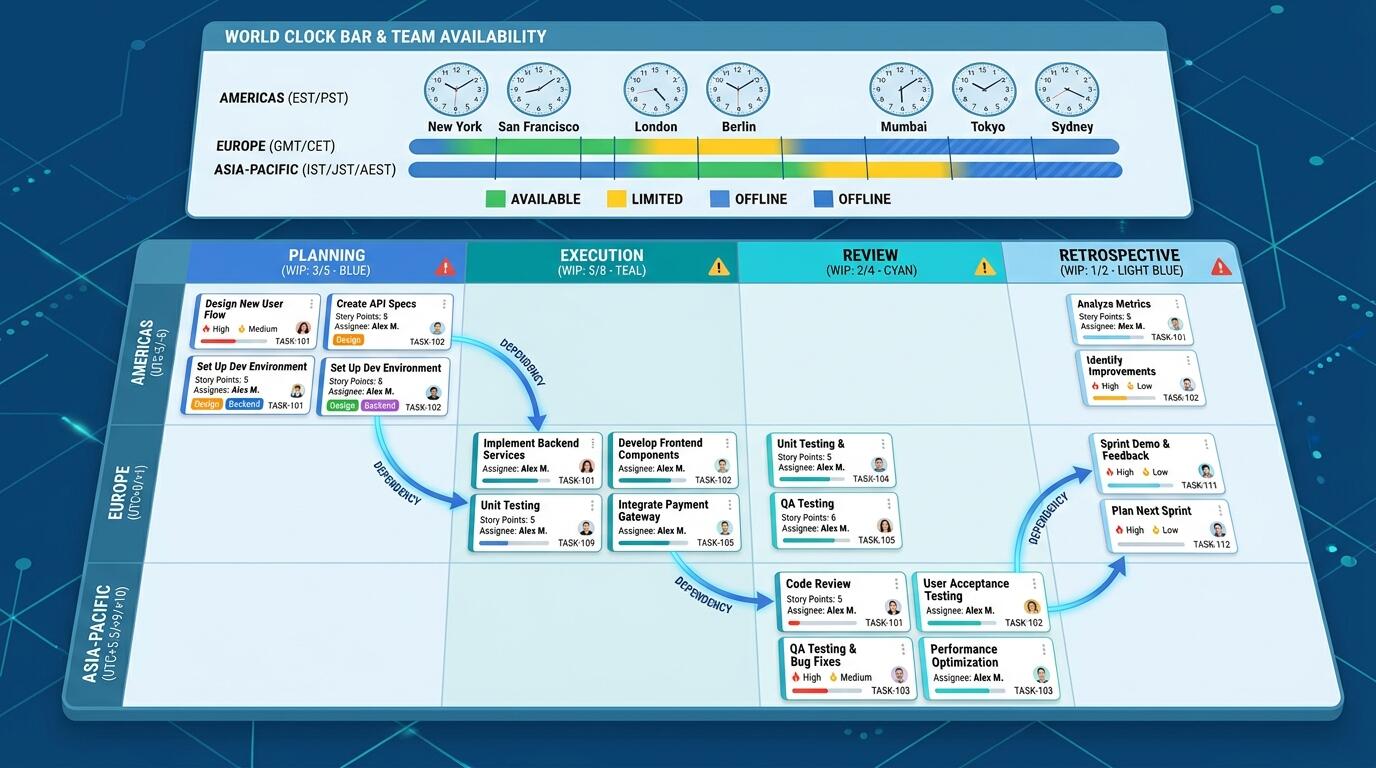
ALT: Remote engineering team sprint planning board showing distributed sprint cadence structure for managing velocity across time zones
Tip: If your sprint retrospectives consistently surface the same themes — unclear requirements, late dependencies, last-minute scope changes — the problem is almost certainly in your sprint entry criteria, not in your team's execution. Fix the input to fix the output.
Step 4: Establish Clear Ownership Models to Eliminate Coordination Debt
Coordination debt is the distributed team equivalent of technical debt: it accumulates quietly, then creates sudden, expensive delays. The primary driver of coordination debt is ambiguous ownership — situations where it is unclear who has decision-making authority, who is responsible for a given component, and who the single point of escalation is for a given problem.
According to organizational design principles articulated by researchers at MIT Sloan School of Management, team performance in complex, distributed environments is strongly correlated with clarity of role boundaries and decision rights. In practice, this means every significant workstream should have a named owner who has both the context and the authority to make calls without requiring upward escalation for routine decisions.
In the distributed teams we work with at the engineering director level, the pattern that consistently shows up in high-performing setups is a "directly responsible individual" model — a single named engineer who owns a given module, feature, or system component end-to-end, from design through deployment and monitoring. This is distinct from the person who does all the work; it is the person who ensures the work gets done and who is accountable for its quality and delivery.
Apply this model explicitly during fall planning, when the temptation to diffuse accountability across a team is highest. Distributed accountability is no accountability.
Tip: Document ownership in a single, visible place — not in someone's head, not in a Slack thread, and not in a document that hasn't been updated since last quarter. If your team has to ask who owns something, ownership is undefined.
Step 5: Implement Structured Dependency Mapping Before Each Sprint
Dependencies are the silent killers of distributed team velocity. When an engineer in one time zone is blocked waiting for a decision, a code review, or an API endpoint from a colleague in another, the effective workday can be lost entirely — not because anyone is failing, but because the dependency was not surfaced and managed ahead of time.
Structured dependency mapping means that before each sprint begins, every ticket that has an external dependency — on another team, another engineer's output, a third-party integration, or a business decision — is explicitly flagged, and a resolution path is agreed upon before the sprint starts. This is not about eliminating dependencies, which is often impossible. It is about making them visible and scheduling their resolution so they do not become mid-sprint blockers.
In practice, this looks like a lightweight dependency review as part of sprint entry criteria: for each dependency, document what is needed, who is responsible for resolving it, and what the deadline is for that resolution to avoid impacting the sprint. If a dependency cannot be resolved by a defined date, the dependent work should be moved to a future sprint rather than allowed to create in-sprint chaos.
Tip: The most dangerous dependencies are the ones engineers assume are "probably fine." Build a culture where surfacing a dependency early is celebrated, not treated as a sign of inadequacy. The cost of a dependency discovered on day one of a sprint is a fraction of the cost of one discovered on day nine.
Step 6: Build a Fall-Specific Communication Rhythm That Accounts for Time Zone and Holiday Windows
Fall is not a neutral quarter for distributed teams. The combination of back-to-school transitions, regional holidays, and year-end planning cycles creates a period where attention is fragmented and scheduling is complex. Building a communication rhythm that explicitly accounts for these dynamics — rather than treating the fall calendar as identical to Q2 — is one of the highest-leverage interventions available to a distributed engineering leader.
Concretely, this means publishing a team-wide calendar at the start of the quarter that marks known low-availability windows for each region, sets expectations for response times during those periods, and identifies which sprint ceremonies will be adjusted or run asynchronously during peak disruption periods. It also means having an explicit "coverage plan" for critical systems during holiday periods — not as a formality, but as a genuine operational artifact that engineers have agreed to.
According to guidance from the Project Management Institute on managing remote and distributed project teams, proactive communication planning — including explicit documentation of availability constraints — is a key differentiator between distributed teams that maintain throughput and those that lose significant time to unplanned disruptions.
Tip: Do not assume your team's holiday schedules are visible to each other. In global teams, engineers from different regions often have very different assumptions about which weeks are "normal" weeks. A shared, explicit calendar removes this ambiguity and prevents the scheduling collisions that erode velocity.
Step 7: Create a Lightweight Engineering Health Dashboard for Continuous Visibility
Distributed team leaders who wait for sprint reviews to discover velocity problems are always reacting too late. A lightweight engineering health dashboard — not a surveillance tool, but a shared visibility instrument — gives the whole team a real-time, shared understanding of how the system is performing.
The dashboard does not need to be sophisticated. The essential signal is whether work is moving through the pipeline at the expected rate, and where it is getting stuck. Track work-in-progress limits, pull request cycle times, and blocker age (how long a blocker has been unresolved). These three metrics, tracked consistently, will surface nearly every velocity problem before it becomes a delivery crisis.
Per research from the DevOps Research and Assessment (DORA) program — a well-established industry research initiative on software delivery performance — teams with strong feedback loops between their delivery metrics and their improvement actions consistently outperform those without them. The health dashboard is that feedback loop made visible.
Tip: Make the dashboard a team artifact, not a manager's artifact. When engineers own the metrics that describe their own throughput, they engage with them differently. The goal is not reporting upward — it is shared awareness that enables self-correction.
Common Mistakes and Troubleshooting in Distributed Team Velocity Management
| Symptom | Likely Cause | How to Fix |
|---|---|---|
| Sprint velocity is inconsistent with no clear pattern | Over-planning relative to actual capacity, compounded by untracked time zone gaps during the sprint | Recalibrate capacity planning to account for actual available hours per engineer per region; track real capacity, not theoretical |
| Engineers appear busy but throughput is low | Excessive context-switching, unclear prioritization, or too many work-in-progress items open simultaneously | Enforce WIP limits; require engineers to complete or explicitly defer tasks before picking up new ones |
| Blockers surface late in the sprint | No structured mechanism for early blocker escalation; cultural norm where raising blockers feels like admitting failure | Introduce daily async blocker checks; celebrate early blocker surfacing explicitly in retrospectives |
| Async updates are low quality or not happening | Updates feel like overhead with no clear recipient or action; no feedback loop when updates are read and acted on | Redesign the update format to be decision-oriented; create a visible acknowledgment ritual so engineers see their updates being used |
| Key decisions get delayed waiting for synchronous windows | Decision authority is unclear or concentrated in one person in a single time zone | Document decision rights explicitly; empower team leads to make defined classes of decisions without escalation |
| Fall holiday periods create delivery gaps that weren't planned for | Calendar planning was done without visibility into regional availability | Publish a shared team calendar at quarter start with all known low-availability windows and agreed coverage plans |
Pro Tips for Better Distributed Team Results This Fall
Separate information-sharing from decision-making in your meeting design. One of the most effective structural changes a distributed engineering leader can make is to stop using meetings for information transfer and start using them exclusively for decisions that require real-time back-and-forth. This alone can reduce meeting load by a significant margin while actually improving the quality of the decisions made.
Invest in written communication as a core engineering competency. In co-located teams, weak written communication skills are masked by casual hallway conversations. In distributed teams, the written word is load-bearing infrastructure. Leaders who treat writing as optional overhead for engineers will consistently see their async communication layer underperform. Make strong written communication a valued and developed skill across the team.
Run a "failure mode" review at the start of Q4 planning, not just at the end of sprints. Before the fall quarter begins in earnest, convene a session where the team explicitly maps out the ways the quarter could go wrong — not to be pessimistic, but to surface the assumptions that are being made implicitly and test them before they become reality. This is a technique borrowed from pre-mortem analysis, and it consistently produces insights that standard planning sessions miss.
Normalize "I don't know, but I'll find out by [date]" as a complete answer. In distributed teams, the ambiguity of not knowing when you'll get an answer to a question is often more damaging to velocity than not yet having the answer. Building a culture where engineers commit to a resolution timeline — even when the answer itself isn't yet available — dramatically reduces the hidden wait time that erodes throughput.
Common misconception: Many engineering leaders believe that high velocity in a distributed team requires more tooling. The tools matter at the margin, but the primary drivers of distributed team velocity are structural: clear ownership, async-first communication norms, and proactive dependency management. Investing in a new project management platform before fixing these structural issues is like tuning an engine that has no oil.
People Also Ask
Q1: How do you measure engineering velocity for a distributed team?
Engineering velocity for a distributed team is best measured through a combination of delivery metrics — sprint completion rate, pull request cycle time, and blocker resolution time — rather than story points alone. Story points measure estimated scope, not actual throughput. Cycle time, which tracks how long a unit of work takes from start to done, is a more reliable signal of team health. The DORA research program identifies deployment frequency and lead time for changes as key indicators of high-performing software delivery teams.
Q2: Are daily standups effective for distributed engineering teams?
Daily standups are effective for distributed teams only when redesigned for async-first execution. The traditional synchronous standup format creates a false dependency on everyone being available at the same moment, which is often impractical across time zones. An async standup — a structured written update shared at the start of each engineer's workday — preserves the coordination benefit of the standup while eliminating the synchronous bottleneck. The key is structuring the update around blockers and dependencies, not status reporting.
Q3: How long does it take to see velocity improvements after restructuring a distributed team?
Velocity improvements in distributed engineering teams typically become visible within two to three sprint cycles after structural changes are implemented, assuming the changes are applied consistently. The first sprint is usually a calibration period where new norms are being learned. The second sprint begins to reflect the impact of clearer ownership and better async communication. By the third sprint, teams have usually internalized the new operating model well enough to see a meaningful, sustained improvement in throughput.
Wrapping Up
Managing a distributed engineering team without losing velocity this fall comes down to three foundational principles: make blockers visible early, make ownership unambiguous, and make async communication load-bearing rather than supplementary. These are not novel ideas — they are the disciplined application of sound systems thinking to the human coordination problem that distributed engineering presents.
The steps in this guide — from auditing your velocity baseline to building a health dashboard to restructuring your sprint cadences for fall's unique calendar pressures — are designed to compound on each other. Each one makes the next one more effective. The teams that consistently ship well across distributed environments are not the ones with the best tools or the largest headcount; they are the ones with the clearest operating systems.
If there is one action to take this week before any of the longer structural work begins, it is this: name the three biggest recurring blockers in your team, and assign a specific owner to resolving each one by the end of the current sprint. That single act of naming and owning will do more for your velocity than any new tool or process layer.
Ready to move faster and ship with more confidence? Darius brings the engineering leadership and AI architecture expertise to help you design, build, and launch complex products — from first principles to production. If your distributed team needs a structural overhaul or you're looking for a technical partner who has done this before, visit the Darius website to explore his work and get in touch.
Sources
- IEEE. "Software Engineering Body of Knowledge (SWEBOK)".
https://www.ieee.org - Project Management Institute. "A Guide to the Project Management Body of Knowledge (PMBOK Guide)".
https://www.pmi.org - MIT Sloan School of Management. Research on Organizational Design and Distributed Team Performance.
https://www.mit.edu - DORA (DevOps Research and Assessment). "State of DevOps Report and Software Delivery Performance Research".
https://www.dora.dev - ACM (Association for Computing Machinery). "Research on Distributed Software Development and Remote Engineering Team Practices".
https://www.acm.org
Note: Standards and research publications may be updated; please check the latest official documents or consult professional advisors for current guidance.