How to Go from Idea to Technical Spec in One Week

ALT: Engineering team using systems design and full-stack development expertise to convert a product idea into a technical spec in one week
From Napkin Sketch to Engineering Blueprint: Why Most Teams Get Stuck at Ideation
Key Conclusion: Most product teams lose weeks — sometimes months — stuck between a promising idea and an actionable technical plan. The teams that consistently ship fast are not necessarily smarter; they have a disciplined approach to systems design, strong engineering leadership, and a framework that bridges business intent with full-stack development reality. Going from idea to technical spec in one week is not just possible — it is a repeatable, learnable process.
The space between "we have a great idea" and "here is what we are building" is where most startups bleed time. Founders and engineering managers often underestimate how much structural thinking is required before a single line of code is written. Without a clear technical specification, development teams build in circles, requirements shift mid-sprint, and technical debt accumulates before the product even launches.
This article lays out a battle-tested, week-long process for turning raw product concepts into a crisp, developer-ready technical specification — the kind that aligns stakeholders, accelerates engineering velocity, and reduces rework at every stage of the build.
Who This Process Is Built For
✅ Applicable Scenarios:
- Startup founders who have validated a problem space and need to communicate their vision to an engineering team or technical co-founder
- Engineering managers and CTOs who need to scope a new product initiative quickly before committing engineering resources
- Senior software engineers leading a greenfield project and responsible for producing an architecture proposal or RFC (Request for Comments)
- Product-minded technical leaders who want to run tighter discovery-to-development cycles using agile methodologies
❌ Not Applicable/Cautions:
- Teams in the very early pre-ideation phase who have not yet done any customer discovery interviews or problem validation — the spec process assumes you have at least a working hypothesis about the user problem
- Organizations with heavily bureaucratic approval chains where a one-week sprint to spec is structurally impossible without executive sponsorship; in those cases, the framework still applies but the timeline should be adjusted accordingly
Why "Move Fast" Often Means Slowing Down First
The modern engineering culture glorifies speed. Ship fast, iterate, break things. But there is a critical distinction between moving fast with clarity and moving fast with chaos. Teams that skip the specification phase often pay a compounding tax: misaligned features, rework cycles, scope creep, and architectural decisions that become impossible to reverse at scale.
The problem is systemic. According to the Project Management Institute, poor requirements management is a primary factor in project failures globally — with scope creep and unclear objectives being among the most cited causes of delayed or failed software projects. In the AI product space, the stakes are even higher. AI systems require upfront thinking about data pipelines, model selection, inference infrastructure, and feedback loops — decisions that cannot easily be undone once development begins.
The good news: the same rigor that makes large engineering organizations effective can be distilled into a lean, week-long framework that any team can execute. Whether you are building a consumer app, an enterprise SaaS platform, or an AI-powered tool, the core discipline of translating ideas into structured technical thinking is a force multiplier for your entire engineering operation.
The goal of this process is not to produce a 100-page waterfall requirements document. It is to produce a living, lean specification — roughly ten to twenty pages — that answers the right questions with enough precision to allow engineering teams to begin building with confidence and adapt as they learn.
The Week-Long Framework: From Concept to Spec
Three-Step Quick Start
Step 1: Run Focused Discovery Sessions (Days 1–2)
Before touching a diagram or writing a single requirement, invest the first two days in structured discovery. This means conducting targeted customer discovery interviews — even if brief — with three to five real or potential users. The goal is not to validate your solution; it is to sharpen your understanding of the problem. Document jobs-to-be-done, friction points, and current workarounds. Simultaneously, align internally with key stakeholders on business objectives, success metrics, and non-negotiables. Time required: approximately eight to twelve focused hours across both days.
Step 2: Translate Insights into Architecture and Scope (Days 3–4)
With discovery inputs in hand, move into systems thinking mode. Map out the high-level architecture — user-facing surfaces, backend services, data models, third-party integrations, and any AI or ML components. Use a whiteboard session or a collaborative tool like Miro or FigJam to externalize the system. Define the MVP scope ruthlessly: what must be in version one, what is explicitly out, and what is a future consideration. This is where strong engineering leadership prevents scope from ballooning. Time required: one to two full working days, ideally with a senior engineer and a product stakeholder in the room.
Step 3: Write, Review, and Lock the Spec (Days 5–7)
The final phase converts your architecture decisions and scope boundaries into a written technical specification. This document should cover: product context and goals, user stories or use cases, system architecture diagrams, API contracts or data schemas, technical constraints and dependencies, open questions, and a phased delivery plan. Run at least one structured review session with both technical and non-technical stakeholders before locking it. A locked spec does not mean frozen — it means deliberate. Changes require a formal decision, not a hallway conversation.
Comparing Approaches to Technical Specification
Different teams approach the idea-to-spec process in meaningfully different ways. Understanding the trade-offs helps you choose the right method for your context.
The right approach depends on your team's maturity, the complexity of the problem, and how much is already known about the solution space. Here is a comparison of three common methods:
| Comparison Dimension | Lean Spec Sprint (This Framework) | Traditional PRD Process | Agile Story Mapping |
|---|---|---|---|
| Time to Produce | One focused week | Two to six weeks | One to three days |
| Depth of Technical Detail | High — includes architecture and system design | Medium — primarily functional requirements | Low — focused on user journeys |
| Stakeholder Alignment | Strong — built into the process | Variable — often document-driven | Moderate — visual but less technical |
| Suitable Team Size | Small to medium (three to fifteen engineers) | Medium to large enterprise teams | Cross-functional agile teams |
| AI/ML Consideration Support | Strong — forces early data and model decisions | Weak — often misses AI-specific requirements | Weak — story mapping rarely captures infra needs |
| Best Programming Language Flexibility | High — language-agnostic approach | Medium — often tied to existing standards | High |
| Output Format | Living document with diagrams | Formal PRD or BRD | User story map and backlog |
For most startup environments and growth-stage product teams, the Lean Spec Sprint offers the best balance of speed and rigor. It is particularly well-suited to AI architecture projects where early decisions about data, model selection, and inference infrastructure carry long-term consequences.
Deep Dive: What Makes a Great Technical Spec
Grounding the Spec in Real User Problems
A technical specification that is not anchored in validated user problems is architecture fiction. The discovery phase exists precisely to prevent this. When running customer discovery interviews, focus on three things: the frequency and severity of the problem, what users currently do to solve it (their workaround), and what success looks like from their perspective.
These insights directly shape your requirements. If users consistently mention that the current solution is "too slow to get results," that is a latency requirement. If they say they "cannot trust the output," that is a reliability and explainability requirement. Real discovery translates directly into technical constraints — and constraints are the raw material of good systems design.
Defining Scope with Surgical Precision
One of the most underrated skills in engineering leadership is the ability to define what you are not building. A well-scoped technical spec has an explicit "out of scope" section that is as detailed as the in-scope section. This prevents the most common form of project failure: feature creep that begins in good faith and ends in delayed launches and burned-out teams.
Use a simple framework: categorize every potential feature or capability as Must Have (launch blocker), Should Have (strong value, can follow shortly), Could Have (nice to have, backlog), or Will Not Have (explicitly excluded from this version). This is the MoSCoW prioritization method, and it works equally well whether you are building a consumer app, an enterprise integration, or an AI-powered recommendation engine.
Architecture Decisions That Survive Contact with Reality
The architecture section of your spec is where technical credibility is established. For full-stack development projects, this means mapping the complete system: frontend framework choices, backend service topology, database selection, caching strategy, authentication model, and external API dependencies.
For AI-native products, the architecture section must go further. It needs to address: what data is required and where it comes from, how the model is trained or fine-tuned, where inference happens (edge vs. cloud), how predictions are surfaced to users, and how feedback loops are instrumented for continuous improvement. The best programming languages for machine learning projects — Python being the dominant choice for model development, with Go or Node.js frequently used for serving infrastructure — should be explicitly called out in the spec along with justification.
Do not let these decisions be implicit. Implicit architecture decisions become technical debt.
Testing Product-Market Fit Through the Spec Itself
Here is a counterintuitive insight: the process of writing a rigorous technical spec is itself a form of product-market fit testing. When you are forced to articulate exactly what you are building, for whom, and why it will be used, gaps in your hypothesis become impossible to ignore.
If you cannot write a clear user story for your primary use case without significant hand-waving, that is signal — not just a documentation problem. The best product development services for startups are those that treat the spec phase as a discovery tool, not just a delivery artifact. Use the spec writing process to surface assumptions, stress-test your value proposition, and identify the riskiest parts of your plan early.
Agile Tools That Support the Spec-to-Sprint Pipeline
Once the spec is locked, the path to execution depends heavily on tooling. Recommended agile tools for product development teams include Linear and Jira for issue tracking, Notion or Confluence for living documentation, GitHub or Linear for engineering-linked spec tracking, and Figma for design-spec alignment. The key is choosing tools that make the spec a living reference — not a document that gets written once and ignored.
For AI-heavy projects, consider adding a model card or data sheet section to your spec, documenting expected model behavior, known limitations, and evaluation criteria. This is not overhead — it is the kind of upfront thinking that prevents expensive surprises at deployment.
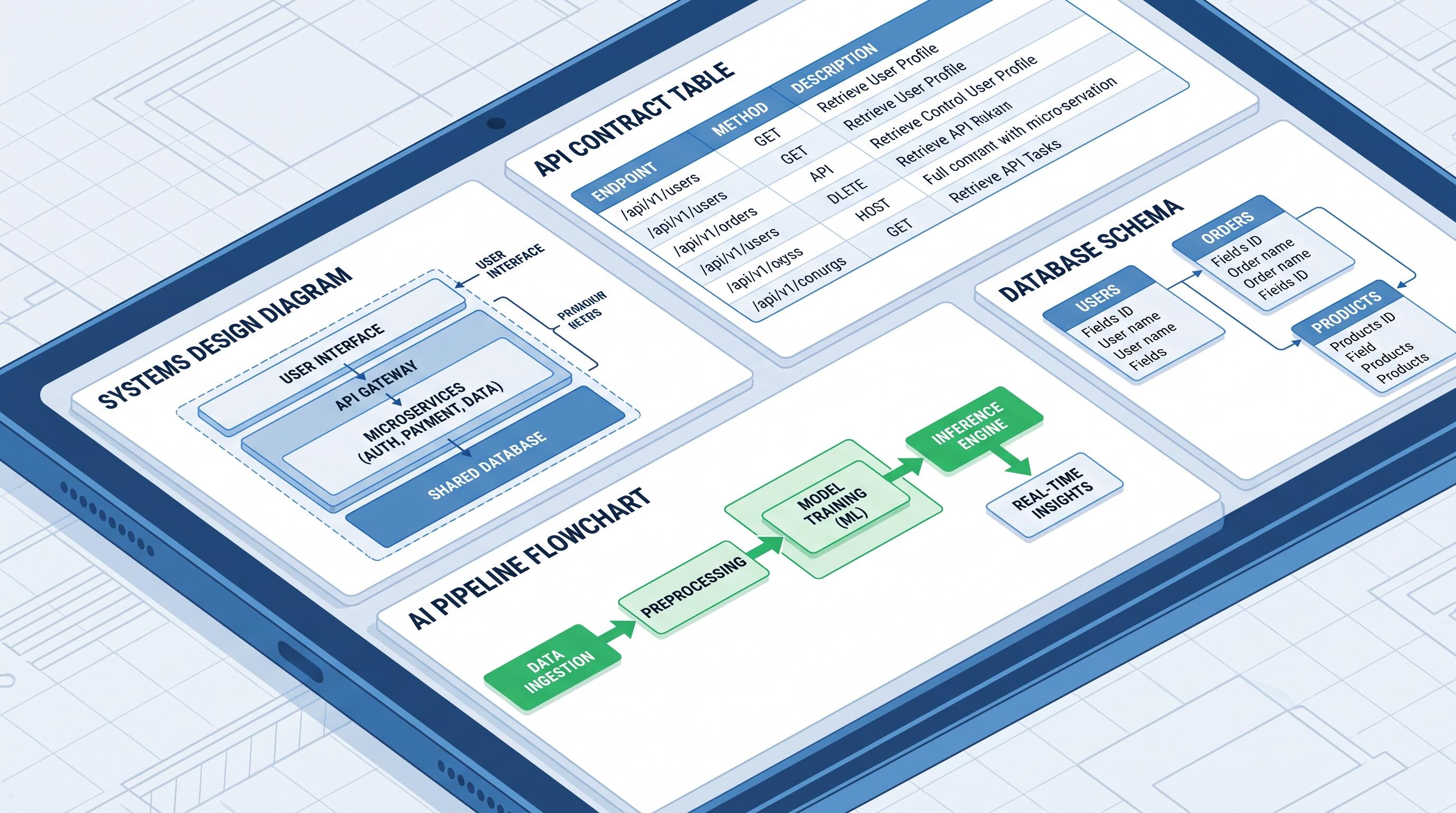
ALT: Detailed technical specification showing systems design diagrams, API contracts, and full-stack development architecture for a new AI product
Advanced Considerations: When the One-Week Timeline Is Not Enough
Handling Ambiguity in Novel Problem Spaces
Not every idea arrives with clean user data and clear scope. For genuinely novel product concepts — especially in emerging AI categories — the discovery phase may surface more questions than answers. In these situations, consider running a two-day "assumption mapping" session before the formal spec sprint. Document every assumption your product concept depends on, rank them by risk and unknowability, and design the smallest possible test to validate each high-risk assumption.
The Misconception That Specs Slow Agile Teams Down
A persistent misconception in engineering culture is that writing detailed specifications is a waterfall practice incompatible with agile development. This is a false dichotomy. A lean technical spec does not prescribe implementation — it defines intent, constraints, and architecture. Agile teams need this clarity to self-organize effectively. Without it, sprints become firefighting exercises rather than focused delivery cycles.
When to Bring in External Technical Leadership
Some founding teams lack the internal engineering leadership to facilitate the spec process effectively. In these cases, bringing in a fractional Engineering Director or AI Architect — even for a single week — can dramatically accelerate the process and improve the quality of the output. External technical leaders bring pattern recognition from multiple product builds, which is particularly valuable for identifying architectural risks early.
Frequently Asked Questions FAQ
Q1: How should I structure customer discovery interviews before writing a technical spec?
Keep discovery interviews focused on problems, not solutions. Use open-ended questions: "Walk me through the last time you experienced this problem," or "What do you currently do when this happens?" Aim for three to five interviews of thirty to forty-five minutes each. Record with permission, take structured notes, and look for patterns across respondents. The outputs should feed directly into your user stories and acceptance criteria in the technical spec — not remain siloed in a research document.
Q2: Is a one-week spec sprint realistic for complex AI products?
Yes, with the right scoping. A one-week sprint produces a first-version spec, not a final one. For AI products, this means locking the system architecture, data requirements, and MVP feature set — while explicitly flagging open questions around model selection, training data availability, and evaluation metrics. The spec is a living document. What matters is having enough clarity to begin with confidence, not achieving theoretical completeness before a single line of code is written.
Q3: How long does it take to go from technical spec to a shipped product?
Timeline varies significantly based on team size, product complexity, and technical stack. A lean MVP built by a team of two to four engineers typically takes four to twelve weeks from a locked spec to a working product in production. The spec itself — when well-constructed — reduces this timeline by eliminating ambiguity-driven rework, which commonly accounts for a substantial portion of engineering time in poorly scoped projects. A strong spec is the single highest-leverage investment you can make before development begins.
Summary
Going from idea to technical spec in one week is not a sprint — it is a discipline. Three principles make it work consistently.
First, discovery must precede design. No amount of architectural brilliance compensates for building the wrong thing. Structured customer discovery interviews and internal stakeholder alignment are non-negotiable inputs to a credible spec.
Second, scope is strategy. The decisions you make about what not to build in version one are as important as what you include. Engineering leadership means having the conviction to say no early, so teams can say yes with full commitment during development.
Third, the spec is a communication artifact, not a compliance document. Its job is to align engineers, designers, product managers, and business stakeholders around a shared understanding of what is being built, why it matters, and how it will work. When it does that job well, development velocity increases, rework decreases, and teams ship with confidence.
The one-week framework is not magic — it is structured thinking applied under time pressure. That pressure is a feature, not a bug. It forces prioritization, surfaces hidden assumptions, and produces output that a team can actually build against.
If your next product initiative is stalling in the space between idea and execution, the answer is almost never "we need more time to think." It is "we need a better process to think with."
If you're looking to turn your next big idea into a live, production-ready product, Darius brings the end-to-end expertise in AI architecture, systems design, and full-stack development to make it happen. Explore real shipped projects, technical insights, and engineering strategies at https://www.darius.wiki. Whether you're a founder, engineer, or tech leader, Darius is ready to help you build smarter and ship faster.
References
- Project Management Institute. "Pulse of the Profession: The High Cost of Low Performance".
https://www.pmi.org/learning/library/pulse-profession-high-cost-low-performance-9920 - Stanford d.school. "Design Thinking Bootleg — Discovery and Framing Methods".
https://dschool.stanford.edu/resources/design-thinking-bootleg - IDEO.org. "The Field Guide to Human-Centered Design".
https://www.designkit.org/resources/1 - Martin Fowler. "Patterns of Enterprise Application Architecture — Documentation and System Design".
https://martinfowler.com/architecture/ - Google Engineering Practices. "Engineering Documentation and Technical Writing Standards".
https://google.github.io/eng-practices/
Note: Standards may be updated, please check the latest official documents or consult professional advisors.
About the Author
Darius is an Engineering Director and AI Architect specializing in transforming ideas into live, running products — with proven experience across AI architecture, systems design, and full-stack development, backed by 3 shipped live projects. Learn more at darius.wiki.
© Darius. All rights reserved. The content in this article is intended for informational purposes only and reflects the author's professional opinions and experiences. Nothing herein constitutes formal engineering, legal, or business advice. Reproduction or redistribution of this content without explicit permission is prohibited.