Hidden Costs of AI API Dependence: What Founders Should Watch This Quarter

ALT: Founder reviewing hidden AI API costs and vendor dependency risks in a startup budget meeting
Why AI API Dependence Is Quietly Draining Your Startup's Budget
The hidden costs of AI API dependence are real, compounding, and largely invisible until they show up as a budget shock — or worse, a product failure you could not predict. As more founders integrate large language models and inference APIs into their core product stack, a pattern emerges in advisory work: the sticker price of an AI API is rarely the actual cost. Rate limits, latency penalties, context window constraints, and the slow erosion of strategic control accumulate quietly behind a pricing dashboard that looks deceptively simple.
This guide is written for founders, startup CTOs, and product leads who are either already running AI APIs in production or evaluating them seriously. It walks through the systemic cost vectors you need to audit this quarter — not as theoretical risk, but as a practical checklist grounded in how real products actually break under AI API pressure.
Before You Start: Prerequisites and Preparation for an AI API Cost Audit
Conducting a meaningful audit of your AI API exposure requires more than pulling an invoice. You need a clear picture of your technical architecture, your cost attribution model, and your product's dependency graph before you can reason about risk and remediation.
What you need beforehand:
- A working knowledge of where AI APIs touch your product — which features, which user flows, which backend services make calls to external inference endpoints.
- Access to your API provider's usage dashboard and, ideally, your own logging layer that captures per-request metadata (model version, token count, latency, error codes).
- A rough understanding of your unit economics: what does each user action that touches the AI layer cost you, and what does it generate in value or retention?
- Familiarity with your contractual terms with each AI API provider, including rate limit tiers, data handling clauses, and any SLA commitments (or lack thereof).
- An honest inventory of what would break, and how badly, if a given provider changed pricing, deprecated a model, or experienced an outage lasting several hours.
This is not a weekend project. Expect to invest meaningful engineering and product leadership time. The goal is not a one-time report — it is building the organizational muscle to treat AI API costs as a first-class infrastructure concern, on par with your cloud spend.
Checklist before starting:
- Usage logs with token-level granularity are available or can be enabled
- You know which API provider accounts map to which product features
- Finance has visibility into AI API line items as distinct from general cloud costs
- You have identified at least one engineer who owns API cost observability
- You have read your current provider's model deprecation and pricing change policies
Auditing and Managing Hidden AI API Costs: A Step-by-Step Approach
Step 1: Map Every AI API Touchpoint in Your Product
The first step is deceptively straightforward: build a complete map of every place in your product that makes an outbound call to an AI inference API. Most founders are surprised by how many touchpoints exist once they look systematically. Search features, content generation, classification pipelines, internal tooling, customer support automation, recommendation logic — each of these may be hitting a separate endpoint, sometimes under different API keys owned by different team members.
Conduct a codebase search for API client imports and initialization patterns. Cross-reference this with your infrastructure logs to catch any calls that live in data pipelines or scheduled jobs rather than in application code. Document each touchpoint with: the provider, the model, the approximate call volume, and the business function it serves.
Tip: Assign an owner to each touchpoint. Unowned API integrations accumulate technical debt and hidden costs faster than any other category, because no one is watching them critically.
Step 2: Decompose the True Cost Per API Call
The visible cost of an AI API call is the per-token or per-request price shown in the provider's pricing page. The true cost includes several additional layers that rarely appear on the invoice but are very real in their business impact.
Latency cost is the first hidden layer. If your API call sits in a synchronous user-facing flow and the provider's p99 latency is several seconds, you are paying for that wait in user drop-off and conversion degradation — costs that never appear in your AI budget but are entirely caused by it. According to research published by Google on web performance and user behavior, latency has a measurable and compounding effect on engagement and revenue at scale.
Retry cost is the second layer. When an API call fails or times out, your system retries — and each retry is a billable event. Without explicit circuit breakers and retry budgets, a brief provider instability event can multiply your API spend significantly within a short window.
Context inflation is the third layer. Large language model APIs charge by the token, and many product implementations grow their context windows over time as engineers add system prompts, few-shot examples, and conversation history. What started as a lean prompt becomes a bloated context that costs several times more per call without any visible feature change.
Tip: Build a cost-per-feature dashboard, not just a cost-per-month view. When you know that your AI-powered search feature costs X times more per user session than your AI-powered summarization feature, you can make architectural and pricing decisions with real data.
Step 3: Identify Vendor Lock-in Vectors and Their Strategic Cost
Vendor lock-in in AI APIs is a strategic cost of AI API dependence, not a financial one — though it converts into financial risk quickly when your provider changes its terms. Lock-in in this context means: how difficult is it to switch your product's AI layer to a different model or provider without significant re-engineering?
The primary lock-in vectors are proprietary prompt formats, model-specific behaviors your product logic depends on, fine-tuned models hosted exclusively on a single provider's platform, and API response structures that your parsing logic treats as stable contracts. Each of these is a bet that your current provider will remain the best option indefinitely — a bet that the current pace of AI model development makes genuinely risky.
A pattern that appears consistently in architecture reviews is teams that have tightly coupled their business logic to the idiosyncrasies of a specific model version. When that model is deprecated or its behavior changes in a non-backward-compatible way — which happens more frequently in AI than in traditional software — the remediation cost is substantial and unplanned.
Tip: Design your AI integration layer with an abstraction interface: a thin internal adapter that normalizes inputs and outputs, so that swapping the underlying model or provider is an implementation detail rather than a product migration.
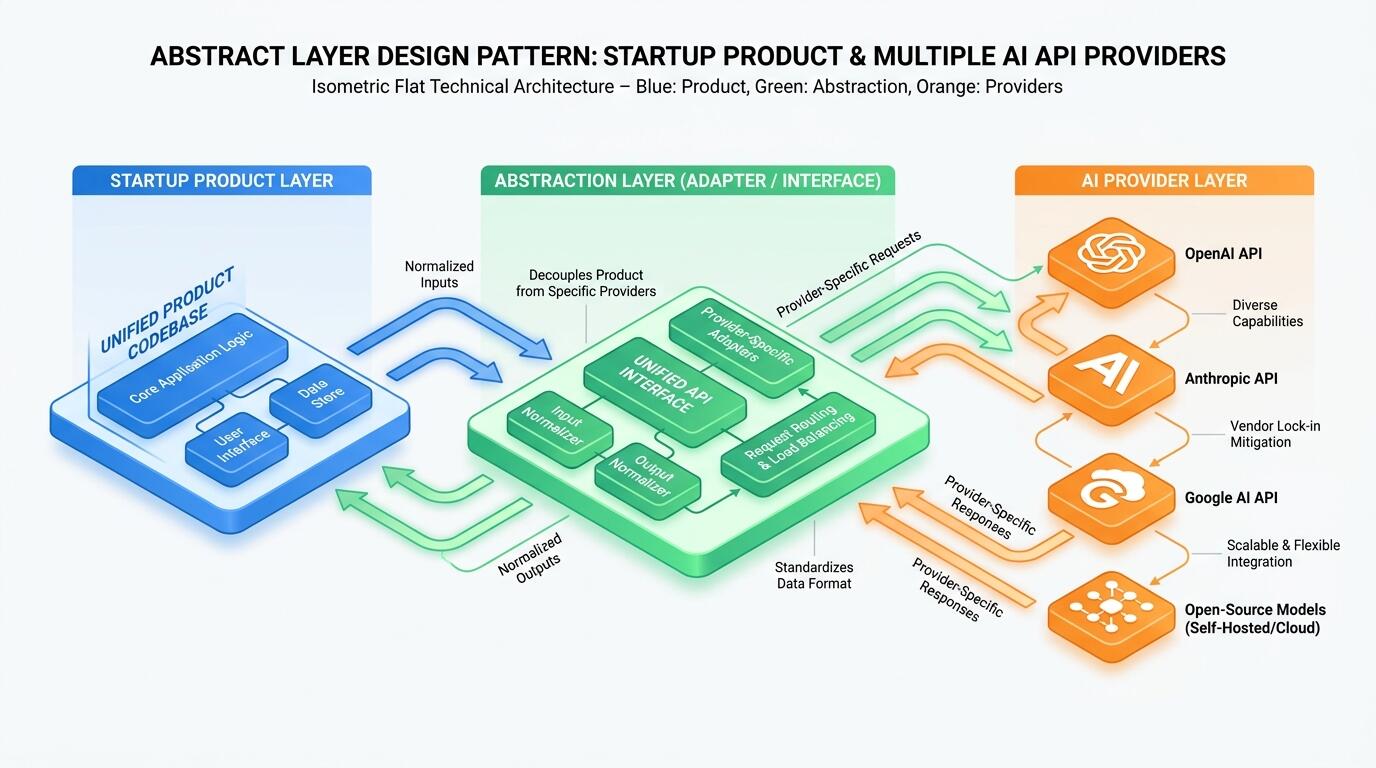
ALT: Architecture diagram showing an abstraction layer between a startup product and multiple AI API providers to reduce vendor lock-in costs
Step 4: Audit Your Data Handling and Compliance Exposure
Data handling is one of the most underappreciated hidden costs of AI API dependence for early-stage companies. When your product sends user data to a third-party AI inference API, you are creating a data flow that has legal, compliance, and reputational dimensions that go beyond the engineering conversation.
Many AI API providers offer terms that allow them to use API inputs for model training by default, with opt-out mechanisms that require explicit configuration. If your team did not configure this when the integration was first built — which is common — you may be sharing user data in ways that conflict with your privacy policy or applicable regulations. The Federal Trade Commission has issued guidance on data practices in AI contexts, and data protection authorities in various jurisdictions are increasingly scrutinizing how companies handle data sent to third-party AI processors.
The remediation cost when this is discovered — whether by a regulator, a customer, or a due diligence process during a funding round — is almost always higher than the cost of getting it right upfront. Audit your data handling configuration for every AI API provider you use this quarter, not next year.
Tip: Treat your AI API data handling configuration as part of your security posture, not just your legal review. Engineer-led audits catch misconfigured settings that legal reviews miss.
Step 5: Stress-Test Your Architecture Against Provider Failure and Pricing Changes
Operational resilience is a cost category that founders systematically undervalue until they experience a production incident. AI API providers do experience outages, and they do change pricing — sometimes with limited notice. If your product has no degraded-mode behavior when the AI layer is unavailable, then your product's availability is directly coupled to your provider's availability. That is a business continuity risk with real financial consequences.
Pricing change risk is less acute on a day-to-day basis but more strategically significant. AI API pricing has moved considerably across the industry as the competitive landscape evolves, and not always in the direction founders assume. Build your unit economics model with scenario analysis: what does your margin look like if API costs increase materially? What does it look like if they decrease, enabling you to expand usage? Both scenarios require different product and architectural responses.
Per the National Institute of Standards and Technology's framework for managing information technology risks, resilience planning should account for both availability and cost variability as threat vectors for technology-dependent services.
Tip: Implement a fallback tier in your product that delivers a reduced but functional experience when the AI layer is unavailable. This protects your users, your SLA commitments, and your business continuity in one design decision.
Step 6: Build a Cost Governance Model for Your AI Layer
Cost governance for AI APIs is the organizational practice of treating inference costs as a managed resource with ownership, budgets, and review cycles — not as a utility bill that arrives and gets paid. Without governance, AI API costs scale with usage in ways that can outpace revenue growth, particularly if your product's engagement increases faster than your monetization model anticipated.
The core elements of a practical cost governance model are: per-feature cost attribution (knowing what each product feature costs to serve, AI-inclusive), usage budgets with alerting thresholds, a review cadence that connects engineering decisions to cost outcomes, and clear escalation paths when costs spike outside expected ranges. This is not bureaucracy — it is the same discipline that mature engineering organizations apply to cloud infrastructure spend.
Founders building on top of Darius's frameworks for AI architecture and systems design will find that cost governance is a first-class design concern from the earliest stages of product architecture, not an afterthought added when the bills become uncomfortable.
Tip: Set a cost budget per user cohort, not just a total monthly budget. Total budgets mask the unit economics degradation that happens when your heaviest users consume disproportionate API resources.
Step 7: Evaluate Build vs. Buy Thresholds for Your Highest-Cost API Calls
The build-versus-buy decision for AI capabilities is more nuanced today than it was even a short time ago. Open-source model weights, self-hosted inference infrastructure, and specialized model fine-tuning have all become more accessible, lowering the barrier to running your own AI layer for specific, high-volume use cases.
The evaluation framework is straightforward: identify your highest-volume, most predictable AI API call patterns. These are the candidates for internalization, because their cost is most material and their behavior is most stable. Calculate the total cost of ownership for self-hosting — including engineering time, infrastructure, maintenance, and the opportunity cost of the engineering investment — and compare it honestly against your projected external API spend over a meaningful time horizon.
This is not an argument for defaulting to self-hosting. External AI APIs provide genuine value in model quality, operational management, and velocity. The argument is for making this decision deliberately, with real numbers, rather than defaulting to external APIs because they were the fastest path at the start.
Tip: The right answer is rarely all-external or all-internal. A hybrid architecture — external APIs for cutting-edge capabilities and variable demand, self-hosted inference for high-volume stable workloads — often delivers the best combination of cost efficiency and capability.
Common Mistakes and Troubleshooting in AI API Cost Management
| Symptom | Likely Cause | How to Fix |
|---|---|---|
| API costs growing faster than user growth | Context window inflation and prompt bloat accumulating without review | Audit prompt templates quarterly; set token budget limits per call type and enforce them in code |
| Unexpected spikes in API spend | Retry storms triggered by provider instability without circuit breakers | Implement exponential backoff with jitter and a retry budget cap; add circuit breaker patterns |
| Product breaks when AI provider has an outage | No fallback or degraded-mode behavior designed into the product | Architect a fallback tier with cached or rule-based responses for core flows |
| Compliance gap discovered during due diligence | API data handling settings not reviewed or configured at integration time | Audit all provider data handling configurations now; update privacy documentation and opt-out where needed |
| Team unaware of AI cost impact of new features | No per-feature cost attribution or cost visibility tooling | Build a cost-per-feature dashboard; require cost estimates as part of feature design reviews |
Pro Tips for Better AI API Cost Control
The most durable cost reduction in AI API dependence comes from architectural discipline, not from negotiating better rates. Rates change; architectural decisions persist.
First, invest in prompt engineering as a cost reduction strategy. Shorter, more precise prompts that reliably produce the output your product needs are cheaper than verbose prompts that hedge through length. Systematic prompt optimization — treating prompts as code, version-controlling them, and measuring their cost and quality outcomes — is one of the highest-ROI engineering activities for any product with significant AI API spend.
Second, implement semantic caching for repetitive queries. A meaningful proportion of AI API calls in most products are functionally similar or identical — the same user asking the same kind of question, or the same pipeline processing semantically equivalent inputs. Caching at the semantic similarity level, rather than exact string matching, can reduce billable API calls substantially for products with predictable usage patterns.
Third, right-size your model selection. The most capable model from a given provider is not always the right model for every task. Many classification, extraction, and structured output tasks can be performed reliably by smaller, cheaper models. A tiered model routing strategy — where simpler tasks are routed to simpler models and only genuinely complex tasks reach the most expensive models — materially reduces cost without degrading user experience.
Fourth, treat model versioning as a stability risk, not just a capability opportunity. When a provider releases a new model version, the behavior change relative to your existing prompts is an unknown. Build model version pinning and staged rollout into your AI integration layer so that model upgrades are deliberate decisions, not automatic changes that affect production behavior.
A common misconception worth addressing directly: many founders believe that AI API costs will inevitably decrease over time as the industry matures, making cost management less urgent today. While API pricing has trended downward in some segments, the usage growth that cheaper access enables often outpaces the savings. Cost governance matters at every price point.
Common Questions
Q1: How do I calculate the true total cost of an AI API integration for my product?
Calculating the true total cost of an AI API integration requires going beyond per-token pricing to include latency impact on conversion, retry overhead from failures, engineering time spent on integration and maintenance, compliance review costs, and the opportunity cost of vendor lock-in. Build a total cost of ownership model that treats AI API spend as infrastructure, not a subscription, and revisit it at least quarterly as usage patterns and provider terms evolve.
Q2: Are open-source self-hosted models always cheaper than commercial AI APIs?
Self-hosted open-source models are not always cheaper than commercial AI APIs when total cost of ownership is calculated honestly. Engineering time, infrastructure management, model maintenance, and the quality gap for cutting-edge tasks can make external APIs more cost-effective for many use cases. The right comparison is projected external API spend over a meaningful time horizon versus the full cost of building and operating self-hosted inference, including the opportunity cost of engineering resources.
Q3: How much time does a thorough AI API cost audit typically take?
The time required for a thorough AI API cost audit depends on the complexity of your product architecture, the number of API integrations, and the quality of your existing logging and cost attribution tooling. For most early-stage products, an initial audit that produces actionable findings can be completed within a focused effort spanning days to a few weeks. Building the ongoing governance infrastructure to keep costs visible and controlled is a longer investment, but one that pays for itself quickly at any meaningful scale of AI usage.
Key Takeaways
The hidden costs of AI API dependence fall into three categories that founders should treat as distinct management problems: financial costs (token spend, retry overhead, context inflation), strategic costs (vendor lock-in, model deprecation risk, negotiating leverage), and operational costs (resilience exposure, compliance gaps, governance debt).
The most important action you can take this quarter is to build visibility before optimizing. You cannot manage costs you cannot see, and most teams do not have per-feature, per-call cost attribution in place. This is the foundational investment that makes every other improvement possible.
The second most important action is to design for optionality at the architecture level. An abstraction layer between your product logic and your AI provider is not over-engineering — it is the minimum viable architecture for a product that will outlive the current AI API landscape.
The third takeaway is that cost governance is not a finance problem; it is an engineering leadership problem. The engineers making implementation decisions about prompts, context, retry logic, and model selection are the people with the most leverage over your AI API costs. Give them the visibility, the budgets, and the mandate to treat cost as a first-class design constraint.
If you want to build AI systems that are both capable and economically sustainable, connect with Darius's engineering practice — where AI architecture, systems design, and full-stack product delivery are treated as integrated disciplines, not separate concerns. Visit the Darius wiki and portfolio to explore frameworks, real-world architectural thinking, and practitioner-level breakdowns that help you build and ship with confidence.
Sources & Further Reading
- Federal Trade Commission. "Artificial Intelligence and Consumer Protection Guidance."
https://www.ftc.gov - National Institute of Standards and Technology (NIST). "AI Risk Management Framework."
https://www.nist.gov - IEEE. "Standards and Guidelines for Artificial Intelligence Systems."
https://www.ieee.org - European Union Agency for Cybersecurity (ENISA). "AI Security and Resilience Guidance."
https://www.enisa.europa.eu - The Linux Foundation. "Open Source AI and Machine Learning Infrastructure Resources."
https://www.linuxfoundation.org
Note: Standards and regulatory guidance may be updated; please check the latest official documents or consult professional advisors for current requirements.