How to Future-Proof Your AI Stack Against Model Deprecation
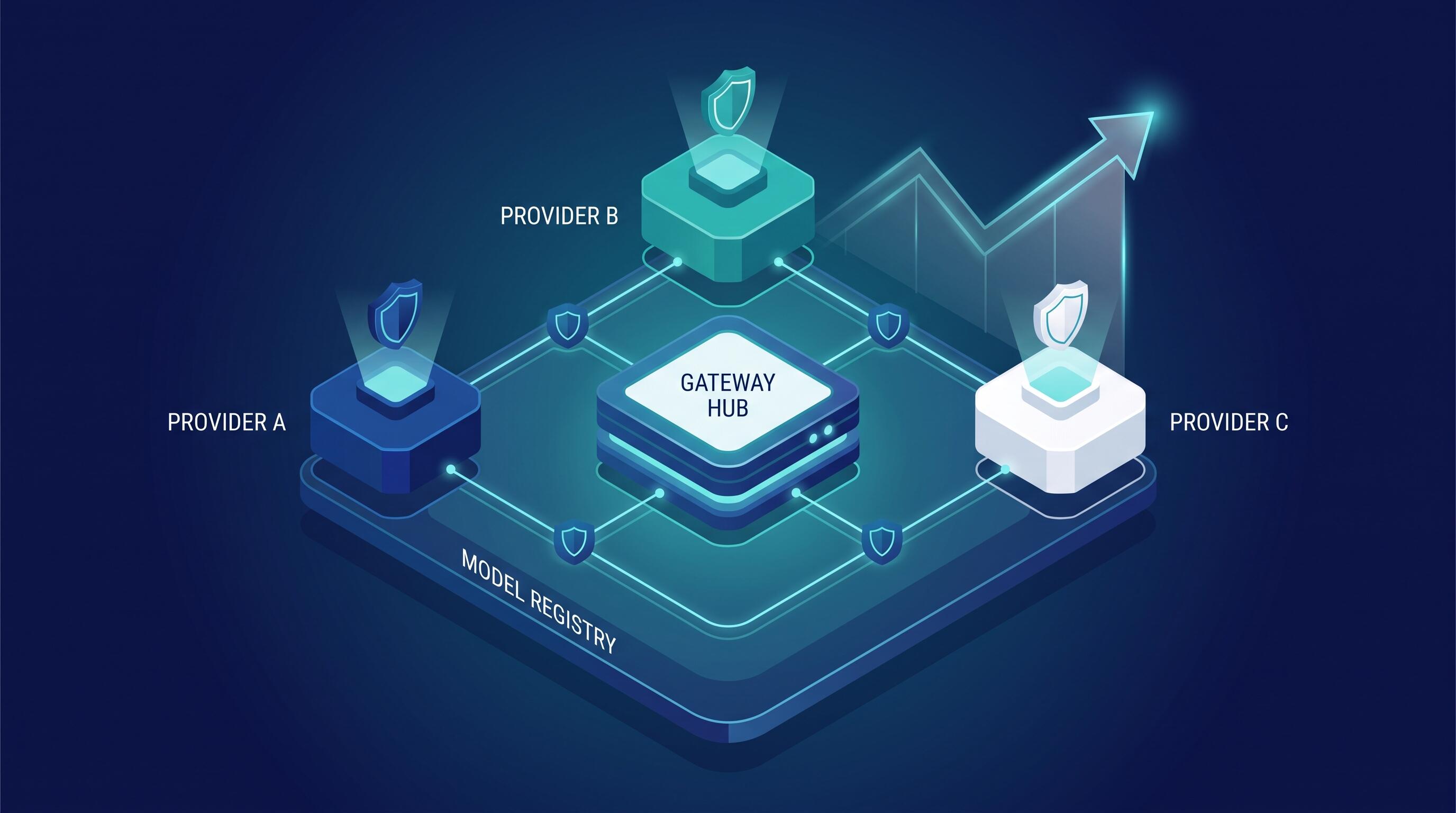
ALT: Future-proofing AI stack against model deprecation in full-stack product development and software engineering
Why Model Deprecation Is the Silent Killer of AI Product Development
Key Conclusion: Model deprecation is one of the most underestimated risks in modern AI product development and software engineering. Building a resilient, provider-agnostic AI stack is not a luxury — it is a foundational requirement for any team committed to sustainable full-stack development. The engineering decisions you make today around abstraction, observability, and fallback logic will determine whether your product survives the next wave of model lifecycle changes.
The AI ecosystem moves fast — faster than most engineering teams anticipate when they first wire a language model into their product. What feels like a stable foundation today can become a deprecated endpoint in twelve months, forcing rushed migrations, broken features, and significant rework. The challenge isn't just technical; it's strategic. Teams that design their AI stack without deprecation in mind are essentially building on borrowed time.
Three compounding factors make this problem acute right now. First, model providers are evolving their offerings rapidly, retiring older versions as newer, more capable models ship. Second, many teams couple their application logic directly to specific model APIs, making any change expensive and risky. Third, the cost of a migration under pressure — when a deprecation notice has already been issued — is dramatically higher than the cost of building for flexibility from day one.
Who This Guide Is For
✅ Applicable Scenarios:
- Startup CTOs and product leaders who are shipping or planning to ship AI-powered features and need a sustainable, production-grade architecture
- Senior engineers and engineering directors responsible for long-term maintainability of systems that depend on third-party LLM providers
- Tech founders evaluating how to structure their AI stack before committing to a specific model or vendor during early product development
❌ Not Applicable/Cautions:
- Teams building one-off scripts or purely experimental prototypes with no path to production — deprecation risk is irrelevant if the system has no longevity requirement
- Organizations already locked into a single proprietary AI platform with contractual guarantees covering model continuity — though even then, architectural flexibility remains advisable as a hedge
The Deprecation Problem in Context: Why This Matters for Software Engineering Teams
The history of software engineering is littered with examples of tight vendor coupling causing long-term pain. From database lock-in to cloud-specific API dependencies, the pattern repeats: teams optimize for speed of initial delivery, defer abstraction work, and eventually pay a compounding tax when the dependency changes beneath them.
With AI models, this risk is structurally amplified. Unlike a database engine or a cloud storage API — which tend to evolve slowly and with long deprecation windows — language model providers operate on much shorter cycles. OpenAI, Anthropic, Google, and Cohere have all retired or significantly modified model versions within months of release, sometimes with relatively short migration windows.
What makes this particularly challenging for product development teams is that model behavior itself changes between versions. A prompt that works reliably with one model version may produce subtly different outputs with its successor. This means a deprecation event is not simply a matter of updating an API endpoint — it can require re-evaluating prompts, re-testing outputs, and re-calibrating downstream logic that depends on consistent model responses.
The best practices for designing scalable AI architecture have evolved significantly as a result. Where early AI integration guides focused almost entirely on capability — what can this model do? — mature engineering teams now prioritize resilience: what happens when this model changes, degrades, or disappears?
For teams asking how to go from prototype to production deployment with an AI component, the answer increasingly requires a deprecation strategy to be in place before the first production commit. This is not overcautious thinking. It is the difference between building a system and building a product.
Building a Deprecation-Resilient AI Stack: A Practical Engineering Blueprint
The Three-Step Foundation for Model-Agnostic Architecture
Step 1: Abstract Your Model Interface Behind a Unified Gateway Layer
The single highest-leverage architectural decision you can make is to ensure that no part of your application directly references a specific model provider's SDK or endpoint. Build or adopt a unified model interface — an internal abstraction layer that your application code calls, and that translates those calls to whichever provider and model version you are currently using. This work, done once cleanly, eliminates provider coupling across your entire codebase. Expect to invest meaningful upfront design time, but the dividend pays across every future migration.
Step 2: Establish a Model Registry With Version Pinning and Routing Rules
Introduce a model registry — even a simple configuration file in early-stage systems — that maps logical model names used in your application code to actual provider model identifiers. Instead of hardcoding gpt-4-turbo in your service layer, your code requests primary-reasoning-model, and the registry resolves the current binding. This gives you the ability to swap, test, and roll back model versions without touching application logic, and to route different use cases to different models based on cost, latency, or capability requirements.
Step 3: Instrument Model Behavior, Not Just Model Availability
Standard uptime monitoring tells you whether your AI calls are returning responses. It does not tell you whether those responses remain qualitatively consistent after a model update. Instrument your AI pipeline with behavioral telemetry: track output structure compliance, confidence distribution across response categories, latency percentiles, and downstream error rates correlated with model version. This observability layer gives you an early warning system when a model update shifts behavior before it becomes a user-facing incident.
Comparing AI Stack Architecture Strategies for Production Systems
When evaluating how to structure your AI stack for long-term resilience, three primary strategies emerge. Understanding their trade-offs is essential for making the right call based on your team's size, engineering maturity, and product requirements.
| Comparison Dimension | Direct API Integration | Internal Gateway Abstraction | Managed AI Orchestration Platform |
|---|---|---|---|
| Migration Effort on Deprecation | High — changes required across entire codebase | Low — update registry/gateway only | Medium — depends on platform flexibility |
| Vendor Lock-in Risk | Very high | Low | Medium to high |
| Operational Complexity | Low initially, high at scale | Medium — requires upfront design investment | Low to medium initially |
| Behavioral Observability | Requires custom instrumentation | Fully customizable | Limited to platform's built-in tooling |
| Cost Optimization Flexibility | Low | High — route by model/cost | Medium — constrained by platform pricing |
| Recommended For | Prototypes and experiments only | Production systems at any scale | Teams prioritizing speed over long-term control |
The internal gateway abstraction approach is what experienced engineering teams consistently land on for production systems. It requires more deliberate upfront software engineering work but delivers compounding returns as the system matures and as the model landscape continues to shift.
Deep-Dive: The Five Engineering Pillars of Model Deprecation Resilience
Pillar One: Provider Diversity as a First-Class Architectural Requirement
The best approach for a startup software development team building AI-native products is to treat provider diversity not as a future option but as a present architectural constraint. This does not mean integrating five providers from day one. It means building your abstraction layer so that adding a second provider is a configuration change, not a refactoring exercise.
In practice, this looks like maintaining your primary model provider for core workloads while keeping a secondary provider integrated and tested in non-production environments. When your primary provider issues a deprecation notice, you have a validated fallback and a practiced migration path rather than an untested emergency response.
Pillar Two: Prompt Versioning and Behavioral Regression Testing
Prompts are code. They should be version-controlled, reviewed, and tested with the same rigor as any other application logic. A dedicated prompt registry — even a simple structured directory in your repository — gives you the ability to track which prompt version was active at any given time and to correlate output quality changes with prompt or model version changes.
Behavioral regression testing takes this further: define a canonical set of test inputs with expected output characteristics, and run this suite automatically whenever a model version changes. This is not about exact string matching — model outputs are non-deterministic — but about verifying structural properties, key information presence, and downstream processing compatibility. Teams that implement this catch behavioral drift early, before it affects users.
Pillar Three: Graceful Degradation and Fallback Orchestration
Production AI systems must handle model unavailability and degraded performance gracefully. This means designing explicit fallback paths at multiple levels: a fallback to a secondary model when the primary is unavailable, a fallback to a simpler rule-based response when both models are unavailable, and a fallback to a cached or default response when latency thresholds are breached.
Fallback orchestration is an area where investment in upfront systems design pays significant dividends. A well-designed fallback tree means that a model outage or deprecation transition — even an unplanned one — results in degraded but functional user experience rather than a complete feature failure.
Pillar Four: Contract-Based Integration Testing Across Model Versions
When evaluating the best cloud-based software development platforms for teams building AI systems, one underappreciated criterion is how well the platform supports contract-based testing across model versions. The principle is straightforward: define a formal contract — a set of input/output expectations — for each AI-powered feature in your product. Run these contracts against any new model version before promoting it to production.
This practice surfaces behavioral incompatibilities early and gives your team a clear, evidence-based decision point for each model upgrade or migration. It transforms what is often a high-anxiety, manual evaluation process into a repeatable, automated quality gate.
Pillar Five: Deprecation Runbooks as a Living Engineering Artifact
Every production AI system should have a deprecation runbook — a documented, regularly rehearsed procedure for executing a model migration under time pressure. This document should cover: how to update the model registry, how to trigger the behavioral regression suite, how to execute a canary deployment of the new model version, and how to roll back if metrics degrade.
Runbooks are not bureaucratic overhead. They are the difference between a team that responds to a deprecation notice with calm, practiced execution and a team that responds with a scramble. For engineering directors and technical leads, maintaining and rehearsing these runbooks is a core part of operational excellence.
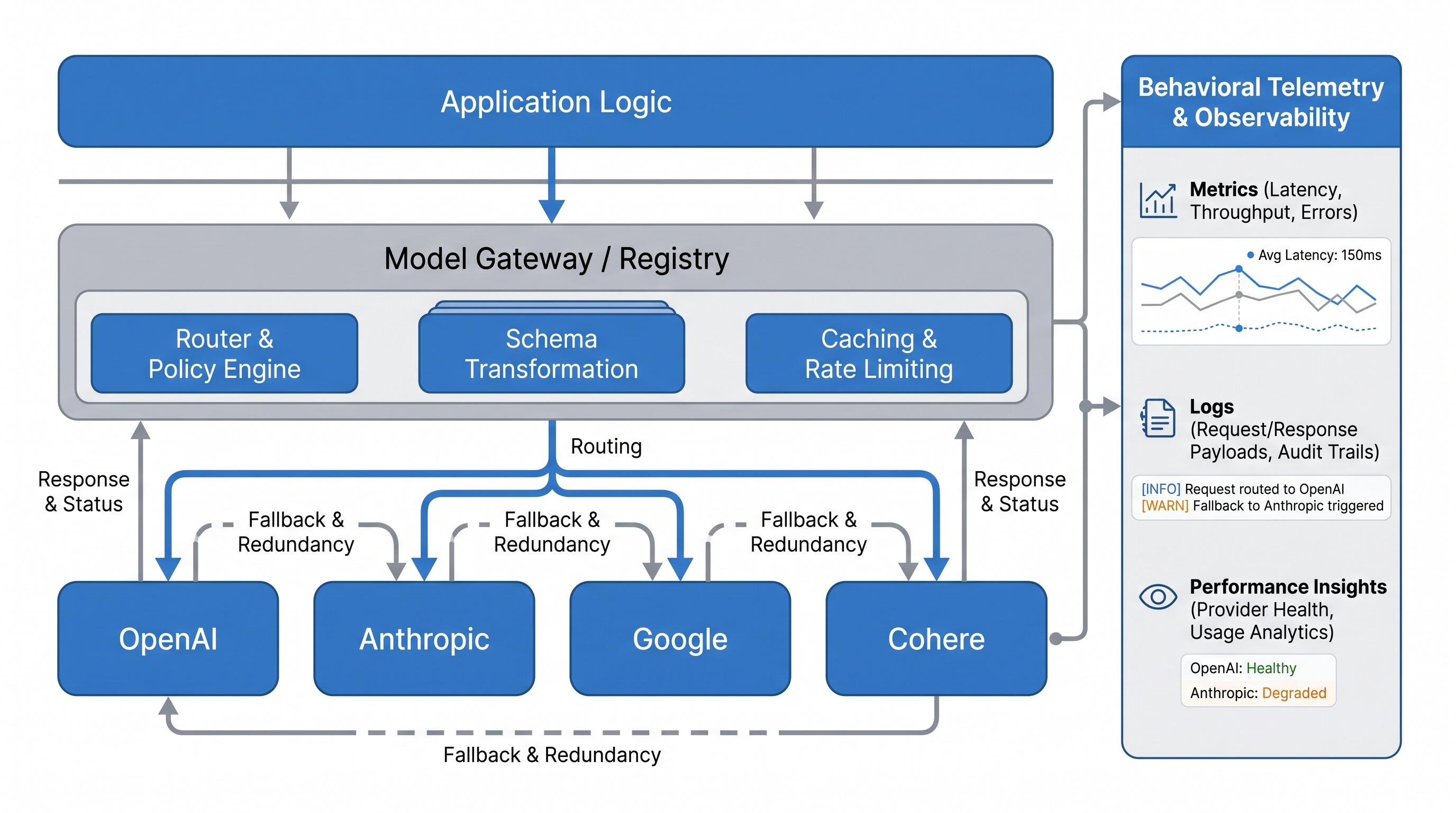
ALT: Diagram of AI stack architecture with model gateway abstraction layer supporting provider-agnostic full-stack software engineering and resilient product development
Advanced Considerations: Edge Cases and Common Misconceptions
Special Situation: Fine-Tuned Models and Custom Model Deprecation
Teams that have invested in fine-tuning proprietary models on top of a base model face an amplified deprecation risk: when the base model is deprecated, the fine-tuned version built on it typically is too. The mitigation strategy requires maintaining training data provenance and fine-tuning pipelines as production artifacts — not one-time experiments — so that re-fine-tuning on a successor base model is a defined, executable process rather than a from-scratch effort.
Special Situation: Multimodal and Embedding Model Dependencies
Deprecation risk extends beyond language models to embedding models and multimodal models. Embedding model changes are particularly insidious because they can silently invalidate vector stores that power semantic search and retrieval-augmented generation features. Any architectural plan for deprecation resilience must include embedding versioning strategy and a tested re-indexing procedure.
Common Misconception: "We'll Deal With Deprecation When It Happens"
This is the most expensive misconception in AI product development. The architectural work required to migrate a tightly coupled system under a deprecation deadline is dramatically more complex than building the abstraction layer correctly from the start. Engineering teams consistently underestimate the cascading effects of a model change on downstream logic, user experience, and prompt behavior. The time to build for resilience is before the first production deployment, not after the first deprecation notice.
Common Misconception: "A Managed Platform Eliminates Deprecation Risk"
Managed AI orchestration platforms reduce some operational burden but do not eliminate deprecation risk — they shift it. You remain exposed to the platform's own model availability decisions, and you may have less visibility into when and how underlying models change. Platform dependency is a form of lock-in that requires its own mitigation strategy.
Frequently Asked Questions FAQ
Q1: How should we structure our codebase to minimize the impact of future AI model changes?
The most effective approach is to implement a model abstraction layer that decouples your application logic from any specific provider SDK or model identifier. All AI calls in your application should reference logical model names resolved through a central configuration or registry. Combined with behavioral regression tests and a prompt versioning system, this structure means that a model migration touches configuration and test validation — not scattered application code — making the operation predictable and low-risk.
Q2: Is it worth investing in multi-provider AI architecture for an early-stage startup?
Yes — with proportionality. You do not need to actively integrate multiple providers from day one, but you must build your abstraction layer so that adding a second provider is a configuration change, not a refactoring project. The marginal cost of building provider-agnostic architecture early is low. The cost of retrofitting it under a deprecation deadline is high. For early-stage teams, the right investment is in the abstraction design, even if only one provider is active initially.
Q3: How long does it typically take to execute a model migration with a well-designed AI stack?
With a proper abstraction layer, model registry, behavioral regression suite, and documented runbook in place, a planned model migration for a production system can be executed in a matter of days rather than weeks. The bulk of that time is spent on regression validation and canary deployment monitoring, not on code changes. Without these architectural elements, the same migration can consume weeks of engineering effort and introduce significant production risk.
Summary
Building an AI stack that survives model deprecation is not a niche concern for large engineering organizations. It is a foundational requirement for any team serious about shipping durable AI-powered products.
Three principles anchor everything in this guide. First, abstraction is your primary defense: decouple your application from specific model providers and versions through a clean, maintainable interface layer. Second, observability is your early warning system: instrument behavioral telemetry, not just availability, so you detect model drift before it becomes user-facing failure. Third, runbooks and regression tests are your execution confidence: when a deprecation notice arrives, you want a practiced response, not an improvised one.
The teams that get this right treat their AI stack with the same engineering rigor they apply to their database architecture or their deployment pipeline. Models are dependencies. Dependencies change. Systems that account for this reality — through deliberate software engineering and systems design — are the ones that compound in value over time rather than accumulating hidden technical debt.
The next step is an honest audit of your current AI integration: where are you directly coupled to a specific model or provider? Where do you lack behavioral observability? Where does your team lack a documented, rehearsed migration procedure? Those gaps are your roadmap.
If you're looking to turn your next big idea into a live, working product, Darius brings the rare combination of AI architecture depth, systems thinking, and full-stack execution to make it happen. Explore real projects, technical insights, and professional background at https://www.darius.wiki. Whether you're building from scratch or scaling an existing system, Darius is the engineering partner who ships.
References
- OpenAI. "Model Deprecations and Migrations — Developer Documentation".
https://platform.openai.com/docs/deprecations - Google Cloud. "Vertex AI Model Versioning and Lifecycle Management".
https://cloud.google.com/vertex-ai/docs/general/model-versioning - NIST. "Artificial Intelligence Risk Management Framework (AI RMF 1.0)".
https://www.nist.gov/system/files/documents/2023/01/26/AI%20RMF%201.0.pdf - Anthropic. "Claude API Model Lifecycle and Version Policy".
https://docs.anthropic.com/en/api/versioning - Linux Foundation AI & Data. "Landscape of AI Infrastructure and MLOps Tooling".
https://lfaidata.foundation/
Note: Standards may be updated, please check the latest official documents or consult professional advisors.
About the Author
Darius is an Engineering Director and AI Architect specializing in transforming ideas into live, running products — with hands-on expertise spanning AI architecture, systems design, and full-stack development, backed by 3 shipped live projects. Learn more at darius.wiki.
© Darius. All rights reserved. The views and technical insights expressed in this article are based on the author's independent professional experience. This content is provided for informational purposes only and does not constitute formal consulting or legal advice.