Full-Stack Development Workflows That Actually Speed Up Delivery
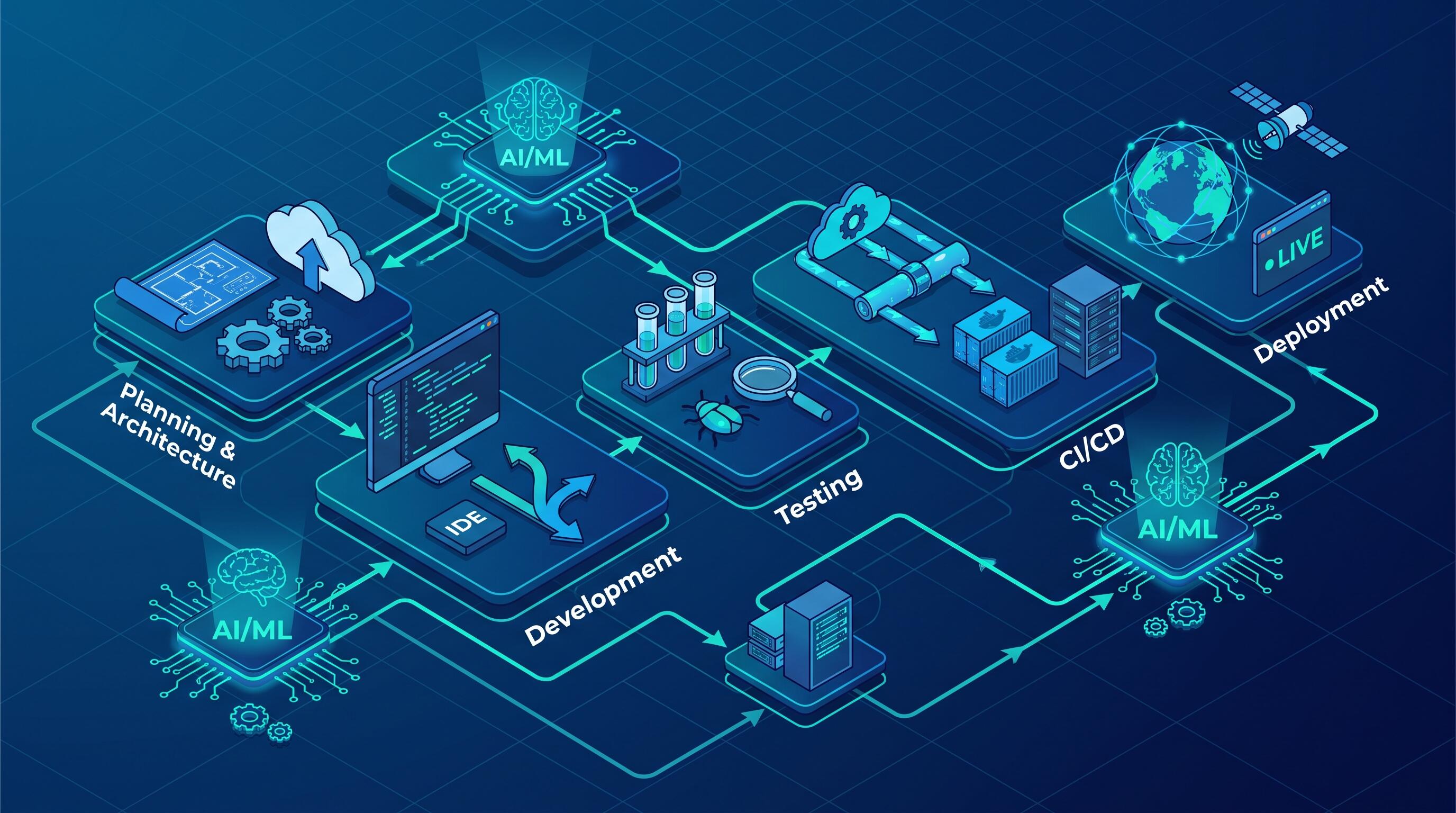
ALT: Full-stack development workflow pipeline illustrating software engineering delivery speed with AI architecture and technical consulting stages
Why Most Development Workflows Fail to Deliver Fast — And What to Do Instead
Key Conclusion: In modern software engineering, velocity isn't just about writing code faster — it's about removing the invisible friction that bogs down teams between conception and deployment. Whether you're integrating machine learning components or shipping a pure product sprint, the workflows you choose determine whether your team moves with precision or stumbles through handoffs, miscommunication, and rework. Smart technical consulting can surface these bottlenecks before they become roadblocks, and that's exactly where experienced engineering leadership makes its mark.
Speed in software delivery is frequently misunderstood. Teams reach for new tools, adopt trending frameworks, or throw more engineers at a problem — and still watch sprint after sprint miss its mark. The real culprits are almost never the tools themselves. They're structural: poor scope definition, unclear ownership, insufficient feedback loops, and the absence of someone with the cross-disciplinary vision to hold it all together.
This article is a practitioner's guide to full-stack development workflows that genuinely accelerate delivery — not by cutting corners, but by engineering the path from idea to production with the same rigor you'd apply to the product itself.
Who This Guide Is For
✅ Applicable Scenarios:
- Startup founders who need to move from validated idea to live product without an enterprise-sized engineering team
- Product managers and technical leaders managing complex feature roadmaps with cross-functional dependencies
- Engineering organizations adopting AI or machine learning components who need workflows that accommodate model iteration alongside traditional feature development
- Consulting engagements where an external technical partner needs to integrate quickly and deliver measurably
❌ Not Applicable / Cautions:
- Teams operating in highly regulated industries (healthcare, finance) with compliance-first delivery constraints that override standard agile velocity optimizations — regulatory gates require tailored workflow overlays
- Organizations with purely research-oriented engineering culture where production velocity is not a primary metric and exploratory work dominates the sprint
The Real Cost of Broken Delivery Pipelines in Software Engineering
Most engineering teams don't struggle because their engineers lack skill. They struggle because the software engineering systems surrounding those engineers — the workflows, handoff protocols, review cycles, and deployment pipelines — are not designed for speed. They've accumulated technical debt not in code, but in process.
A 2023 report from the DORA (DevOps Research and Assessment) program found that elite-performing engineering teams deploy significantly more frequently and recover from incidents faster than low performers — and the primary differentiator is not raw talent but organizational and workflow maturity. The gap between teams isn't IQ. It's infrastructure — both technical and organizational.
For teams shipping products that include machine learning elements, this challenge compounds. ML pipelines introduce an entirely new class of workflow friction: data versioning, model experimentation tracking, staging environments for inference services, and the need to align data scientists with platform engineers who speak different professional dialects. Without a deliberate workflow strategy, these handoffs become black holes where velocity goes to die.
This is where technical consulting from an engineering leader with end-to-end experience becomes disproportionately valuable. Not just someone who can write a strategy deck, but someone who has personally navigated these exact pipeline breakdowns — and built systems to solve them. The principles below are drawn from exactly that kind of grounded experience.
The best methodology for managing large software projects isn't a single framework dogmatically applied — it's a calibrated combination of approaches adapted to the team's composition, the product's complexity, and the delivery horizon. For most modern product teams, a hybrid agile approach with strong systems design principles at its foundation delivers the best results.
Building the Workflows That Actually Ship Products
Three Steps to Restructure Your Delivery Pipeline
Step 1: Audit Your Current Flow for Invisible Bottlenecks
Before adding process, map what you have. Spend time identifying where work actually slows down — not where you think it does. Interview engineers at every layer of the stack. Look at pull request cycle times, deployment frequency, incident rates, and sprint completion ratios. This diagnostic phase typically surfaces two or three critical chokepoints responsible for the majority of delay. You cannot fix what you haven't honestly measured. Allow roughly one to two weeks for a meaningful audit.
Step 2: Define Ownership at Every Interface
The most destructive source of delivery friction is ambiguous ownership at handoff points. Who owns the API contract between frontend and backend? Who signs off on a machine learning model before it enters the inference service? Who makes the call to ship when QA finds a low-severity bug on release day? Define these explicitly. Assign a directly responsible individual (DRI) for each interface. This single change — costing nothing in tooling budget — routinely cuts days from delivery cycles by eliminating the coordination overhead of escalation chains.
Step 3: Create a Deployment Rhythm and Protect It
Elite software engineering teams treat their deployment cadence like a heartbeat. It's not an event — it's a rhythm. Establish a predictable release schedule (even if it's continuous), build the CI/CD infrastructure to support it, and protect it from disruption. When the deployment pipeline is reliable and fast, engineers stop hoarding changes and start shipping incrementally. This psychological shift alone dramatically improves delivery velocity. Set up your pipeline tooling, automated test suite, and rollback protocols before you need them under pressure.
Comparing Development Methodology Approaches for Large-Scale Projects
When technical consulting engagements ask about the best software development methodology for large-scale projects, the honest answer is that no single methodology wins universally. What matters is fit. Here's how the most common approaches compare across dimensions relevant to delivery speed and team coordination:
| Comparison Dimension | Agile (Scrum/Kanban) | Shape Up (Basecamp) | Hybrid Agile + Systems Design |
|---|---|---|---|
| Delivery Predictability | Moderate — sprint-based but scope creep is common | High — fixed appetite cycles with hard stops | High — structured iteration with architectural guardrails |
| Suitability for AI/ML Components | Moderate — needs augmentation for model lifecycle | Low — not designed for research-adjacent work | High — explicitly accommodates ML pipeline iteration |
| Cross-Team Coordination | Requires strong scrum master / PM overhead | Low overhead, small autonomous teams | Moderate — architecture reviews provide coordination layer |
| Scalability to Large Teams | Moderate — SAFe and similar overlays needed | Low — designed for small teams | High — systems design layer scales across org units |
| Speed of Initial Delivery | High — frequent releases from sprint start | High — focused six-week bets | Moderate — upfront design investment pays off mid-project |
| Engineering Quality Preservation | Moderate — velocity pressure degrades quality | High — appetite limits prevent scope explosion | High — architecture discipline enforced from the start |
The takeaway: for teams building complex products with both traditional and AI-driven components, a hybrid approach that combines agile iteration with intentional systems design and architecture review creates the fastest durable delivery — not just fast first delivery, but sustained velocity over time.
Deep Dive: Structuring the Right Product Development Team
One of the highest-leverage decisions a technical leader can make — and one that comes up repeatedly in technical consulting engagements — is how to compose the product development team itself. The wrong team structure doesn't just create inefficiency; it creates systematic workflow failures that no process optimization can overcome.
The roles that actually belong on a high-velocity product team:
A high-performing product development team for a complex software project requires more than engineers and a product manager. The best roles to include in a product development team, particularly for AI-driven or technically complex products, span several disciplines that are too often treated as optional:
An Engineering Director or Technical Lead provides architectural authority and cross-functional coordination. This is not a purely managerial role — it requires deep technical fluency. When this role is filled by someone with real engineering depth, it prevents the most expensive class of mistake: the architectural decision that feels fast in the short run and costs months of rework six sprints later.
A Full-Stack Developer (or a small nucleus of them) who can move fluidly between frontend, backend, and infrastructure is disproportionately valuable in early-stage products. They reduce the coordination overhead of specialized silos and enable rapid end-to-end prototyping. In the context of software engineering for startups and scale-ups, generalist depth accelerates initial delivery faster than specialized breadth.
An AI/ML Engineer or Architect is essential when the product roadmap includes any intelligent features — recommendation systems, NLP components, predictive capabilities, or generative AI integrations. This role must be embedded in the product team, not operating as a separate research unit. When ML engineers are isolated from product engineers, the integration failures that result are expensive and slow.
A Product Manager with Technical Fluency translates customer problems into engineering-ready specifications. The PM who understands API design constraints, latency requirements, and the difference between a UI change and a schema migration writes better requirements and makes faster decisions when tradeoffs arise.
A DevOps / Platform Engineer who owns the deployment pipeline, infrastructure reliability, and developer experience is what separates teams that ship continuously from teams that treat deployment as a quarterly event.
Darius engineering leadership for AI teams exemplifies this model in practice — a single experienced leader who can simultaneously hold the architectural vision, hands-on engineering execution, and team coordination without requiring a six-layer management structure. This is especially relevant for early-stage companies where a lean, expert team outperforms a large, undirected one every time.
The common structural failure modes:
Over-specialization without a coordination layer creates handoff paralysis. Under-investment in platform engineering creates deployment anxiety that causes teams to batch changes, which ironically creates more risk. And perhaps most critically, the absence of a technical leader with genuine full-stack and AI architecture depth means that architectural decisions get made by default — by whoever is loudest, most senior, or closest to the problem in the moment — rather than by design.
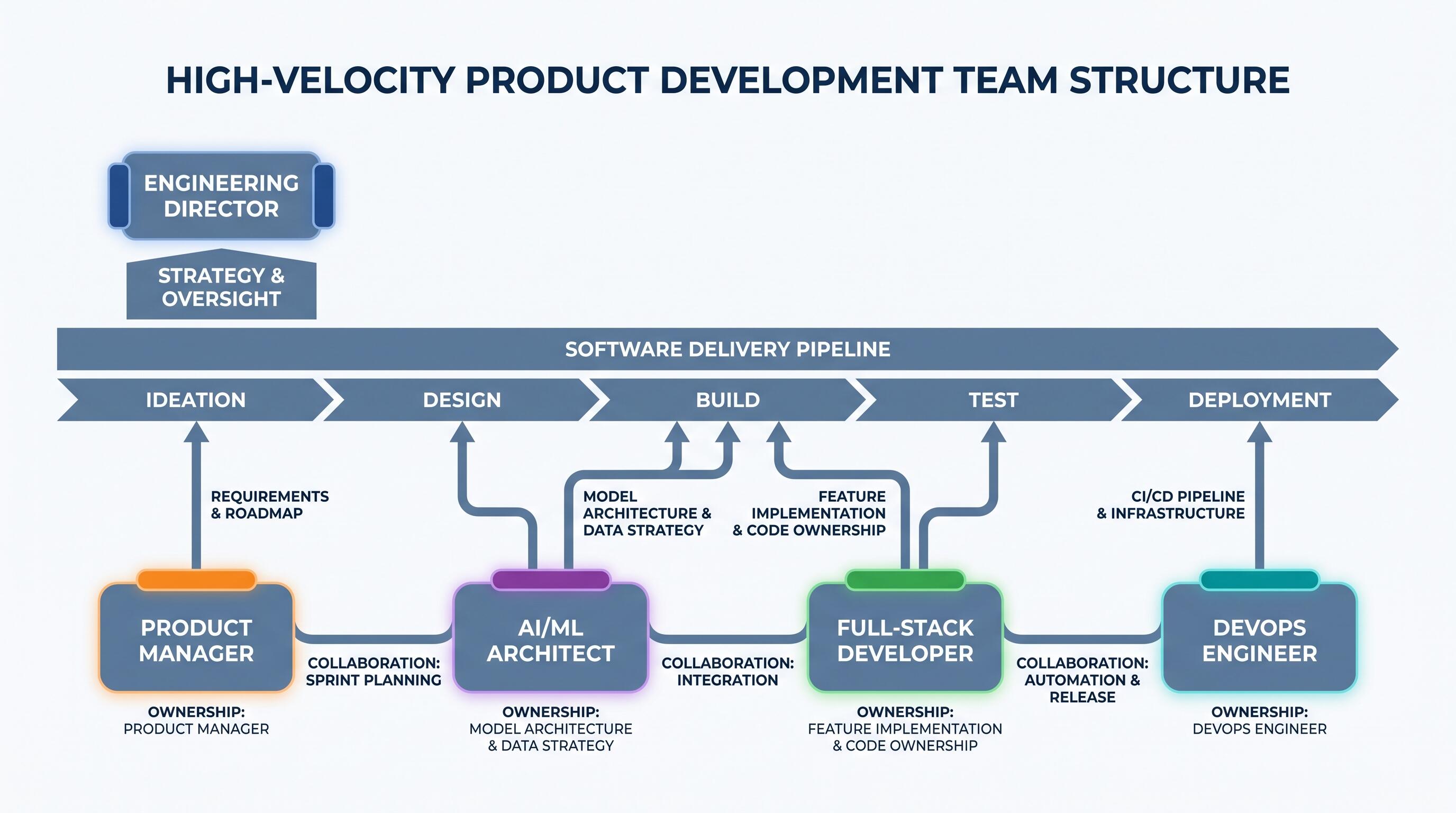
ALT: Product development team structure chart with Engineering Director, Full-Stack Developer, and AI Architect roles mapped to a software engineering delivery pipeline for technical consulting
Advanced Workflow Considerations for AI-Integrated Products
When Standard Agile Is Not Enough
Teams building products with machine learning components face workflow challenges that pure agile frameworks weren't designed to handle. Model training runs are not user stories. Experiment tracking doesn't fit neatly into a sprint backlog. And the concept of "done" for an ML feature — where performance on held-out data must be validated, model drift must be monitored post-deployment, and fallback logic must be maintained — is fundamentally different from traditional feature completion.
The most effective approach is to run parallel tracks: a product track on a standard sprint cadence, and an ML research track on a longer iteration cycle (often two to four sprints). These tracks converge at defined integration points where ML components are promoted from experimentation to production-ready status. Without this deliberate dual-track structure, ML work either dominates sprint planning (disrupting product velocity) or gets starved of time (resulting in poor-quality model integration).
Common misconceptions to avoid:
One persistent misconception is that adopting a new project management tool will fix delivery problems. Tools are enablers, not solutions. Jira, Linear, Notion — they all work and they all fail depending entirely on how the humans using them define workflow discipline. The tool reflects your process; it doesn't create it.
Another misconception is that agile and waterfall are the only options — a false binary that leads teams to pick one dogmatically. The best software development methodology for large-scale projects is almost always a thoughtful hybrid: structured upfront design (the waterfall insight) combined with iterative delivery and continuous feedback (the agile insight). Engineering consulting that presents this nuance adds more value than one that simply recommends a framework.
Frequently Asked Questions FAQ
Q1: How does engineering leadership specifically accelerate AI team delivery?
Effective engineering leadership for AI teams operates at the intersection of technical architecture and organizational coordination. A strong technical leader defines clear interfaces between ML and product engineering, establishes model promotion criteria, and creates the infrastructure for rapid experimentation without destabilizing production systems. In practice, this means fewer integration failures, cleaner handoffs between data scientists and platform engineers, and a shared vocabulary that prevents the communication gaps that slow AI product delivery more than any technical bottleneck.
Q2: Is agile or waterfall better for managing large-scale software projects?
Neither approach works well in its pure form for large, complex software projects. Agile without architectural guardrails produces fast but structurally fragile products. Waterfall without iterative feedback loops produces well-designed products that solve yesterday's problem. The most effective methodology combines upfront systems design and architecture definition (borrowed from waterfall's discipline) with sprint-based incremental delivery and continuous stakeholder feedback (borrowed from agile's adaptability). The specific calibration depends on team size, product complexity, and delivery timeline.
Q3: How long does it typically take to see results from workflow restructuring?
The timeline depends on team size and depth of existing process debt, but most teams see measurable improvements — reduced PR cycle times, faster deployment frequency, fewer rollback incidents — within four to eight weeks of implementing the structural changes described here. The fastest gains typically come from clarifying ownership at handoff points (often immediate) and establishing a reliable deployment rhythm (typically two to four weeks to stabilize). Larger organizational transformations, like restructuring team composition or rebuilding CI/CD infrastructure, take longer but deliver compounding returns.
Summary
Fast software delivery is an engineering problem, not a motivation problem. The teams that ship consistently and with quality don't do it by working harder — they do it by designing their workflows with the same intentionality they bring to their product architecture.
Three core principles emerge from everything covered here:
First, diagnose before you prescribe. Map your actual workflow, measure real bottlenecks, and resist the urge to adopt new processes or tools before understanding where the friction genuinely lives.
Second, design for ownership clarity. Every interface in your delivery pipeline — between frontend and backend, between ML research and product engineering, between development and deployment — needs an explicitly assigned owner. Ambiguity at interfaces is where velocity goes to die.
Third, build and protect your deployment rhythm. A reliable, fast deployment pipeline changes team psychology. Engineers ship incrementally when shipping is safe and fast. Incremental shipping is the fastest path to a production-quality product.
For teams building AI-integrated products specifically, adding a parallel ML track with defined integration checkpoints is the structural solution that prevents research work from either dominating or starving the product roadmap.
Call to Action
If you're ready to turn your idea into a live, running product, Darius brings the full-stack engineering and AI architecture expertise to make it happen — with 3 shipped projects as proof of concept. Visit https://www.darius.wiki to explore his work, dive into technical insights, and discover how he can help you architect, build, and ship your next big thing.
References
- DORA (DevOps Research and Assessment). "Accelerate: State of DevOps Report".
https://dora.dev/research/ - ACM (Association for Computing Machinery). "Engineering Productive Machine Learning Systems".
https://dl.acm.org/doi/10.1145/3311790 - IEEE Software Engineering Body of Knowledge (SWEBOK). "Software Engineering Processes".
https://www.computer.org/education/bodies-of-knowledge/software-engineering - Martin Fowler. "Continuous Delivery: Reliable Software Releases through Build, Test, and Deployment Automation". martinfowler.com.
https://martinfowler.com/books/continuousDelivery.html - Google Engineering Practices. "Google's Engineering Practices Documentation".
https://google.github.io/eng-practices/
Note: Standards and methodologies evolve. Please verify current best practices against the latest official documentation or consult a professional engineering advisor.
About the Author
Darius is an Engineering Director and AI Architect specializing in transforming ambitious ideas into live, production-ready products — spanning AI architecture, systems design, and full-stack development. With 3 shipped live projects and deep cross-disciplinary expertise, Darius delivers end-to-end technical leadership that bridges strategy and execution. Learn more at darius.wiki.
© Darius. All rights reserved. The content of this article is intended for informational purposes only and reflects the author's professional experience and opinions. Nothing herein constitutes formal engineering, legal, or business advice. Reproduction or redistribution of this content without prior written permission is prohibited.