The Full-Stack Developer's Tech Stack for Building AI-Powered Apps in 2026
ALT: Full-stack developer reviewing AI-powered app architecture and tech stack tools in 2026
What the Right AI Tech Stack Actually Looks Like for Full-Stack Developers in 2026
What does a production-ready tech stack for AI-powered applications actually look like in 2026 — and how is it different from what worked even two years ago? The honest answer is that the stack has collapsed in scope while expanding in capability: a skilled full-stack developer can now own the entire lifecycle of an intelligent application, from data ingestion through model orchestration to deployed UI, using a tighter set of integrated tools than ever before.
In our work helping founders and engineering leaders ship AI-powered products, a pattern we consistently see is that teams which struggle in production are not choosing the wrong AI model — they are choosing the wrong architecture around it. The model is almost always the smallest problem. The real challenge is how you wire together data pipelines, inference layers, API surfaces, frontend state, and observability into something that actually holds up under real user load.
This article maps the full landscape of a modern AI full-stack tech stack — from foundational infrastructure to frontier AI integration — with an emphasis on pragmatic, opinionated choices that reflect what is genuinely shipping in production today. It is aimed at founders, CTOs, and engineering leaders who need to make real technology decisions, not just follow a hype cycle.
Where This Stack Applies — and Where It Doesn't
Applicable Scenarios:
- You are building a net-new AI-powered product or feature and need to make foundational architecture decisions before writing significant code.
- You are a startup CTO or engineering lead evaluating whether your current stack can support LLM integration, retrieval-augmented generation (RAG), or agentic workflows.
- You are a founder or product manager who wants to speak fluently with your engineering team about technology trade-offs at the intersection of AI and full-stack development.
Not Applicable / Cautions:
- If you are maintaining a large legacy enterprise codebase, this stack is a reference for new greenfield modules — a wholesale migration would require a separate architectural strategy.
- If your primary use case is pure data science or ML research (training custom foundational models), the infrastructure priorities here differ substantially from what you need; this stack is optimized for product delivery and inference, not training at scale.
Why the Full-Stack AI Landscape Shifted So Sharply Heading Into 2026
The role of the full-stack developer has not been replaced by AI — it has been restructured around it. According to research published by NuCamp, full-stack developers in 2026 are not being displaced by AI tools; instead, their responsibilities are expanding to include AI integration, prompt engineering, and intelligent system design as core competencies. The developer who only handles frontend and backend is increasingly rare; the developer who can also reason about model behavior, context windows, embedding strategies, and agent orchestration is the one teams are competing to hire.
Several forces converged to create this shift. Large language model APIs became reliable and affordable enough for production use. Vector databases matured from experimental curiosities into first-class infrastructure components. Frontend frameworks gained native support for streaming responses. And cloud platforms began offering managed AI services that removed much of the undifferentiated heavy lifting from teams that previously needed dedicated ML engineers just to deploy an inference endpoint.
The result is a meaningful compression of the expertise required to ship an AI-powered application — but also a meaningful expansion of the decisions a full-stack developer must now make well. Choosing the wrong vector database, using synchronous API calls where you need streaming, or neglecting observability at the model layer are all ways to ship something that demonstrates well in a demo and fails in production.
This guide is built around the architecture of systems we have seen shipped successfully: products that handle real user traffic, real data, and real edge cases. For a broader overview of AI product development strategy, the Darius website covers the end-to-end journey from architecture to production.
The Modern Full-Stack AI Tech Stack: Layers, Choices, and Trade-offs
Three-Step Quick Start for Evaluating Your Stack
Step 1: Map Your AI Integration Points
Before selecting any specific tool, identify exactly where intelligence enters your application. Is it a single LLM call on user input? A multi-step agent with tool use? A RAG pipeline over proprietary documents? Your answers determine whether you need a simple API wrapper, a full orchestration framework, or a dedicated vector database. Spend time on this scoping step — getting it wrong means rebuilding the most complex part of your system later.
Step 2: Validate Infrastructure Fit Early
Once you know your AI integration pattern, validate that your infrastructure choices support it before writing product logic. Test that your hosting environment handles streaming responses correctly, that your database can store and retrieve embeddings at the query latency your UX demands, and that your observability stack captures model inputs, outputs, and latency from day one. Infrastructure surprises discovered after launch are significantly more expensive to fix than those caught in early prototyping.
Step 3: Build a Thin Vertical Slice First
Ship one complete end-to-end path through the full stack — user input to AI processing to rendered response — before building out breadth. This forces every layer of the stack to be real and integrated, surfacing integration problems that component-level testing misses. In practice, this approach consistently reveals which architectural decisions matter most for your specific use case, and gives the team a deployable artifact to reason about from the earliest stages.
AI Tech Stack Layer Comparison: Core Architectural Options
Selecting the right tool at each layer of an AI-powered full-stack application involves real trade-offs between flexibility, operational complexity, and ecosystem maturity. The table below reflects the practical decision space that teams face in 2026.
| Stack Layer | Option A | Option B | Option C |
|---|---|---|---|
| LLM API Provider | OpenAI (GPT-series) | Anthropic (Claude-series) | Open-source via hosted inference (e.g. Mistral, Llama variants) |
| Orchestration Framework | LangChain / LangGraph | LlamaIndex | Custom orchestration (direct SDK calls) |
| Vector Database | Pinecone | Weaviate | pgvector (PostgreSQL extension) |
| Backend Runtime | Node.js / TypeScript | Python (FastAPI / Django) | Edge runtime (Cloudflare Workers, Vercel Edge) |
| Frontend Framework | Next.js (React) | SvelteKit | Remix |
| Auth & Identity | Clerk | Auth0 / Okta | Supabase Auth |
| Managed Database | Supabase (PostgreSQL) | PlanetScale (MySQL) | Neon (serverless Postgres) |
| Deployment & Infra | Vercel / Railway | AWS (ECS, Lambda) | Fly.io |
| Observability | LangSmith / LangFuse | Helicone | Custom OpenTelemetry pipeline |
The right combination depends on team size, existing expertise, and the specific AI integration pattern. A small founding team building a RAG-based document tool will make very different choices than a growth-stage company scaling an agentic workflow product.
Deep Dive: Each Layer of the 2026 AI Full-Stack
The LLM API Layer
Choosing an LLM provider is the decision that attracts the most attention and often warrants the least obsession. OpenAI's GPT-series, Anthropic's Claude-series, and a growing ecosystem of open-source models available through managed inference providers each cover the majority of production use cases competently. The more consequential question is how you abstract the provider behind your own interface layer, so that swapping models — which you will almost certainly need to do as the market evolves — does not require rewriting product logic. In our experience with AI product development, teams that hard-code provider-specific SDK calls throughout their codebase consistently regret it within two major model generations.
Orchestration and the RAG Pattern
Retrieval-augmented generation — the pattern of augmenting an LLM prompt with relevant retrieved context — is now the dominant architecture for knowledge-intensive AI applications. LangChain and LlamaIndex are the two most widely used orchestration frameworks for implementing RAG and agentic patterns. LangChain's broader ecosystem and LangGraph's support for stateful agent workflows make it the stronger choice for complex multi-step reasoning systems. LlamaIndex, meanwhile, excels specifically at document ingestion and retrieval pipelines, offering a simpler API surface for teams whose primary use case is search and summarization over proprietary content. According to the AI-Powered Full Stack Developer Roadmap published by MindMapAI, orchestration competency is now considered a core skill for full-stack developers building AI products, not an optional specialization.
For simpler use cases — a single-turn chat interface, a classification endpoint — direct SDK integration without an orchestration framework is often the cleaner choice. Orchestration frameworks add abstraction and capability; they also add debugging complexity. Choose them when the workflow complexity justifies it.
Vector Databases and Embedding Strategy
A vector database is a purpose-built data store that indexes high-dimensional numerical representations (embeddings) of content, enabling semantic similarity search at scale. Pinecone is the most mature managed option and the lowest-friction choice for teams that want a hosted, scalable vector store without operational overhead. Weaviate offers more flexibility and a richer query API for teams that need hybrid search (combining semantic and keyword retrieval). For teams already running PostgreSQL, pgvector delivers acceptable vector search performance for moderate scale, eliminating the operational cost of a separate datastore.
Embedding strategy matters as much as the database choice. The quality of your retrieval is a direct function of how you chunk documents, which embedding model you use, and how you handle metadata filtering. In production RAG systems, retrieval quality is frequently the primary determinant of end-user satisfaction — poor chunking strategies produce confident but contextually wrong responses, which erodes user trust quickly.
Backend Runtime: Python vs. TypeScript
Python remains the language of the AI ecosystem — model SDKs, ML libraries, and data tooling are all Python-first. FastAPI is the standard choice for Python backends that serve AI endpoints: it is asynchronous, performant, and generates OpenAPI documentation automatically. For teams that want a unified TypeScript codebase across frontend and backend, Node.js with the Vercel AI SDK or tRPC provides excellent ergonomics for building AI-integrated APIs, and the ecosystem has matured significantly for production use.
The most practical answer for many teams is a hybrid: a TypeScript Next.js application for the product surface, with Python microservices handling AI-intensive workloads. This division of responsibility plays to each language's strengths without forcing either into uncomfortable territory.
Frontend: Streaming, State, and the AI UX Problem
Next.js has become the default full-stack React framework for AI-powered web applications, and for good reason. Its server-side rendering, API routes, and native support for streaming responses through the Vercel AI SDK create a coherent development model for building chat interfaces, progressive content generation, and real-time AI feedback loops.
Streaming is not optional for AI-powered UIs that involve LLM text generation. Waiting for a complete response before rendering produces an experience that feels slow and unresponsive even when latency is objectively low. Streaming partial tokens as they arrive transforms the perceived performance of the application. Implementing streaming correctly — handling partial state, error boundaries, and reconnection logic — is one of the genuinely tricky frontend engineering challenges in this stack.
Observability: The Layer Teams Skip and Regret
Observability for AI systems means capturing inputs, outputs, latency, token usage, and failure modes at the model layer — not just at the HTTP level. LangSmith (for LangChain-based systems) and Helicone (provider-agnostic) both provide this visibility with minimal integration overhead. LangFuse is a strong open-source alternative for teams with data residency requirements.
The pattern we consistently see with teams that skip this layer is a specific failure mode: they cannot diagnose why their AI feature produces bad outputs in production, because they have no record of what prompts and contexts produced those outputs. Observability is the difference between having a feedback loop that improves the product and flying blind.
Auth, Data, and Deployment
Clerk has emerged as the cleanest developer experience for authentication in modern full-stack applications, offering pre-built UI components and tight Next.js integration. Supabase — a PostgreSQL-based backend-as-a-service — has become a default choice for teams that want a managed relational database with a real-time API, built-in auth, and a generous free tier.
For deployment, Vercel and Railway both offer low-friction environments for full-stack applications with AI backends, with automatic scaling and preview deployments. For teams with more complex infrastructure requirements or regulatory needs, AWS remains the most capable option, though at higher operational cost.
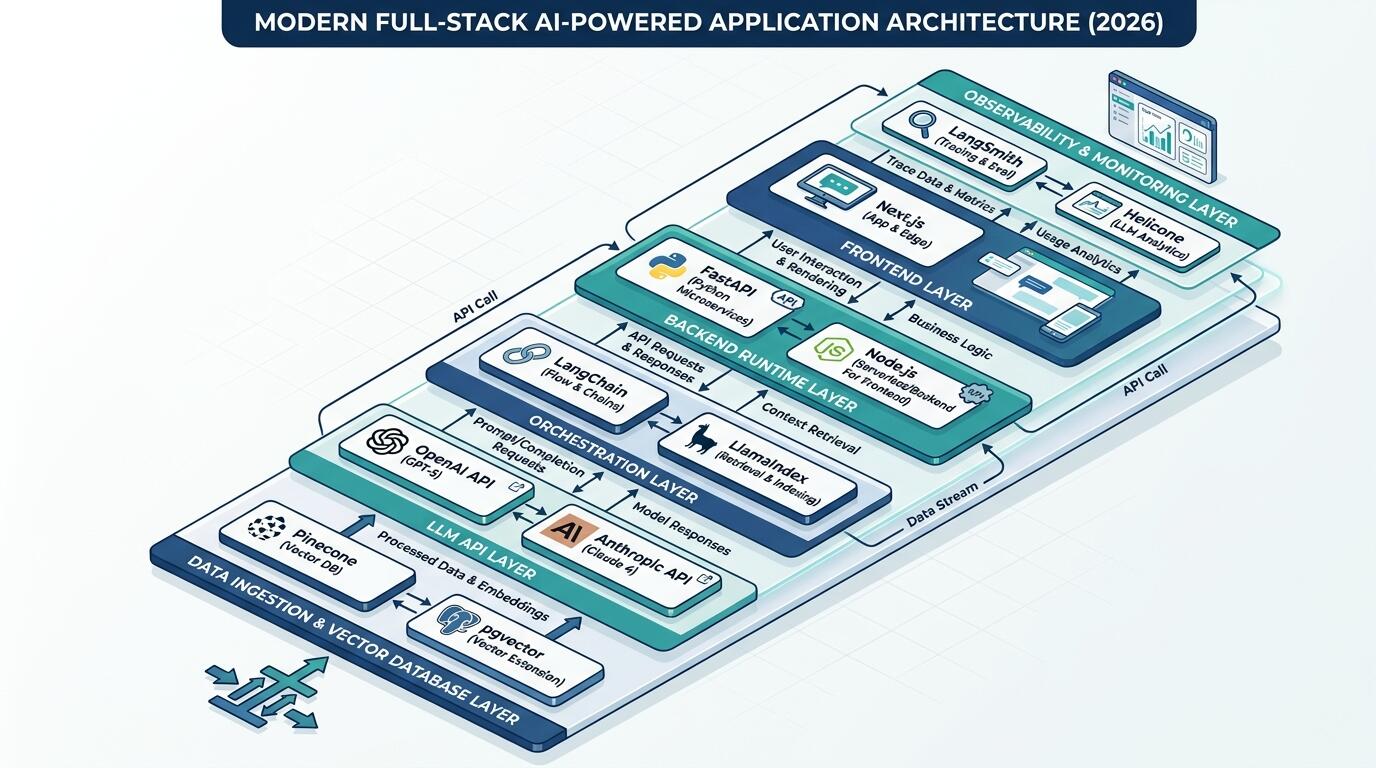
ALT: Layered architecture diagram of a modern full-stack AI-powered application stack showing LLM, vector database, backend, and frontend in 2026
Advanced Considerations: Where the Stack Gets Interesting
Handling Agentic Workflows in Production
Agentic systems — architectures where an LLM autonomously calls tools, retrieves information, and makes sequential decisions — introduce a class of production challenges that simpler LLM integrations do not. Non-determinism, latency compounding across steps, and failure recovery all require explicit architectural handling. LangGraph's stateful graph model and frameworks like AutoGen provide patterns for managing these workflows, but the key insight is that agentic systems need deterministic guardrails around non-deterministic AI behavior. Defining clear tool schemas, capping agent iteration counts, and logging every intermediate step are non-negotiable practices for production-grade agentic products.
The Misconception That More Context Solves More Problems
A common misconception when teams first work with large context window models is that stuffing the maximum context with all available information produces better outputs. In practice, retrieval precision almost always outperforms retrieval volume. Sending a tightly relevant 2,000-token context window produces better, more focused responses than sending an unfocused 50,000-token context. The skill is curation, not accumulation.
Security and Prompt Injection
As noted by the IEEE in its work on AI system trustworthiness, security considerations for AI-integrated systems extend beyond conventional application security. Prompt injection — where user-provided input manipulates the LLM's behavior in unintended ways — is a real attack surface that requires explicit mitigation. Input validation, output filtering, and clear separation between system instructions and user content are baseline security practices for any AI application handling untrusted input.
People Also Ask
Q1: How do I choose between LangChain and building custom LLM orchestration from scratch?
LangChain is the right default for teams building RAG pipelines, multi-step agents, or any workflow that involves chaining model calls with tool use. It provides abstractions that accelerate development and a large ecosystem of integrations. Custom orchestration makes sense when your use case is simple enough that the framework's abstraction adds more complexity than it removes — for instance, a single-turn classification endpoint rarely benefits from an orchestration layer. Start with LangChain and simplify to direct SDK calls where the framework proves unnecessary overhead.
Q2: Is Python or TypeScript the better choice for an AI-powered full-stack app backend in 2026?
Both are viable production choices in 2026, and the right answer depends on your team's existing expertise and your AI integration complexity. Python is the native language of the AI/ML ecosystem, with the richest library support for model SDKs, embeddings, and data processing. TypeScript offers a unified language across frontend and backend, which reduces context switching for smaller teams. A practical hybrid — TypeScript for the product layer, Python for AI-intensive microservices — is increasingly common and plays to each language's strengths without forcing compromise in either direction.
Q3: How long does it typically take to go from concept to a deployed AI-powered MVP using this stack?
A focused team of two to three developers using this stack — Next.js frontend, FastAPI or Node.js backend, a managed vector database, and a hosted LLM API — can ship a functional AI-powered MVP with core features in a compressed timeline, particularly when leveraging managed services that eliminate infrastructure setup overhead. The variables that most significantly affect timeline are retrieval quality tuning for RAG systems (which requires iterative testing with real data) and the complexity of the agentic workflow, if any. Simple AI-augmented features ship faster; multi-step agent systems require more architectural iteration.
Wrapping Up
The full-stack AI tech stack in 2026 is a genuinely coherent architecture — not a patchwork of experimental tools, but a set of mature, integrated choices that give skilled developers the ability to ship production-grade intelligent applications with a smaller team than ever before.
Key Takeaways:
- The architecture around the model matters more than the model itself — observability, retrieval quality, and streaming UX are where production AI applications succeed or fail.
- Abstraction at the LLM provider layer is a form of technical risk management; hard-coding provider-specific calls is a debt that compounds quickly.
- Orchestration frameworks like LangChain and LlamaIndex are right for complex workflows; direct SDK integration is right for simple ones — match tool complexity to problem complexity.
- Observability at the AI layer is not optional; teams that skip it lose the feedback loop needed to improve their product in production.
- A thin vertical slice shipped early — one complete path through the full stack — is the single most effective risk-reduction strategy in AI product development.
The teams that ship great AI products in 2026 are not the ones with access to the best models. They are the ones that make sound architectural decisions early and execute with discipline across every layer of the stack.
Ready to build something that actually ships? Explore real projects, technical insights, and professional portfolio at Darius — and get in touch if you're a founder, CTO, or engineering team looking to bring your next AI-powered product to life.
Sources & Citations
- MindMapAI. "AI-Powered Full Stack Developer Roadmap (2026)".
https://mindmapai.app/mind-mapping/ai-powered-full-stack-developer-2026 - LaraCopilot. "8 AI Platforms for Building Apps in 2026 (Ranked)".
https://laracopilot.com/blog/ai-platforms-for-building-apps/ - NuCamp. "Why AI Won't Replace Full Stack Developers in 2026 (But Will Change Your Job)".
https://www.nucamp.co/blog/why-ai-won-t-replace-full-stack-developers-in-2026-but-will-change-your-job - IEEE. "IEEE Standards and Technical Resources on AI Systems and Trustworthiness".
https://www.ieee.org - OpenAPI Initiative. "OpenAPI Specification — Industry Standard for API Documentation".
https://www.openapis.org
Note: Standards and technical guidance may be updated; please check the latest official documents or consult professional advisors for current best practices.