Fractional CTO vs. In-House Engineering Lead: Revisiting the Decision for Q4 2026
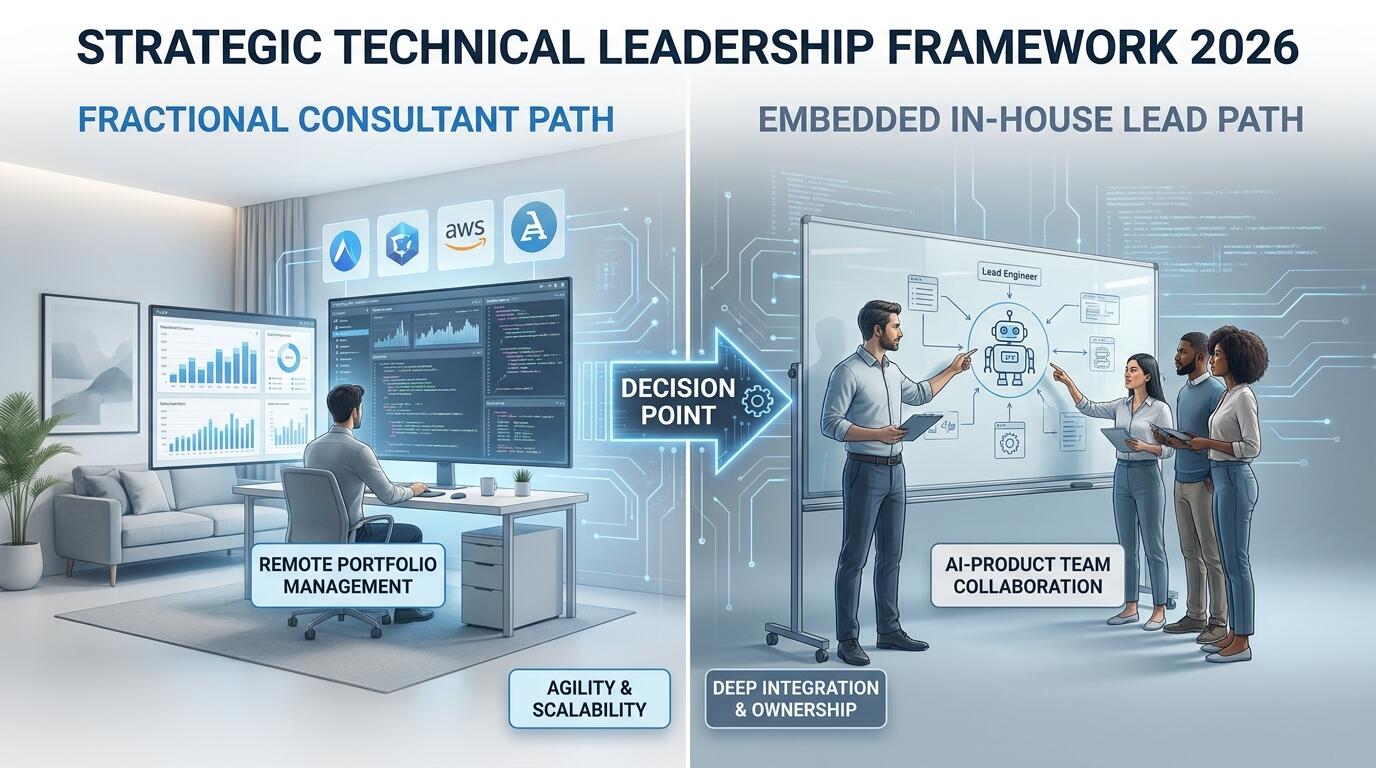
ALT: Fractional CTO versus in-house engineering lead decision framework for AI-driven product teams in 2026
Fractional CTO vs. In-House Engineering Lead: Which Model Fits Your Q4 2026 Engineering Strategy?
You're six months into building an AI-driven product. Your seed round is spent, a Series A is on the horizon, and your engineering team — two solid full-stack developers and a data scientist — is waiting for someone to set architectural direction. You need technical leadership, and you need it now. The question is whether that leadership comes from a full-time hire sitting in your Slack at 9 AM every day, or from a seasoned fractional partner who holds your roadmap accountable across a portfolio of engagements.
This decision is not new, but the landscape around it has shifted meaningfully heading into Q4 2026. The proliferation of AI tooling, the compressed product cycles it enables, and the acute shortage of senior engineering talent have all recalibrated the trade-offs. This article compares the fractional CTO model against the in-house engineering lead hire across the criteria that genuinely matter — cost structure, strategic depth, time-to-value, team fit, and long-term scalability — to help founders, product leaders, and senior engineers make the call with clarity.
The core comparison is between two models of technical leadership: engaging a fractional CTO (a senior technical executive contracted for a defined number of hours or days per week) versus hiring a full-time, in-house engineering lead or CTO (a dedicated employee embedded within the organization). Both models are evaluated against criteria relevant to AI-product companies at growth inflection points.
Evaluation Criteria: What Actually Matters When Choosing Technical Leadership in 2026
The right criteria for this comparison are the ones that directly affect your ability to ship production-ready product, retain engineering talent, and attract investment. A pattern consistently observed in work with early and growth-stage teams is that founders often anchor the decision on salary cost alone — which is the wrong primary filter.
Cost structure and financial flexibility matter because early-stage capital is finite. The real question is not just base compensation but total cost of engagement, including onboarding time, benefits, equity dilution, and the opportunity cost of a poor hire.
Strategic depth and architectural judgment determine whether your technical leader can make durable decisions — about AI architecture, system scalability, data pipelines, and API surface design — that will not become liabilities twelve months later. Per the IEEE's published guidance on systems engineering competencies, architecture decisions made early in a product's lifecycle carry disproportionate long-term consequences.
Time-to-value reflects how quickly the engagement produces directional clarity, unblocks the team, and begins reducing technical risk. For AI products specifically, where model selection, infrastructure choices, and data strategy need to be resolved before significant engineering investment, this criterion is particularly acute.
Team alignment and cultural fit are underweighted in most hiring frameworks. A technical lead who cannot communicate architectural rationale to non-technical founders, or who struggles to coach junior engineers, will underdeliver regardless of their individual expertise.
Long-term scalability of the model asks whether the structure you're adopting today will still serve you when headcount doubles, the product enters new markets, or you're preparing for due diligence. Technical leadership models that work at ten engineers often break at thirty.
Availability and organizational bandwidth capture a practical reality: a fractional leader is, by definition, not fully present. Whether that constraint is acceptable depends on your team's current maturity and your product's phase of development.
The Contenders: Two Models of Engineering Leadership at the Executive Level
Fractional CTO: Senior Strategic Guidance on a Defined Engagement Basis
A fractional CTO is a senior technical executive — typically with Director- to CTO-level experience — who contracts with a company for a portion of their working time, often ranging from one day to three days per week. The model is structurally similar to a part-time consulting engagement but is distinguished by ongoing strategic accountability rather than discrete project delivery.
Fractional CTOs typically bring cross-industry pattern recognition, having worked across multiple companies at similar stages. They are well-suited to companies that need to establish architectural foundations, conduct technical due diligence, build out engineering hiring pipelines, or navigate a specific inflection point — such as migrating to a new AI infrastructure stack or preparing for a Series A technical review. Because they operate across a portfolio of engagements, fractional CTOs stay current on emerging tooling, market practices, and architectural patterns in ways that embedded leaders sometimes do not.
The engagement model is commercially flexible. Contracts can be structured on a monthly retainer, hourly advisory basis, or a defined-scope engagement tied to a milestone — such as shipping an MVP or completing an architectural review. Equity participation varies widely and is typically a fraction of what a full-time hire would command.
The primary constraint is bandwidth. A fractional CTO who is simultaneously advising three companies cannot provide the deep daily context that comes from being embedded in a single codebase and team dynamic. Availability during crises, sprint planning sessions, and team offsites is negotiable and often limited.
In-House Engineering Lead: Full-Time Embedded Technical Ownership
An in-house engineering lead — whether titled VP of Engineering, CTO, or Head of Engineering — is a full-time employee with complete organizational immersion. They attend every stand-up, build relationships with every engineer, participate in product discussions, and carry institutional knowledge that accumulates over time.
For companies past early product-market fit, with a growing engineering team and increasing operational complexity, the in-house model provides a quality of presence that is simply not replicable on a fractional basis. The lead is available for spontaneous problem-solving, can observe team dynamics in real time, and can build the internal engineering culture that sustains the organization through rapid scaling.
The cost of this model is significant and multi-dimensional. Beyond a competitive senior engineering salary — which the U.S. Bureau of Labor Statistics consistently reports as among the highest in the professional services sector — there are recruiting costs, onboarding time, benefits, and equity. The wrong full-time hire is also far more expensive to unwind than a fractional engagement.
The risk with in-house hires is specificity bias: a leader with deep experience in one domain (say, enterprise SaaS infrastructure) may bring that mental model to problems better served by different architectural approaches. In AI-product companies specifically, where the field evolves rapidly, this can produce technical decisions that are locally coherent but globally misaligned with where the industry is heading.
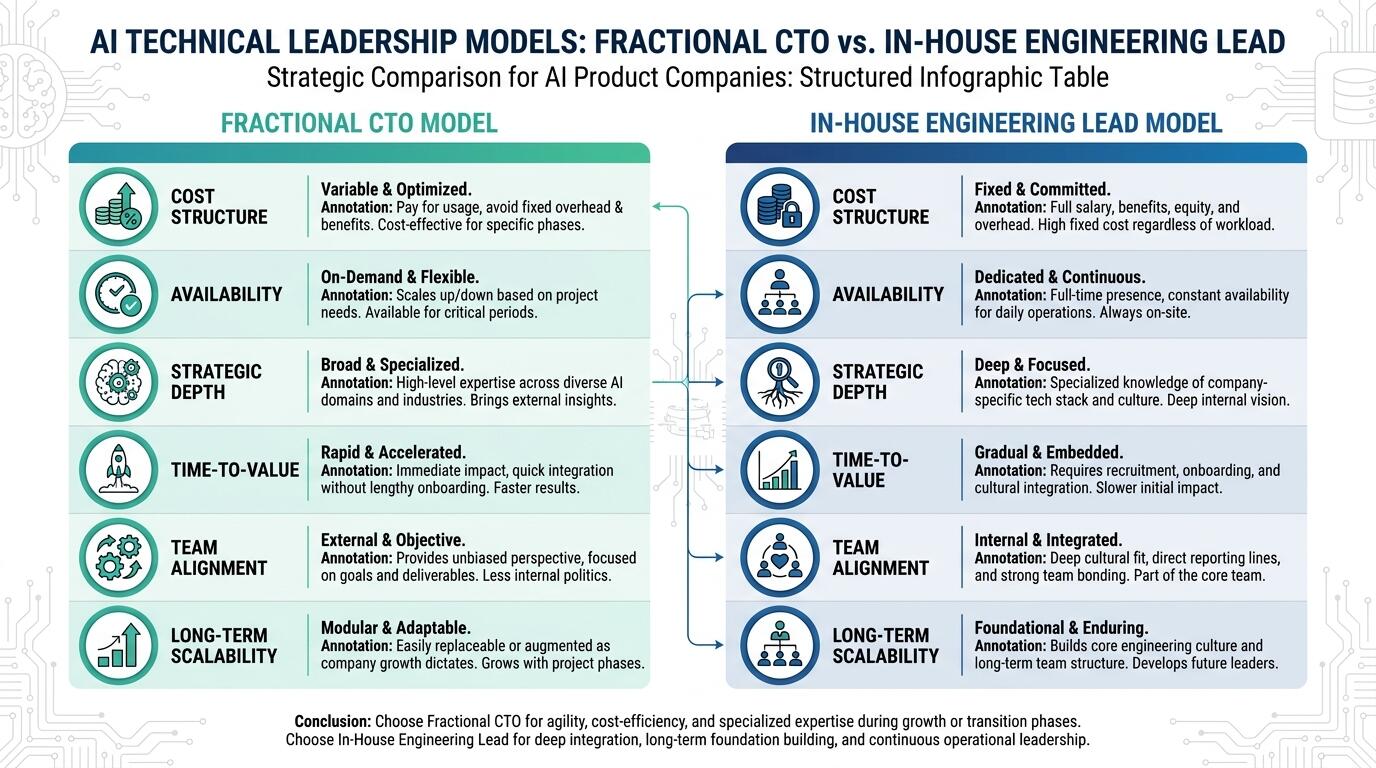
ALT: Side-by-side comparison of fractional CTO versus in-house engineering lead for AI product companies evaluating technical leadership models in 2026
Head-to-Head Comparison: Fractional CTO vs. In-House Engineering Lead
| Criterion | Fractional CTO | In-House Engineering Lead |
|---|---|---|
| Cost structure | Lower total cash outlay; retainer or hourly model; partial equity | Full salary, benefits, equity; high recruiting cost |
| Strategic depth | High — broad cross-portfolio pattern recognition | High — deepens over time through organizational context |
| Time-to-value | Fast — typically operational within days or weeks | Slow — onboarding and context-building takes months |
| Availability | Limited — defined hours per week, unavailable in most crises | Full — embedded, real-time access |
| Team alignment & culture | Variable — depends on communication style and engagement depth | Strong — builds over time through daily presence |
| Long-term scalability | Model has natural ceiling; transition required as team grows | Scales with the organization; grows into the role |
| Suitability for AI architecture | High — often maintains current market exposure | Variable — depends on individual background |
| Risk of wrong fit | Lower — easier to transition or restructure | Higher — costly to unwind; severance and re-recruiting |
The table highlights a structural reality: the fractional model front-loads value and reduces financial risk, while the in-house model compounds value over time but demands a larger upfront commitment and carries more downside risk if the hire is misaligned.
What the table cannot fully capture is the qualitative dimension of trust. In-house engineering leads build the kind of institutional trust — with co-founders, with the board, with the engineering team — that becomes a genuine organizational asset. A fractional CTO, by contrast, often operates with a narrower mandate, which can be clarifying or limiting depending on the organization's needs.
It is also worth noting that the two models are not mutually exclusive in practice. A pattern that consistently emerges in early-to-growth-stage companies is a sequenced approach: engage a fractional CTO to establish architectural foundations, define hiring criteria, and de-risk early technical decisions — then bring in a full-time in-house lead once the team, product, and strategy are sufficiently stable to justify the investment. According to research from the National Bureau of Economic Research on organizational structure in technology startups, early-stage companies that defer executive hiring until product-market signals are clearer tend to allocate capital more efficiently.
The head-to-head also reveals a Q4 2026-specific factor: the pace of AI tooling evolution. In an environment where new model providers, inference infrastructure options, and AI orchestration frameworks are releasing significant updates on a monthly basis, fractional leaders who work across multiple AI-product companies often carry a broader and more current view of the option space than a single embedded leader whose context is necessarily narrower.
Which Should You Choose? Scenario-Based Recommendations for Engineering Leaders
If you are pre-product-market fit with a technical team that needs direction but not full-time oversight, engage a fractional CTO. The speed of access to senior judgment outweighs the cost of limited availability at this stage. Your primary technical risk is making poor foundational decisions, and a fractional engagement directly addresses that risk without overextending your burn rate.
If you are scaling past ten engineers with increasing operational complexity and team management demands, hire in-house. At this scale, technical leadership is less about architecture selection and more about organizational design, engineering culture, and cross-functional coordination — functions that require daily presence to execute well.
If you are preparing for a fundraise and need to signal technical credibility to investors, a fractional CTO can provide that signal in the near term, but sophisticated investors will likely ask about your path to full-time technical leadership. Use the fractional engagement to build the architecture and the hiring profile for the permanent hire.
If your product has a significant AI component and your team lacks deep AI architecture experience, a fractional AI architect or CTO with documented AI systems experience provides faster de-risking than a full-time hire who will take months to onboard and may not have the same depth of current exposure.
If you have already achieved product-market fit and are entering an operational scaling phase, the in-house model is almost always the right answer. The compounding value of embedded leadership — mentoring, culture-building, cross-functional trust — cannot be replicated on a part-time basis once the organization reaches this complexity.
Summary of trade-offs: the fractional model offers speed, flexibility, and financial efficiency; its limitations are availability, presence, and the natural ceiling of divided attention. The in-house model offers depth, continuity, and compounding organizational value; its risks are hiring cost, onboarding time, and the high cost of a misaligned hire.
Common Questions
Q1: How do you evaluate whether a fractional CTO has sufficient depth for an AI-driven product?
Evaluating a fractional CTO for an AI product requires looking beyond titles and years of experience. Assess whether they have directly architected and shipped production AI systems — not just advised on them. Ask for concrete examples of model selection decisions, inference infrastructure trade-offs, and data pipeline design. Fractional leaders who maintain active hands-on technical work tend to carry significantly more current and applicable knowledge than those who have moved purely into advisory roles.
Q2: Is a fractional CTO arrangement appropriate for a funded startup preparing for Series A due diligence?
A fractional CTO can be highly effective for Series A preparation, particularly for establishing architectural documentation, conducting internal technical audits, and coaching the team through investor technical reviews. However, sophisticated institutional investors will typically want to understand the path to full-time technical leadership. The fractional engagement is best framed as a bridge — providing immediate credibility and strategic clarity while the company identifies and recruits its permanent engineering leader.
Q3: What is the typical time horizon before a fractional CTO engagement transitions to a full-time hire?
The transition timeline is highly context-dependent and not governed by a fixed rule. In practice, the transition becomes warranted when the engineering team grows to the point where management overhead requires daily presence, or when the product's operational complexity demands continuous technical judgment rather than episodic strategic input. Many early-stage companies operate effectively with fractional leadership for a period of months before the business case for a full-time hire becomes clear. The signal to transition is organizational complexity, not a calendar date.
Final Thoughts
The fractional CTO versus in-house engineering lead decision is not a permanent binary — it is a stage-appropriate choice that should be revisited as your organization evolves. Three points consistently prove decisive in this decision.
First, your current engineering stage is the primary driver. Pre-product-market fit companies almost universally benefit from the speed and flexibility of fractional engagement. Post-product-market fit companies with scaling teams need the embedded presence of a full-time leader.
Second, the quality of the individual engagement matters more than the model. A high-quality fractional CTO with genuine AI architecture depth and a track record of shipped production systems will outperform a mediocre full-time hire at almost every stage. The model is the container; the practitioner's expertise is what fills it.
Third, the two models can be sequenced deliberately. Use fractional leadership to de-risk early architectural decisions, build your engineering hiring criteria, and establish the technical foundation — then bring in a full-time leader to compound on that foundation. This sequenced approach is increasingly common among well-run early-stage AI product companies.
The right next step is an honest assessment of where your organization sits today: what technical decisions are most consequential in the next ninety days, what your team needs to ship reliably, and what your capital structure can support. That assessment, made clearly, will point you to the right model.
Explore real shipped AI products, technical architecture insights, and the full professional background at the Darius website — and connect directly to accelerate your path from concept to production-ready launch.
Sources & Further Reading
- IEEE. "Systems and Software Engineering — Competencies for Systems Engineering Professionals".
https://www.ieee.org - U.S. Bureau of Labor Statistics. "Occupational Outlook Handbook: Computer and Information Systems Managers".
https://www.bls.gov - National Bureau of Economic Research. "Organizational Structure and Decision-Making in Technology Startups".
https://www.nber.org
Note: Standards and research publications may be updated; please check the latest official documents or consult professional advisors for current guidance.