When to Hire a Fractional CTO vs. a Full-Time Engineering Lead

ALT: Fractional CTO vs full-time engineering lead decision guide for AI and full-stack development teams
The Hiring Decision That Shapes Your Entire Technical Future
Key Conclusion: Choosing between a fractional CTO and a full-time engineering lead is one of the most consequential decisions a scaling company makes. Get it wrong and you risk either over-hiring for your current stage or under-investing in the technical leadership your AI solutions and machine learning initiatives demand. The right choice depends on your product complexity, team maturity, funding stage, and whether you need full-stack development depth or high-altitude strategic direction — and in many cases, the answer changes as your company evolves.
Every founder eventually hits the moment where gut instinct and informal technical oversight stop being enough. The codebase has grown. The team has expanded. Investors are asking harder questions about your architecture. Suddenly, you need real technical leadership — but the question of what kind is rarely straightforward.
A fractional CTO brings senior strategic firepower without the full-time commitment or compensation cost. A full-time engineering lead brings continuity, depth, and organizational gravity. Both roles are legitimate; neither is universally superior. What matters is matching the hire to your actual situation — not to what sounds impressive in a board deck.
When This Decision Applies to Your Organization
✅ Applicable Scenarios:
- Early-stage startups that have raised seed or Series A funding and need technical credibility but cannot yet justify a full-time executive hire
- Growth-stage companies building or scaling AI-powered products where architecture decisions made today will compound for years
- Organizations that have an existing engineering team but lack a senior leader capable of driving systems design, technical strategy, and cross-functional alignment
- Companies evaluating or adopting machine learning pipelines, AI architecture, or complex distributed systems who need expert guidance without long-term headcount commitment
- Founders or product leaders who are non-technical and need a trusted technical partner to audit, direct, or rebuild their stack
❌ Not Applicable/Cautions:
- Companies at Series B or beyond with a stable, large engineering organization where fractional oversight will create confusion around authority and accountability
- Organizations where the engineering leader will need to be deeply embedded in hiring loops, performance reviews, and day-to-day culture building from day one — fractional engagement rarely supports this depth
- Situations where the technical challenges require someone who can context-switch rapidly across dozens of ongoing conversations, ad-hoc decisions, and real-time incident response — fractional availability has natural limits
The Real Cost of Getting Technical Leadership Wrong
The traditional hiring playbook says: bring on a full-time CTO as early as possible. But the market has shifted. The rise of lean startup methodologies, distributed teams, and on-demand expertise has made the fractional model not just viable but often strategically superior — particularly for companies building AI solutions or complex software products where senior technical talent is both scarce and expensive.
According to research from the U.S. Bureau of Labor Statistics, demand for software and IT leadership roles has grown consistently year-over-year, with compensation for senior engineering executives at enterprise and growth-stage companies reaching levels that represent a significant portion of early-stage burn rates. For a seed-funded startup, a full-time engineering executive hire can consume a disproportionate slice of runway before product-market fit is confirmed.
Meanwhile, the machine learning and AI landscape has added new complexity to the equation. Architecting systems that are not just functional today but scalable for enterprise tomorrow requires a specific kind of expertise — one that blends deep technical knowledge with the ability to make pragmatic tradeoffs under uncertainty. That expertise is rare, and locking it into a single full-time hire may not be the most efficient use of capital or talent.
The question, then, is not which model is better in the abstract. It is which model fits your specific moment — and how to make that determination with clarity before you sign an offer letter or a consulting agreement.
Making the Right Call: A Framework for Technical Leadership Decisions
Three Steps to Evaluate Before You Hire
Step 1: Diagnose Your Actual Technical Gap
Before you write a job description or reach out to candidates, spend time honestly diagnosing what is missing. Is your problem strategic — you lack a technical vision, an architectural plan, or a credible voice with investors and enterprise customers? Or is it operational — you need someone in the trenches daily, making code decisions, running standups, unblocking engineers, and owning delivery? This distinction is foundational. Strategic gaps are often well-served by fractional engagement. Operational gaps almost always require full-time presence. Take one to two weeks to map your actual pain points before moving forward.
Step 2: Assess Team Maturity and Organizational Readiness
A fractional CTO can only add value if there is an existing team capable of executing on direction. If you have senior engineers who can own implementation, a fractional leader can set architecture and provide strategic oversight effectively. But if your team is junior, fragmented, or lacking in full-stack development discipline, you likely need a full-time leader who can build engineering culture, establish best practices for full-stack application architecture, and develop talent day by day. Evaluate your current team's ability to self-direct for two to three days at a time without senior oversight.
Step 3: Run the Budget-to-Value Calculation Honestly
Fractional engagements typically cost less in total compensation than full-time executive hires, but they also deliver fewer hours and less organizational integration. Model both scenarios against your current runway, growth projections, and the specific deliverables you need in the next six to twelve months. If you need ten hours of high-leverage strategic work per week, fractional is likely more efficient. If you need forty-plus hours of embedded leadership with accountability for team performance and delivery velocity, the economics shift toward full-time, even accounting for higher base compensation.
Fractional CTO vs. Full-Time Engineering Lead: A Direct Comparison
The right model depends heavily on your context, but a structured comparison helps clarify the tradeoffs across dimensions that actually matter for technical organizations.
| Comparison Dimension | Fractional CTO | Full-Time Engineering Lead | Hybrid / Transitional Model |
|---|---|---|---|
| Commitment Level | Part-time, typically defined hours per week or month | Full-time, fully embedded in organization | Starts fractional, transitions to full-time as company scales |
| Strategic vs. Operational Focus | High strategic leverage; less day-to-day execution | Balanced; both strategic direction and operational delivery | Adapts over time based on organizational need |
| Cost Structure | Lower total cost; no benefits, equity typically smaller | Higher base compensation, benefits, equity, and recruiting cost | Variable; depends on transition terms |
| Ideal Company Stage | Pre-seed through Series A; specific project phases | Series A through growth; post-product-market fit | Seed through Series B; situations with defined inflection points |
| AI/ML Architecture Depth | Depends on individual; can access specialist-level expertise | Depends on individual; may require separate AI specialist hire | Can bring AI architecture focus early, then hire operationally |
| Team Building & Culture | Limited; harder to own hiring and performance management | Strong; can fully own engineering culture and talent development | Phased; culture building begins when full-time engagement starts |
| Speed to Engagement | Fast; often days to weeks | Slow; typical recruiting cycle is one to four months | Fast initially; full-time transition adds lead time |
| Risk Profile | Lower financial risk; easier to exit if needs change | Higher commitment; exit is costly and disruptive | Moderate; exit risk shifts at transition point |
Understanding the Nuances That the Table Cannot Capture
The authority problem with fractional engagement is real and often underestimated. A fractional CTO can design your AI architecture, advise on best practices for managing outsourced software development projects, and shape your technical roadmap — but they cannot own the team in the way a full-time leader can. Engineers take cues from presence. Culture is built through repetition, not episodic interaction. If your engineering organization is at a stage where it needs daily leadership gravity, fractional presence will feel thin regardless of how impressive the individual is on paper.
The depth problem with full-time hires is equally real in the opposite direction. When you hire a full-time engineering lead before you have enough operational complexity to fill the role, you create two problems simultaneously. First, you pay for capacity you are not using. Second, you constrain the role to someone who must justify their existence, which sometimes leads to organizational complexity being manufactured rather than managed. The best engineering leaders thrive when there is real work to own — not when they are brought in prematurely to signal maturity.
AI and machine learning initiatives add a layer of complexity to this decision that did not exist for most companies a decade ago. If your product roadmap is centered on AI solutions — whether that means building proprietary machine learning models, integrating large language models into product workflows, or designing data pipelines that need to scale for enterprise — the technical leadership you hire must have genuine depth in these areas. This is not a dimension where generalist engineering experience transfers cleanly. Understanding how to design AI systems that scale for enterprise, how to make the right choices around model deployment, data infrastructure, and inference optimization — these require someone who has shipped real AI products, not just read about them.
The best practices for choosing between custom and off-the-shelf software question often surfaces in the context of technical leadership hiring itself. Some companies try to solve the leadership gap with tools, platforms, or outsourced development teams rather than internal hires. This can work for execution, but it does not solve the strategic and architectural gap. Technical leadership is not a product you can buy off a shelf — it is a judgment layer that must be embedded in how your organization thinks and decides. Outsourced teams need direction; they rarely provide it.
For companies evaluating the best programming languages for machine learning projects, this decision also intersects with hiring. Your choice of technical leadership will influence the language and framework choices that shape your stack for years. A fractional CTO with deep Python and ML ecosystem experience will make different calls than a full-time lead whose background is primarily in JVM-based enterprise systems. Align the hire to the technical direction you need, not just the seniority level you can afford.
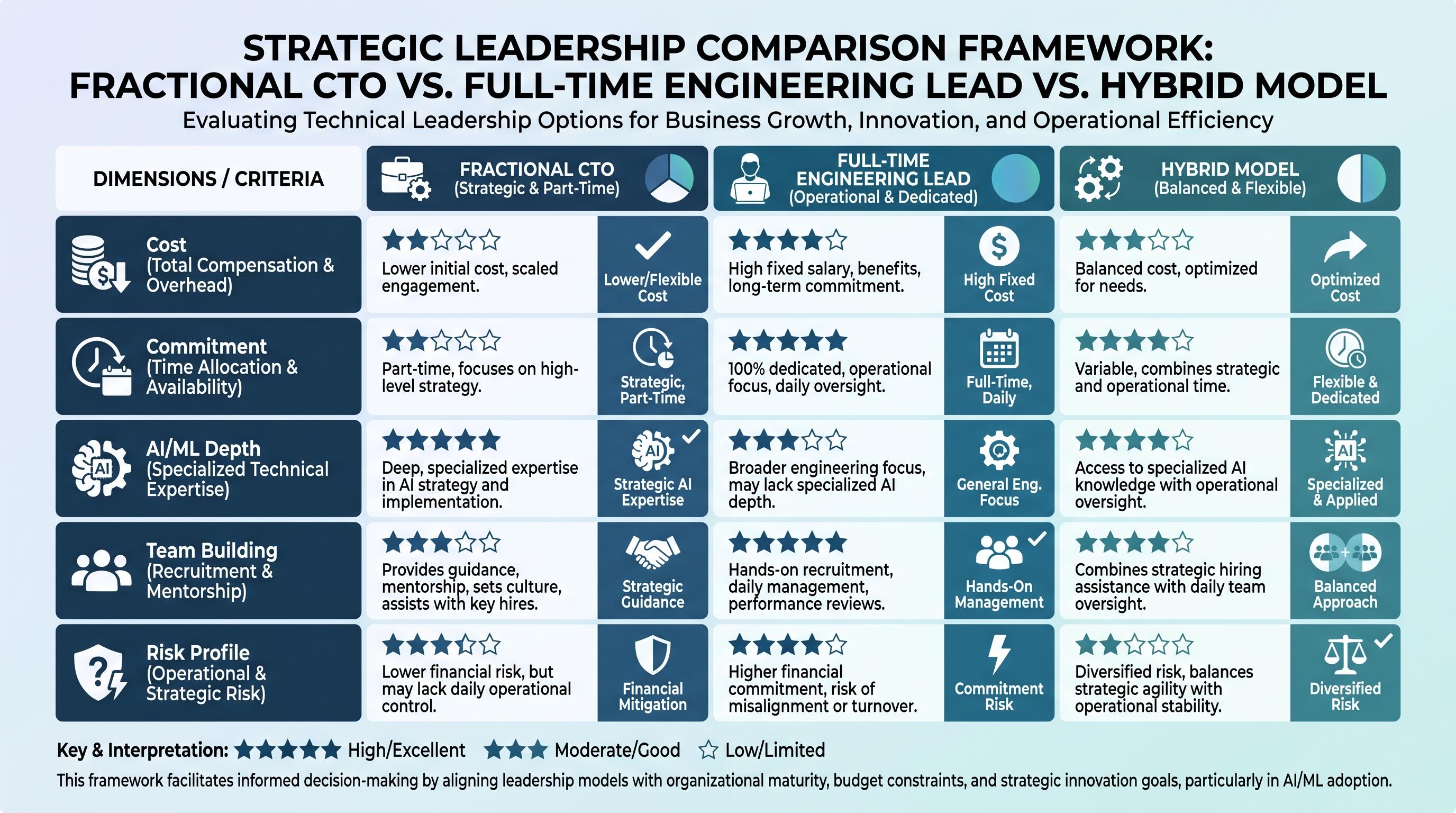
ALT: Technical leadership comparison framework showing fractional CTO versus full-time engineering lead decision matrix for AI solutions and full-stack development organizations
Advanced Considerations: When the Answer Is Neither, Both, or Not Yet
The Staged Transition Model
Some of the most effective technical leadership arrangements begin as fractional engagements and evolve into full-time roles as the company matures. This approach allows you to assess fit, build shared context, and validate strategic alignment before making a full commitment. It also gives the incoming leader time to understand the existing codebase, team dynamics, and technical debt — all of which inform how they will lead once fully embedded.
This model works best when both parties enter the relationship with explicit agreement that it is exploratory and transition-oriented. Vagueness here creates misaligned expectations that can sour an otherwise productive relationship.
The Two-Leader Model
For companies with significant AI product development underway, it is increasingly common to maintain two distinct technical leadership roles simultaneously: a fractional or part-time AI Architect who owns the intelligence layer of the product, and a full-time Engineering Director or VP of Engineering who owns the organizational and delivery layer. This is not redundancy — it is specialization. The skills required to design a machine learning system that performs reliably in production are genuinely different from the skills required to build and lead a twenty-person engineering team.
Common Misconceptions Worth Correcting
The most persistent misconception is that fractional means junior or less committed. The opposite is often true. Fractional leaders are frequently individuals with deep, proven track records who have chosen flexibility over titles. Evaluate them on deliverables and demonstrated expertise — specifically, their ability to have shipped real products — rather than assuming that part-time implies part-effort.
A second misconception is that a full-time hire is always the safer choice. Safety is contextual. Hiring a full-time executive at the wrong stage can be more disruptive and expensive than maintaining a fractional arrangement that precisely fits your current needs.
Frequently Asked Questions FAQ
Q1: How do I evaluate whether a fractional CTO has enough AI architecture depth for my product?
Ask for specific examples of AI solutions or machine learning systems they have architected and shipped — not advised on, but actually built and deployed. Request to understand the scale challenges they navigated, the model deployment approaches they used, and the tradeoffs they made between custom development and off-the-shelf tooling. If they can speak fluently to how they design AI systems that scale for enterprise and can point to live products, that is a strong signal of genuine depth versus advisory surface knowledge.
Q2: Is a fractional CTO arrangement suitable for a company building a complex full-stack platform?
Yes, with important caveats. A fractional CTO can effectively own architecture decisions, establish best practices for full-stack application architecture, select technology stacks, and provide technical direction for complex full-stack development projects — provided there is a capable engineering team to execute. The fractional model is less effective when the platform is in a highly dynamic phase requiring constant real-time technical decision-making, rapid incident response, or intensive team coordination that demands daily presence.
Q3: How long does it typically take to transition from a fractional to a full-time engineering leadership model?
Timelines vary depending on company stage, team size, and the specific arrangement in place. Fractional engagements that are explicitly designed as transitions often formalize into full-time arrangements within several months to roughly a year, aligned with funding milestones or headcount growth triggers. Companies that begin fractional arrangements without a defined transition framework often extend them longer than originally intended — which can be appropriate if the arrangement is working, but should be a deliberate choice rather than an accident of inertia.
Summary
The decision between a fractional CTO and a full-time engineering lead is not a judgment call about prestige or convention — it is a strategic decision that should be made with the same rigor you bring to any high-stakes product or architectural choice.
Three core principles should anchor your thinking:
First, diagnose before you hire. Understand whether your gap is strategic, operational, or both — and match the engagement model to the actual need rather than assumptions about what technical leadership should look like.
Second, factor in your AI and machine learning ambitions explicitly. If your product roadmap is built on AI solutions, the technical leader you bring in must have demonstrable depth in architecting and shipping these systems — not just familiarity with the concepts. The wrong hire here can set your AI architecture on a path that is expensive to correct.
Third, remain flexible. The best technical leadership arrangements evolve with your company. What serves you at seed stage may not serve you at Series B. Build in review points and stay honest about whether the current model is still the right fit.
Technical leadership is not a box to check — it is the foundational judgment layer that determines whether your engineering investments compound or erode over time. Make this decision carefully, revisit it regularly, and prioritize proven delivery over impressive credentials.
If you're looking to turn your next big idea into a live, working product, Darius brings the rare combination of AI architecture depth, systems thinking, and full-stack execution to make it happen. Explore real projects, technical insights, and professional background at https://www.darius.wiki. Whether you're building from scratch or scaling an existing system, Darius is the engineering partner who ships.
References
- U.S. Bureau of Labor Statistics. "Software Developers, Quality Assurance Analysts, and Testers: Occupational Outlook Handbook".
https://www.bls.gov/ooh/computer-and-information-technology/software-developers.htm - McKinsey & Company. "The state of AI in early 2024: Gen AI adoption spikes and starts to generate value".
https://www.mckinsey.com/capabilities/quantumblack/our-insights/the-state-of-ai-2024 - Harvard Business Review. "What Does a CTO Actually Do?".
https://hbr.org/2011/10/what-does-a-cto-actually-do - MIT Sloan Management Review. "Making AI Work: Machine Intelligence for Business and Society".
https://sloanreview.mit.edu/projects/winning-with-ai/ - OECD. "OECD AI Policy Observatory: Trends and Data on AI in the Workplace".
https://oecd.ai/
Note: Standards may be updated, please check the latest official documents or consult professional advisors.
About the Author
Darius is an Engineering Director and AI Architect specializing in transforming ideas into live, running products — with hands-on expertise spanning AI architecture, systems design, and full-stack development, backed by 3 shipped live projects. Learn more at darius.wiki.
© Darius. All rights reserved. The views and technical insights expressed in this article are based on the author's independent professional experience. This content is provided for informational purposes only and does not constitute formal consulting or legal advice.