Evaluating a New Model Release Against Your Own Workload

ALT: Engineer evaluating a new AI model release against real production workload benchmarks
Why Model Release Hype Rarely Matches Your Production Reality
A new frontier model drops. The benchmarks look impressive, the blog post is well-written, and your team Slack lights up with messages asking whether you should switch. This is a familiar pattern for anyone running AI products in production — and it's where the real evaluation work begins, not ends.
The core conclusion is straightforward: evaluating a new model release against your own workload is the only reliable signal that matters. Third-party benchmarks measure someone else's workload. Your production tasks, your latency constraints, your error modes, and your cost structure are specific enough that no external leaderboard can tell you whether a new model deserves migration effort. The practitioners at Darius who run multiple AI products simultaneously have learned this the hard way — a model that scores highest on popular reasoning benchmarks may perform worse on domain-specific extraction tasks that drive actual product value.
This article lays out a disciplined, workload-first methodology for assessing any new model release. It covers how to structure your evaluation dataset, which dimensions to measure, how to interpret ambiguous results, and when the cost of switching is simply not worth the performance delta.
When This Evaluation Framework Applies
Applicable Scenarios:
- You are running at least one AI feature or product in production and are considering whether to migrate to a newly released model
- You have a repeatable set of real tasks — summarization, classification, extraction, code generation, or multi-step reasoning — that form the backbone of your product's value
- You have some baseline: prior latency measurements, cost-per-call figures, or human-labeled quality assessments from your current model
Not Applicable / Cautions:
- If you are at the prototyping stage with no production data, you have no workload to evaluate against; focus on exploration instead of structured benchmarking
- If your product's tasks change radically week to week, a static evaluation dataset will not capture your actual distribution — invest in dynamic evals first
- This framework assumes you can make direct API calls to the candidate model; fine-tuned or distilled deployments require additional evaluation steps not covered here
The Benchmark Gap: Why Generic Scores Mislead AI Product Builders
The benchmark gap is the divergence between a model's published performance on standard evaluation suites and its actual performance on any specific production workload. This gap is not a flaw in benchmark design — it is an inherent consequence of the diversity of real-world tasks.
Standard evaluation suites such as MMLU, HumanEval, or MATH measure defined, narrow capabilities. They are valuable for tracking the research frontier, but they were not constructed with your document pipeline, your customer support classification schema, or your structured data extraction prompts in mind. A model that improves ten points on a reasoning benchmark may show no measurable improvement on your task — or may even regress if the new training mix reduced the model's fluency in your specific domain.
The economic stakes make this matter more than it used to. Cloud inference costs for frontier models are non-trivial at scale. Switching models is not free — it involves prompt re-engineering, regression testing, monitoring updates, and in some cases customer-facing changes. A migration decision made on benchmark enthusiasm rather than workload evidence can consume weeks of engineering time with no user-facing gain. Running your own evaluation before committing to a migration is one of the highest-ROI activities a small AI product team can execute.
A pattern we consistently see in teams building on top of foundation models: the evaluation step is skipped when excitement is high, and the cost of that skip is paid downstream during an incident, a quality regression, or a surprise billing spike. Structured evaluation is the engineering discipline that bridges model releases to production decisions.
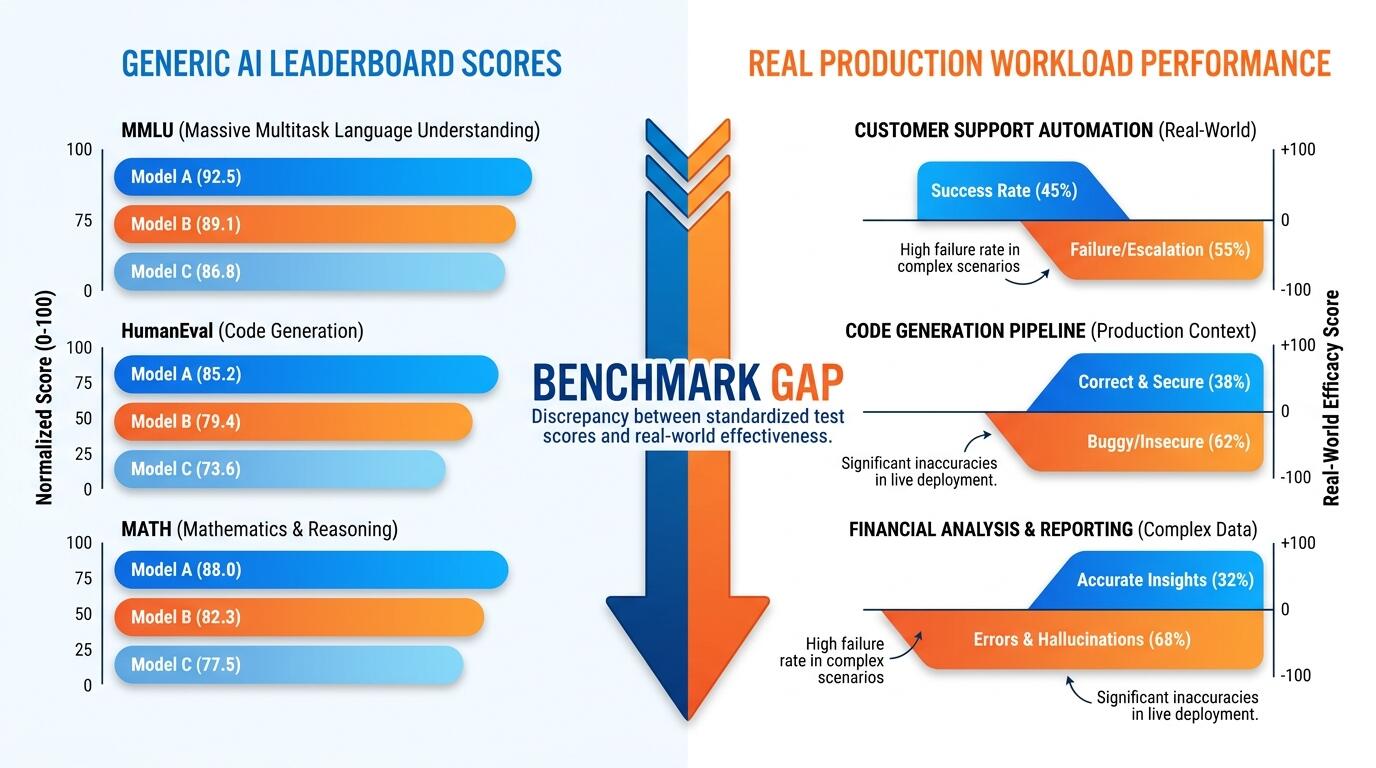
ALT: Diagram comparing generic AI benchmark scores versus actual production workload performance metrics for AI product builders
A Workload-First Evaluation Methodology
Build Your Evaluation Dataset Before You Look at the New Model
Step 1: Assemble a Representative Task Sample
Before you load a single prompt into the new model, assemble a sample of real production inputs. Pull at least fifty to one hundred examples from your actual traffic — more if your task distribution is heterogeneous. Label or annotate these examples with expected outputs using your current best standard (human review, your existing model's outputs, or both). This dataset is your ground truth. The key constraint: the sample must reflect the full distribution of difficulty, edge cases, and input formats you encounter in production, not just the easy cases where any model succeeds. Budget roughly a half-day for this step if your data is accessible and already structured.
Step 2: Define Measurable Success Criteria
For each task type in your sample, define what a passing response looks like. This sounds obvious, but it is where most informal evaluations fail. For extraction tasks, define precision and recall on structured fields. For classification, define per-class accuracy thresholds. For generation tasks, decide whether you will use automated metrics (such as ROUGE or embedding similarity), an LLM-as-judge approach, or human review — and document the decision. Vague success criteria produce ambiguous results that cannot drive a migration decision. This step should take two to four hours and is worth every minute.
Step 3: Run Parallel Evaluation and Compare on All Dimensions
Run your evaluation dataset through both the incumbent model and the new model candidate, keeping prompts as consistent as possible. Record quality scores, latency per call, and cost per call. Do not optimize prompts for the new model at this stage — you are benchmarking the out-of-the-box experience, because that is the realistic baseline before you invest in prompt re-engineering. After scoring, compare across all three dimensions simultaneously. A new model that improves quality by a meaningful margin but doubles per-call cost may still be the right choice — or it may not — depending on your margin structure. Run this pass over a weekend or within a single sprint cycle.
Comparing Evaluation Approaches for Production AI Systems
Different teams take different approaches to workload evaluation. Each has genuine trade-offs in terms of cost, speed, and signal quality. The table below summarizes three common approaches.
| Comparison Dimension | Leaderboard-Only Evaluation | Internal Golden Dataset Eval | Live A/B Shadow Test |
|---|---|---|---|
| Signal relevance to your workload | Low — measures someone else's tasks | High — measures your actual inputs | Very high — measures live user interactions |
| Setup cost | Near zero | Moderate (annotation, dataset curation) | High (infra, traffic routing, monitoring) |
| Time to decision | Hours | Days to one week | Weeks to months |
| Cost sensitivity | Not captured | Measurable if you log API costs | Fully measurable with production billing |
| Risk of production regression | High (no safety net) | Medium (regression only in test) | Low (shadow or canary limits exposure) |
| Recommended for | Initial triage only | Standard migration decision | High-stakes, high-traffic migration |
The practical recommendation for most AI product teams: use leaderboard data only for initial triage (is this model even worth evaluating?), always run an internal golden dataset evaluation before any migration, and reserve live A/B shadow testing for changes that affect high-traffic or revenue-critical paths.
Interpreting Results and Making the Migration Decision
Interpreting ambiguous quality deltas is where practitioner judgment matters most. If the new model scores marginally better on automated metrics but no better on human review, the automated metric is likely not capturing what users actually value. Trust the human signal over the automated number, especially for generation tasks where quality is inherently multidimensional.
Cost modeling is non-negotiable. Before committing to a migration, build a cost projection at your expected scale. Frontier model pricing changes frequently, and a model that is cheaper per token may have higher output verbosity, which closes the cost gap. Measure tokens consumed per task, not just price per token, on your actual sample. A pattern we see repeatedly: teams compare price-per-million-token rates without accounting for the fact that the new model generates systematically longer outputs for the same task, making real per-task cost higher than the headline rate suggests.
Latency has product-layer implications that are easy to undercount. A model that adds 800ms of median latency to a user-facing feature may have measurable effects on engagement, even if the quality improvement is genuine. For async or background processing tasks, latency matters far less. Map each task type to its latency sensitivity before interpreting latency results.
The regression checklist is the final gate before migration approval. Run your full evaluation dataset with a focus on failure modes: which input types does the new model handle worse than the current model? If those failure modes correspond to high-frequency or high-value inputs, the migration is not ready even if aggregate quality improves. Selective regression on a critical sub-segment is a blocking issue.
Prompt compatibility is a specific regression risk that deserves its own check. New model versions — even minor releases from the same provider — sometimes respond differently to prompts that worked reliably on the prior version. Test your existing production prompts verbatim on the candidate model before assuming they are portable.
Advanced Considerations for Model Evaluation at Scale
Evaluation drift over time is a risk that teams running continuous model evaluation encounter: your golden dataset becomes stale as your product's use cases evolve, new input patterns emerge, or your user base shifts. Treat your evaluation dataset as a living artifact. Add new failure cases discovered in production to the dataset systematically, so each new model release is benchmarked against a progressively more comprehensive sample.
LLM-as-judge reliability deserves scrutiny before you rely on it heavily. Using a large language model to score another model's outputs is a practical solution for scale, but it introduces its own biases. Models tend to favor their own output style and verbose responses. Calibrate your judge model against human ratings on a subset before trusting its scores on the full dataset.
The switching cost calculation should include more than engineering time. Factor in monitoring system updates, prompt library versioning, customer communication if the quality change is perceptible to users, and the cognitive overhead of operating on a new model's behavior envelope. A smaller quality improvement warrants a higher switching cost bar. A team running three AI products simultaneously — as is the case in the editorial practice behind Darius — cannot afford to migrate all products simultaneously; prioritize migrations by impact-to-cost ratio.
Multi-model architectures add a layer of complexity. If your system routes tasks to different models based on complexity or cost thresholds, evaluating a single new model in isolation may not reflect its behavior when it is one node in a larger orchestration graph. Test the new model in the routing context it will actually occupy, not just as a standalone replacement.
People Also Ask
Q1: How do I build an evaluation dataset if I don't have human-labeled production data?
Start with your existing model's outputs as a weak baseline and manually review a small sample — even twenty-five to fifty examples — to identify which outputs you would consider passing versus failing. Use this review to define your quality criteria, then label that small set as your initial ground truth. This is not a perfect solution, but it is far more useful than relying on generic benchmarks. Expand the dataset incrementally as you accumulate reviewed examples from real production traffic.
Q2: Is it worth evaluating a new model if the benchmark improvement over the current model is small?
Small benchmark improvements rarely justify the migration cost unless your specific task type is exactly what the benchmark measures. The more useful question is whether the improvement is concentrated in the dimensions your product depends on. Run a targeted evaluation on your highest-value task type first. If the delta there is also small, the migration ROI is unlikely to clear the switching cost bar — and engineering time is better invested elsewhere.
Q3: How long does a proper workload evaluation typically take, and what are the main cost factors?
A focused workload evaluation for a single AI product feature typically takes three to five working days end-to-end: one day to assemble and curate the task sample, one day to define success criteria and run the evaluation, and one to three days to interpret results and build the cost model. The main cost factors are annotation labor (if you need human labeling), API inference costs for running your sample through the candidate model, and engineering time. For most small teams, the total cost is modest relative to the cost of a poorly-informed migration decision.
Final Thoughts
Evaluating a new model release against your own workload is an engineering discipline, not a one-time activity. The three principles worth carrying forward are: ground your evaluation in production data rather than benchmark scores; measure quality, latency, and cost simultaneously rather than optimizing for any single dimension; and treat the switching cost as a real variable in the migration decision, not an afterthought.
The practical next step for any team considering a model migration: before you write a single evaluation prompt for the new model, spend the first hour assembling fifty real production examples and defining what a passing output looks like. That hour of discipline will save days of post-migration debugging.
Model releases will keep coming at an accelerating pace. The teams that build a repeatable, workload-anchored evaluation process are the ones that make consistently better migration decisions — and avoid the expensive mistakes that come from moving too fast on headline benchmarks.
Visit the Darius newsletter for concise, practitioner-first breakdowns of AI model releases and production AI decisions — each issue is curated with first-hand operational context, not editorial speculation.
Sources & Citations
- IEEE (Institute of Electrical and Electronics Engineers). "Standards and Guidelines for AI System Evaluation and Benchmarking."
https://www.ieee.org/ - Tempo. "IT release management: Streamline software deployment."
https://www.tempo.io/blog/it-release-management - Mesh.ai. "Ace Your Next Performance Review with These Self-Evaluation Tips."
https://www.mesh.ai/blogs/ace-your-next-performance-review-with-these-self-evaluation-tips
Note: Standards and model evaluation best practices evolve rapidly; consult the latest official documentation and primary sources for current guidance.