Running Effective Technical Reviews: A Framework for Engineering Leaders

ALT: Engineering leader running a structured technical review meeting with a development team
What Makes a Technical Review Effective — and Why Most Fail
Key Conclusion: Effective technical reviews are structured, outcome-oriented processes that align engineering decisions with business goals. Without a deliberate framework, reviews devolve into status updates or blame sessions. Engineering leaders who establish clear evaluation criteria, defined roles, and a culture of constructive critique consistently ship better products, catch systemic risks earlier, and build higher-performing teams.
Technical reviews are one of the most powerful — and most misused — tools in an engineering leader's arsenal. In our work across AI architecture, systems design, and full-stack delivery, a pattern emerges consistently: teams that struggle with quality, velocity, or architectural debt almost always have one thing in common — their technical reviews are either absent, poorly structured, or focused on the wrong things.
This article compares four common approaches to running technical reviews, evaluates them across criteria that matter in real engineering organizations, and provides a clear framework for choosing and implementing the right approach based on your team's context. Whether you're a startup CTO trying to scale a small engineering org, an engineering director managing multiple product streams, or a senior engineer stepping into your first leadership role, this framework gives you something concrete to implement immediately.
Evaluation Criteria: How to Judge a Technical Review Approach
The right technical review framework is one that is consistently adopted by the team, surfaces meaningful risks before they become production incidents, and improves decision quality without killing delivery velocity.
To evaluate different approaches to technical reviews fairly, the following five criteria are used throughout this article:
Scalability of process. A review process that works for a five-person team will often collapse at fifty people. The framework needs to grow with the organization — accommodating more contributors, more product surface area, and more complex interdependencies — without becoming a bureaucratic bottleneck.
Risk detection capability. The primary engineering value of any review is catching problems before they ship. This includes design flaws, security vulnerabilities, performance regressions, and architectural inconsistencies. A strong framework makes risk visible early, not at the retrospective.
Decision quality and alignment. Technical reviews are not just about what gets built — they're about why. A well-run review surfaces trade-offs explicitly and creates shared understanding across the team. This is especially critical when technical decisions carry product or business implications.
Team development impact. The best reviews are also learning moments. A framework that only gatekeeps produces compliance culture. One that teaches, questions, and invites reasoning builds senior engineers and future leaders. According to the Leading Effective Engineering Teams deep dive by The Pragmatic Engineer, the highest-performing engineering organizations treat code and design reviews as intentional development tools, not just quality gates.
Adoption and consistency. A technically perfect review process that nobody follows is worthless. Frameworks are evaluated here on how naturally they integrate into existing workflows and how likely teams are to maintain them without constant top-down enforcement.
The Contenders: Four Approaches to Technical Reviews
Ad Hoc Review: The Default State of Most Teams
Ad hoc review is the state most engineering teams operate in before any explicit process is introduced. Reviews happen informally — a senior engineer glances at a pull request, a lead asks a few questions in a Slack thread, or a quick hallway conversation substitutes for a design discussion. There are no templates, no required attendees, and no defined outcomes.
Ad hoc review is fast, low-friction, and completely unpredictable in quality. It works reasonably well when a team is very small, the codebase is young, and everyone has full context on what's being built. As complexity grows, it becomes the primary source of accumulated technical debt and undetected architectural drift.
Checklist-Based Review: Structure Without Thinking
Checklist-based review introduces a standardized list of questions or requirements that reviewers apply to every pull request, design document, or architecture proposal. Common checklist items include test coverage thresholds, security headers, logging standards, and dependency version policies.
This approach excels at ensuring baseline compliance across a large team where senior oversight is limited. It's repeatable and auditable. The downside is that checklists reward surface-level conformance and can create a false sense of quality — engineers tick boxes without genuinely engaging with the design decisions underneath them.
Formal Design Review: Depth at the Cost of Speed
Formal design review — sometimes called an Architecture Decision Review or Technical Design Review — is a structured, meeting-based process in which engineers present proposals to a group of stakeholders before significant work begins. Proposals are documented (often as Architecture Decision Records or design documents), reviewed in advance, and discussed in a dedicated session with defined roles: presenter, critics, domain experts, and a decision owner.
This approach is the gold standard for high-stakes decisions — new services, AI system architectures, infrastructure migrations, major API contracts. When implemented well, it catches the class of problems that no checklist will surface: misaligned assumptions, premature optimization, missing failure modes, and decisions that look locally correct but globally problematic. The tradeoff is time and coordination overhead, making it unsuitable for routine changes.
Continuous Review with Feedback Loops: The Modern Practice
Continuous review integrates review activities into the everyday development workflow rather than treating them as a discrete gate. It combines lightweight async code review (pull requests with structured expectations), automated checks (linting, static analysis, CI/CD pipelines), periodic architecture syncs, and explicit team norms around how feedback is given and received.
The defining characteristic of this approach is that review is never a single event — it's a persistent, low-friction conversation that happens at multiple fidelity levels throughout the development cycle. This is the approach that scales from early-stage startups to large engineering organizations, and it's the one that consistently produces the best outcomes in our experience shipping production-grade products.
Head-to-Head Comparison: Which Approach Performs Best?
| Criterion | Ad Hoc Review | Checklist-Based Review | Formal Design Review | Continuous Review with Feedback Loops |
|---|---|---|---|---|
| Scalability of process | Poor — breaks down quickly as team grows | Moderate — scales in breadth, not depth | Low — high coordination cost limits use to critical decisions | High — designed to scale across team size and complexity |
| Risk detection capability | Low — inconsistent and context-dependent | Moderate — catches known classes of problems | High — deep analysis of high-stakes decisions | High — multi-layer detection across the full development cycle |
| Decision quality and alignment | Variable — depends entirely on who's in the room | Low — compliance focus crowds out trade-off reasoning | High — structured discussion surfaces assumptions and alternatives | High — ongoing dialogue keeps decisions transparent |
| Team development impact | Low — learning is incidental | Low to moderate — enforces standards but doesn't teach reasoning | High — juniors and seniors develop through structured critique | High — embedded learning at every stage of development |
| Adoption and consistency | High initially (low friction), then inconsistent | Moderate — automated checks help, manual items drift | Low — requires discipline to maintain outside critical path | High when well-established — becomes the team's natural operating mode |
The table above reveals a clear pattern: neither the ad hoc approach nor checklist-only review can carry the weight of a growing engineering organization. They serve as useful tactical components but should not be the primary framework.
Formal design review occupies a specific and important niche. It is the right tool for decisions with long architectural half-lives — the choices that will be difficult to reverse, that touch multiple systems, or that require explicit stakeholder alignment. Engineering performance review frameworks consistently highlight that engineering leaders who distinguish between routine and high-stakes decisions — applying proportionate review rigor to each — make significantly better use of their team's time.
Continuous review with feedback loops is the framework that does the most work across the most contexts. It doesn't replace formal design review — it provides the connective tissue that makes every other type of review more effective. When teams have clear norms around pull request feedback, run lightweight architecture syncs on a regular cadence, and have automated checks that catch the routine issues, formal reviews become sharper and faster because participants arrive with shared context.
One nuance worth naming: even the best framework fails without psychological safety. A team in which engineers fear criticism will optimize for review theater — the appearance of rigor without the substance. The most consequential work an engineering leader does in a technical review is model the behavior they want to see: asking genuine questions, acknowledging trade-offs, and treating disagreement as signal rather than noise.
Which Should You Choose? Scenario Recommendations for Engineering Leaders
Choosing the right technical review approach depends on where your team is today, what risks you're carrying, and what outcomes you need to prioritize. Mapping common engineering leadership scenarios to the most appropriate framework:
If you're a startup CTO with a team of fewer than ten engineers, the priority is establishing a continuous review baseline quickly. Start with structured pull request conventions, a lightweight architecture sync every two weeks, and one or two non-negotiable automated checks. Resist the temptation to build elaborate formal review processes — they will consume time you don't have. Introduce formal design review for significant architectural decisions only.
If you're leading a mid-size engineering organization and you're seeing architectural drift, the gap is almost certainly in the absence of formal design review for decisions that warranted it. As a priority, introduce Architecture Decision Records (ADRs) as the artifact format for significant decisions, and establish a regular design review cadence for proposals above a defined complexity threshold. Per documented engineering performance frameworks, teams that track architectural decisions as explicit records see measurable improvement in onboarding speed and reduced decision-reversal cost.
If you're an engineering director managing multiple product teams and reviews are inconsistent across teams, the investment is in standardizing the continuous review layer — shared norms for async feedback, common tooling, and a cross-team architecture forum where significant proposals are visible to the broader organization. A pattern seen consistently in high-output engineering organizations is that the most important decisions an engineering director makes in a quarter are often structural ones — about how the team makes decisions, not the decisions themselves.
If you're a senior engineer stepping into technical leadership for the first time, start by improving the quality of review you give before redesigning the process. Write review comments that explain the reasoning, not just the fix. Ask questions that build understanding rather than assert correctness. The culture of a technical review is shaped more by individual behavior than by process design.
Pros and cons summary:
Ad hoc review — pro: zero setup cost; con: quality is entirely person-dependent and doesn't scale.
Checklist-based review — pro: ensures baseline consistency; con: rewards compliance over genuine quality thinking.
Formal design review — pro: highest signal for high-stakes decisions; con: expensive to run frequently; requires organizational maturity to sustain.
Continuous review with feedback loops — pro: scales across team sizes, embeds learning, provides multi-layer risk detection; con: requires upfront investment in norms, tooling, and culture to function well.
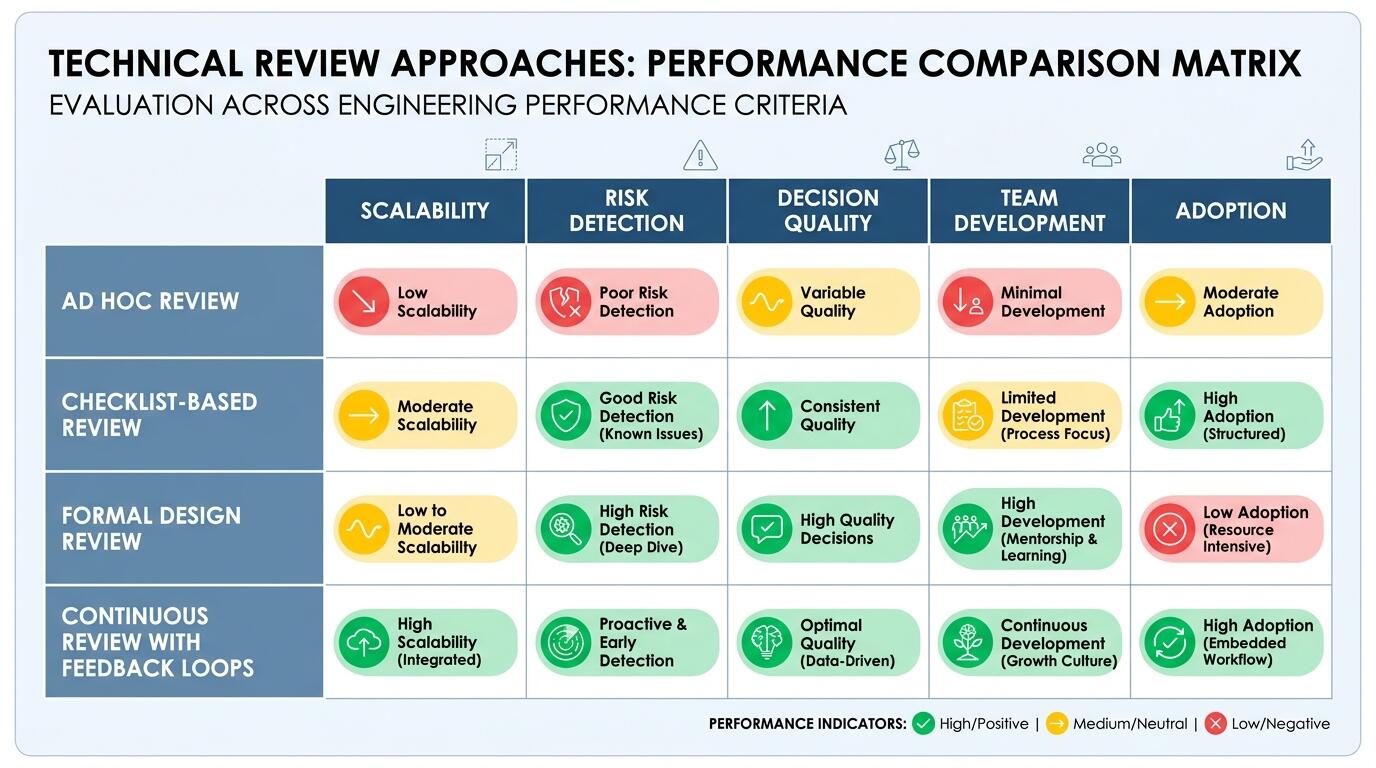
ALT: Comparison table showing four technical review approaches evaluated against engineering team performance criteria
Questions & Answers
Q1: How do you run a technical design review for an AI system architecture?
Running a technical design review for an AI system architecture requires attention to concerns that don't appear in standard software reviews: data pipeline reliability, model evaluation criteria, inference latency at scale, and feedback loop design. The proposal document should address not just what the system does, but how it fails — what happens when model quality degrades, when input distribution shifts, or when a dependency changes. Reviewers should include someone with production ML experience, not just software architects.
Q2: Are formal technical reviews necessary for small startups, or are they overhead?
Formal design reviews are not overhead for small startups — they are selective investments. The mistake is applying formal review to every decision rather than calibrating review depth to decision consequence. A five-person team shipping a new microservice should use a brief async design document and a focused discussion. A five-person team choosing its core data architecture or AI model serving strategy should run a proper review — the cost of a wrong decision at that scale is disproportionately high, and a structured review is cheap insurance.
Q3: How long does it take to establish a continuous technical review culture on a team?
Establishing consistent continuous review norms typically requires sustained leadership attention across multiple weeks of deliberate practice — not months of process design. The fastest path is to model the behavior explicitly: write thorough, reasoned review comments yourself, create a simple pull request template, and hold one architecture sync to establish the expectation. Consistency compounds — teams that maintain the practice past the initial period typically self-sustain it, because engineers experience the value directly.
Wrapping Up
Running effective technical reviews is not about adding more process — it's about applying the right level of rigor to the right decisions, consistently.
Key Takeaways:
- Ad hoc review is the default, not a strategy; it must be replaced with intentional structure as a team grows.
- Checklist-based review ensures compliance but cannot substitute for genuine design critique.
- Formal design review is essential for high-stakes architectural decisions but too expensive to apply universally.
- Continuous review with embedded feedback loops is the foundational framework that scales across team sizes and decision types.
- The culture of a review — psychological safety, modeling good feedback behavior, treating disagreement as signal — matters as much as the process itself.
The next step is an honest assessment: pick the single weakest link in your current review practice and close that gap first. If your team has no formal design review for significant decisions, start there. If you have process on paper but inconsistent adoption, the investment is in culture, not more documentation.
If you're building an engineering organization and want guidance grounded in real delivery experience — from AI architecture to full-stack systems — explore the technical insights and shipped-product case studies at the Darius website.
Sources
- The Pragmatic Engineer. "Leading Effective Engineering Teams: a Deepdive".
https://newsletter.pragmaticengineer.com/p/leading-effective-engineering-teams - EM Tools. "Engineering Performance Review Framework (With Examples)".
https://www.em-tools.io/frameworks/performance-review-framework - IEEE. Institute of Electrical and Electronics Engineers — standards and resources for software and systems engineering practice.
https://www.ieee.org/
Note: Standards and frameworks may be updated; please check the latest official documents or consult professional advisors.