Designing Multi-Agent Systems: Lessons from Real Deployments
ALT: Designing multi-agent systems architecture with real-world deployment lessons for AI engineers
Why Multi-Agent System Design Is Harder Than It Looks in Production
You've seen the demos: a swarm of AI agents collaborating seamlessly, routing tasks, checking each other's work, and producing polished outputs with minimal human intervention. Then you try to deploy something similar in a real product environment, and the gap between the whiteboard and production becomes painfully clear. Designing multi-agent systems that actually hold up — systems that are robust, maintainable, and economically viable — demands a fundamentally different mindset than prototyping one.
The core conclusion from building these systems hands-on is this: multi-agent architecture is not primarily a model selection problem. It is a systems design problem. The agents are the easy part. Coordination, failure handling, observability, and cost governance are where production deployments succeed or fail. This article distills the lessons learned from working across real deployments — the patterns that work, the anti-patterns that burn time and money, and the architectural decisions that determine whether your system ships or stalls.
Where Multi-Agent Architectures Apply — and Where They Don't
Applicable Scenarios:
- Complex workflows with genuinely parallel or sequential subtasks that benefit from specialization — for example, a research pipeline where one agent retrieves sources, another synthesizes, and a third fact-checks
- Products requiring adaptive, context-aware orchestration where a single prompt chain would collapse under edge cases — such as a customer operations system handling diverse intent types
- Teams that have already shipped a working single-agent or chain-based product and are hitting clear capability ceilings that more agents would address
Not Applicable/Cautions:
- Early-stage MVPs where a single well-prompted LLM call would solve the problem — adding agent orchestration before you understand your core workflow is an expensive form of over-engineering
- Use cases without robust observability tooling in place — deploying multiple autonomous agents without structured logging and tracing turns debugging into archaeology
- Organizations that lack the engineering bandwidth to own the operational complexity multi-agent systems introduce, including failure recovery, cost monitoring, and prompt governance
The State of Multi-Agent Systems in Applied AI Engineering
Multi-agent systems (MAS) are architectures in which multiple autonomous AI agents — each with defined roles, tools, and scopes of action — collaborate or compete to accomplish goals that a single agent could not reliably achieve alone. The concept draws on decades of academic research in distributed systems and autonomous agent theory, but its practical relevance has accelerated sharply with the maturation of large language model (LLM) APIs and function-calling capabilities.
According to Cognizant's AI Lab research on multi-agent systems, organizations are increasingly adopting these architectures to handle tasks requiring diverse reasoning modes, parallel execution, and role-based specialization — from autonomous coding assistants to enterprise workflow orchestration. The appeal is real: specialization improves output quality, parallelism reduces latency, and modularity theoretically improves maintainability.
But "theoretically" is doing a lot of work in that last sentence. A pattern that consistently emerges in applied work is that teams underestimate the combinatorial complexity introduced by agent-to-agent communication. Each inter-agent boundary is a failure surface. Each tool call is a latency and cost event. And unlike a monolithic prompt chain, a multi-agent system can fail in ways that are difficult to detect — agents confidently completing their subtasks while the system-level output is quietly wrong.
The Designing Multi-Agent Systems reference — a practitioner-oriented resource covering architectural patterns for modern agentic applications — frames this clearly: the architectural decisions you make early about agent roles, communication topology, and state management will constrain every subsequent engineering decision. Getting these right is not a finishing step; it is the foundation.
For founders and CTOs evaluating whether to invest in multi-agent architecture, the business case depends heavily on whether the target workflow has genuine parallelism or specialization requirements. If it doesn't, you are buying complexity without buying capability. At Darius, the first question in any AI architecture engagement is always: does this problem actually require multiple agents, or does it require a better-designed single agent?
Building Production-Grade Multi-Agent Systems: A Practitioner's Playbook
Three Steps to Get Your Architecture Off the Ground
Step 1: Map the Workflow Before Designing Any Agent
Before defining a single agent, document the target workflow as a directed graph. Identify every discrete step, every decision point, and every data dependency. Annotate which steps are parallelizable, which are sequential, and which require validation from another step's output. This exercise typically takes several focused working sessions for a real production workflow, and it will reveal whether you actually need agents or just a better orchestration layer. Most teams skip this step and pay for it in refactoring costs later.
Step 2: Define Agent Roles, Scopes, and Failure Contracts
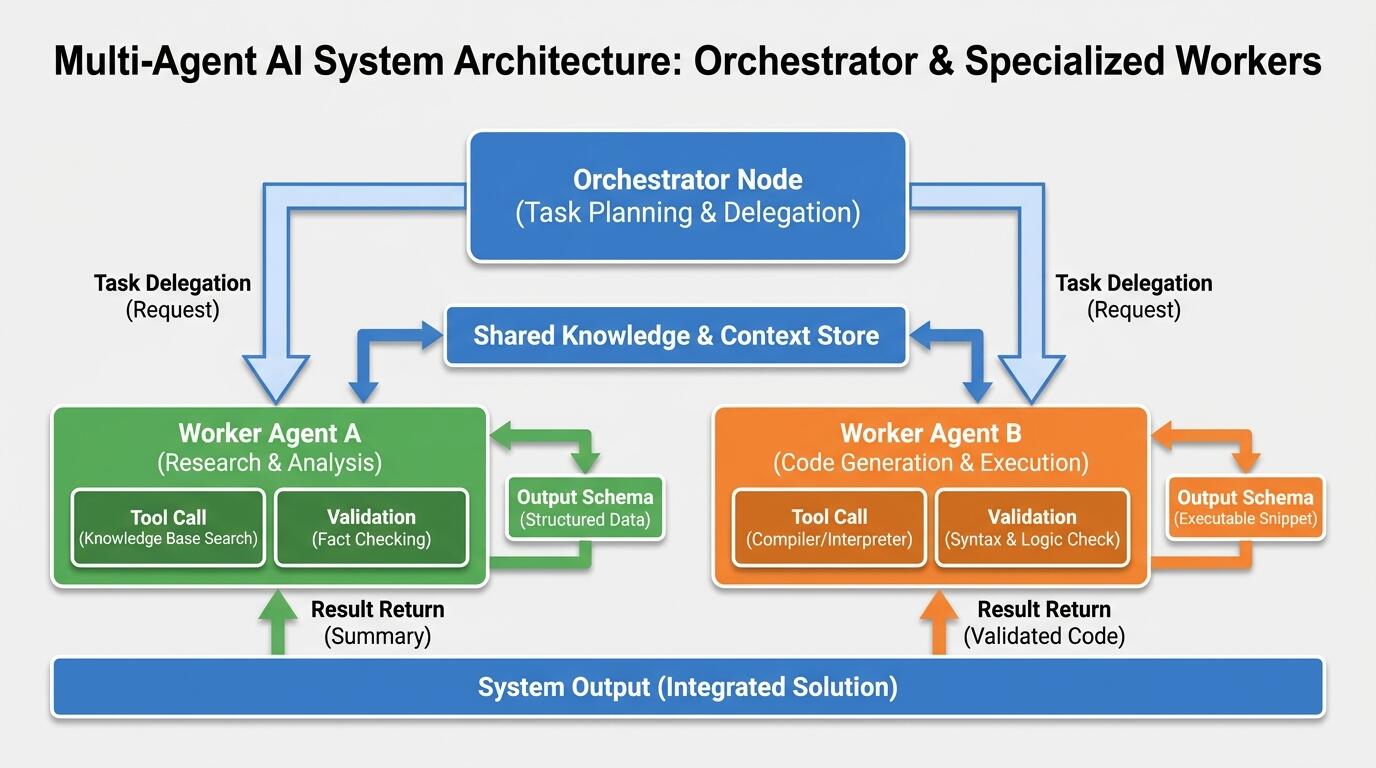
Once the workflow graph is clear, assign agent roles to nodes — but constrain each role tightly. A well-designed agent has a narrow scope, a defined set of tools, and an explicit contract for what it returns and under what conditions it escalates or fails. Document failure modes for each agent before writing a line of code. Ask: what does this agent do when its tool call times out? When its LLM output is malformed? When the input from the upstream agent is incomplete? Answering these questions in design rather than in production debugging is one of the highest-ROI investments in multi-agent architecture.
Step 3: Instrument Everything Before You Scale
Before adding more agents or tools, instrument the system thoroughly. Every agent call, tool invocation, token count, latency measurement, and inter-agent message should be logged and traceable. Set up structured logging from the first deployment, not after the first production incident. In practice, the cost of adding observability retroactively — both in engineering time and in the cognitive load of debugging an opaque system — far exceeds the cost of building it in from day one. Treat observability as a first-class architectural concern, not a DevOps afterthought.
Comparing Common Multi-Agent Topology Patterns
Different orchestration topologies suit different problem structures. Choosing the wrong topology for your use case is one of the most common and costly architectural mistakes in multi-agent deployments. The following comparison covers the three patterns most frequently encountered in production AI systems.
| Comparison Dimension | Hierarchical (Orchestrator-Worker) | Peer-to-Peer (Collaborative Mesh) | Pipeline (Sequential Chain) |
|---|---|---|---|
| Best suited for | Complex tasks with diverse subtasks requiring central coordination | Tasks requiring iterative negotiation or cross-validation between agents | Linear workflows with clear sequential dependencies |
| Coordination overhead | Medium — centralized orchestrator manages routing | High — all agents must handle messaging and state | Low — each agent hands off to the next |
| Failure isolation | Good — orchestrator can detect and reroute worker failures | Challenging — failures propagate laterally | Moderate — downstream agents inherit upstream errors |
| Observability complexity | Moderate — single coordination point to instrument | High — distributed message graph is hard to trace | Low — linear trace is straightforward |
| Cost predictability | Moderate — orchestrator adds token overhead | Low — highly variable depending on negotiation rounds | High — deterministic path means predictable token spend |
| Recommended maturity level | Teams with prior agent deployment experience | Advanced teams with strong distributed systems backgrounds | Teams new to multi-agent systems or with simple workflows |
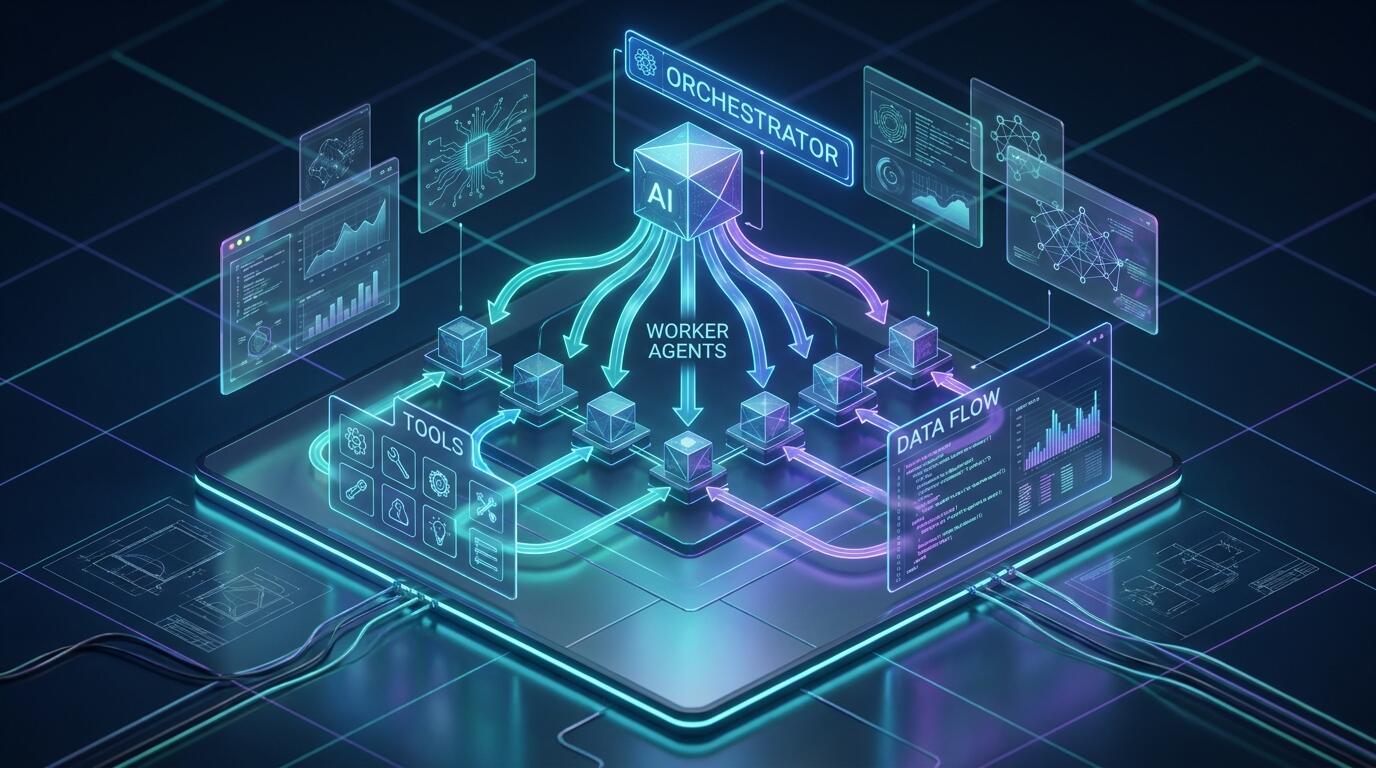
The hierarchical pattern — an orchestrator agent that decomposes tasks and delegates to specialized worker agents — is the topology most commonly encountered in production deployments, and for good reason. It maps naturally to how engineering teams already think about task decomposition, it provides a clean coordination point for observability, and it keeps failure handling centralized. In work across multiple AI product engagements, this pattern has consistently delivered the best balance of capability and operational manageability for teams at the early-to-mid stage of agentic maturity.
The Lessons That Only Show Up in Production
Lesson One: Token Cost Is an Architectural Variable, Not an Operational Detail
In prototype environments, token cost is easy to ignore. In production, it becomes a primary constraint that shapes architectural decisions. Each agent-to-agent communication passes context — and context costs tokens. In a multi-agent system with deep hierarchies or frequent inter-agent messages, context accumulation can make individual workflows dramatically more expensive than a single-agent equivalent.
The practical response is to treat context management as a first-class design concern. Define what context each agent actually needs, pass only that, and use structured summaries rather than full conversation histories wherever possible. In deployments where this discipline was applied from the start, token costs for equivalent task completion were materially lower than in systems where context was passed unrestricted.
Lesson Two: Agents Fail Silently in Ways That Propagate Downstream
A single-agent system that produces a bad output is obvious — you see a bad output. A multi-agent system where one worker agent produces a subtly incorrect output can propagate that error through several subsequent agents before it surfaces in a way that is detectable. Each downstream agent treats the upstream output as ground truth unless explicitly instructed to validate it.
The design response to this reality is twofold. First, build validation agents or validation steps into workflows at defined checkpoints — not everywhere, but at critical junctions where an incorrect output would cascade. Second, design agent output schemas to be explicit and parseable, so that malformed or incomplete outputs fail loudly rather than being silently passed forward. Schema validation at inter-agent boundaries is one of the simplest and highest-value additions to any multi-agent architecture.
Lesson Three: Human-in-the-Loop Is an Architecture Decision, Not a UX Afterthought
A recurring pattern in early multi-agent deployments is treating human oversight as a UI feature that can be added later. In practice, where in the workflow a human can intervene, review, approve, or override is a fundamental architectural question. It determines which agents need to be interruptible, how state is persisted across sessions, and how the system recovers from human corrections.
Getting this right requires deciding human intervention points during the workflow design phase — Step 1 of the quick-start above. Teams that retrofit human-in-the-loop often end up with brittle integration points, inconsistent state management, and poor user experiences. The systems that handle this well treat human review as a first-class event in the agent workflow graph, with the same care given to any other node.
Lesson Four: Autonomy Level Is a Dial, Not a Binary Switch
Multi-agent system design often gets framed as a question of how autonomous to make agents. The more useful framing is: for each agent role and each decision type, what is the appropriate autonomy level, and what conditions should trigger escalation to a higher authority — whether another agent or a human?
Mapping autonomy levels explicitly during design — using a simple matrix of action type versus autonomy level — prevents both under-automation (agents that check in too frequently, defeating the purpose of the architecture) and over-automation (agents that make consequential decisions without sufficient validation). This is particularly important in production deployments where the system interacts with external services, writes to databases, or sends communications.
Advanced Considerations: Avoiding the Most Costly Mistakes
Misconception: More agents means more capability. In practice, adding agents adds complexity and cost. A common failure mode is decomposing a workflow into too many fine-grained agents, each with a narrow role, creating coordination overhead that exceeds any benefit from specialization. The right number of agents is the minimum that genuinely requires specialization — not the maximum that could theoretically be justified.
Misconception: LLM reliability makes fault tolerance optional. Even with frontier models, LLM outputs are probabilistic. In multi-agent systems, this means that rare failure modes at the individual agent level become frequent events at the system level, because the system executes many agent calls per workflow. Designing fault-tolerant agent orchestration — with retries, fallbacks, and graceful degradation — is not optional for production deployments. It is the difference between a system that works in demos and one that works for users.
Special case: Multi-agent systems across organizational boundaries. When a multi-agent system coordinates agents that touch different systems, data stores, or organizational ownership domains — a common pattern in enterprise deployments — governance and security constraints become architectural requirements. Who owns the orchestrator? Which agent can access which data? How are access credentials managed across agent contexts? These questions need answers before deployment, not after the first security review.
Relationship to broader AI architecture decisions: Multi-agent system design does not exist in isolation. It sits within a broader AI architecture that includes model selection, retrieval-augmented generation (RAG) design, fine-tuning decisions, and infrastructure provisioning. The most effective multi-agent architectures are designed with a clear view of the full stack — which is why end-to-end AI architecture expertise, from data layer to user-facing product, produces qualitatively better outcomes than narrow agent-layer specialization.
ALT: Multi-agent system architecture diagram illustrating orchestrator-worker coordination for production AI deployment
Frequently Asked Questions FAQ
Q1: How do you decide when a workflow actually needs multiple agents rather than a single, well-designed prompt chain?
The clearest signal is genuine task specialization or parallelism — situations where different subtasks require different tools, different context, or different reasoning modes that would conflict if handled by one agent. If you can achieve the outcome with a single agent and a structured prompt, that is almost always the right choice. Multi-agent architecture earns its complexity cost when the workflow has natural decomposition points that a single agent cannot manage without significant quality degradation or latency problems.
Q2: Are multi-agent systems significantly more expensive to run than single-agent pipelines?
They can be, and cost predictability decreases as agent count and inter-agent communication increases. The primary cost drivers are token consumption from context passing between agents, increased LLM call volume, and orchestration overhead. Teams that manage this well do so through disciplined context minimization, structured output schemas that reduce retry rates, and careful selection of model tiers — using smaller, cheaper models for simpler subtasks and reserving frontier models for reasoning-intensive roles.
Q3: How long does it typically take to move a multi-agent prototype into a production-ready system?
This varies substantially based on workflow complexity, team experience, and the rigor of observability and fault-tolerance requirements. In practice, the gap between a working prototype and a production-grade deployment is almost always larger than teams initially estimate. The primary time investment goes into failure handling, observability instrumentation, and human-in-the-loop integration — none of which are visible in a demo but all of which are essential for a system real users depend on. Planning for this gap explicitly, rather than discovering it during launch preparation, is one of the most valuable things a team can do.
The Bottom Line
Multi-agent systems are not a feature you add to a product — they are an architectural commitment that shapes every subsequent engineering decision. Three principles consistently separate deployments that succeed from those that stall:
First, design the workflow before designing the agents. The graph of tasks, decisions, and dependencies is the foundation; the agents are how you execute it. Second, treat token cost, failure handling, and observability as first-class architectural concerns from day one — not as optimizations for a later sprint. Third, match the autonomy level of each agent to the risk and reversibility of its decisions, and build escalation paths as explicitly as you build the happy path.
For founders and technical leaders evaluating whether to invest in multi-agent architecture, the most important question is not "what can these agents do?" It is "what does this system need to do reliably, at what cost, and with what operational overhead?" Getting clear answers to those questions before designing the architecture is how you avoid the expensive rebuilds that plague most first-generation deployments.
If you are at the stage of evaluating or designing a multi-agent system for a real product, working with someone who has shipped these systems — not just prototyped them — compresses the learning curve significantly and protects you from the failure modes that only become visible in production.
If you're building a product that requires serious AI architecture and want to move from idea to deployed system without the expensive detours, explore the work, shipped projects, and technical insights at the Darius website — and get in touch to discuss what your system actually needs.
Sources & Citations
- Cognizant AI Lab. "Multi-Agent Systems: Architecture, Applications & Real ..."
https://www.cognizant.com/us/en/ai-lab/blog/what-are-multi-agent-systems - Multiagentbook.com. "Designing Multi-Agent Systems: Home"
https://multiagentbook.com/ - LinkedIn / Victor Dibia. "How to read Designing Multi-Agent Systems book quickly"
https://www.linkedin.com/posts/dibiavictor_designing-multi-agent-systems-activity-7396215722085040128-1UX5
Note: The multi-agent systems landscape evolves rapidly. Verify architectural patterns and tooling recommendations against current documentation and community resources before making production decisions.