Data Pipeline Architecture Decisions for AI Applications in Production
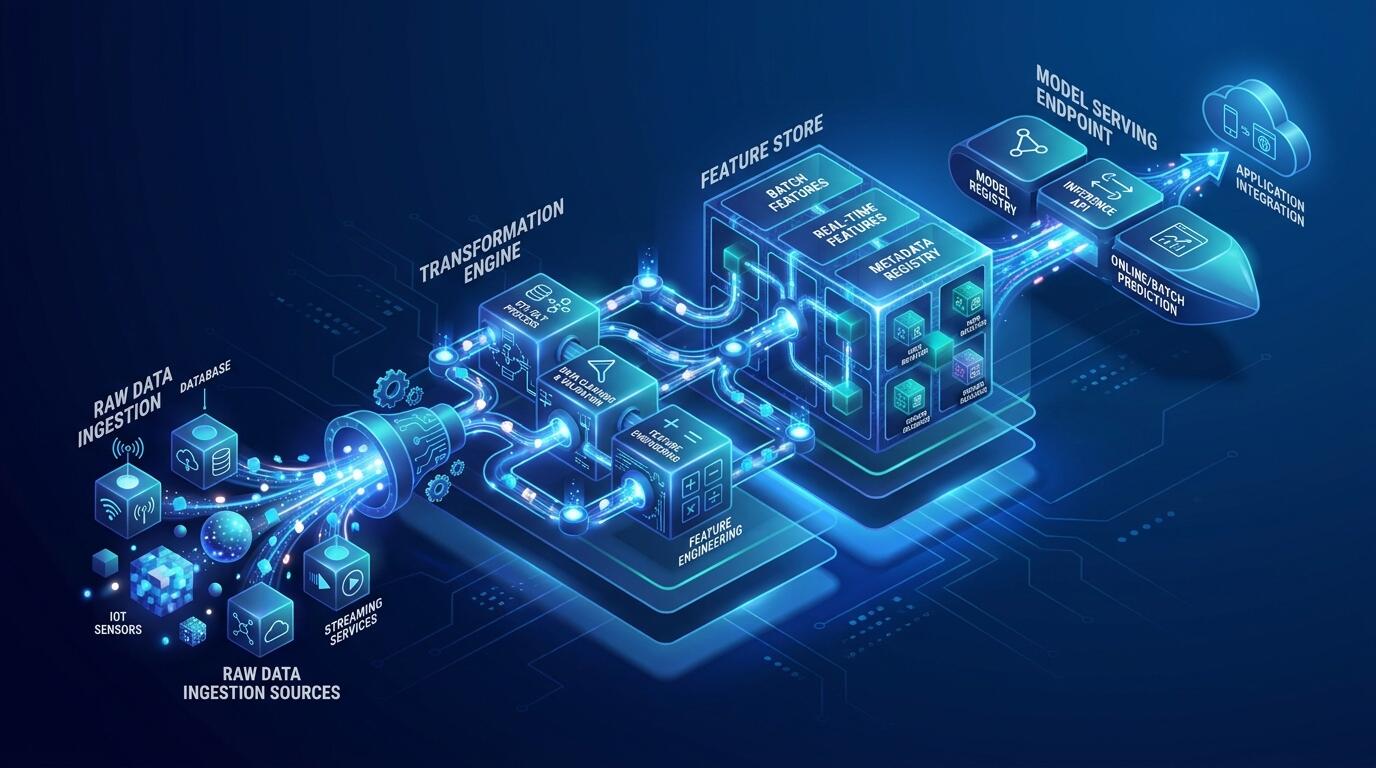
ALT: Data pipeline architecture decisions for AI applications running in production environments
Why AI Production Pipelines Fail Before They Ship
Key Conclusion: Data pipeline architecture decisions for AI applications in production are not engineering afterthoughts — they are the foundation that determines whether a model ever delivers value. The choices made around ingestion patterns, transformation logic, schema contracts, and latency tolerance will define system reliability, cost trajectory, and how fast teams can iterate. Getting these decisions right early is one of the clearest differentiators between AI projects that ship and those that stall indefinitely in staging.
Most AI projects do not fail because the model is wrong. They fail because the infrastructure surrounding the model cannot sustain real-world data volume, variability, or velocity. A pattern that surfaces repeatedly in engineering work at the intersection of AI and systems design is teams that invest heavily in model quality but treat the data pipeline as a bridge to build later — and then spend months backfilling decisions that should have been made on day one.
The Current State of AI Data Infrastructure
AI data pipelines have matured considerably over the last several years, but the maturity of available tooling has outpaced most teams' ability to evaluate and choose correctly. The ecosystem now includes stream processors, feature stores, vector databases, transformation orchestrators, data contract frameworks, and a growing class of "AI-native" pipeline platforms — each promising to simplify what is, at its core, a deeply contextual problem.
According to Teradata's analysis of AI pipeline architecture, a production AI data pipeline is a system that collects, transforms, stores, and serves data to machine learning models in a reliable, repeatable, and scalable way — and crucially, the architecture of that system must be designed around the characteristics of the data and the latency requirements of the model, not the other way around. This framing matters because it shifts ownership of pipeline decisions from infrastructure teams to the product and AI architects who understand what the model actually needs.
The industry is also grappling with a newer challenge: the rise of large language models and retrieval-augmented generation (RAG) systems has introduced data pipeline patterns that did not exist in classical ML workflows. Pipelines now need to handle document ingestion, embedding generation, vector index updates, and retrieval serving — each with its own throughput, latency, and freshness tradeoffs. As documented by VeloDB in their glossary on AI data pipelines, the architecture of these systems must account for both structured and unstructured data at every stage, from raw ingestion through to model-ready feature surfaces.
The result is an environment where engineering teams face genuinely novel decisions — and where the cost of a wrong architectural choice is higher than it has ever been, because the wrong choice tends to get embedded into tooling, contracts, and team habits before anyone notices it is wrong.
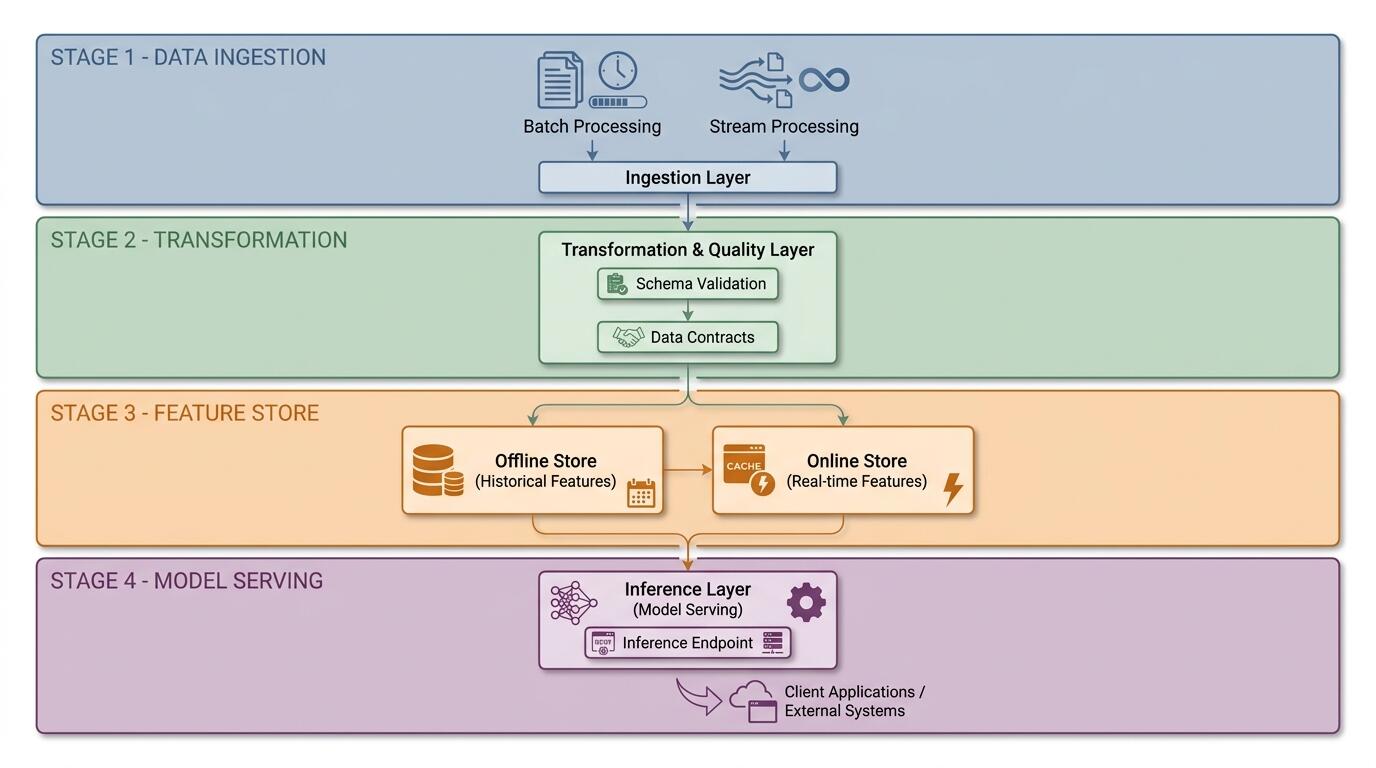
ALT: Diagram showing AI data pipeline architecture stages including ingestion, transformation, feature store, and model serving layers for production systems
Breaking Down the Core Architecture Decisions
The architecture of a production AI data pipeline is not a single decision — it is a sequence of layered choices, each one constraining the options available at the next layer. Understanding these decisions individually, and the dependencies between them, is where experienced AI architects earn their keep.
Batch vs. Stream vs. Lambda: Choosing the Right Ingestion Pattern
The ingestion pattern — whether data enters the pipeline in scheduled batches, as a continuous stream, or through a hybrid lambda architecture — is the foundational decision that shapes everything downstream. Batch pipelines are simpler to reason about, easier to replay, and cheaper to operate at moderate scale. Stream pipelines reduce latency and enable real-time model serving but introduce complexity around state management, ordering guarantees, and failure recovery.
A lambda architecture attempts to provide both, maintaining a batch layer for accuracy and a speed layer for low latency. In practice, lambda architectures are expensive to maintain because they require two separate codebases that must produce identical outputs — and divergence between them is a common source of subtle, hard-to-diagnose production bugs. The cleaner modern alternative for many teams is a kappa architecture, which processes all data through a single stream pipeline with the ability to replay historical events.
The right choice depends on the model's latency requirements. A fraud detection model that must score transactions in under 100 milliseconds has fundamentally different infrastructure needs than a churn prediction model that refreshes overnight. Mismatching the ingestion pattern to the latency requirement is one of the most expensive mistakes teams make — often discovered only when the system is in staging and the rewrite cost is already significant.
Schema Management and Data Contracts
Schema drift is among the most underestimated risks in production AI pipelines. Upstream data sources change — columns are renamed, types shift, nullable fields become required — and without explicit contracts enforcing schema stability, these changes propagate silently into model inputs, causing silent degradation rather than loud failures. Silent degradation is worse: the model keeps serving predictions that are subtly wrong, and teams often attribute the quality drop to model drift rather than data drift.
A data contract is a formal, versioned agreement between a data producer and a data consumer that specifies the structure, semantics, and quality expectations of a dataset. Establishing data contracts at the ingestion boundary is one of the highest-leverage architectural investments a team can make early. It transforms a class of silent failures into loud, detectable errors. Tools for enforcing contracts exist across the ecosystem, but the discipline of defining them is an organizational practice, not a tooling question.
Feature Engineering and the Role of a Feature Store
Feature engineering — the process of transforming raw data into model-ready inputs — is where most of the intellectual labor in ML pipelines lives. Without explicit architecture around feature management, teams end up with feature logic duplicated across training notebooks and serving code, which inevitably diverges and produces training-serving skew. This is a situation where the model is trained on features computed one way and served features computed a different way — sometimes with different logic, sometimes on different data distributions.
A feature store is a centralized system that manages the computation, storage, versioning, and serving of features for machine learning models. Per Databricks' documented best practices for data pipeline architecture, the separation of feature computation from model serving — with a shared feature store as the bridge — is a recommended pattern for teams building production ML systems at scale. The feature store does not need to be a commercial product; a well-designed internal service that enforces consistency between offline and online feature computation provides the same guarantee.
Orchestration, Lineage, and Observability
Pipeline orchestration is the scheduling and dependency management layer that ensures transformation steps run in the right order, handle failures gracefully, and support reruns. Orchestration failures are common in early production deployments, where teams underestimate the number of failure modes that emerge only under real traffic patterns.
Data lineage — the ability to trace a model prediction back through every transformation step to its raw source data — is essential for debugging, compliance, and model governance. Without lineage, debugging a prediction anomaly requires archaeological excavation through logs. With lineage, it becomes a structured investigation.
Observability in AI pipelines goes beyond infrastructure monitoring. It encompasses data quality monitoring (detecting distribution shifts in inputs), feature drift detection (identifying when feature values move outside training distributions), and model performance monitoring (catching degradation before it affects end users). These three layers of observability are distinct and require separate instrumentation strategies.
Comparing Architectural Approaches: Trade-offs in Practice
The decisions outlined above combine into identifiable architectural patterns, each with genuine strengths and real costs. In the work of designing AI systems that ship to production, the pattern that works is almost always the one that matches the team's operational maturity and the model's actual requirements — not the most sophisticated pattern available.
| Perspective / Approach | Strengths | Trade-offs | Best Fit |
|---|---|---|---|
| Batch-only pipeline | Simple to reason about, easy to replay, lower operational cost | Latency measured in hours or days; limited real-time capability | Overnight analytics models, reporting, offline scoring |
| Pure streaming pipeline | Low latency, continuous data freshness, event-driven reactions | Higher complexity, harder to test, state management overhead | Fraud detection, real-time personalization, live monitoring |
| Lambda architecture | Combines batch accuracy with stream speed | Dual codebase maintenance, divergence risk, high operational burden | Teams with legacy batch infrastructure that need real-time layered on |
| Kappa architecture | Single codebase, stream-first with replay capability | Requires robust stream infrastructure, harder to optimize for analytical queries | Greenfield systems prioritizing consistency and operational simplicity |
| Feature store-centric design | Eliminates training-serving skew, enables feature reuse across models | Adds architectural complexity, requires organizational buy-in | Multi-model products, teams scaling beyond a single use case |
The most consistent mistake observed in production AI projects is over-engineering the pipeline relative to the team's current scale. A startup with a single model and a modest data volume does not need a distributed feature store and a multi-region stream processor. It needs a pipeline that is correct, observable, and simple enough for a small team to maintain confidently. Complexity should be introduced in response to demonstrated need, not anticipated need.
Conversely, under-engineering the pipeline at the data contract and observability layers is consistently the source of the most painful post-launch incidents. These investments are cheap to make early and expensive to retrofit.
Where AI Pipeline Architecture Is Heading
The field is moving toward tighter integration between pipeline infrastructure and model lifecycle management. The boundary between a data pipeline and an ML platform is becoming harder to draw: feature stores are incorporating model metadata, orchestrators are gaining awareness of model training jobs, and monitoring systems are beginning to close the loop by triggering retraining when drift thresholds are crossed.
Several trends are shaping the near-term landscape. Real-time AI use cases are accelerating, which is creating demand for pipeline architectures that can serve fresh features with sub-second latency at scale. Multimodal data — combining text, images, audio, and structured records in a single pipeline — is becoming a practical requirement for production AI products rather than a research challenge. And regulatory pressure around AI governance is making data lineage and auditability infrastructure mandatory in regulated industries, pushing teams to build these capabilities earlier than they might have otherwise.
For engineering leaders evaluating their current stack, the most actionable near-term investment is usually observability. Most production AI pipelines are under-monitored. Teams discover problems through user complaints rather than through instrumented alerts. Building comprehensive monitoring across data quality, feature drift, and model performance pays dividends immediately and compounds over time.
The second most impactful investment is data contracts at ingestion boundaries. This is especially true for teams consuming data from external systems, partner APIs, or internal teams with their own release cadences. A formal contract does not prevent upstream changes — but it ensures those changes are detected immediately rather than silently absorbed.
Questions & Answers
Q1: How do you choose between batch and streaming for an AI production pipeline?
Choosing between batch and streaming for an AI production pipeline starts with the model's latency requirement. If the model must serve predictions within seconds or milliseconds of an event, a streaming architecture is necessary. If predictions can be precomputed on a schedule — hours or overnight — batch processing is simpler and cheaper. Most teams benefit from starting with batch and introducing streaming only when a validated use case demands it, avoiding premature complexity.
Q2: Are data contracts necessary for smaller AI teams or early-stage products?
Data contracts are valuable at any team size, but the implementation can be proportional to scale. For smaller teams, a lightweight contract — even a documented schema with automated validation checks at ingestion — provides the core protection against silent data drift without requiring enterprise tooling. The risk of skipping contracts entirely is silent model degradation after an upstream schema change, which is a costly debugging exercise regardless of team size.
Q3: How long does it typically take to build a production-grade AI data pipeline?
The time required depends heavily on data volume, the number of source systems, team experience with the chosen tooling, and whether observability and data contracts are built in from the start or added later. Teams that architect for production from the beginning — including monitoring, schema validation, and lineage — typically see faster total time to stability than teams that build quickly without these foundations and then retrofit them after encountering production incidents.
Final Thoughts
Getting data pipeline architecture right for AI applications in production is not about choosing the most sophisticated tools — it is about making deliberate, well-reasoned decisions that match the model's actual requirements, the team's operational capacity, and the organization's tolerance for complexity.
Key Takeaways:
- Match your ingestion pattern (batch, stream, or kappa) to the latency requirements of your model, not to the most fashionable architecture in the ecosystem.
- Establish data contracts at ingestion boundaries early — they are cheap to implement and prevent the most painful class of production failures.
- Eliminate training-serving skew by enforcing consistent feature computation between offline training and online serving, whether through a feature store or a well-disciplined internal service.
- Build observability across three distinct layers: data quality, feature drift, and model performance — monitoring infrastructure metrics alone is insufficient for AI systems.
- Introduce architectural complexity in response to demonstrated need, not anticipated need — over-engineering relative to current scale is as costly as under-engineering.
The next step for most teams is an honest assessment of where their current pipeline has gaps: which of these layers — contracts, feature management, observability, orchestration — is the weakest link, and what is the cost of leaving it unaddressed for another quarter?
If you are building or scaling an AI-powered product and want a structured review of your pipeline architecture and technical strategy, explore real shipped projects and connect directly through the Darius website — where engineering depth meets end-to-end product execution.
Sources
- Teradata. "AI Data Pipeline: A Guide to Stages and Architecture".
https://www.teradata.com/insights/ai-and-machine-learning/ai-data-pipeline - VeloDB. "AI Data Pipeline Explained: Architecture, Workflow & How It Works".
https://www.velodb.io/glossary/ai-data-pipeline - Databricks. "Data Pipeline Best Practices: Architecture, Modern Approaches".
https://www.databricks.com/blog/data-pipeline-best-practices - IEEE. IEEE Standards Association — Standards and Resources for Data Engineering and AI Systems.
https://www.ieee.org - NIST. National Institute of Standards and Technology — AI Risk Management and Data Infrastructure Guidance.
https://www.nist.gov
Note: Standards and best practices in this domain evolve rapidly. Consult the latest official documentation from relevant standards bodies and authoritative sources before making production architecture decisions.