AI Weekly Roundup: GPT-5.6, On-Device Models & Humanoid Robot Breakthroughs Across 4 Platforms
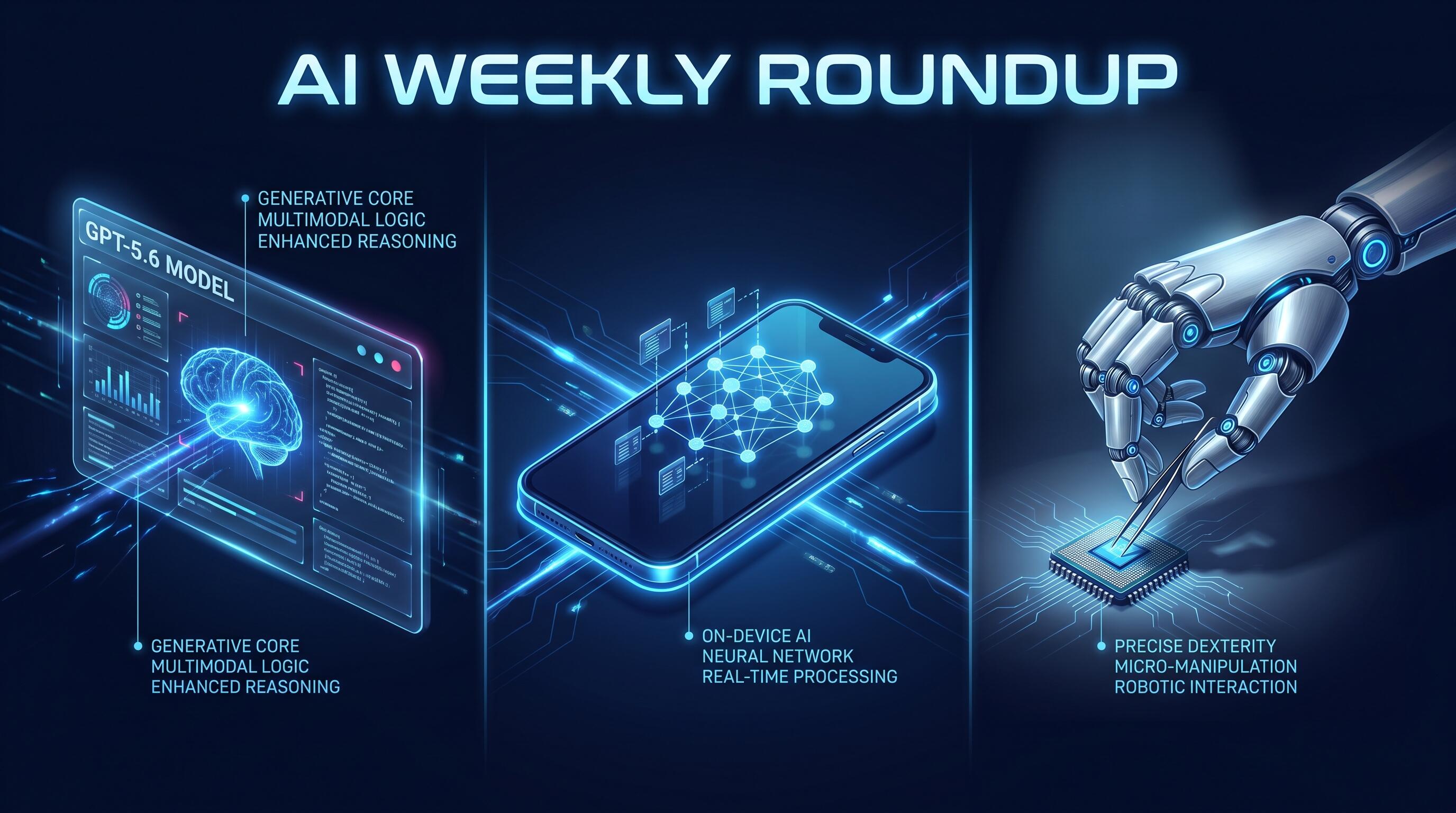
ALT: A visual overview of this week's major AI breakthroughs including GPT-5.6 upgrades, on-device AI models, and humanoid robot dexterity advances.
This past week was one of those moments in AI where it became genuinely difficult to keep up. Across our published content, we covered a dense cluster of developments — major model upgrades from OpenAI, Meta, Google, and Grok; open-source releases from Tencent and Alibaba; new multimodal image generation tools from Reve and ByteDance; and a robotics hardware breakthrough that felt like a genuine milestone. The unifying thread was speed: the pace of iteration across every layer of the AI stack — foundation models, edge deployment, creative tooling, and physical hardware — accelerated noticeably in a single week. We published across LinkedIn, Pinterest, TikTok, and YouTube, each with a distinct angle suited to its audience. Here's how we approached it and what we think held up.
Reviewing Our AI Weekly Roundup Posts
LinkedIn: Setting the Professional Frame
Our LinkedIn post was deliberately written for a professional audience that tracks AI not just out of curiosity, but because it shapes business and career decisions. We opened with a direct question — what happened in AI this week that's worth your attention? — and then delivered a dense but readable bullet-style summary: GPT-5.6 merging with Codex into a productivity application, the flagship voice model supporting real-time interruptions, Meta and Grok's model capability improvements, Tencent's open-source agent release, Qwen running locally on an iPhone, new image generation models from Reve and ByteDance, and 1X's humanoid dexterous hand.
The Angle and Its Value
What we were going for here was editorial credibility — signal over noise for people who don't have time to track every AI publication. The closing question, "Which direction are you most focused on?", was intentional: LinkedIn rewards conversation, and we wanted to open a genuine dialogue rather than broadcast a list. The post held together because each item named something concrete and specific rather than making vague claims about "the future of AI."
Pinterest: Scannable, Saveable, Visual-First
The Pinterest post required a completely different editorial approach. Pinterest is a save-for-later platform — people pin content they want to return to, not necessarily consume immediately. So we distilled the week's developments into five tight, visually formatted bullet points: GPT-5.6 merging Codex, on-device large models on iPhone, new image generation models, open-source world models and 3D tracking tools, and humanoid robot hands.
Adapting Depth for Discovery
We made a conscious choice to strip away the nuance and optimize for scannability. Phrases like "save this for your AI reading list" reflect the platform's save-driven behavior. The tradeoff is that depth is sacrificed — this post won't satisfy someone looking for context. But that's appropriate: its job is to surface these topics to people who might not yet know to look for them, and then hand them off to richer content.
TikTok: One Minute, Maximum Energy
Our TikTok post leaned hard into the short-form video format's defining constraint: capture attention in the first two seconds or lose it entirely. We framed the week as a "one-minute speed run" of AI news and led with the three highest-impact items — GPT-5.6 going live and merging Codex into a super-app, Qwen running on iPhone, and the humanoid dexterous hand reaching human-level performance. The copy closed with "come see what you missed", a framing that plays on the fear of falling behind that's genuinely widespread in the AI-curious audience.
Compression as a Creative Constraint
Writing for TikTok forces useful editorial discipline. By being required to pick three items instead of eight, we had to decide what was actually most significant this week. That selection itself carries editorial value — we were not summarizing, we were curating.
YouTube: The Full Briefing
The YouTube video was the most comprehensive piece of the set. Structured as a sub-one-minute weekly AI briefing, it organized the week's developments into four clear clusters: major lab model updates (OpenAI, Grok, Meta, Google), edge and open-source moves (Tencent, Alibaba Qwen, Codex-assisted tooling), multimodal and creative AI (Reve, ByteDance, Alibaba's digital human and world model, 3D tracking and audio-to-MIDI tools), and robotics hardware (1X's dexterous hand, the AI glove for skill transfer).
Structure as Editorial Argument
Organizing the content into these four buckets was itself an argument — that this week's news wasn't a random scatter of announcements but reflected coordinated momentum across the entire AI stack simultaneously. The YouTube format gave us room to make that structural point, which the shorter-form posts couldn't. It's the piece we'd point someone to if they wanted to actually understand the week, not just know its headlines.
Cross-Post Insights: What We Were Really Saying
Looking across all four posts, a few things stand out about what we were collectively arguing.
The stack moved all at once. It wasn't a week where one layer of AI advanced while others stood still. Foundation model upgrades, on-device inference, creative generation tools, and physical robotics all had meaningful news simultaneously. That convergence is worth naming explicitly, because it changes the strategic picture for anyone building on or adjacent to AI.
Edge deployment crossed a threshold. Qwen running natively on an iPhone isn't just a technical curiosity — it signals that the capability gap between cloud and device is narrowing faster than most roadmaps anticipated. We touched on this across multiple posts because it has downstream implications for privacy, latency, and what applications become possible without a network connection.
Open source remained a serious counterweight. Tencent's agent model release, the Codex-assisted open-source tooling for video editing and design, the 3D tracking tool, and the audio-to-MIDI project all pointed to a healthy open-source ecosystem keeping pace with proprietary releases. We tried to represent this consistently rather than letting the headline-grabbing closed-model announcements crowd it out.
Key editorial takeaway: When we cover a weekly AI roundup, the goal isn't completeness — it's identifying the connective tissue between developments. A list of announcements is trivia; a structured view of simultaneous progress across layers is insight.
Here's a quick view of how each post approached the same content set:
| Post | Platform | Primary Angle | Depth Level |
|---|---|---|---|
| LinkedIn weekly roundup | Professional signal-filtering | Medium | |
| 5 AI Breakthroughs | Visual scannability, save-for-later | Low (by design) | |
| One-minute speed run | TikTok | High-energy curation, top 3 picks | Low (by design) |
| Full weekly briefing | YouTube | Structured, layered analysis | High |
Frequently Asked Questions
What is GPT-5.6 and how does the Codex merger change things?
GPT-5.6 is OpenAI's latest model release, and this week it was merged with Codex — OpenAI's code-focused model — into a unified productivity application. Rather than maintaining separate tools for language and code tasks, the integration creates a single interface with broader capability. This week's posts also noted the simultaneous launch of a flagship voice model supporting real-time interruptions, which meaningfully upgrades conversational interaction. Together, these moves position ChatGPT less as a chatbot and more as a general-purpose productivity environment.
What does on-device AI running on iPhone actually mean for everyday users?
On-device AI means a large language model runs locally on the phone's hardware — no internet connection required, no data sent to a cloud server. This week, Alibaba's Qwen model was reported running on an iPhone in this configuration. For everyday users, the immediate implications are faster response times, offline capability, and stronger privacy guarantees since queries never leave the device. It's a meaningful shift from the current model where most AI inference happens on remote servers.
What's significant about humanoid robot hands reaching human-level dexterity?
1X's dexterous hand demonstration this week represented a hardware milestone: robotic manipulation that matches human fine motor skill levels. What made the news more pointed was the pairing with an AI glove project that allows human skills to be directly loaded and reproduced by the robot — effectively transferring a learned physical skill rather than programming it manually. This combination of hardware capability and skill-transfer methodology is what makes the development notable beyond prior robotics milestones.
Conclusion
This week's content set was one of the more satisfying to produce because the underlying news genuinely warranted the breadth we gave it. Across four platforms, we tried to serve different audiences with the same underlying editorial judgment: this was a week where AI progress was simultaneous, layered, and consequential across multiple dimensions at once. The formats varied by necessity — a one-minute TikTok serves a different reader than a structured YouTube briefing — but the underlying curatorial stance stayed consistent.
If you've found this retrospective useful and want to follow our ongoing AI coverage as we publish it, the best starting point is our weekly YouTube briefing series — it's the format where we have the most room to connect the dots between developments, and it's designed to be genuinely time-efficient for people who want to stay current without getting lost in the noise.