What Does It Cost to Keep Three AI Products Online Every Month?
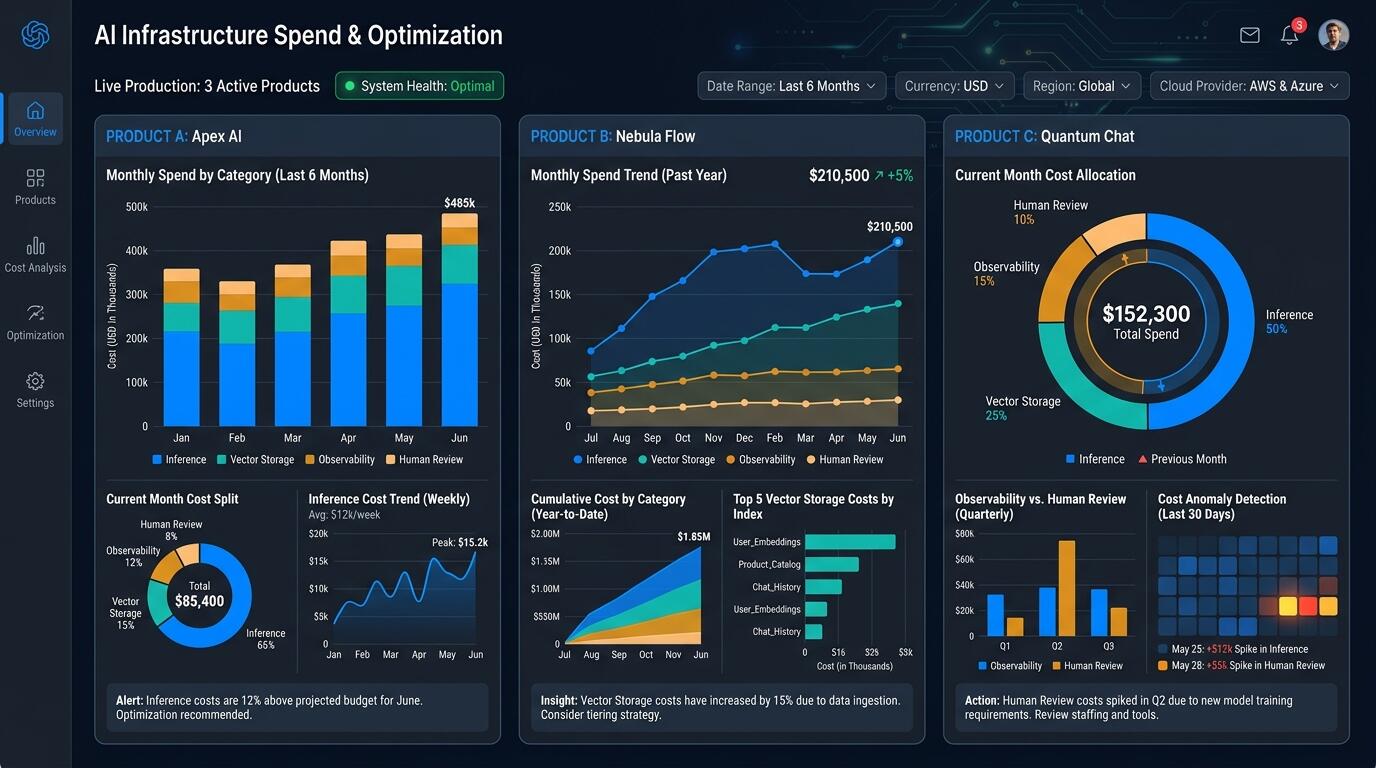
ALT: Monthly operating cost breakdown dashboard for three AI products running in production environments
The Real Monthly Bill: What It Actually Costs to Keep AI Products Running
Key Conclusion: Running three AI products in production simultaneously costs more than most teams budget for — and the surprise is rarely the model API itself. The recurring bill is shaped by a complex interplay of inference costs, vector storage, observability tooling, human review overhead, and the quiet tax of model-version drift. Teams that plan only for the "build" phase routinely underestimate steady-state operating expenses by a significant margin, and that gap compounds every month the products stay live.
Most articles about AI product costs stop at "API calls are cheap." That's true in isolation and misleading in practice. The moment you move from a prototype to a product that real users depend on, a second layer of costs appears — infrastructure, reliability, safety, and maintenance — and it doesn't announce itself with a single invoice. This article breaks down exactly what that second layer looks like when you're operating not one but three AI products at the same time.
How AI Product Operating Costs Got So Complicated
The steady-state cost of running an AI product in production is now a first-class engineering concern, not an afterthought. A few years ago, most AI products were either internal tools with low stakes or narrow automations with predictable call volumes. That calculus has changed. Models have become more capable, which means teams are shipping more ambitious products; users expect higher availability; and the vendor ecosystem has fragmented into dozens of specialist providers for embeddings, vector search, evaluation, monitoring, and fine-tuning.
The result is that the monthly operating bill for an AI product in 2025 is rarely a single line item. It is a portfolio of costs, each with its own pricing model, scaling behavior, and failure mode. When you multiply that portfolio across three products — each with different usage patterns, user bases, and model dependencies — the management overhead alone becomes material.
What's changed most recently is the pricing structure of frontier model APIs. Leading providers have moved toward tiered pricing with significant differences between cached and uncached tokens, input and output tokens, and priority versus batch inference. Teams that don't actively instrument their token usage end up paying for the most expensive configuration by default. We consistently see this pattern in production systems: teams overpay not because the model is expensive, but because they haven't tuned how they call it.
Beyond the model layer, the data infrastructure costs have risen as retrieval-augmented generation (RAG) — a technique that retrieves relevant documents from a knowledge base at inference time rather than baking all knowledge into the model — has become standard. Running a vector database at production scale, keeping embeddings fresh, and managing indexing jobs adds a non-trivial recurring cost that many teams discover only after launch.
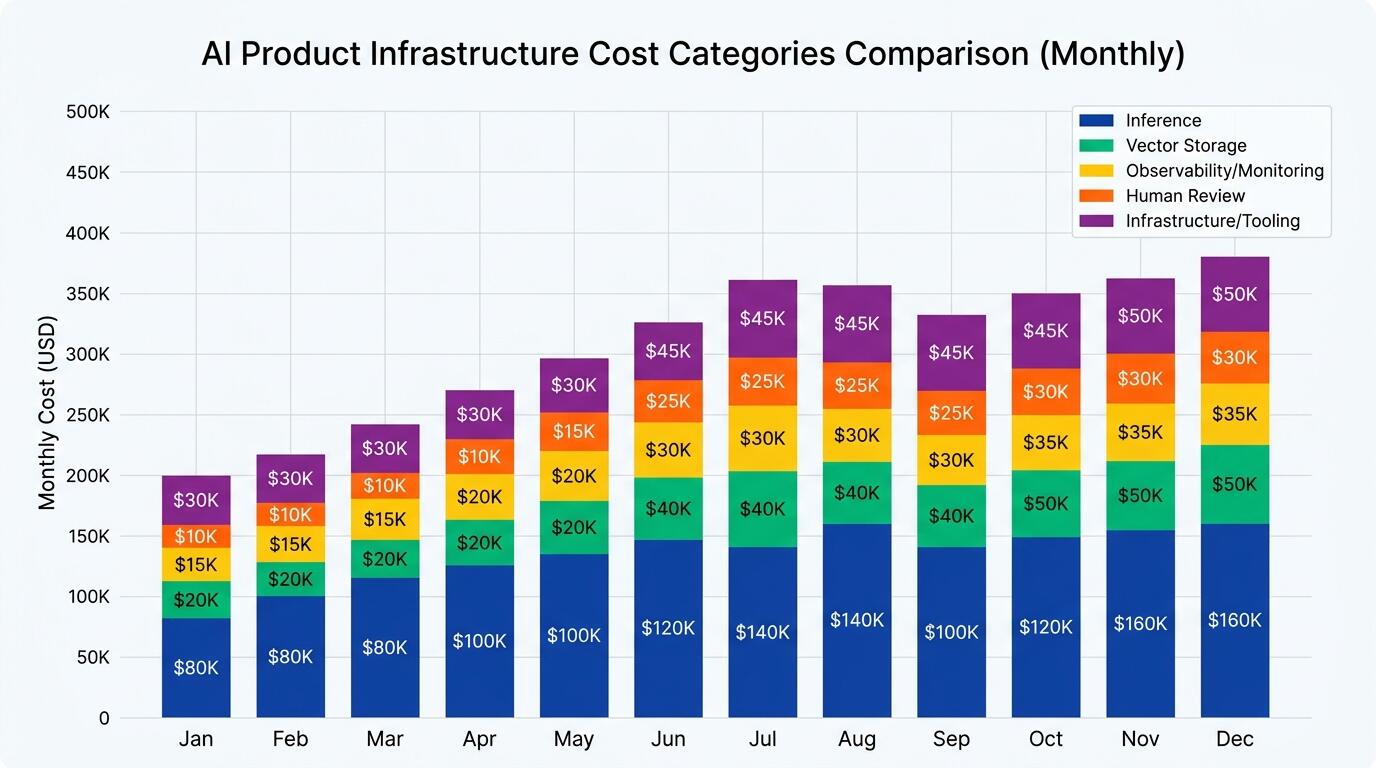
ALT: Stacked cost category comparison for AI product infrastructure including inference, vector storage, monitoring, and human review overhead
Where the Money Actually Goes: A Mechanism Analysis
The monthly cost of keeping an AI product online breaks down into five distinct cost centers. Understanding each one separately is the only way to manage them.
Inference Costs: The Visible Tip
Inference cost is the charge you pay each time your product calls a language model API. It is the most visible line item and, counterintuitively, often not the largest once a product matures. Inference pricing is typically metered by tokens — the units of text the model processes — with output tokens priced higher than input tokens because generation is computationally more expensive than reading.
The critical variable here is call frequency relative to user value. A product that makes five model calls per user interaction will cost five times more per session than one that consolidates context and makes one well-structured call. Prompt engineering discipline — writing system prompts that are concise without losing specificity — is therefore a direct cost control lever, not just a quality concern. Teams that treat their system prompt as a living document and audit its token count regularly tend to have more predictable inference bills.
Retrieval and Vector Storage: The Hidden Growth Engine
Vector storage refers to databases that store numerical representations (embeddings) of documents so that semantically similar content can be retrieved quickly at inference time. This infrastructure is foundational to RAG-based products and carries two cost components: storage (how much data you hold) and query throughput (how many retrievals you execute per second).
What makes this cost center dangerous from a budgeting perspective is that it scales with data growth, not just with user growth. Every time your product ingests new documents — support tickets, product updates, user-generated content — the index grows, and so does the storage bill. Teams that set up RAG pipelines without a data retention policy often find their vector storage bill growing steadily even during periods of flat user traffic. Keeping embeddings synchronized with source data is also a recurring compute job, which adds to the cost.
Observability and Evaluation: What You Can't Skip
Observability in AI products means logging inputs, outputs, latency, and model behavior at a level of granularity that lets you diagnose problems and detect regressions. Unlike traditional software observability — which mostly looks at system metrics — AI observability needs to capture semantic quality: Is the model drifting? Are there new failure modes appearing in the output?
The tooling for this has matured, but it is not free. Most serious production teams use a dedicated LLM observability platform, and the cost scales with log volume. Running three products means three separate logging pipelines, three dashboards, and three sets of evaluation runs. If you share an observability budget across products, you will inevitably under-sample one of them — and you will find out why that matters only after a quality incident.
Human Review and Quality Assurance
Human review is the cost category most frequently omitted from pre-launch budgets. It covers the people-hours spent reviewing model outputs, labeling edge cases, writing evaluation sets, and maintaining prompt libraries. For products in regulated domains — anything touching health, finance, legal, or employment — this overhead is not optional.
Even outside regulated domains, the pattern we consistently see is that teams allocate engineer time for the build phase and then understaff the ongoing quality maintenance. Hallucinations, policy violations, and tone regressions don't disappear after launch; they evolve as user behavior shifts and model providers update their underlying systems.
Infrastructure, Tooling, and the Coordination Tax
Running three AI products means running three sets of deployment pipelines, three sets of secrets management configurations, three sets of rate-limit monitoring alerts. The infrastructure overhead scales sub-linearly — shared components reduce duplication — but the coordination overhead does not. Product-specific configurations, access controls, and vendor contracts multiply. This is the "coordination tax," and it shows up as engineering time that cannot be attributed to any single product but is essential to keeping all three stable.
Cost Approaches Compared: Evidence from Real Production Patterns
Production teams operating multiple AI products generally adopt one of three cost management postures, each with distinct trade-offs.
| Perspective / Approach | Strengths | Trade-offs | Best Fit |
|---|---|---|---|
| Shared infrastructure, shared model provider | Consolidates billing, simplifies vendor management, enables volume discounts | Creates single points of failure; one provider outage affects all products | Teams with tight budget constraints and products that have similar latency requirements |
| Per-product isolation, multiple providers | Fault isolation; each product can optimize for its own cost-quality curve | Higher management overhead; harder to negotiate volume pricing; more vendor relationships | Teams with products that have very different scale or compliance requirements |
| Hybrid: shared observability, isolated inference | Balances operational visibility with inference independence | Requires careful instrumentation across providers; adds integration complexity | Mature teams with dedicated platform engineering capacity |
The case for shared infrastructure is primarily economic: many managed vector databases and observability platforms offer pricing tiers that reward consolidated usage. But this optimization has a systemic risk — a misconfiguration or a vendor pricing change affects all three products simultaneously. We have seen teams discover this risk the hard way when a provider restructured its token pricing mid-contract and the bill for all three products changed overnight.
The case for per-product isolation is resilience and customization. A customer-facing chatbot has different latency requirements and risk tolerance than an internal document summarization tool. Routing these through the same inference pipeline forces uncomfortable compromises. The cost is higher operational complexity, which requires either a dedicated platform team or accepting more manual management work.
Industry analysis of AI tooling costs — including assessments from AI ecommerce tools cost reviews and AI agent pricing breakdowns published by specialist practitioners — consistently points to one finding: teams that instrument their costs at the product level from day one spend less over a 12-month horizon than teams that start with consolidated billing. Granular visibility creates faster feedback loops for optimization.
Where This Is Heading and What It Means for Your Next Decision
The economics of running AI products in production are not stabilizing — they are shifting. Inference costs for frontier models have declined in real terms over the past several years, driven by model efficiency improvements and competition among providers. However, the total cost of ownership for an AI product has not declined proportionally, because the surrounding infrastructure — evaluation, observability, safety, retrieval — has become both more necessary and more sophisticated.
The trend to watch is the consolidation of AI platform services. Several providers are now offering integrated inference-plus-observability-plus-evaluation bundles, which reduce the integration overhead of the hybrid approach and can lower total vendor spend. The risk is lock-in: bundled platforms are harder to exit, and their pricing leverage over you increases as you embed more deeply.
For teams running three or more AI products, the most actionable step is product-level cost attribution. Assign infrastructure costs — even shared ones — to individual products using a reasonable allocation model. This makes the economics of each product visible, surfaces which products are subsidizing others, and enables decisions about which products merit continued investment.
Three specific actions that consistently improve cost predictability:
- Instrument token usage at the call level, not just at the product level, so you can identify the most expensive user journeys and optimize them specifically.
- Set hard budget alerts per product, not just at the account level — this prevents one product's traffic spike from silently consuming another product's allocation.
- Review your data retention policy for vector storage every quarter. Stale embeddings are a common source of cost growth that adds no user value.
The broader implication is that AI product economics are now a product design concern, not just an infrastructure concern. Decisions made during product design — how many model calls per user action, what data gets indexed, how much logging granularity you need — have compounding cost consequences. The teams that design with cost in mind from the first sprint tend to build products that remain economically viable as they scale.
Staying current on model pricing changes, new retrieval architectures, and emerging observability tooling is not a luxury — it's a maintenance requirement for anyone operating AI products in production. This is exactly the kind of signal that practitioners building in this space need to track continuously.
Frequently Asked Questions FAQ
Q1: How do inference costs scale when you run multiple AI products on the same API account?
Running multiple AI products under one API account does not automatically reduce per-token costs, though some providers offer volume tiers where aggregate usage across products unlocks lower rates. The more important scaling factor is call architecture: products that share a prompt caching layer or consolidate context retrieval can reduce redundant token usage. Without deliberate optimization, inference costs scale roughly linearly with total call volume across all products.
Q2: Are vector database costs significant compared to model API costs for typical RAG products?
Vector database costs are often underestimated relative to model API costs, particularly as the knowledge base grows. For products with large, frequently updated document collections, vector storage and embedding refresh jobs can rival or exceed inference spend. The ratio depends heavily on query-to-ingestion patterns. Products with high read volume relative to writes can often optimize storage costs through index compression and tiered storage, but this requires deliberate architectural choices at build time.
Q3: What is a realistic monthly operating cost range for maintaining three AI products in production?
Providing a precise figure would require fabricating specifics that vary enormously by product type, user volume, model selection, and infrastructure choices — so treat any single number with skepticism. Qualitatively, teams consistently report that the total monthly operating cost for three production AI products is significantly higher than the sum of their model API bills alone, often by a factor of two to four when observability, retrieval infrastructure, and human review are included. Product-level cost tracking from day one is the most reliable way to build an accurate baseline for your specific context.
Wrapping Up
Three points anchor everything in this analysis. First, model API costs are the most visible part of the AI product operating bill but rarely the largest once a product is mature — the surrounding infrastructure is where costs accumulate quietly. Second, running three products simultaneously introduces a coordination overhead that does not scale the same way infrastructure costs do; it compounds with team size and product complexity. Third, product-level cost attribution is the single most actionable practice for managing multi-product AI economics — you cannot optimize what you cannot see.
The next step is measurement before optimization. Before restructuring your vendor relationships or rearchitecting your inference layer, spend two weeks instrumenting what you actually spend per product. That baseline will surface the most expensive assumptions you've been making, and it will make every subsequent cost decision faster and better grounded.
For ongoing signal on model pricing changes, new retrieval architectures, and infrastructure trade-offs that affect production AI economics, the best investment is a reliable information source built by practitioners who operate these systems rather than observe them from a distance.
If you're building AI products and don't want to lose time sifting through noise, visit Darius — a bilingual AI newsletter written by engineers running AI products in production, filtering the week's most actionable signals with first-hand source links and real production judgment. Subscribe and let every issue directly serve your next decision.
Sources & Citations
- Rovela AI. "AI Ecommerce Tools Cost: What You'll Really Pay in 2026".
https://rovela.ai/blog/ai-ecommerce-tools-cost - Omago AI. "AI Agent Pricing for Small Business: 2026 Cost Breakdown".
https://www.omago.ai/blog/real-cost-ai-agents-small-business - YouTube. "My Simulated Shopify Store Made Over $100k/month with 3 ...".
https://www.youtube.com/watch?v=bigp_lIb0DY - IEEE (Institute of Electrical and Electronics Engineers) — standards and technical publications on AI systems, infrastructure, and machine learning engineering practices.
https://www.ieee.org/
Note: Pricing structures for AI APIs, vector databases, and observability platforms change frequently. Verify current rates directly with each vendor before making budgeting decisions.