How Much Does It Cost to Make 10,000 Files Semantically Searchable?
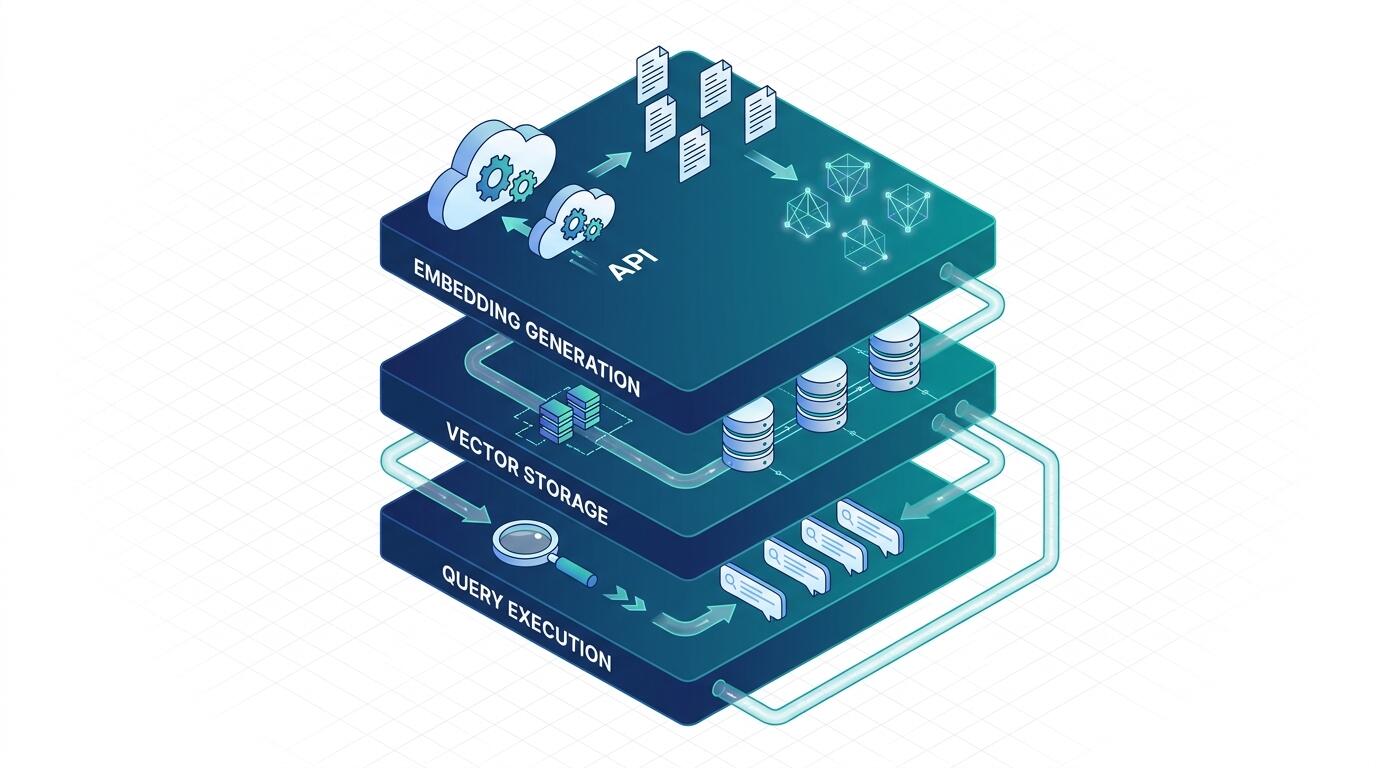
ALT: Cost breakdown for making 10,000 files semantically searchable using vector embeddings and AI search infrastructure
What Does Semantic Search Actually Cost at Scale — and Which Approach Fits Your Budget?
The single question most AI product builders ask when evaluating semantic search is deceptively simple: if I have 10,000 files, what will this actually cost me? The honest answer is that the total cost spans three distinct layers — embedding generation, vector storage, and query execution — and the differences between provider combinations can range from negligible to substantial depending on your architecture choices.
This article compares four realistic implementation approaches: managed embedding APIs paired with a hosted vector database, open-source embedding models on self-hosted infrastructure, hybrid SaaS platforms that bundle everything, and lightweight in-process options suited to smaller-scale deployments. The comparison criteria are embedding cost, storage cost, query cost, operational overhead, and latency characteristics.
Evaluation Criteria: What Actually Drives Semantic Search Cost
Making files semantically searchable means converting each document into a vector representation (an embedding), storing those vectors in a queryable index, and serving retrieval requests at runtime. The cost of each layer compounds differently depending on scale, so evaluating them separately is essential before committing to an architecture.
Embedding generation cost is a one-time expense per document (unless content changes), but at 10,000 files it becomes meaningful. Embedding cost is measured in tokens, and the practical throughput ceiling of a given API — its rate limits and batch size — determines how long the ingestion job takes and whether you need to build retry logic.
Vector storage cost is ongoing. A single embedding vector from a modern model sits somewhere in the hundreds to thousands of dimensions, and storing 10,000 of them with metadata and an HNSW index is not free, especially in managed services priced by index size or record count.
Query cost is the runtime expense — either API calls charged per query or compute consumed by a self-hosted service. For a product serving real users, query cost scales with usage and often overtakes embedding cost within weeks.
Operational overhead covers the engineering time required to build, maintain, and monitor the pipeline. A managed API eliminates infrastructure management but introduces vendor dependency. A self-hosted stack gives control but demands expertise in container orchestration, model versioning, and index maintenance.
Latency and retrieval quality matter because semantic search is often user-facing. A cheaper embedding model that produces lower-quality representations will degrade downstream answer quality in any RAG (retrieval-augmented generation) application, which is a cost that does not show up on a cloud bill.
The Contenders: Four Approaches to Semantic Search at 10,000 Files
Managed Embedding API + Hosted Vector Database
This is the most common starting point for teams building AI products. You call an embedding provider's API — such as OpenAI Embeddings, Cohere Embed, or Voyage AI — to convert documents into vectors, then store those vectors in a managed vector database such as Pinecone, Weaviate Cloud, or Qdrant Cloud.
The appeal is speed to production. You can have a working pipeline in hours rather than days. The cost structure, however, is layered: you pay per token for embedding generation, then pay a separate monthly fee for the vector index. At 10,000 files averaging a few hundred tokens per document, embedding generation is typically a one-time cost that is modest in absolute terms. The ongoing expense is storage and query throughput in the managed vector database, which at 10,000 records usually falls within free-tier or near-free-tier thresholds on most providers.
The risk is that costs escalate quickly if your document count grows or if you re-embed frequently due to model upgrades. Query costs on some hosted platforms are also priced per request at scale, which can surprise teams that underestimate usage volume.
Open-Source Embedding Models on Self-Hosted Infrastructure
Running a model like sentence-transformers/all-MiniLM-L6-v2 (maintained by the Sentence Transformers project at Hugging Face) or a BAAI BGE model on your own GPU or CPU infrastructure eliminates per-token API costs entirely. The trade-off is upfront infrastructure investment and ongoing engineering overhead.
At 10,000 files, the pure compute cost of running a self-hosted embedding model on a modest cloud instance is low — a single batch ingestion job can complete in minutes on a CPU-only machine. Paired with an open-source vector database such as Qdrant, Chroma, or Milvus running as a Docker container, the marginal cost of storing 10,000 vectors approaches zero (it fits comfortably within standard instance memory and disk).
The real cost here is engineering time. Someone needs to build the ingestion pipeline, manage model versions, monitor the service, and handle failures. For a team with strong infrastructure capability, this is often the most cost-effective long-term path. For a small team without dedicated MLOps resources, the hidden operational cost can easily exceed the savings on API fees.
Bundled SaaS Semantic Search Platforms
Several platforms — including Algolia NeuralSearch, Azure AI Search with vectorization, and Amazon Kendra — offer end-to-end semantic search as a managed service: you provide the documents, they handle chunking, embedding, indexing, and querying through a unified API.
These platforms abstract away nearly all infrastructure complexity. At 10,000 files, pricing models vary widely: some charge by the number of indexed documents, others by query volume, and others by a combination. Enterprise-tier features like fine-grained access control, audit logging, and multi-tenant isolation are often included but priced at a premium. For product teams that need to ship quickly and cannot afford embedding pipeline maintenance, this approach offers strong value despite higher per-unit cost.
Lightweight In-Process Semantic Search
For teams with smaller corpora or prototyping needs, libraries such as LlamaIndex with local embeddings, or even simple FAISS (Facebook AI Similarity Search) indexes running in-process, can deliver semantic search with near-zero infrastructure cost. At 10,000 files, a FAISS flat index fits in memory and query latency is acceptable without a dedicated server.
This approach is not suitable for production systems requiring real-time updates, multi-user access, or high query concurrency. But for offline document search, internal tooling, or early-stage product validation, it eliminates all cloud costs during the exploration phase.
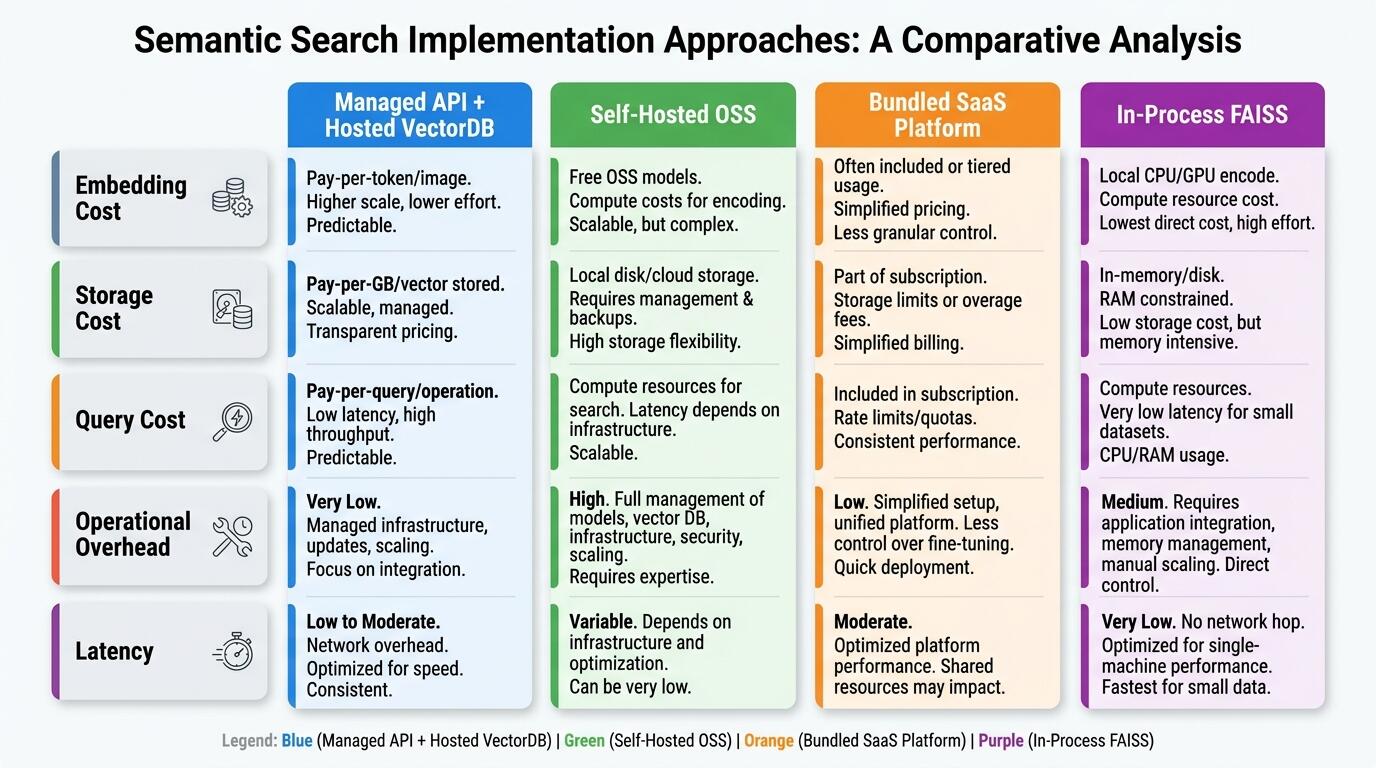
ALT: Comparison table of semantic search implementation costs across managed API, self-hosted, SaaS platform, and in-process approaches for 10,000 files
Head-to-Head Comparison: Cost and Trade-offs Across Approaches
| Criterion | Managed API + Hosted VectorDB | Self-Hosted OSS | Bundled SaaS Platform | In-Process (FAISS/Local) |
|---|---|---|---|---|
| Embedding generation cost (10K files, one-time) | Low to moderate (per-token pricing, typically within a few dollars at this scale) | Near-zero (compute only, often minutes on a small instance) | Included in platform fee | Near-zero |
| Ongoing storage cost | Low to moderate (managed index pricing, often free-tier eligible at 10K records) | Near-zero (self-managed storage) | Moderate to high (platform subscription) | Near-zero |
| Query cost at scale | Per-request or bundled; can escalate with usage | Compute-only; scales with instance size | Included or per-query; varies by tier | Near-zero (in-memory) |
| Operational overhead | Low (managed service) | High (pipeline, model, infra maintenance) | Very low (fully managed) | Very low (library-level) |
| Retrieval quality ceiling | High (state-of-the-art models available) | High (same models, self-deployed) | Platform-dependent | Model-dependent, often lower |
| Production readiness | High | Medium (requires investment) | High | Low (not for concurrent multi-user use) |
| Latency | Low to medium (network overhead) | Low (co-located) | Low to medium | Very low (in-process) |
The table reveals a clear pattern: at 10,000 files, no approach is prohibitively expensive in absolute dollar terms. The dominant cost variable is not the cloud bill — it is engineering time. A team that spends two weeks building a self-hosted pipeline at fully-loaded engineering cost will have spent far more than the API fees they saved, unless that pipeline serves hundreds of thousands of documents downstream.
The second key insight is that query cost, not embedding cost, is the long-term driver. Embedding 10,000 files is a one-time or infrequent operation. Answering search queries happens continuously. Teams that optimize only for ingestion cost and ignore query pricing structure often face unpleasant surprises at growth.
Retrieval quality deserves equal weight alongside cost. In practice, the gap between a well-tuned embedding from a state-of-the-art model and a smaller distilled model is meaningful in user-facing applications. Saving on embedding API costs by downgrading model quality can reduce downstream answer relevance in RAG pipelines — an indirect cost that does not appear in the infrastructure bill but does appear in user engagement metrics.
Which Should You Choose? Matching Approach to Situation
If you are prototyping or validating a concept, use in-process semantic search with a local embedding model and FAISS. The cost is effectively zero beyond developer time, and you can validate retrieval quality before committing to an infrastructure architecture. Migrate to a managed or self-hosted solution once the use case is confirmed.
If you are a small team shipping a product quickly without dedicated MLOps resources, the managed API plus hosted vector database combination is the pragmatic choice. At 10,000 files, the cost is low enough that it will not materially affect your runway, and you avoid the operational burden of maintaining infrastructure. Monitor your query volume carefully as you scale, and set cost alerts on your vector database provider.
If you are building at scale with strong infrastructure capability and a long time horizon, invest in the self-hosted open-source stack. The per-document cost of embedding with a self-hosted model drops toward zero at volume, and running Qdrant or Milvus on your own infrastructure gives you full control over data residency, latency tuning, and index configuration. The break-even point compared to managed APIs is typically in the tens of thousands of documents with moderate query volume — right around the scale this article addresses.
If you need enterprise features out of the box — role-based access control, SOC 2 compliance, audit logs, multi-tenant isolation — a bundled SaaS platform eliminates the engineering cost of building those features yourself. The higher per-unit cost buys you compliance and operational coverage that would take significant engineering time to replicate.
Pros and cons in brief: Managed API combos offer speed and simplicity but carry vendor dependency and per-query costs. Self-hosted stacks offer cost efficiency and control at the price of operational complexity. SaaS platforms offer the fastest path to enterprise-grade features but at the highest ongoing cost. In-process solutions are ideal for low-stakes prototyping but not for production at any meaningful concurrency.
Common Questions
Q1: How should I estimate the total token count for 10,000 files before calling an embedding API?
A rough heuristic widely used in the industry: one token is approximately four characters of English text, or roughly 0.75 words. A typical document of a few hundred words corresponds to a few hundred tokens. To get a precise estimate before spending money, run a tokenizer library — most embedding API providers publish open-source tokenizers — against a representative sample of your corpus, then extrapolate. This prevents budget surprises and helps you choose the right embedding model tier.
Q2: Are open-source embedding models good enough for production semantic search?
Open-source embedding models — particularly those from the BAAI BGE family and the Sentence Transformers library — achieve retrieval quality that is competitive with commercial API offerings on many standard benchmarks. The practical difference in production depends heavily on your domain: general-purpose corpora often see negligible quality gaps, while specialized technical or legal documents may benefit from domain-adapted or fine-tuned models. The key is benchmarking on your own data before committing to a cost structure, not assuming that paid automatically means better.
Q3: What does it realistically cost to re-embed 10,000 files when a new model is released?
Re-embedding is essentially a repeat of the initial ingestion job. At 10,000 files with managed API pricing, the one-time cost is modest — often within the range of a few dollars for mainstream model tiers, depending on average document length. The non-trivial cost is engineering time: updating your pipeline to handle a new model's output dimensions, migrating the vector index, and validating retrieval quality regression. Budget for that engineering effort rather than the compute cost when planning model upgrade cycles.
The Bottom Line
Making 10,000 files semantically searchable is an engineering problem where the architecture decision matters far more than the cloud bill.
Key Takeaways:
- At 10,000 files, embedding generation cost is a one-time, modest expense with managed APIs — it is not the budget risk.
- Query cost is the long-term cost driver; evaluate pricing models for retrieval, not just ingestion, before choosing a platform.
- Engineering time — building, maintaining, and operating the pipeline — is the largest real cost regardless of infrastructure approach.
- Self-hosted open-source stacks become cost-efficient at scale but require meaningful operational investment upfront.
- Retrieval quality is an indirect cost: a cheaper embedding that reduces answer relevance in a user-facing product has a business cost that does not appear on a cloud invoice.
Before committing to an architecture, run a small-scale benchmark on your own corpus with two or three candidate approaches. The cost of that experiment is trivial; the cost of rebuilding your pipeline after launch because you optimized for the wrong variable is not.
If you are making these architecture decisions as part of a broader AI product build, staying current on embedding model releases, vector database pricing changes, and emerging retrieval patterns is genuinely useful — not as noise, but as decision inputs. Subscribe to Darius for practitioner-level analysis of exactly these kinds of AI infrastructure developments, delivered in bilingual format with real engineering context behind every item.
Sources
- IEEE. "IEEE Standards for Artificial Intelligence and Machine Learning Systems".
https://www.ieee.org/ - ACM (Association for Computing Machinery). "ACM Digital Library — Information Retrieval and Vector Search Research".
https://www.acm.org/ - National Institute of Standards and Technology (NIST). "NIST Guidelines on AI and Information Retrieval Systems".
https://www.nist.gov/ - arXiv (Cornell University). "Research Papers on Dense Retrieval, Vector Embeddings, and Approximate Nearest Neighbor Search".
https://arxiv.org/ - The Linux Foundation. "Open Source AI and Machine Learning Infrastructure Projects".
https://www.linuxfoundation.org/
Note: Standards and pricing models may be updated; please check the latest official documentation from relevant providers and standards bodies.