Choosing the Right LLM Provider for Your Product in the Current Market

ALT: Engineering team evaluating LLM providers for AI product architecture and system design decisions
How to Choose the Right LLM Provider for Your AI Product in Today's Competitive Market
The market for large language model providers has shifted from a single-player landscape into a genuinely crowded field, with serious options spanning general-purpose reasoning engines, domain-specialized models, open-weight alternatives, and multimodal platforms. For anyone building a production AI product — not just prototyping — this abundance creates a real decision problem. Choosing wrong doesn't just cost you money; it can lock you into a provider whose pricing model, rate limits, or capability gaps undermine your product months after launch.
This guide distills the key dimensions practitioners use when selecting an LLM provider for a live product. The items in this list were selected based on a pattern that consistently appears in real engineering work: teams routinely optimize for the wrong axis (usually raw benchmark performance) while underweighting factors like cost predictability, latency at scale, output controllability, and vendor lock-in risk. Each section below maps a distinct provider or architectural category to the specific product situations where it tends to win — and flags where it tends to break down.
The Major LLM Providers and What They're Actually Good At
OpenAI (GPT Model Family)
OpenAI's GPT model family is the default starting point for most product teams because it offers the broadest ecosystem support, a mature API, and consistently strong general-purpose reasoning. The GPT line handles diverse tasks — structured extraction, conversational AI, code generation, and multimodal inputs — without requiring heavy prompt engineering to produce usable results. For teams that need to ship quickly with minimal AI-specific infrastructure, that out-of-the-box capability has real value.
The function-calling and structured-output features are particularly production-friendly: they make it easier to integrate LLM outputs into deterministic application logic without brittle regex parsing. According to research published by enterprise AI adoption analysts, OpenAI's API tooling remains the most widely documented in third-party frameworks, which reduces integration friction.
Best for: Product teams on a tight timeline that need broad general capability and extensive library support, especially when the use case spans multiple task types.
Watch out: Cost-per-token can accumulate quickly at scale, and the pricing model for high-volume, always-on features can make unit economics difficult to model without careful usage caps and caching strategies.
Anthropic Claude
Anthropic Claude is a family of large language models developed by Anthropic with an explicit focus on instruction-following precision, reduced hallucination risk, and safety-aligned behavior. In practice, Claude's standout production characteristic is its extended context window and its unusual fidelity to complex, multi-step instructions — it's the model that tends to surprise teams when they throw a long, constraint-heavy system prompt at it and get a structurally clean response.
A pattern that appears consistently in content-heavy product work — think document processing, policy enforcement, or multi-turn support systems — is that Claude often outperforms on tasks requiring the model to "follow the rules" reliably rather than be maximally creative. The Constitutional AI methodology Anthropic uses in training produces a model that is noticeably more cautious about making up information, which matters enormously in regulated or trust-sensitive contexts.
Best for: Products where output reliability, instruction adherence, and reduced hallucination risk are non-negotiable — legal tech, compliance tooling, document intelligence, and enterprise assistants.
Watch out: Anthropic's model availability and regional API access have historically lagged behind OpenAI's, and the ecosystem of third-party integrations is narrower. Budget for more integration work.
Google Gemini
Google Gemini is Google DeepMind's flagship large language model series, designed from the ground up as a natively multimodal system capable of processing text, images, audio, and code within a single model architecture. Gemini's key differentiator for product builders is its deep integration with Google Cloud infrastructure, which makes it a natural fit for teams already operating on GCP who want to co-locate their AI inference layer with their data and application infrastructure.
The long-context capabilities in the advanced Gemini tiers are among the strongest currently available, making it a genuine option for use cases that involve large document corpora or complex retrieval-augmented generation pipelines. Per industry analysis from enterprise AI evaluators, Gemini's performance on code and reasoning tasks has improved substantially with successive model iterations, closing the gap with earlier leaders.
Best for: GCP-native teams, multimodal product features, and applications that need very long effective context windows with enterprise-grade infrastructure SLAs.
Watch out: Gemini's API behavior and feature availability have changed frequently in its relatively short commercial lifespan. Teams should treat stability planning as a first-class concern and avoid deep feature-level dependencies without a fallback strategy.
Meta Llama (Open-Weight Models)
Meta Llama is a series of open-weight large language models released by Meta AI, with weights available for download and self-hosted deployment. The Llama family has become the de facto benchmark for open-weight models and the foundation for a large number of fine-tuned derivatives in the open-source community. For product teams, the central value proposition is control: you run the model on your own infrastructure, no data leaves your environment, and your inference costs are a function of compute rather than per-token pricing.
This matters a great deal for products operating in data-sensitive domains — healthcare, finance, legal — where sending user data to a third-party API creates compliance complexity. It also matters for teams with predictable, high-volume inference workloads where the economics of owned compute clearly outpace API pricing over time. Fine-tuning on domain-specific data is also dramatically more accessible with open-weight models.
Best for: Teams with in-house ML infrastructure capability, products in regulated verticals where data residency is a hard requirement, and high-volume workloads where long-term compute economics favor self-hosting.
Watch out: Self-hosting is not free — it requires GPU infrastructure, MLOps tooling, ongoing model management, and engineering attention. Teams that underestimate operational overhead often end up with worse reliability than a well-managed API would have provided.
Mistral AI
Mistral AI is a European AI research company producing a family of efficient, high-performance language models designed to deliver strong capability at relatively low parameter counts and inference costs. Mistral's models have consistently outperformed larger models from other providers on a capability-per-compute basis, which makes them practically useful for latency-sensitive features or cost-constrained applications.
The Mistral API and its open-weight releases offer a middle path between the convenience of a managed API and the control of a self-hosted solution. For European product teams in particular, Mistral's EU-based infrastructure addresses data residency and GDPR compliance considerations that can otherwise complicate cloud AI deployment. According to external analysis from LLM evaluation practitioners, Mistral models perform especially well on instruction-following benchmarks relative to their inference cost profile.
Best for: Cost-sensitive products, latency-critical features, and European teams with data residency requirements. Also a strong option as a lower-cost tier in a multi-model routing architecture.
Watch out: Mistral's model ecosystem is smaller than OpenAI's or Google's, and tooling support in third-party frameworks — while improving rapidly — is not yet on par. Expect to write more integration code than you would with the major platforms.
AWS Bedrock and Azure OpenAI Service
AWS Bedrock and Azure OpenAI Service are managed cloud platforms that provide access to multiple LLM providers — including Anthropic, Meta, Mistral, Cohere, and OpenAI respectively — through a single, enterprise-grade cloud interface. Rather than integrating directly with each model provider's API, teams using these platforms consolidate their AI inference within an existing cloud contract, unified IAM, VPC networking, and compliance tooling.
For enterprise teams, this is not a minor convenience. A significant operational and security cost exists in managing multiple external API credentials, audit logs, and data handling agreements. Consolidating through a cloud provider's managed AI platform converts those scattered concerns into a single compliance surface. As noted in enterprise LLM evaluation literature from macro4.com, organizations often underestimate the governance and integration costs of multi-vendor AI API management.
Best for: Enterprise product teams already committed to AWS or Azure, organizations with strict data governance and audit requirements, and teams that want model optionality without managing multiple vendor relationships.
Watch out: Managed platforms introduce an additional abstraction layer. Model versions available through Bedrock or Azure OpenAI may lag behind what's available directly from the model provider, and pricing includes the cloud provider's margin on top of the base model cost.
Cohere
Cohere is an enterprise-focused AI company offering large language models purpose-built for business applications, with particular strength in retrieval-augmented generation, text embedding, and semantic search. Cohere's Command models and its Embed API are designed explicitly for enterprise deployment patterns — the company's go-to-market is built around on-premise and private cloud deployments, which differentiates it from providers primarily targeting public API consumption.
For products where the core AI capability is enterprise search, document retrieval, or knowledge base augmentation, Cohere's embedding and reranking infrastructure is operationally mature and production-tested. It is one of the few providers that treats embedding and retrieval as first-class capabilities rather than auxiliary features.
Best for: Products where semantic search, document retrieval, or knowledge management is the core use case. Strong fit for enterprise deployments with on-premise or private cloud requirements.
Watch out: Cohere is less competitive on pure generative tasks compared to OpenAI or Anthropic. If your product requires both strong retrieval and strong generative capability, you may end up in a multi-model architecture regardless.
Multi-Model Routing Architecture (Model-Agnostic Approach)
A multi-model routing architecture is an approach where a product's AI layer is designed from the start to route different request types to different LLM providers based on task requirements, cost thresholds, or latency targets — rather than depending on a single provider for all inference. This is less a provider choice and more an architectural stance, and it's one that increasingly makes sense as providers differentiate meaningfully on cost and capability profiles.
In practice, this means a simpler classification or extraction task might route to a smaller, cheaper model, while a complex reasoning task escalates to a more capable and expensive one. When implemented well, this pattern significantly improves cost efficiency and resilience — if one provider has an outage or rate-limits your account, requests can failover to an alternative. For a deeper look at how architectural decisions like this compound over time, the most important decisions an engineering director makes in a quarter often include exactly this kind of foundational infrastructure choice.
Best for: Products with diverse AI workloads, teams with mature MLOps capability, and any product where LLM inference costs are a meaningful line item that warrants optimization.
Watch out: Multi-model routing introduces significant orchestration complexity. Prompt compatibility, output schema normalization, and differential failure modes across providers require deliberate engineering investment. Do not adopt this pattern as an afterthought — design for it from the start or it becomes a maintenance liability.
Quick Comparison at a Glance
The table below summarizes each provider category against the dimensions that matter most in production: the scenarios where each option tends to win, the primary technical or operational strength it brings, and the single most common limitation teams run into.
| Provider / Approach | Best For | Key Strength | Primary Limitation |
|---|---|---|---|
| OpenAI GPT | Fast-shipping generalist products | Broadest ecosystem, mature tooling | High cost at scale; rapid pricing changes |
| Anthropic Claude | Trust-sensitive, instruction-heavy apps | Low hallucination, long-context fidelity | Narrower third-party ecosystem |
| Google Gemini | GCP-native, multimodal features | Native multimodal, long context, Google infra | Feature/API instability in early commercial lifecycle |
| Meta Llama (open-weight) | Regulated verticals, high-volume workloads | Data sovereignty, fine-tuning control | Requires significant MLOps investment |
| Mistral AI | Cost-sensitive, latency-critical features | High capability-per-compute ratio | Smaller tooling ecosystem |
| AWS Bedrock / Azure OpenAI | Enterprise governance requirements | Unified cloud compliance, model optionality | Model version lag; added cost layer |
| Cohere | Search, retrieval, knowledge base products | Best-in-class embeddings and reranking | Weaker on pure generative tasks |
| Multi-model Routing | Diverse workloads, cost optimization | Resilience, cost efficiency, task-specific optimization | High orchestration and maintenance complexity |
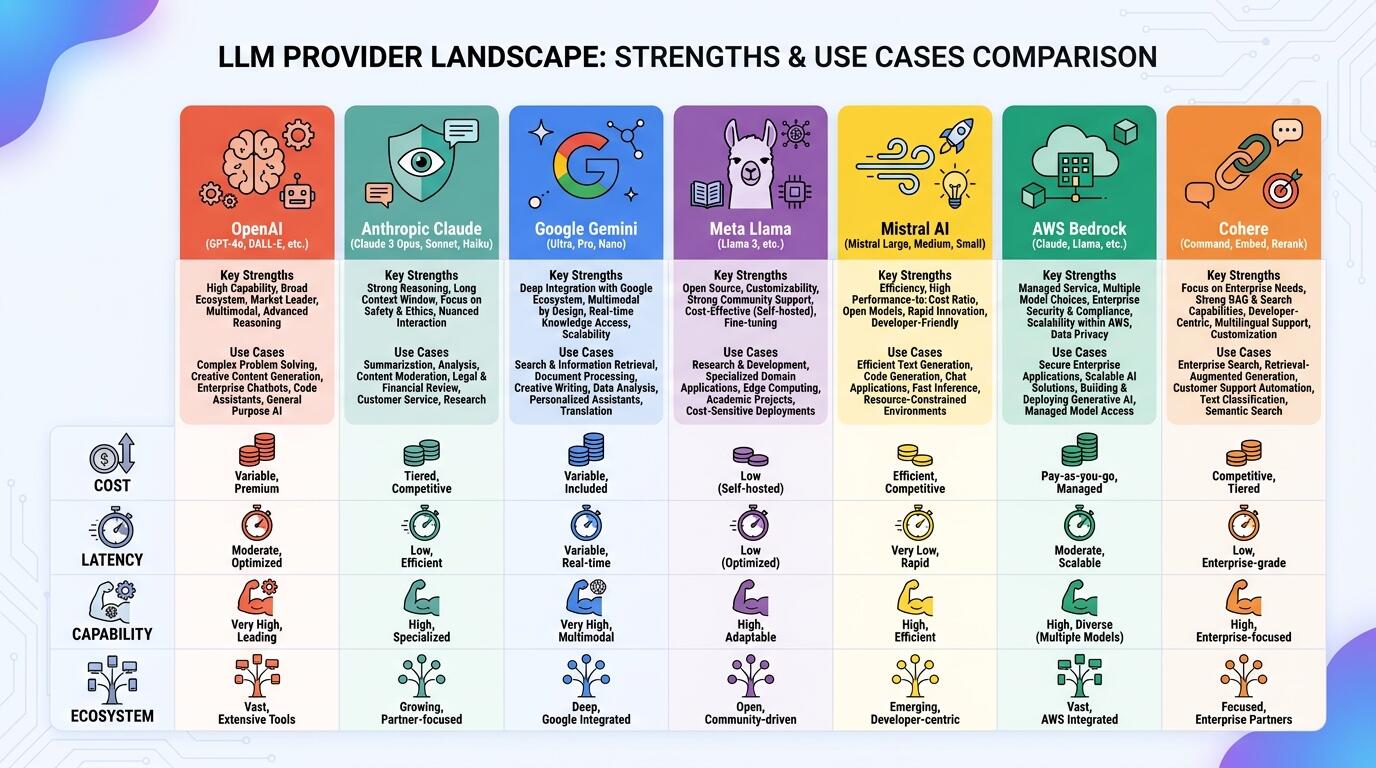
ALT: Comparison of LLM providers including OpenAI, Anthropic, Google Gemini, and open-weight models for AI product architecture decisions
How to Choose the Right LLM Provider for Your Specific Situation
The right LLM provider for your product depends primarily on four factors: your data sensitivity requirements, your inference cost model, your team's infrastructure capability, and how differentiated the AI behavior needs to be from general-purpose outputs.
Start with data sensitivity. If your product handles personal health information, financial data, or legally privileged content, your shortlist shrinks immediately to options that support private deployment — Llama, Cohere's private cloud, or AWS Bedrock with appropriate data agreements. Sending regulated data to a standard third-party API is an architectural mistake that is expensive to reverse.
Next, model your cost trajectory. A feature used sporadically by a small user base has a fundamentally different economics profile than an always-on, high-frequency inference pipeline. Per-token API pricing compounds quickly with scale. If you can project high inference volume, run the numbers on self-hosted alternatives before committing to a managed API — the breakeven point arrives sooner than most teams expect.
Third, be honest about your team's infrastructure capability. Open-weight models and self-hosted deployments offer control and cost efficiency, but they transfer operational responsibility to your team. If you don't have the MLOps capacity to manage GPU infrastructure, model versioning, and serving reliability, you will trade one problem (cost) for a worse one (instability). A well-managed API is a legitimate choice for teams that should be spending their engineering cycles on product differentiation rather than infrastructure.
A common misconception worth dispelling: the most capable model is not automatically the best model for your product. Benchmark performance measures aggregate capability across diverse tasks. In production, you are not running diverse tasks — you are running a specific, bounded set of operations. A model that scores lower on general benchmarks but follows your system prompt precisely, maintains schema compliance, and costs a fraction of the market leader will outperform on every axis that actually matters to your product's users. As noted in evaluation guidance from Floatbot AI and Whitespectre, matching model characteristics to specific use-case requirements consistently outperforms selecting purely on benchmark rankings.
If you are architecting an AI product from scratch and want to avoid the lock-in trap, design your application layer to treat the LLM as an interchangeable component behind an abstraction — whether through a framework like LangChain or LlamaIndex, or a custom orchestration layer. Building that abstraction early, even when you start with a single provider, is the architectural move that preserves your options. This is one of those foundational decisions that, once skipped, generates compounding rework. For guidance on how to structure these kinds of consequential technical choices across the full product lifecycle, the work behind shipping three live products from idea to launch offers a practitioner's perspective on exactly this category of decision.
People Also Ask
Q1: How do you evaluate LLM providers before committing to one for production?
Evaluating LLM providers for production should involve task-specific testing on your actual data and prompt patterns, not just general benchmark scores. Build a small evaluation harness that runs your representative use cases against candidate models and scores them on the dimensions that matter to you — output quality, latency, schema compliance, and failure rate. Also evaluate developer experience, API reliability, and pricing predictability under your projected load. According to LLM evaluation guidance from enterprise AI practitioners, task-specific evaluation consistently outperforms relying on published benchmark rankings alone.
Q2: Is vendor lock-in a real risk with LLM API providers?
Vendor lock-in is a genuine architectural risk with LLM providers, and it's often underestimated at the prototype stage. Lock-in emerges when application logic, prompt engineering, or output handling is tightly coupled to a specific provider's API schema, model quirks, or proprietary features. If that provider changes pricing, deprecates a model, or experiences an outage, the cost of switching is high. The mitigation is straightforward in principle: design your AI integration layer with provider abstraction from the start, so that swapping the underlying model requires configuration changes rather than code rewrites. This is easier to build in at the beginning than to retrofit later.
Q3: How long does it take to switch LLM providers if the original choice doesn't work out?
Switching LLM providers mid-product can take anywhere from days to several weeks of engineering effort, depending on how tightly the original integration was built. If the application layer was designed with provider abstraction — a clean separation between business logic and the model API — a switch may be a matter of updating a configuration and re-testing outputs. If prompts, output parsers, and application logic were built directly against one provider's behavior, expect a meaningful re-engineering effort. The safest approach is to treat provider flexibility as a design requirement from day one, even when you have no immediate plans to switch.
Final Thoughts
Choosing the right LLM provider for your product is not a one-time decision — it's an architectural stance that should be revisited as your product scales, your usage patterns clarify, and the provider landscape continues to evolve. Three things to carry forward from this guide:
First, lead with your constraints. Data sensitivity, latency requirements, and cost model are harder constraints than capability preferences. Eliminate providers that fail your constraints before evaluating the ones that remain.
Second, avoid the benchmark trap. Production performance on your specific tasks is the only metric that matters. A mid-tier model that reliably follows your instructions and fits your cost model beats a state-of-the-art model that's expensive, unpredictable, and overspecified for your use case.
Third, build for optionality. The provider you start with may not be the right one at scale. Abstract the integration layer early, test alternatives in parallel, and treat your LLM provider selection as a living decision rather than a permanent commitment.
If you are at the stage of designing your AI architecture — whether that's a new product, a feature addition, or an overhaul of an existing system — the pattern of decisions you make in the early stages will determine how much freedom you have later. For teams that want to build on a foundation that ships and scales, explore the work, shipped products, and technical insights at the Darius website — and reach out if you want an experienced AI architect in your corner from day one.
References
- Floatbot AI. "Choosing the right LLM for your Business & Use Case".
https://floatbot.ai/blog/choosing-right-large-language-model-llm-for-your-business - Macro4. "Choosing the right large language model (LLM) for your enterprise".
https://www.macro4.com/blog/comparing-llms-for-the-enterprise-choosing-the-right-ai-for-the-task/ - Whitespectre. "Selecting an LLM for Your AI Product: How to Stay Flexible".
https://www.whitespectre.com/ideas/how-to-choose-llm-for-ai-tools/ - IEEE (Institute of Electrical and Electronics Engineers). Standards and publications on AI systems engineering and machine learning best practices.
https://www.ieee.org - NIST (National Institute of Standards and Technology). AI Risk Management Framework and guidance on responsible AI system deployment.
https://www.nist.gov
Note: Standards and provider offerings may be updated; please check the latest official documentation or consult professional advisors for the most current guidance.