Building a High-Performing Full-Stack Team from Scratch

ALT: Engineering director building a high-performing full-stack team from scratch in a modern tech startup
Why Building a Full-Stack Team from Scratch Is One of the Hardest Things a Technical Leader Will Do
You've secured the funding, the product roadmap is ready, and now you need to hire engineers — fast. But every candidate looks strong on paper, the interviews are draining, and you're still not sure whether you're assembling a team or just a collection of individuals who happen to work in the same Slack workspace. This scenario plays out constantly across early-stage startups and scaling scaleups alike, and it rarely gets easier without a deliberate framework.
Building a high-performing full-stack team from scratch is not simply a hiring problem. It is an architectural problem — one that requires the same systems thinking you'd bring to designing a backend service. Get the structure wrong early, and you'll spend the next eighteen months fighting coordination overhead, skill gaps, and missed delivery windows. Get it right, and you create a compounding advantage: a team that ships, learns, and self-improves as a unit.
This article goes beyond generic hiring advice to examine what actually differentiates high-performing full-stack teams, how to build one deliberately from day zero, and where most technical leaders make structurally predictable mistakes.
The Current Landscape: Why Full-Stack Teams Are Harder to Build Than Ever
Full-stack development has evolved from a buzzword describing a developer who knows both HTML and SQL into something considerably more demanding. Today, a full-stack team is a cross-functional engineering unit responsible for the entire vertical slice of a product — from user interface to database schema, from API design to deployment pipeline.
According to research highlighted by Saucal, full-stack teams improve efficiency in software development by reducing hand-off latency and enabling end-to-end ownership of features. This is the core efficiency argument for the model. Rather than having frontend and backend teams work in parallel silos, a full-stack team owns the full lifecycle of a feature, which dramatically reduces the back-and-forth that bleeds delivery timelines.
But the market conditions for building such a team have become more complex. The proliferation of AI tooling, cloud-native infrastructure, and modern JavaScript frameworks means the surface area of what "full-stack" requires has widened considerably. A strong full-stack engineer today is expected to reason about client-side rendering strategies, serverless functions, containerized deployments, and increasingly, AI integration patterns — all in the same sprint. The bar has risen, and the talent pool that authentically meets this bar is narrower than job boards suggest.
At the same time, distributed and remote hiring has expanded the geography of available talent while adding new coordination costs. Teams spread across time zones can access world-class engineers but must invest more deliberately in documentation culture, async communication norms, and shared engineering standards. These aren't soft considerations — they are load-bearing elements of team performance.
A pattern that consistently surfaces in engineering leadership practice is that most early-stage teams underinvest in team design and overinvest in raw headcount. They hire quickly, then discover that six engineers with poorly defined ownership boundaries deliver less than three engineers with crisp charters and clear interfaces between their work.
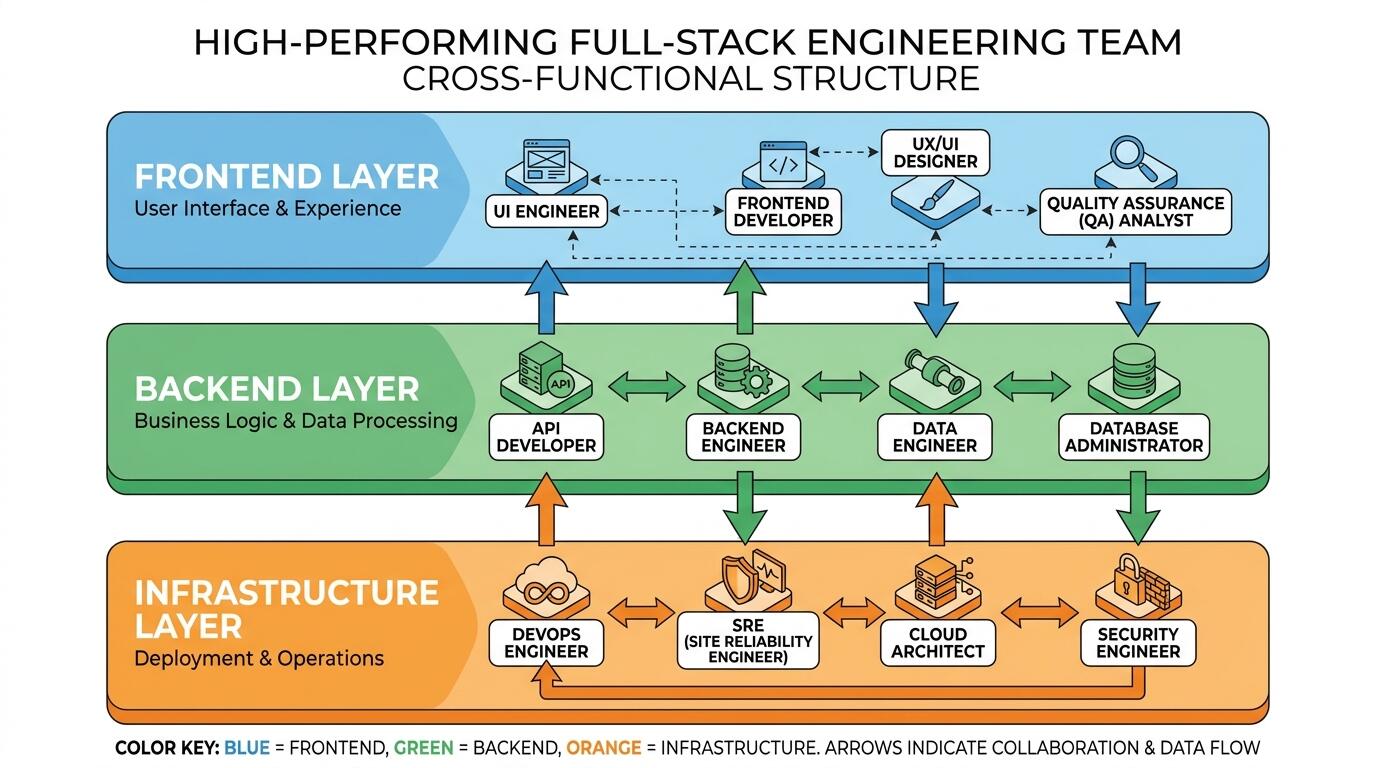
ALT: Diagram showing the cross-functional structure of a high-performing full-stack engineering team covering frontend, backend, and infrastructure layers
The Root Causes of Full-Stack Team Failure — and What Drives Success
Understanding why full-stack teams underperform is more instructive than enumerating best practices in the abstract. There are several structural failure modes that appear repeatedly, and they tend to cluster around three root causes.
Skill Coverage Gaps Hidden by Generalist Titles
Skill coverage gaps are the most common and least visible failure mode in full-stack team construction. The instinct to hire "full-stack engineers" and assume the team will cover all technical surface area is seductive but often wrong.
In practice, most engineers who describe themselves as full-stack have genuine depth in one or two areas and shallow competence in others. A frontend-leaning full-stack engineer may be exceptional at React component architecture but reach their limit when debugging a slow PostgreSQL query or designing an event-driven microservice. The inverse is equally common. Neither profile is deficient — but a team composed entirely of one pattern creates dangerous blind spots.
Effective team construction means deliberately mapping your product's technical surface area and then auditing candidate profiles against that map. You are not hiring for job titles; you are filling a technical coverage matrix. For most products, this matrix includes: client-side rendering and state management, REST or GraphQL API design, backend business logic and data modeling, infrastructure and CI/CD, and increasingly, AI/ML integration. Each cell in that matrix needs a primary owner and at least a secondary backup.
Ownership Architecture That Hasn't Been Designed
Ownership architecture refers to the explicit assignment of who is responsible for what, at both the component level and the process level. Teams that lack this design default to informal norms that work acceptably when the team is small but collapse under growth or personnel change.
A pattern commonly observed in early-stage engineering teams is what might be called "ownership fog" — a state where nobody is certain who should make the final call on a given decision, so either everyone debates it endlessly or someone makes an undocumented unilateral decision that creates technical debt. Neither outcome is acceptable at pace.
The remedy is not bureaucracy. It is a lightweight ownership model — often as simple as a shared document that maps system components to named engineers and defines the decision rights associated with each. This document does more than prevent conflicts; it forces the team to make explicit the implicit assumptions about how work flows and who unblocks whom.
Feedback Loop Deficiencies
Feedback loops — the mechanisms by which a team detects that something is wrong and course-corrects — are the immune system of an engineering organization. High-performing full-stack teams tend to operate multiple overlapping feedback loops simultaneously: automated testing catches regressions before merge, code review transmits tacit knowledge between engineers, retrospectives surface process dysfunction, and production monitoring closes the loop between what was shipped and how it performs.
Teams built for speed often cut feedback loop investment first, reasoning that they'll add rigor later. This is a structurally dangerous tradeoff. The cost of defects and architectural drift compounds quickly; catching a broken assumption in code review costs a fraction of what it costs to diagnose it in production six weeks later. As technical leaders know from shipping production-grade systems, the teams that ship fastest over a sustained period are almost always the ones with the shortest feedback loops, not the ones that cut review steps.
Evidence and Approaches: Comparing Full-Stack Team Models
The question of how to structure a full-stack team does not have one universal answer. Technical leaders consistently debate several competing models, each with genuine strengths and real trade-offs. According to analysis on building high-performing software engineering teams published in The Startup on Medium, team structure has a direct impact on delivery velocity and engineering morale — getting the structural model right is not an HR concern, it is a product execution concern.
| Perspective / Approach | Strengths | Trade-offs | Best Fit |
|---|---|---|---|
| Pure Full-Stack Generalists | Maximum flexibility; any engineer can pick up any task; low coordination overhead on small teams | Skill depth suffers at scale; complex infrastructure or AI work may exceed generalist capability | Very early stage (2-5 engineers), MVP development, rapid prototyping |
| Specialization with Full-Stack Literacy | Deep expertise where the product demands it; generalists can collaborate across layers; better quality ceiling | Requires deliberate hiring to maintain coverage balance; slightly higher coordination cost | Growth-stage teams shipping complex features; products with AI or infrastructure-heavy requirements |
| Feature-Based Squads | High feature ownership; clear accountability; team autonomy drives morale | Risk of platform fragmentation; shared infrastructure work falls through the cracks | Larger teams (12+); companies with distinct product areas or user segments |
| Platform + Product Split | Dedicated infrastructure reliability; product engineers work on a stable foundation | Platform team can become a bottleneck; organizational distance between layers | Mid-to-large companies; products with high operational complexity |
In work with early-stage founders and technical teams, the most durable approach for teams under fifteen engineers is typically the second model: a small set of genuine specialists — usually one strong infrastructure or AI engineer, one deep backend engineer, and one or two frontend engineers with backend literacy — operating under a shared full-stack ownership norm. This gives the team depth where it matters while preserving the flexibility that small teams need.
The IEEE (Institute of Electrical and Electronics Engineers) has long documented through its software engineering standards that well-defined team roles and structured communication channels are foundational to software quality outcomes. This is not an abstract principle — it is an operational reality for any team trying to ship production-grade software consistently.
One frequently underestimated factor is the role of the engineering lead or director in actively shaping team culture during the first ninety days. A technical leader who codes alongside the team in this period accomplishes something no process document can: they demonstrate the standards, the tone, and the decision-making style that will become the team's informal operating system. The team learns what "good enough to ship" means by watching, not by reading guidelines.
Where This Is Heading — and What It Means for Technical Leaders Today
The demands placed on full-stack teams are increasing. AI-assisted development tools are compressing the time it takes a senior engineer to implement features, which means the bottleneck in team performance is shifting from raw implementation speed toward architectural judgment — knowing what to build, how to structure it, and how to avoid locking in the wrong abstractions.
Technical leaders who recognize this shift are beginning to hire differently: prioritizing engineers with strong systems intuition and a track record of making good architectural calls, even if their line-of-code output is not the highest. An engineer who asks the right question before writing a line of code is more valuable to a full-stack team than one who ships quickly but creates structural problems others must clean up.
For teams incorporating AI capabilities into their product, the architectural complexity increases further. AI integration is not a single technical decision — it involves model selection, data pipeline design, latency management, reliability engineering, and responsible deployment considerations. Full-stack teams that try to absorb this complexity without at least one engineer who has shipped AI features in production tend to make costly architectural mistakes early that constrain the product for months.
The practical implication is this: if you are building a full-stack team today, prioritize architectural range over narrow specialization, invest in feedback loop infrastructure before you feel the pain of not having it, and treat team design as a first-class engineering problem.
Specific actions that technical leaders should take at the outset include conducting a technical surface area audit before the first hire, writing explicit ownership maps even for two-person teams, establishing automated testing and deployment pipelines as table stakes before the team reaches its third engineer, and scheduling a brief retrospective cadence from day one rather than waiting until something breaks.
Frequently Asked Questions FAQ
Q1: How do you assess whether a full-stack engineer candidate has genuine depth versus surface-level familiarity across layers?
The most reliable signal is to ask candidates to walk through an architectural decision they made — not one they observed or read about, but one they owned, including the trade-offs they weighed and the things they would change in hindsight. Genuine depth reveals itself in the specificity of the reasoning, not the confidence of the delivery. Candidates with surface-level familiarity tend to describe what they did; candidates with real depth describe why and what it cost them.
Q2: Is a full-stack team model the right approach for every product stage?
A full-stack team model is not universally optimal at every stage. For very early-stage products where the primary goal is validating an idea quickly, a small team of two to three generalists with complementary strengths often outperforms a more structured model. As the product matures and technical complexity increases — particularly when AI components, complex infrastructure, or strict reliability requirements enter the picture — adding deliberate specialization within the full-stack ownership norm becomes a structural necessity rather than a luxury.
Q3: How long does it typically take to build a cohesive, high-performing full-stack team from scratch?
Most technical leaders report that a newly assembled full-stack team reaches genuine cohesion — where communication patterns are established, ownership norms are internalized, and delivery velocity is predictable — somewhere between three and six months after the core group is in place. The variables that most directly influence this timeline are the clarity of ownership structure set at formation, the quality of onboarding documentation, and how actively the engineering lead models desired behavior in the first sprint cycles.
Summary
Building a high-performing full-stack team from scratch is fundamentally an architectural challenge, not just a hiring challenge. Three principles consistently separate teams that perform from teams that struggle.
First, map your technical surface area before you hire, not after. Understand what your product requires across the entire stack — frontend, backend, infrastructure, and AI if applicable — and build your hiring plan against that map rather than against abstract job titles.
Second, design ownership explicitly from day one. Even a two-person team benefits from documented ownership of system components and decision rights. The cost of ownership fog — where nobody is certain who decides what — compounds quickly as the team grows.
Third, invest in feedback loop infrastructure early. Automated testing, code review norms, and production monitoring are not luxuries to add when the team is "more mature." They are the foundation that allows a team to move fast sustainably, and the teams that consistently ship high-quality products in production are almost always the ones that built these loops in early.
The practical next step for any technical leader about to build a team is to resist the instinct to start with a hiring requisition. Start with a technical surface area audit and a draft ownership model. The hiring plan will be more coherent, the interview process will be more focused, and the team you assemble will have a structural foundation to build on rather than a blank canvas to argue over.
If you're ready to turn your idea into a live, running product, explore the engineering leadership and AI architecture work at the Darius website — including shipped projects, technical insights, and guidance that moves from system design all the way to launch.
Sources & Further Reading
- Saucal. "How Full-Stack Teams Improve Efficiency in Software Development".
https://saucal.com/blog/full-stack-team/ - The Startup / Medium. "How to Build a High-Performing Software Engineering Team".
https://medium.com/swlh/how-to-build-a-high-performing-software-engineering-team-441226ef0cbc - YouTube / Developer Tutorial. "Building a Full Stack App from Scratch".
https://www.youtube.com/watch?v=o3p0YkUPJig - IEEE (Institute of Electrical and Electronics Engineers). Software Engineering Standards and Publications.
https://www.ieee.org/
Note: Standards and research may be updated; please check the latest official documents or consult professional advisors.