Building APIs Designed to Work Cleanly with LLM-Powered Features
ALT: Engineering APIs designed for LLM-powered features, AI architecture, and clean integration patterns
Why API Design Is the Overlooked Foundation of Every LLM-Powered Product
Key Conclusion: Building APIs that work cleanly with large language model (LLM) powered features requires a deliberate architectural shift — one that accounts for the probabilistic, latency-sensitive, and context-hungry nature of AI systems. Teams that treat LLM integration as an afterthought bolt complexity onto fragile foundations, while those who design for it from the start ship faster, scale more predictably, and avoid the production failures that quietly kill AI-first products.
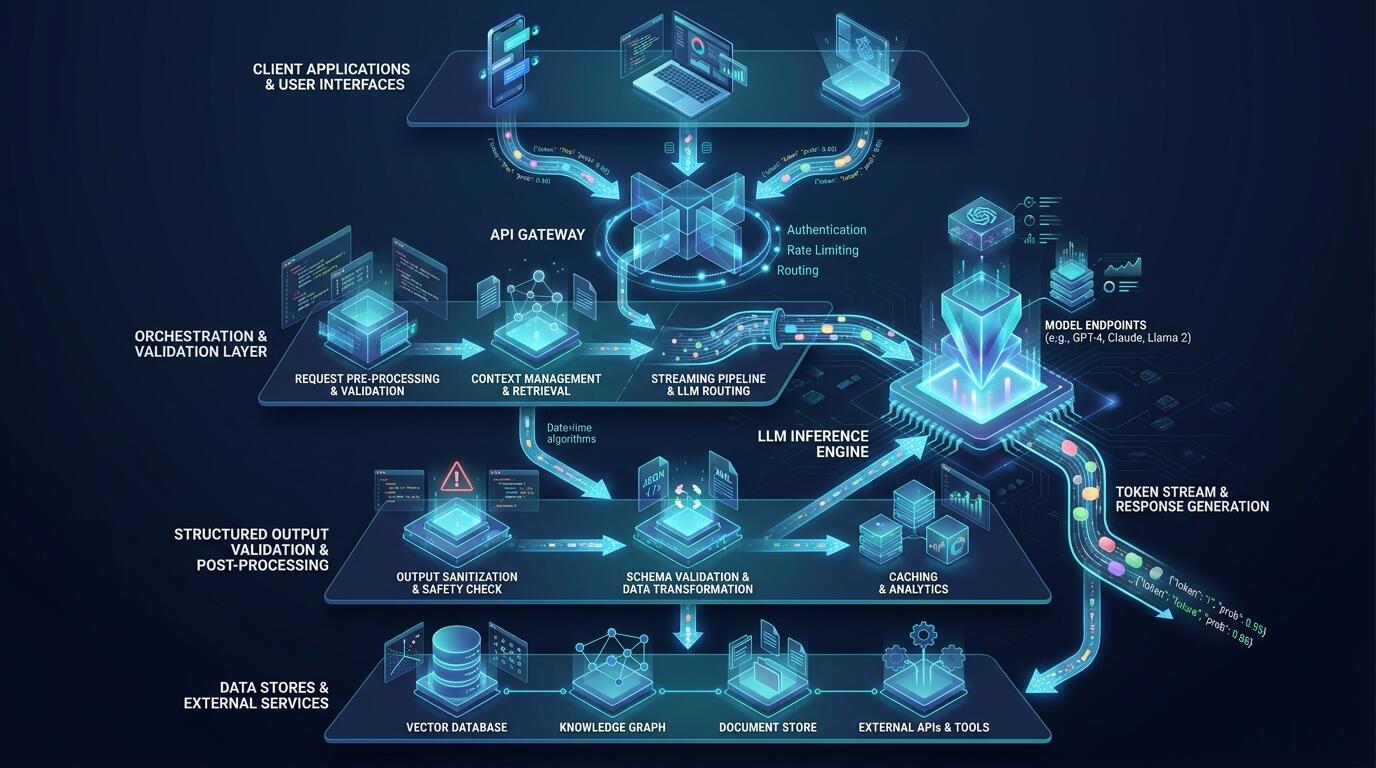
The conversation around LLMs in production tends to focus on the model itself — which one to choose, how to fine-tune it, what prompt engineering technique to apply. What rarely gets the same attention is the API layer sitting between your application and the model. That layer is where most production failures actually live. In the work of designing and shipping AI-powered systems, the patterns that separate stable products from brittle ones almost always trace back to API design decisions made early — and often without the right frame of reference.
The State of LLM-API Integration: A Discipline Still Finding Its Footing
API design has been a mature discipline for decades. RESTful conventions, versioning strategies, rate limiting, authentication patterns — the craft is well-established. But large language models introduce a set of characteristics that conventional API thinking was never designed to handle, and the ecosystem is still catching up.
LLM inference is fundamentally different from a standard database query or microservice call. Responses are non-deterministic, meaning the same input can produce meaningfully different outputs across calls. Latency is high — often an order of magnitude higher than traditional service calls — and it varies unpredictably based on output length, model load, and hardware availability. Output formats are freeform text unless explicitly constrained, which means the traditional assumption that a service response maps cleanly to a typed schema breaks down immediately.
According to analysis published by Gravitee on designing APIs for LLM apps (see gravitee.io), LLM-integrated APIs face unique challenges around streaming, token management, and the need for richer metadata in responses — challenges that require rethinking standard API gateway patterns rather than simply extending them.
At the same time, the market is moving fast. Foundation model providers publish their own APIs, and a growing ecosystem of orchestration frameworks — LangChain, LlamaIndex, and others — has emerged to abstract over them. But abstraction has a cost: teams that rely too heavily on third-party orchestration without understanding what sits beneath tend to inherit its failure modes without the ability to debug them.
A pattern that emerges consistently when working with teams building their first LLM-powered features is a kind of optimistic integration — an assumption that wiring the API call to the model is the hard part, and that everything downstream will work itself out. It rarely does. The hard part is designing the contract between your application and the LLM such that the rest of your system can depend on it reliably.
The Root Causes of API-LLM Friction — and How to Address Them
LLM-powered feature failures are rarely caused by the model itself. They are almost always caused by the interface around it. Understanding the underlying mechanisms makes it possible to design defensively.
Unstructured Output in a Structured World
The most immediate source of friction is output format. Traditional service APIs return structured data — JSON objects with predictable fields, typed values, defined schemas. LLMs, by default, return natural language. Even with careful prompting, a model may return a response that is semantically correct but structurally inconsistent: fields in different orders, optional keys missing, extra prose where a clean value was expected.
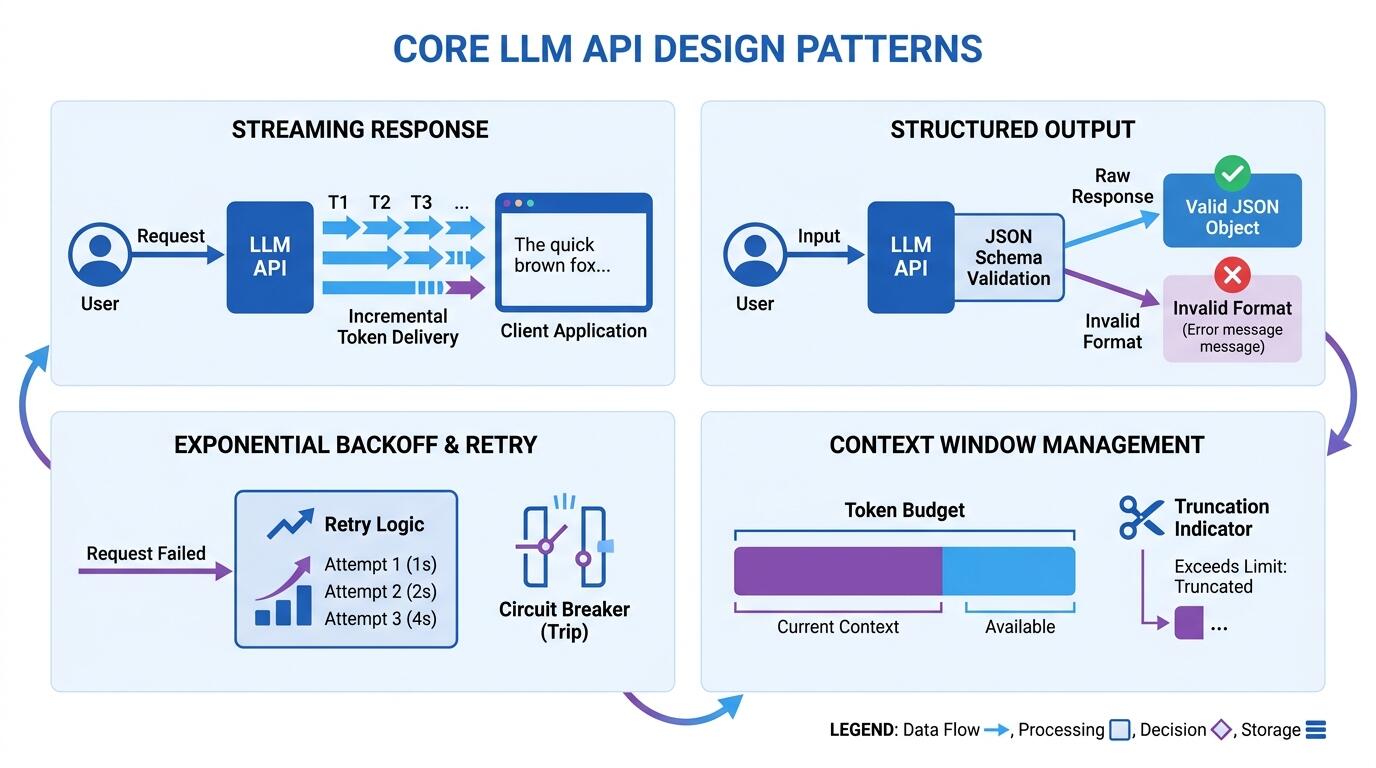
Structured output enforcement is the discipline of constraining model responses to a predictable schema. Leading model providers now support this natively — through JSON mode, function calling, or tool-use interfaces — but enabling the feature is only the start. The API layer needs to validate that the returned structure actually matches the expected schema before passing it downstream, because models can still produce schema-valid but semantically broken outputs.
Latency That Breaks Synchronous Assumptions
Conventional APIs operate on a synchronous request-response model that assumes a response will arrive in a time window that is short enough to hold a connection open. LLM inference can take anywhere from a few seconds to well over a minute for complex tasks, depending on model size and prompt length. Streaming responses — where the model returns tokens incrementally rather than waiting for completion — are the standard mitigation, but they require the API layer, the application server, and the client to all support a streaming contract.
Teams that do not design for streaming from the start often find themselves retrofitting it later under production pressure, which is significantly more expensive than getting it right initially. The API design needs to answer a clear question: is this feature user-facing and latency-sensitive (favoring streaming), or is it a background task where the result can be delivered asynchronously via a webhook or polling pattern?
Context Window Management as an API Concern
Every LLM call has a context limit — a maximum number of tokens that can be sent and received in a single interaction. Managing what goes into that context window is not just a prompt engineering problem; it is an API design problem. The API layer needs to enforce context budgets, handle truncation gracefully, and avoid silently dropping critical information when a conversation or document exceeds the limit.
Context window management at the API layer means defining explicit policies: what gets summarized when the context grows too large, what gets dropped, and what is always preserved regardless of length. Teams that leave this undefined typically discover the gap in production, when a model starts producing degraded responses on long conversations without any visible error.
Retry Logic and Probabilistic Reliability
LLM API providers experience rate limits, transient errors, and capacity constraints at a frequency that is higher than most traditional services. A naive integration that does not implement exponential backoff with jitter, circuit breakers, and fallback strategies will surface these failures directly to end users. The API contract needs to define what a degraded response looks like and whether a fallback to a smaller, faster model is acceptable in lieu of a timeout.
According to NVIDIA's developer documentation on building LLM-powered API agents (see developer.nvidia.com), robust agentic architectures require explicit handling of tool-use failures, retry orchestration, and state management — none of which a thin API wrapper provides automatically.
Observability Gaps
Standard API observability — HTTP status codes, response times, error rates — is insufficient for LLM-powered endpoints. A call can return HTTP 200 with a perfectly formatted JSON body that contains a semantically wrong answer, and your monitoring will record it as a success. LLM-specific observability requires logging prompt inputs, token counts, model version identifiers, and output quality signals alongside standard metrics. Without this, debugging production issues becomes nearly impossible.
Evidence and Architectural Approaches Compared
Different teams approach LLM-API integration from different architectural starting points, and each carries meaningful trade-offs.
| Perspective / Approach | Strengths | Trade-offs | Best Fit |
|---|---|---|---|
| Direct model API integration | Minimal abstraction, full control, lowest latency overhead | High maintenance burden, no built-in retry or observability | Small teams with deep AI expertise shipping a single feature |
| Orchestration framework (e.g., LangChain, LlamaIndex) | Rapid development, built-in tools for chaining and retrieval | Framework lock-in, hidden complexity, harder to debug at scale | Prototyping and early product exploration |
| Custom API gateway layer | Full control over retry, observability, schema validation, versioning | Higher upfront engineering cost | Production systems at scale where reliability is non-negotiable |
| Async / queue-based architecture | Decouples LLM latency from user-facing response, scales horizontally | Requires more infrastructure, adds UX complexity | Batch processing, background AI features, high-volume workloads |
As noted in analysis from Vinit Shahdeo's AI-native backend research (see vinitshahdeo.substack.com), the shift toward AI-native backends is changing how engineers think about API contracts at a foundational level — not just what the API returns, but how it manages state, time, and uncertainty.
In practice, the most resilient production systems tend to use a hybrid: an orchestration framework for the prompt and retrieval logic, wrapped by a custom thin service layer that handles observability, schema validation, error handling, and versioning. The framework handles the complexity it is good at; the custom layer provides the reliability guarantees the framework does not offer.
One pattern that consistently appears in teams shipping multiple LLM-powered features is the importance of API versioning from the start. Because prompt changes, model upgrades, and output schema changes all constitute breaking changes from a client's perspective, the API layer needs to absorb these changes without forcing coordinated client updates. Treating LLM behavior as a versioned resource — not just the endpoint — is a discipline that pays significant dividends as a product evolves.
Where This Is Heading and What It Means for Your Architecture
The trajectory of LLM-API integration is toward tighter standardization and more explicit contract definitions. The IEEE and OpenAPI communities are actively developing conventions for describing AI-augmented APIs — including how to express probabilistic outputs, streaming semantics, and context constraints in a machine-readable format. The OpenAPI Initiative, in particular, has been working on extensions that could bring structured tooling to this space in ways that are currently absent.
For teams building today, this trajectory suggests two things. First, the patterns being established now will likely become conventions — so investing in clean API design is not just about the current product; it is about avoiding future technical debt when standards consolidate. Second, the tooling around LLM-API management is maturing quickly, and teams that build brittle integration patterns now will face painful migrations when better primitives arrive.
The practical implications are concrete:
- Design streaming and async delivery as first-class behaviors, not retrofits.
- Enforce structured output at the API layer, not just at the prompt level.
- Instrument every LLM call with token counts, model version, and latency — not just HTTP status.
- Version your LLM-backed endpoints the same way you version any breaking interface change.
- Define explicit fallback behaviors for rate limits, timeouts, and degraded model responses.
- Treat context window limits as a resource constraint that the API layer manages, not something left to chance.
For founders and product managers, the implication is that the engineering investment in API design for LLM features is not overhead — it is the infrastructure that determines whether the feature ships reliably or becomes a maintenance burden. Teams that shortcut this layer typically find themselves debugging production issues that are invisible to standard monitoring, difficult to reproduce, and expensive to fix under time pressure.
For engineers and technical leads, the invitation is to apply the same rigor to LLM-facing API design that you would to any critical service boundary — schema contracts, versioning, observability, and explicit failure modes. The model is not magic; it is a dependency, and dependencies need to be managed.
ALT: Diagram showing LLM API design patterns including streaming, structured output, retry logic, and context window management for AI-powered features
Frequently Asked Questions FAQ
Q1: How should I handle streaming responses in an LLM-powered API without breaking existing clients?
Streaming in LLM APIs works by returning server-sent events (SSE) or chunked HTTP responses that deliver tokens incrementally. The cleanest approach is to expose both a streaming and a non-streaming endpoint variant from the start, letting clients opt into the behavior they support. If you retrofit streaming onto an existing endpoint, use content negotiation headers rather than path changes to avoid breaking clients that depend on the synchronous contract.
Q2: Are orchestration frameworks like LangChain suitable for production LLM API architectures?
Orchestration frameworks are well-suited for accelerating development and managing prompt chaining, retrieval, and tool-use logic. However, they are not a substitute for a production-grade API layer — they typically lack enterprise-grade observability, fine-grained retry control, and schema validation. The most reliable production architectures use a framework for the AI logic while wrapping it in a custom service layer that handles reliability, versioning, and monitoring independently of the framework's internals.
Q3: How much additional infrastructure cost does a proper LLM API layer add, and is it worth it?
The infrastructure overhead of a well-designed LLM API layer — including validation, observability, and retry handling — is modest relative to the cost of LLM inference itself. The real cost comparison is not between a thin wrapper and a proper layer; it is between investing in clean design upfront versus debugging opaque production failures later. In consistently observed engineering practice, teams that skip the proper API layer spend multiples of that initial effort on production incident response within the first few months of shipping.
Final Thoughts
Building APIs that work cleanly with LLM-powered features is an engineering discipline, not a configuration task. The stakes are high because the failure modes are subtle — they do not always throw errors, they degrade silently, and they are difficult to reproduce or observe without the right instrumentation in place.
Key Takeaways:
- LLM-powered APIs require fundamentally different design assumptions than traditional service APIs — non-determinism, high latency, and unstructured output are properties to engineer around, not ignore.
- Structured output validation, streaming architecture, and context window management must be first-class concerns in the API layer, not afterthoughts.
- Observability for LLM endpoints goes beyond HTTP metrics — prompt inputs, token counts, model versions, and output quality signals are all necessary for production debugging.
- API versioning applies to LLM behavior, not just endpoint paths — model upgrades and prompt changes constitute breaking changes that the API layer must absorb.
- Orchestration frameworks accelerate development but do not replace the need for a reliable, observable, custom service layer in production.
The teams shipping the most reliable AI-powered products are not the ones with the best prompts — they are the ones who treated the interface around the model with the same engineering discipline they bring to any critical system boundary.
Ready to build LLM-powered features on a foundation that actually holds up in production? Explore real shipped projects, technical insights, and professional background at the Darius website — and get in touch if you want end-to-end expertise on your next AI architecture challenge.
Sources & Citations
- Gravitee. "Designing APIs for LLM Apps: Build Scalable and AI-Ready Integrations".
https://www.gravitee.io/blog/designing-apis-for-llm-apps - Vinit Shahdeo. "The AI-Native Backend: How LLMs Are Changing API Design".
https://vinitshahdeo.substack.com/p/ai-native-backend-llm-api-design - NVIDIA Developer Blog. "Build an LLM-Powered API Agent for Task Execution".
https://developer.nvidia.com/blog/build-an-llm-powered-api-agent-for-task-execution/ - OpenAPI Initiative. OpenAPI Specification and AI-augmented API standards.
https://www.openapis.org/ - IEEE. Standards and technical resources on software engineering, AI systems, and API architecture.
https://www.ieee.org/
Note: Standards and specifications may be updated; please consult the latest official documents from the relevant organizations or seek professional technical advice before implementation.