When to Build vs. Buy: AI Infrastructure Decisions for Startups

ALT: Startup founder evaluating AI infrastructure build vs buy decisions for scalable systems
The Most Expensive Question in AI Infrastructure: Build or Buy?
Key Conclusion: For startups navigating AI infrastructure decisions, the build vs. buy question is rarely about technology alone — it's about resource allocation, competitive advantage, and long-term scalability. Whether you're seeking technical consulting to evaluate your options or engineering support for scalable systems and full-stack development, the right decision depends on your stage, team capability, and where your core value actually lives.
Every week, I talk to founders and technical leaders who are wrestling with the same dilemma: should we build our own AI infrastructure, or buy a managed solution? This question sounds tactical but it's deeply strategic. Get it wrong and you either waste months of engineering time reinventing the wheel, or you paint yourself into a corner with a vendor dependency that limits your growth.
The answer isn't universal. It depends on your company stage, the nature of your product, your team's capabilities, and — critically — where your differentiation lies. This article lays out a practical framework for making that decision clearly and confidently.
Who This Framework Is For
✅ Applicable Scenarios:
- Early-stage startups building AI-powered products who need to move fast without burning runway on infrastructure
- Growth-stage companies that have validated their product and are now evaluating whether current tooling can scale
- Technical leaders and product managers who need to make an informed recommendation to their board or CTO
- Engineering teams considering a migration from third-party AI services to proprietary models
❌ Not Applicable/Cautions:
- Enterprise organizations with established ML platform teams and mature MLOps pipelines — your calculus is fundamentally different
- Teams evaluating AI tooling purely on cost without accounting for opportunity cost and engineering velocity
- Projects where regulatory requirements mandate on-premise or sovereign AI deployments — this warrants a dedicated compliance-first analysis
Why This Decision Is Harder Than It Looks
The AI infrastructure landscape has shifted dramatically. What once required months of engineering effort — training pipelines, inference serving, vector storage, RAG orchestration — can now be provisioned through APIs in hours. OpenAI, Anthropic, Google, AWS, Azure, and a growing ecosystem of specialized vendors have made powerful AI capabilities accessible at unprecedented speed.
This abundance of options has paradoxically made the build vs. buy decision harder, not easier. The sheer volume of tools, the marketing noise, and the speed at which capabilities evolve mean that what's true today may be obsolete in six months. Founders and technical leaders are making infrastructure bets with incomplete information and real consequences.
There's also an organizational dimension. The best practices for scaling machine learning models in enterprise environments are not the same as what works for an early-stage startup. Enterprise teams optimize for governance, reproducibility, and compliance. Startups optimize for speed, iteration, and learning. Applying enterprise-grade infrastructure thinking to a five-person team is a recipe for over-engineering that kills momentum.
At the same time, technical debt compounds. Decisions made under pressure at Series A can become architectural anchors at Series B. Understanding the strategic implications of your infrastructure choices — not just the immediate convenience — is what separates builders who scale from those who stall.
A Practical Framework for Making the Call
Three-Step Evaluation Process
Step 1: Map Your Value Chain
Before evaluating any tool or platform, map out where your product's differentiation actually lives. Ask: if we stripped away the AI layer entirely, what remains? If the answer is "not much," then AI is your core product and the infrastructure decisions are strategic. If AI is an enabler of a fundamentally differentiated workflow, dataset, or distribution model, you have more flexibility to buy commodity infrastructure and build where it matters. This exercise takes a half-day with your product and engineering leads and is worth every minute.
Step 2: Assess Team Capability and Opportunity Cost
Building custom AI infrastructure requires ML engineering expertise that is expensive, scarce, and time-consuming to hire. Honestly inventory your team: do you have the people to build, maintain, and iterate on custom infrastructure without pulling them off product work? Factor in not just salary but the opportunity cost of their time. A two-engineer team spending three months building a custom embedding pipeline could instead ship three major product features. The math changes as you scale, but early-stage teams almost always underestimate this cost.
Step 3: Stress-Test the Decision Against Future States
Infrastructure decisions that feel right at a thousand users often break at a hundred thousand. Before committing, define your likely scale scenarios over the next 12–18 months and ask: does this solution get us there? What does the migration path look like if it doesn't? This is not about predicting the future with certainty — it's about ensuring you're not locking yourself into a dead end. Build some optionality into your architecture, even when buying. Adapter patterns, abstraction layers, and clean interfaces between your application logic and your AI infrastructure are cheap insurance.
Comparing Your Core Options
When it comes to AI infrastructure, most startups are choosing between three broad approaches. Here's how they compare across the dimensions that matter most:
| Comparison Dimension | Fully Managed API (Buy) | Hybrid (Buy Core, Build Wrapper) | Custom Build |
|---|---|---|---|
| Time to Production | Days to weeks | Weeks to months | Months to years |
| Engineering Cost | Low upfront | Moderate | High |
| Scalability | Vendor-dependent | Flexible | Full control |
| Data Privacy / Compliance | Varies by vendor | Configurable | Full control |
| Customization Depth | Limited | Moderate | Unlimited |
| Ongoing Maintenance | Vendor-managed | Shared | Fully internal |
| Switching Cost | Moderate | Low to moderate | High |
| Best Fit | Pre-PMF startups | Post-PMF, scaling teams | Mature ML orgs |
The hybrid approach is often underrated. It combines the speed of buying with the strategic flexibility of owning your critical differentiation layer. You use managed APIs for commodity capabilities (embeddings, summarization, classification) while building proprietary logic around your data, prompting strategy, evaluation pipelines, and user experience.
The Hidden Costs Founders Miss
Vendor lock-in is not just technical — it's strategic. When you build deeply on top of a single provider's proprietary features, you're not just taking a technical dependency. You're handing them pricing leverage over your business. I've seen startups absorb painful cost increases mid-growth because migrating away from their AI vendor would require rewriting core product functionality. The solution isn't to avoid vendors — it's to architect with abstraction in mind, so you can swap providers without a complete rebuild.
Estimating project costs accurately requires accounting for the full lifecycle. A common failure mode I see in technical consulting engagements is that teams estimate the cost of building something but forget to estimate the cost of maintaining, monitoring, and evolving it. A custom fine-tuned model isn't a one-time cost — it needs retraining pipelines, evaluation harnesses, drift monitoring, and human-in-the-loop review processes. Managed APIs externalize most of this operational burden, and that has real dollar value that rarely appears in build vs. buy spreadsheets.
Compliance is not an afterthought. Meeting regulatory requirements in product design — particularly for AI systems handling personal data, financial information, or health data — can fundamentally change your infrastructure calculus. Some managed AI services may not offer the data residency, auditability, or contractual guarantees your compliance posture requires. If you're building in a regulated industry, these requirements should be the first filter you apply, not the last.
Security posture deserves equal weight. Sending sensitive user data to third-party AI APIs introduces exposure that your legal and security teams need to understand and sign off on. For many consumer-facing startups this is acceptable. For B2B SaaS targeting enterprise customers, it can be a deal-breaker. Enterprise buyers increasingly ask detailed questions about data handling, and "we use OpenAI" is no longer a sufficient answer without accompanying data processing agreements and architecture documentation.
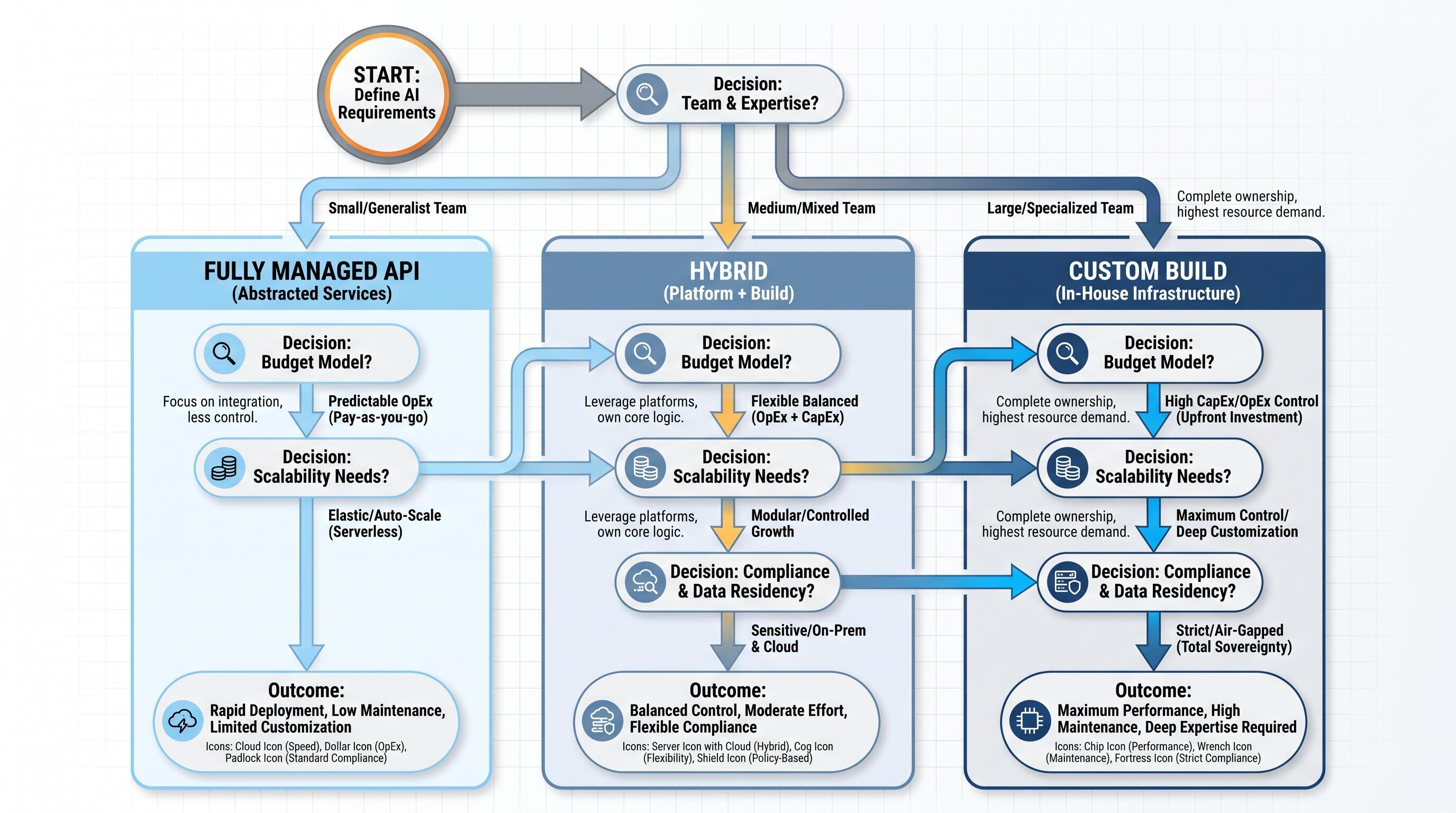
ALT: Technical diagram showing AI infrastructure build vs buy decision framework for scalable startup systems and full-stack development
Advanced Considerations for Teams at the Inflection Point
Once a startup crosses product-market fit and begins scaling, the build vs. buy question re-emerges with different stakes. What worked at a hundred users often breaks at ten thousand — and not just technically. Organizationally, economically, and strategically, the calculus shifts.
When to revisit a "buy" decision: If your AI API costs are growing faster than revenue, you're likely approaching the point where building custom inference infrastructure becomes economically justified. This threshold varies, but significant monthly API spend is commonly cited in the industry as a trigger for evaluating proprietary model serving. The key is building the capability to evaluate this decision before you're forced into it by cost pressure.
The fractional CTO question: Many founders ask whether fractional CTO services for early-stage startups can help navigate these infrastructure decisions. The honest answer is yes — with caveats. A fractional technical leader who has actually shipped AI products in production brings pattern recognition that most founding teams lack. They can compress the decision cycle significantly and help you avoid expensive mistakes. The value is highest when you're making foundational architecture decisions, because those are the ones that are hardest and most expensive to undo.
Common misconception: "We'll migrate later." One of the most dangerous phrases in startup engineering is "we'll clean it up when we have more time." AI infrastructure debt is particularly sticky because it touches data pipelines, model contracts, evaluation logic, and often user-facing behavior. Teams that defer these decisions consistently find that "later" never comes, and they end up with a significant refactoring effort precisely when they can least afford it — during a growth phase that demands feature velocity.
Agile vs. waterfall for AI infrastructure projects: The debate around the best methodology for managing large software projects — agile or waterfall — is largely settled in the industry toward iterative approaches, and AI infrastructure is no exception. But AI projects introduce a wrinkle: model behavior is probabilistic, not deterministic, which means requirements evolve based on observed model performance. Teams need planning frameworks that accommodate this empirical feedback loop — shorter cycles, explicit evaluation phases, and willingness to pivot based on what the data shows.
Frequently Asked Questions FAQ
Q1: How do I know when my startup should invest in building custom AI infrastructure?
The clearest signal is when your AI API costs are consuming a disproportionate share of your gross margin, or when managed services can no longer support the customization your product requires. A secondary signal is when data privacy requirements from enterprise customers exceed what your current vendor arrangements can satisfy. Before making the transition, invest in a thorough technical consulting evaluation of both the build cost and the operational maintenance burden — the full lifecycle cost is almost always higher than the initial estimate.
Q2: Are managed AI APIs a viable long-term strategy for scaling AI products?
For many products, yes. The assumption that you must eventually build your own models is a holdover from an earlier era when foundational model access was limited. Today, the best-managed AI providers continuously improve their models, and companies building proprietary wrappers around their APIs — with custom prompting, retrieval, and evaluation logic — can maintain meaningful differentiation without owning the underlying model weights. The key is ensuring your competitive moat lives in your data, workflow, or distribution — not in a proprietary model that's expensive to maintain and rapidly depreciated by frontier model improvements.
Q3: How long does it typically take and what does it cost to migrate from a managed AI service to a custom-built solution?
Migration timelines and costs vary widely based on how deeply the managed service is integrated into your product architecture. Teams with clean abstraction layers between their application logic and AI infrastructure can often migrate a core capability in weeks. Teams that built tightly coupled integrations face multi-month efforts. Cost-wise, you're looking at significant senior engineering time plus the operational infrastructure for model serving, monitoring, and retraining. Architectural decisions made early — specifically around abstraction and interface design — are the single biggest factor in whether migration is feasible or catastrophic.
Summary
The build vs. buy decision in AI infrastructure is one of the most consequential choices a startup makes — and it's rarely made once. It's a question you'll revisit at every major inflection point as your product, team, and scale evolve.
Three principles should guide every iteration of this decision:
First, differentiation is your compass. Build where your competitive advantage actually lives. Buy everything else. Resist the temptation to build infrastructure that has become a commodity just because it feels more "real" than using an API.
Second, account for the full lifecycle cost. The build vs. buy spreadsheet that only counts initial development cost is lying to you. Factor in maintenance, monitoring, compliance, talent retention, and opportunity cost. The true cost of building is almost always higher than the visible cost.
Third, design for optionality. Whether you build or buy, architect your systems with clean interfaces and abstraction layers that give you the ability to change your mind without a full rewrite. Flexibility has compounding value in a landscape that moves as fast as AI.
The most effective technical leaders aren't the ones who always build or always buy — they're the ones who make deliberate, well-reasoned decisions at each stage and architect for the ability to course-correct.
Call to Action
If you're ready to turn your idea into a live, running product, Darius brings the full-stack engineering and AI architecture expertise to make it happen — with 3 shipped projects as proof of concept. Visit https://www.darius.wiki to explore his work, dive into technical insights, and discover how he can help you architect, build, and ship your next big thing.
References
- McKinsey & Company. "The state of AI in early 2024: Gen AI adoption spikes and starts to generate value"
https://www.mckinsey.com/capabilities/quantumblack/our-insights/the-state-of-ai-2024 - MIT Sloan Management Review. "Why Build When You Can Buy? AI Infrastructure Strategy for Growing Companies."
https://sloanreview.mit.edu/ - National Institute of Standards and Technology (NIST). "AI Risk Management Framework (AI RMF 1.0)."
https://www.nist.gov/system/files/documents/2023/01/26/AI%20RMF%201.0.pdf - Stanford HAI. "Artificial Intelligence Index Report 2024."
https://aiindex.stanford.edu/report/ - a16z. "The New AI Stack: How Companies Are Building with AI in 2024."
https://a16z.com/ai/
Note: Standards and market conditions may be updated. Please check the latest official documents or consult professional advisors before making infrastructure decisions.
About the Author
Darius is an Engineering Director and AI Architect specializing in transforming ambitious ideas into live, production-ready products — spanning AI architecture, systems design, and full-stack development. With 3 shipped live projects and deep cross-disciplinary expertise, Darius delivers end-to-end technical leadership that bridges strategy and execution. Learn more at darius.wiki.
© Darius. All rights reserved. The content of this article is intended for informational purposes only and reflects the author's professional experience and opinions. Nothing herein constitutes formal engineering, legal, or business advice. Reproduction or redistribution of this content without prior written permission is prohibited.