How to Build a Provider-Agnostic LLM Adapter Layer in Your Stack
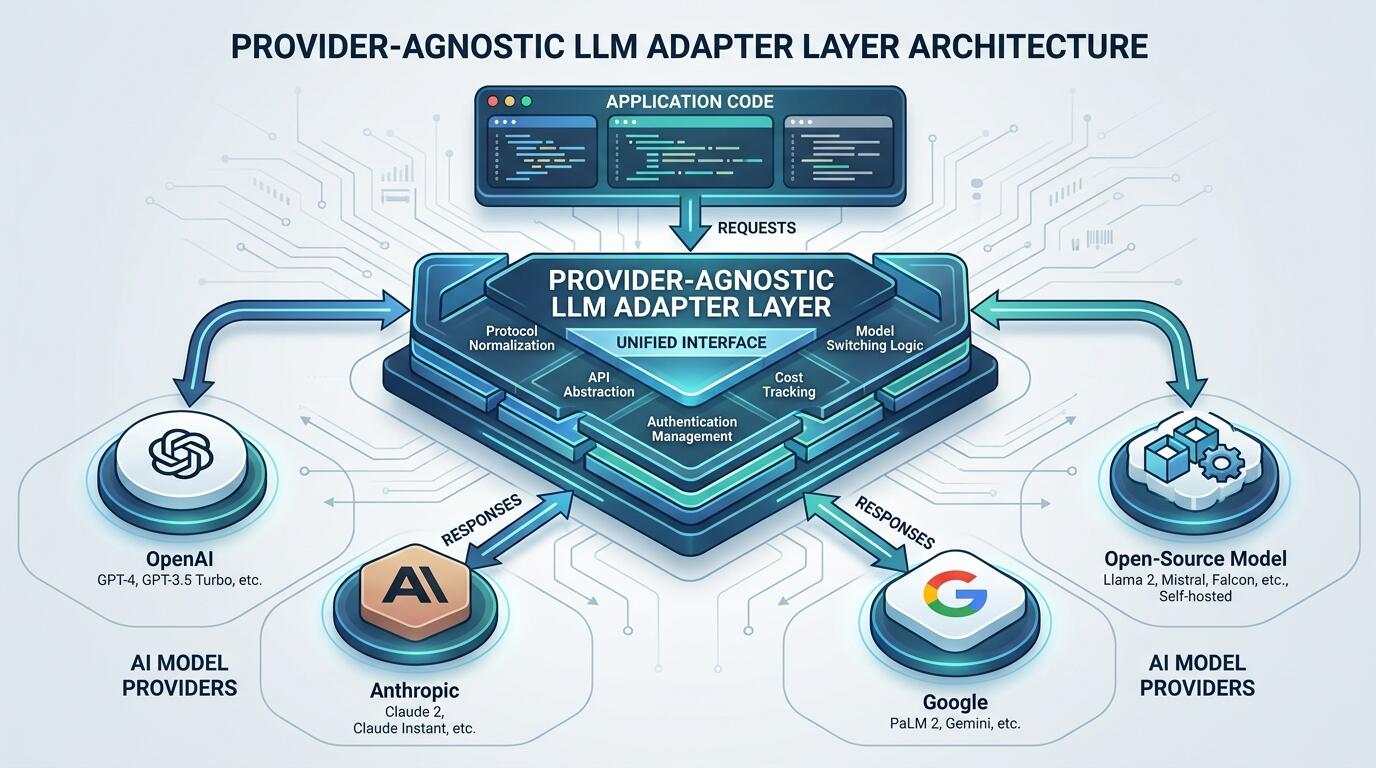
ALT: Diagram showing a provider-agnostic LLM adapter layer connecting multiple AI model providers
Build a Provider-Agnostic LLM Adapter Layer to Future-Proof Your AI Stack
Key Conclusion: A provider-agnostic LLM adapter layer is a unified interface that decouples your application code from any single AI model vendor, letting you swap or combine large language model providers without rewriting business logic. Building one requires a common request/response schema, per-provider connectors, centralized configuration, and a fallback strategy. Teams that adopt this pattern gain resilience, cost control, and negotiating leverage as the model landscape keeps shifting.
Engineering teams that hard-wire a single large language model provider into their product almost always regret it within a release cycle or two. Pricing changes, rate limits, deprecations, and simply better models arriving elsewhere force a rewrite that a well-designed abstraction would have avoided. This guide walks beginners and experienced engineers alike through constructing a provider-agnostic LLM adapter layer — a middleware component that normalizes how your application talks to OpenAI, Anthropic, Google, open-source inference servers, or any other model provider — so your codebase depends on your own interface rather than someone else's API contract.
Before You Start: Prerequisites and Preparation
Before writing a single line of adapter code, you need clarity on which providers you actually intend to support and why. A provider-agnostic LLM adapter layer only pays off if you have a genuine multi-provider need — cost arbitrage, redundancy, regional compliance, or feature access that varies by vendor. If you are permanently committed to one vendor, the abstraction still has value for testing and future flexibility, but the return on investment is lower.
You will need working API credentials for at least two model providers to validate the abstraction meaningfully — for example, one commercial hosted API and one self-hosted or open-weight model server. A basic understanding of REST or gRPC calling conventions is assumed, along with familiarity with your stack's dependency injection or module system, since the adapter layer is typically registered as a swappable service rather than instantiated ad hoc throughout the codebase.
Set aside time to read each provider's current API documentation for request shape, authentication method, streaming support, and token accounting, since these details drive the design of your common interface. This is not a one-afternoon task if you are supporting several providers with meaningfully different capabilities — plan for iterative refinement as edge cases surface, particularly around streaming responses, function calling, and error semantics.
In our work building production AI products, a pattern we consistently see is teams underestimating how much providers diverge in error handling and rate-limit signaling. Budget extra time specifically for that reconciliation work rather than treating it as an afterthought.
Checklist before starting:
- API keys or access credentials for at least two LLM providers, including one non-primary provider for testing
- A clear list of capabilities your application actually uses (chat completion, streaming, function/tool calling, embeddings, vision input)
- Familiarity with your application's dependency injection, service registration, or module-loading pattern
- A designated environment (staging or local) where you can safely test provider failover without affecting production traffic
- Logging or observability tooling already in place, or a plan to add basic request/response logging during this build
Step-by-Step Instructions
Step 1: Define Your Common Request and Response Contract
Start by designing a single, provider-neutral data structure that every part of your application will use to send prompts and receive completions. This contract — often called a unified schema or canonical message format — should capture the superset of fields your product needs: role-based messages, system instructions, temperature and other sampling parameters, tool/function call definitions, and metadata like request IDs for tracing. Keep the schema provider-agnostic by naming fields generically (for example, "maxOutputTokens" rather than a vendor-specific parameter name) so it never leaks a particular vendor's vocabulary into your core application logic.
Tip: Write this contract as if a brand-new provider will be added next quarter that you have never heard of today. If the schema requires a redesign every time you onboard a provider, it is not abstract enough yet.
Step 2: Build Individual Provider Connectors
For each LLM provider you support, implement a connector — a small, self-contained module responsible solely for translating your common contract into that provider's specific API format and translating its response back into your common contract. Each connector should be the only piece of code in your entire stack that imports a provider-specific SDK or constructs a provider-specific HTTP payload. This isolation is the core mechanical trick behind a provider-agnostic LLM adapter layer: business logic never touches vendor-specific code directly.
Tip: Name connectors by capability plus provider, such as "OpenAIChatConnector" or "AnthropicChatConnector," and keep each one under a single, easily testable responsibility so a new engineer can understand it without reading the whole adapter layer.
Step 3: Implement the Adapter Interface and Router
Create the adapter interface itself — the class or module that your application code actually calls — and have it delegate to the appropriate connector based on configuration rather than hardcoded logic. This router typically accepts a provider identifier (or resolves one from configuration, feature flags, or routing rules) and forwards the common-contract request to the matching connector. According to guidance from industry practitioners on LLM-agnostic integration patterns, as discussed in analyses of building LLM-agnostic adapters for AI model integration, the router layer should remain thin and stateless, pushing all provider-specific complexity down into the connectors rather than accumulating conditional logic at the routing level.
Tip: Resist the temptation to add provider-specific branches inside the router itself. If you find yourself writing "if provider equals X then do Y," that logic belongs inside the connector for provider X.
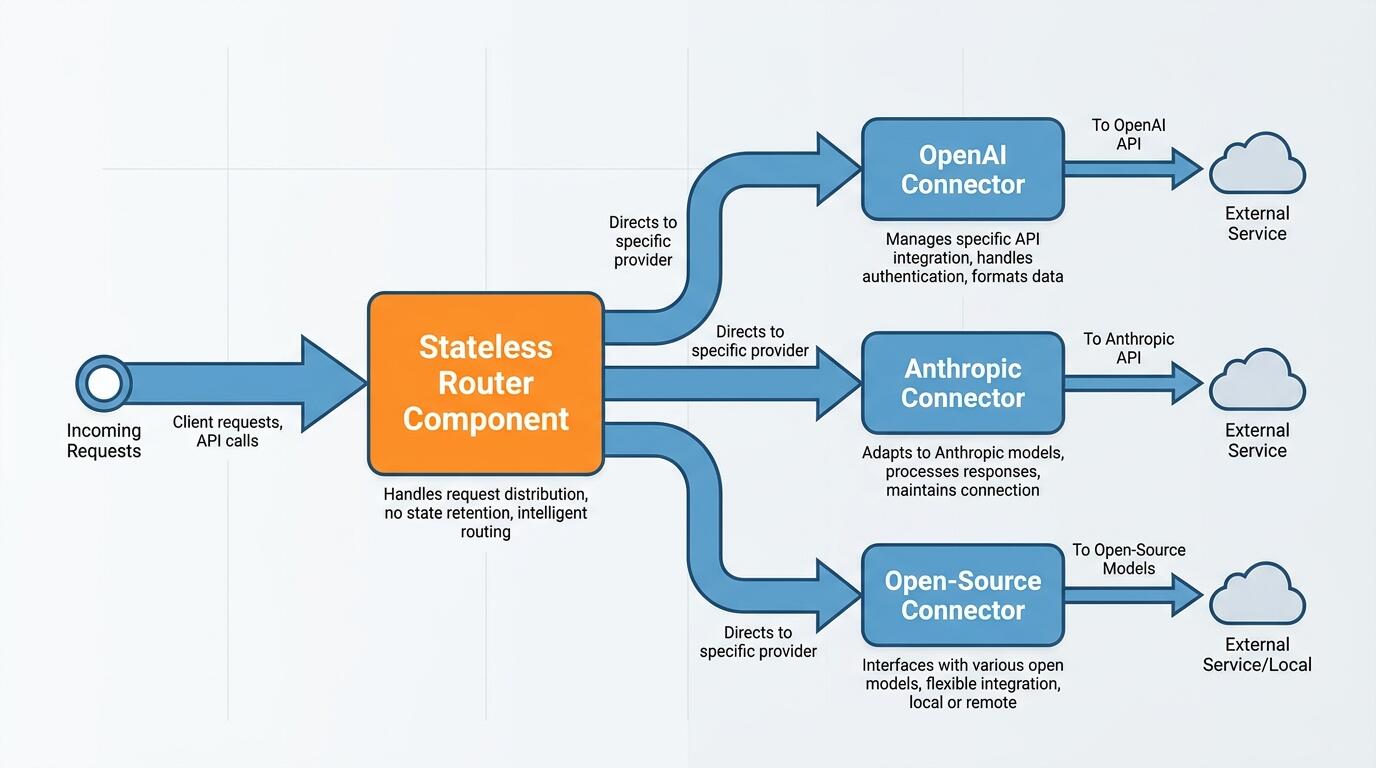
ALT: Architecture flowchart showing adapter router directing requests to separate provider connectors
Step 4: Add Configuration-Driven Provider Selection
Externalize which provider (or providers) handle which requests using configuration files, environment variables, or a feature-flag service rather than embedding provider choice in application code. This lets you shift traffic between providers — for cost, latency, or capability reasons — without a code deployment. Many teams implement this as a simple mapping of use case to provider, such as routing high-volume, low-stakes summarization to a cheaper model while routing complex reasoning tasks to a premium provider.
Tip: Store provider configuration per environment (development, staging, production) so you can safely test a new provider in staging before it ever touches production traffic.
Step 5: Build a Fallback and Retry Strategy
Design explicit fallback behavior for when a provider is unavailable, rate-limited, or returns an error — this is arguably the single highest-value feature of a provider-agnostic LLM adapter layer, since it converts a hard outage into a graceful degradation. A well-built fallback layer detects failure signals (timeouts, HTTP error codes, malformed responses) and automatically retries against a secondary provider using the same common-contract request, transparently to the calling code. Discussions of building a fallback layer before a model provider vanishes emphasize that fallback logic should be tested regularly under simulated failure, not just designed once and forgotten, since untested fallback paths tend to fail exactly when you need them most.
Tip: Log every fallback event with the original provider, the failure reason, and the provider that ultimately served the request, since this data becomes essential for both incident review and long-term provider-cost analysis.
Step 6: Normalize Error Handling and Observability
Map each provider's distinct error codes, rate-limit headers, and failure messages into a shared set of error categories your application already understands — such as "rate limited," "invalid request," "provider unavailable," and "content policy rejection." Without this normalization step, your downstream error-handling code ends up littered with provider-specific conditionals, defeating the purpose of the abstraction. Pair this with consistent logging and tracing across all providers so a single dashboard can show latency, error rate, and token usage regardless of which vendor served a given request.
Tip: Treat observability as a first-class part of the adapter layer, not an add-on. Teams that skip this step often discover cost overruns or quality regressions weeks after they happen, simply because provider-level metrics were never unified.
Step 7: Validate With Contract Tests Across Providers
Write a shared suite of contract tests that runs against every registered provider connector, verifying that each one correctly implements the common request/response contract, handles streaming consistently, and surfaces normalized errors as expected. This is the step that actually proves your abstraction works rather than merely compiles — a connector that passes the contract test suite can be swapped in with real confidence. Approaches described around building provider-agnostic AI features with frameworks such as Microsoft Extensions for AI reinforce that contract-level testing, rather than manual spot-checking, is what makes a multi-provider architecture maintainable over time as new models and SDKs are released.
Tip: Run the contract test suite automatically whenever a provider updates its SDK version, since silent behavior changes in a vendor's API are one of the most common causes of adapter-layer regressions.
Common Mistakes and Troubleshooting
| Symptom | Likely Cause | How to Fix |
|---|---|---|
| Business logic breaks whenever a provider changes its SDK | Provider-specific types or payloads leaked outside the connector layer | Refactor so only the connector imports the provider SDK; enforce this with linting rules or module boundaries |
| Fallback silently returns lower-quality answers with no visibility | Fallback events are not logged or surfaced in monitoring | Add structured logging and alerting for every fallback trigger, including which provider ultimately responded |
| Streaming responses work for one provider but break for another | Common contract does not account for differences in chunking or token-boundary behavior | Normalize streaming output into a single internal event format before it reaches application code |
| Cost spikes unexpectedly after adding a new provider | Routing configuration defaults new traffic to the most expensive provider | Set explicit default routing rules and review provider-selection configuration after every onboarding |
| Error handling code has many provider-specific conditionals | Error normalization step was skipped or incomplete | Build a shared error taxonomy in the adapter layer and map every provider's error codes into it |
| Adapter layer becomes a bottleneck under load | Router or shared contract layer holds state or performs blocking work | Keep the router stateless and push any heavy logic into asynchronous, horizontally scalable connectors |
Pro Tips for Better Results
Treat your provider-agnostic LLM adapter layer as a product in its own right, with its own versioned interface and changelog, rather than an internal implementation detail nobody documents. Teams that document the adapter's contract clearly find that onboarding a new provider takes far less time, since engineers can reference a stable specification instead of reverse-engineering prior connectors.
A common misconception is that provider-agnostic simply means "call a different API endpoint." In practice, true provider independence also requires normalizing token counting, prompt formatting conventions, and safety-filter behavior, since these vary meaningfully between vendors and directly affect output quality and cost estimates.
Build in a lightweight capability registry that records which features (streaming, function calling, vision input, embeddings) each connector actually supports, and have the router consult it before routing a request. This avoids runtime failures when a request requires a capability the selected provider does not offer.
Consider a hybrid routing strategy rather than an all-or-nothing switch: route by task type, cost sensitivity, or latency requirement instead of treating all requests identically. This is a pattern we consistently apply when designing AI-native products, since it lets the adapter layer optimize for both cost and quality simultaneously rather than forcing a single provider choice for every use case.
Finally, revisit your adapter layer's configuration and fallback logic on a recurring basis, not just when something breaks. The model provider landscape changes quickly, and an adapter design that fit your needs previously may need adjustment as new capabilities or pricing tiers emerge.
People Also Ask
Q1: How does a provider-agnostic LLM adapter layer differ from just using an SDK wrapper?
A simple SDK wrapper typically renames a provider's methods without changing the underlying data shapes, so switching providers still requires touching application code. A true provider-agnostic LLM adapter layer defines its own common contract independent of any vendor, isolates all provider-specific logic inside connectors, and lets application code remain completely unaware of which provider is active.
Q2: Is building a provider-agnostic LLM adapter layer worth it for a small team?
It depends on your multi-provider needs, but even small teams benefit from the testing and resilience advantages. If you rely on a single provider indefinitely, a lighter version — a thin interface with one connector and clear separation of concerns — still protects you from painful rewrites if you need to switch providers later.
Q3: How long does it typically take to build a working adapter layer?
Effort varies significantly with the number of providers and capabilities supported, but a functional version covering basic chat completion for two providers is achievable in a focused engineering sprint. Adding streaming, function calling, and robust fallback logic across multiple providers extends the timeline meaningfully, since each capability needs its own normalization and testing.
The Bottom Line
A provider-agnostic LLM adapter layer is one of the highest-leverage architectural investments an AI-driven engineering team can make, and the effort pays back the first time a provider changes pricing, deprecates a model, or experiences an outage.
Key takeaways:
- Define a common request and response contract before writing any provider-specific code
- Isolate all vendor-specific logic inside individual connectors, never inside shared routing or business logic
- Build explicit fallback and retry behavior so provider outages degrade gracefully instead of breaking your product
- Normalize errors and observability across providers so your team has one consistent view of cost, latency, and reliability
- Validate the abstraction with shared contract tests run against every connector, not just manual spot checks
Teams that treat AI capability as a native, deeply integrated part of their architecture — rather than a bolted-on API call — are the ones best positioned to adapt as the model landscape keeps evolving.
Ready to experience AI built the right way—native, not bolted-on? Explore Darius's suite of production-ready AI products, from an intelligent cloud drive to an AI-powered mock interview platform and creator cockpit, at the Darius website. Visit today and discover how these tools can streamline your workflow and accelerate your goals.
Sources and Further Reading
- LinkedIn Top Content. "Building LLM-Agnostic Adapters for AI Model Integration".
https://www.linkedin.com/top-content/artificial-intelligence/ai-model-development/building-llm-agnostic-adapters-for-ai-model-integration/ - The Road to Enterprise. "Build an LLM Fallback Layer Before Your Model Vanishes".
https://theroadtoenterprise.com/blog/model-agnostic-ai-layer-fallbacks - Medium. "Build Provider-Agnostic AI Features in .NET with Microsoft Extensions for AI".
https://medium.com/@bhargavkoya56/build-provider-agnostic-ai-features-in-net-with-microsoft-extensions-ai-bec094c0af75
Note: Standards may be updated; please check the latest official documents or consult professional advisors.