How to Build an AI Product Roadmap That Engineering Can Actually Execute

ALT: Engineering team reviewing an AI product roadmap that bridges strategy and execution
What a Truly Executable AI Product Roadmap Looks Like — and How to Build One
How do you write an AI product roadmap that your engineering team will not quietly shelve by sprint three? The answer is to design the roadmap for execution from the very first line — anchoring every item to a technical constraint, a data dependency, or a validated capability before it ever enters a planning document.
This guide is for startup CTOs, product managers, and engineering leaders who are tired of watching ambitious AI initiatives collapse between the strategy deck and the first production deployment. A pattern that comes up consistently in practice is that the gap is rarely vision; it is the translation layer between what the product wants to do and what the system can actually deliver. The steps below are the translation layer.
Before You Start: Prerequisites and Preparation for AI Roadmap Planning
Building an executable AI product roadmap is not a whiteboard exercise that starts from scratch. It is a structured synthesis of existing technical knowledge, business context, and honest constraint mapping. Before you sit down to plan, you need enough raw material to make real tradeoffs — not just aspirational feature lists.
The preparation phase is often underestimated. A common mistake is treating roadmap planning as a meeting rather than a discovery process. In practice, the quality of the roadmap is determined almost entirely by the depth of pre-work.
Here is what you need in place before beginning:
Technical literacy across your AI stack. You do not need to have finalized your model choices, but someone on the planning team must understand the difference between fine-tuning and retrieval-augmented generation, the latency profile of inference in production, and the basic data pipeline requirements for your intended use case. Without this, estimates will be fictional.
A clear product hypothesis. The AI feature or system you are planning should have a stated problem it solves for a specific user, a rough success criterion, and at least one prior validation signal — a user interview, a prototype test, or competitive evidence. Roadmaps built on pure assumptions accumulate technical debt before the first line of code is written.
Access to your engineering team. Planning a roadmap without synchronous input from the engineers who will execute it is one of the most reliable ways to produce a document that no one follows. You need candid estimates and constraint flags, not post-hoc sign-off.
Visibility into your data assets. AI systems are data-dependent in ways that traditional software is not. Know what data you have, what shape it is in, and what gaps exist — before you commit to a timeline.
A working understanding of your infrastructure. Cloud environment, existing CI/CD pipelines, observability tooling, and any compliance or security requirements will all constrain what is possible and when.
Checklist before starting:
- At least one engineer with hands-on AI/ML experience involved in planning sessions
- Defined problem statement and target user for the AI system
- Inventory of available training data, labeled datasets, or third-party model access
- Agreed definition of "done" for the first meaningful milestone
- Knowledge of any regulatory or compliance requirements that affect model use or data handling
- Stakeholder alignment on what a successful v1 looks like (not v3)
Step-by-Step: How to Build an AI Product Roadmap Engineering Can Execute
Step 1: Start with Capability Mapping, Not Feature Lists
An AI product roadmap should begin by cataloguing what your system can actually do, not what stakeholders wish it could do. Capability mapping is the process of inventorying the AI and engineering competencies your team currently holds, the ones you can realistically acquire, and the hard boundaries that will not move within your planning horizon.
For each proposed AI capability — natural language understanding, recommendation, anomaly detection, image classification, whatever applies — work through three questions: Do we have the data for this? Do we have the compute and infrastructure for this? Does our team have the expertise to ship and maintain this? Every capability that cannot answer "yes" to all three is a risk item, not a roadmap item, until you have a plan to close the gap.
Per guidance documented in How to Build an AI Product Roadmap (Step-by-Step Guide), the most durable AI roadmaps treat capability development as a first-class workstream — not a background assumption behind the feature list.
Tip: Create a two-column table: one column for the user-facing feature, one for the underlying AI capability it requires. Any feature without a mapped, validated capability is a planning risk, not a commitment.
Step 2: Define the Minimal Intelligent System
A minimal intelligent system is the smallest version of your AI product that produces a measurable, meaningful result for a real user — analogous to an MVP, but specifically engineered for AI's unique failure modes (model drift, data quality degradation, edge-case hallucination). Defining this boundary early is what separates roadmaps that ship from ones that perpetually defer to "when the model is better."
Work with your engineering team to identify the lowest-fidelity AI behavior that still validates your core product hypothesis. This is often a rule-based baseline augmented by a single model call, rather than a sophisticated multi-stage pipeline. The goal of the first roadmap milestone is not to build the best possible AI system — it is to build one that is good enough to learn from in production.
This step also forces an honest conversation about what "good enough" means in measurable terms: a precision threshold, a user satisfaction score, a task completion rate. Without this, every sprint review becomes a qualitative debate.
Tip: If your team cannot describe the minimal intelligent system in two sentences without referencing the full architecture, the scope is still too large. Keep reducing until you reach a shippable, testable unit.
Step 3: Sequence Work Around Data Dependencies, Not Feature Priority
Traditional software roadmaps sequence by business priority. AI roadmaps must sequence by data dependency. A high-priority feature that depends on a labeled dataset you do not yet have will block an entire team regardless of its business value ranking. This is one of the most common and costly misunderstandings in early AI product planning.
Map out the data pipeline requirements for each capability: raw data collection, labeling or annotation, transformation, validation, and model training or integration. Assign each a readiness status. Then reorder your roadmap so that the data acquisition and preparation work for each capability precedes — ideally by at least one sprint — the engineering work that depends on it.
In work with founders and engineering teams navigating their first AI builds, a pattern that consistently surfaces is teams that parallelize data work and model work without any buffer. When the data lands late or dirty, the model work stalls, and the roadmap slips in ways that are very hard to recover from.
Tip: Add a "data readiness gate" as an explicit milestone before each AI capability workstream. This makes the dependency visible in the roadmap and gives stakeholders an early warning signal when timelines are at risk.
Step 4: Build in Evaluation Infrastructure Before You Need It
Evaluation infrastructure — the tooling and processes you use to measure whether your AI system is performing as intended — should be treated as a roadmap item in its own right, not scaffolding to be added later. Teams that defer this consistently find themselves unable to make confident decisions about model updates, rollbacks, or capability improvements because they have no reliable ground truth against which to measure.
At minimum, the evaluation layer should include: an offline evaluation set representative of real production inputs, a set of behavioral tests that cover known edge cases, and a lightweight production monitoring setup that tracks model output quality over time. This does not need to be elaborate to be effective — the key is that it exists and is actively maintained from the first deployment.
According to guidance published at How to Build an AI Product Roadmap That Actually Ships, evaluation and observability are among the most frequently under-resourced workstreams in early AI product teams, and their absence is a leading cause of AI features being quietly rolled back after launch.
Tip: Designate one engineer as the owner of evaluation infrastructure from the beginning of the project. Shared ownership in this domain almost always means no one is actually tending it.
Step 5: Decompose AI Work into Time-Boxed Experiments, Not Open-Ended Research
AI development involves a class of uncertainty that standard engineering estimation does not account for: model behavior is not fully predictable from first principles. A feature that works perfectly in a controlled experiment may behave unpredictably on the long tail of production inputs. Roadmaps that treat AI work like deterministic engineering work will consistently produce missed deadlines and frustrated teams.
The practical fix is to structure AI development work as time-boxed experiments with explicit hypotheses and exit criteria. Instead of "build recommendation model — three weeks," the roadmap item reads: "Two-week experiment: can a collaborative filtering baseline achieve X% precision on the validation set? Exit criteria: ship if yes, escalate scoping decision if no." This reframes uncertainty as a structured process rather than an open-ended liability.
This approach also creates a natural decision cadence — at the end of each experiment, the team makes an informed go/no-go call rather than drifting deeper into an approach that is not working.
Tip: Keep experiment time-boxes short enough that a negative result is informative rather than catastrophic. In most AI product contexts, two-week experiment windows strike a practical balance between discovery and momentum.
Step 6: Align Stakeholders on AI's Non-Linear Progress Curve
One of the most reliable sources of roadmap breakdown in AI products is the mismatch between stakeholder expectations and how AI development actually progresses. Traditional software tends to improve in roughly linear increments. AI capabilities tend to improve in jumps — with long flat periods punctuated by step-change improvements when data quality crosses a threshold, architecture choices are revised, or evaluation surfaces a systematic error.
Build this expectation into the roadmap itself, explicitly. Schedule stakeholder checkpoints not at arbitrary calendar intervals but at the exit points of experiments and evaluation gates. At each checkpoint, present the current capability benchmark alongside the target, explain what the next improvement lever is, and give a qualitative estimate of when the next step-change is likely. This turns what would otherwise feel like stagnation into a disciplined technical process.
Tip: Prepare a simple "capability trajectory" view for non-technical stakeholders — a qualitative illustration of where the AI system is today, what the next plateau looks like, and what investment is required to get there. This prevents the common scenario where leadership loses confidence in the AI program precisely at the moment the team is closest to a meaningful breakthrough.
Step 7: Encode Rollback and Fallback Paths as First-Class Roadmap Items
Every AI capability that touches a production user flow needs a fallback — a rule-based, deterministic, or human-in-the-loop path that activates if model quality degrades below threshold. Planning this fallback is not pessimism; it is the engineering discipline that makes it safe to ship AI features incrementally rather than waiting for a "perfect" model.
Roadmaps that omit fallback planning tend to either delay launch indefinitely (waiting for a model confidence level that never arrives) or ship without a safety net and suffer costly rollbacks when edge cases surface in production. In practice, the teams that ship AI features most reliably are the ones who treat the fallback path with the same engineering care as the primary AI path.
Encode the fallback design, its trigger conditions, and its maintenance requirements as explicit items in the roadmap. This also has a useful side effect: it forces a concrete conversation about what "model failure" actually means for your system, which sharpens the evaluation criteria established in Step 4.
Tip: Frame fallbacks not as "the AI didn't work" paths, but as "graceful degradation" — the system behaves correctly at reduced capability rather than breaking. This framing makes fallbacks easier to prioritize with product stakeholders.
Common Mistakes and Troubleshooting in AI Roadmap Execution
| Symptom | Likely Cause | How to Fix |
|---|---|---|
| Roadmap items slip every sprint despite team effort | AI tasks scoped as deterministic engineering work with no uncertainty buffer | Reframe as time-boxed experiments with explicit exit criteria; add uncertainty buffers to estimates |
| Model performance stalls and team cannot diagnose why | No evaluation infrastructure or ground-truth benchmark in place | Retroactively build evaluation set; designate an owner; treat this as an emergency roadmap item |
| Data pipeline work constantly blocks model development | Data dependencies not sequenced ahead of the work that requires them | Reorder roadmap around data readiness gates; surface blockers two sprints in advance |
| Stakeholders lose confidence and demand scope changes mid-cycle | Expectations set against a linear progress curve; no structured checkpoint cadence | Introduce experiment-exit checkpoints; share capability trajectory views at each stakeholder review |
| AI feature ships but gets quietly deprecated after launch | No fallback path; edge case failures erode trust before team can respond | Add fallback design as a pre-launch gate; define model quality thresholds and monitoring triggers |
| Engineering team ignores or rewrites the roadmap | Roadmap built without engineering input; constraints not surfaced during planning | Involve at least one senior engineer in every planning session from the capability mapping stage forward |
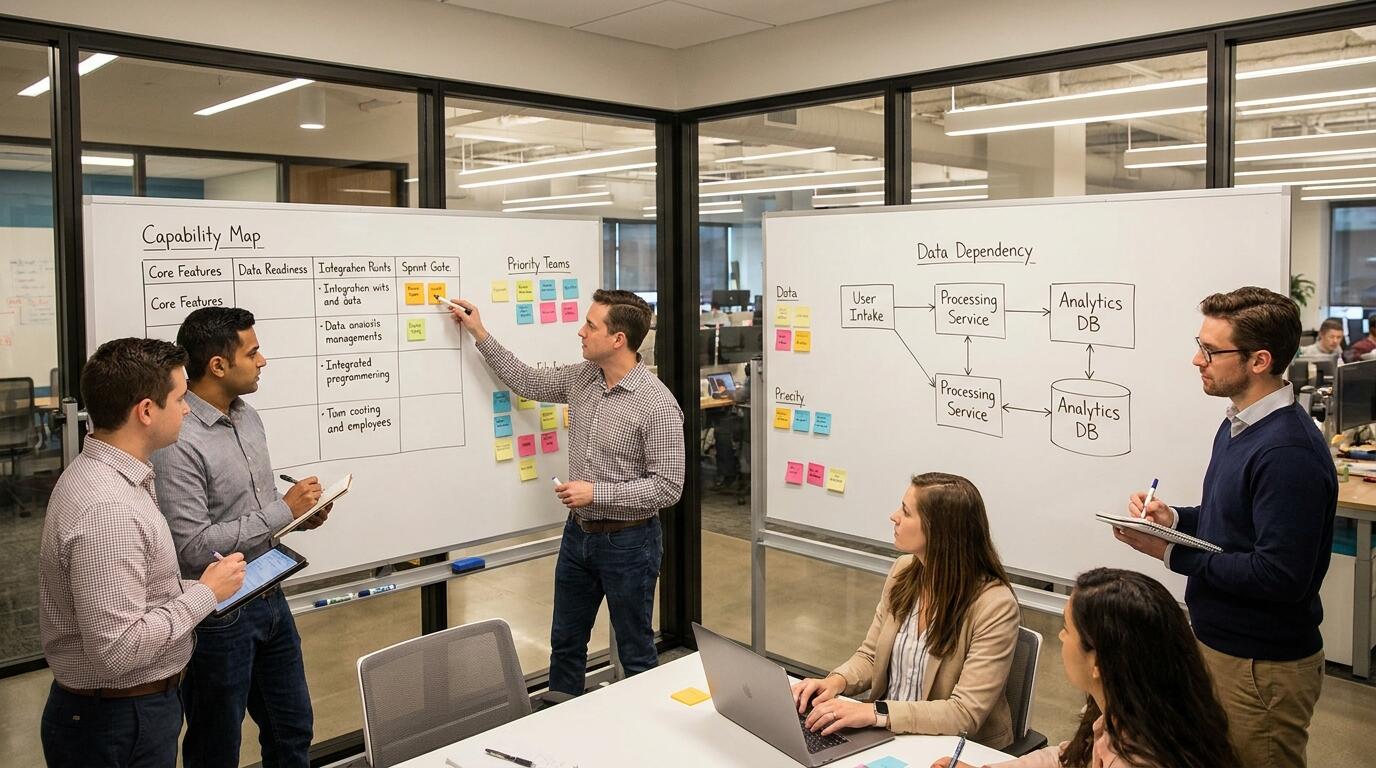
ALT: Engineering and product teams collaborating on an executable AI roadmap with capability mapping and data dependency sequencing
Pro Tips for Better AI Roadmap Outcomes
Treat your first production deployment as a data collection event, not a product launch. The primary value of v1 in most AI products is the production data and behavioral signals it generates — not the feature it delivers. Design the roadmap so that v1 is optimized for learning velocity: instrument everything, minimize scope, and have a clear plan for what you will do with what you learn.
Use confidence levels instead of fixed deadlines for AI milestones. Where a traditional software task can be estimated with reasonable precision, an AI capability milestone often cannot. Communicate AI milestones as "high confidence we can deliver X in two sprints; medium confidence on Y in four sprints; Z is contingent on experiment outcomes." This is more honest and more useful than false precision.
Separate the AI roadmap layer from the product roadmap layer — then reconnect them explicitly. The AI development timeline (data, training, evaluation, integration) and the product release timeline (user-facing features, UI, go-to-market) are different cadences that need to be coordinated, not merged into one flat list. A pattern that works well in practice is maintaining two synchronized roadmap views with an explicit integration layer that shows where AI capability milestones gate product feature readiness.
Do not over-index on model selection in early planning. A common misconception is that choosing the right model architecture is the central challenge of AI product development. In practice, teams that invest heavily in model selection before they have clean data and a working evaluation framework are optimizing the wrong variable. Model selection is a mid-cycle decision, not a pre-planning one.
Build in a recurring "AI health review" sprint ceremony. Beyond standard retrospectives, a monthly or bi-weekly review focused specifically on model performance, data quality trends, and evaluation coverage keeps the AI system from silently degrading between feature cycles. This ceremony does not need to be long — it needs to be consistent.
People Also Ask
Q1: How long does it take to build an initial AI product roadmap?
Building an initial AI product roadmap — from capability mapping through stakeholder alignment — typically takes one to three focused working sessions for a small team, assuming the prerequisites (data inventory, product hypothesis, engineering input) are in place. The preparation work takes longer than the roadmap document itself. Teams that try to compress the process into a single meeting typically produce a roadmap that collapses at the first technical constraint.
Q2: Are AI product roadmaps fundamentally different from traditional software roadmaps?
AI product roadmaps differ from traditional software roadmaps in two important ways. First, they must account for data dependencies as first-class sequencing constraints — not background assumptions. Second, AI development involves irreducible uncertainty around model behavior that standard engineering estimation does not handle well. Per practices documented in resources like How to Build an AI Product Roadmap (Step-by-Step Guide), structuring AI work as time-boxed experiments rather than deterministic tasks is one of the most effective adaptations.
Q3: What is the most common reason AI product roadmaps fail to ship on time?
The most common reason AI product roadmaps fail to ship is unsequenced data dependencies — the data a model requires is not ready when the engineering work that depends on it begins. A close second is the absence of evaluation infrastructure, which makes it impossible to make confident decisions about when a model is ready for production. Both are planning failures, not execution failures, and both are preventable with the preparation steps outlined in this guide.
Final Thoughts
Building an AI product roadmap that engineering can actually execute is not about constraining ambition — it is about making ambition achievable by grounding it in the technical and data realities that determine whether AI systems ship and survive in production.
Key takeaways from this guide:
- Start with capability mapping — know what your team can actually build before you commit to what users will see.
- Sequence the roadmap around data dependencies, not business priority alone.
- Define a minimal intelligent system as your first milestone and measure it concretely.
- Build evaluation infrastructure early; it is what makes every subsequent decision defensible.
- Structure AI work as time-boxed experiments with explicit exit criteria — this reframes uncertainty as process, not risk.
- Encode fallback paths as first-class engineering deliverables, not afterthoughts.
- Align stakeholders on AI's non-linear progress curve from the beginning, not after the first missed deadline.
The teams that ship AI products reliably are not the ones with the best models — they are the ones with the clearest translation between vision and execution. That translation layer is the roadmap, and it starts with the work described here.
If you are ready to move from strategy to a roadmap your team can actually execute, explore hands-on perspectives and shipped AI systems at the Darius website — or get in touch directly to work through your specific product and architecture challenges.
Sources & Further Reading
- Prodmap. "How to Build an AI Product Roadmap (Step-by-Step Guide)".
https://www.prodmap.ai/blog/how-to-build-ai-product-roadmap/ - Origami Studios. "How to Build an AI Product Roadmap That Actually Ships".
https://origamistudios.us/blog/how-to-build-ai-product-roadmap/ - IEEE (Institute of Electrical and Electronics Engineers) — Standards and resources on AI systems engineering and software development practices.
https://www.ieee.org/
Note: Standards and best practices in AI product development evolve rapidly; please verify the latest guidance from official sources or consult qualified practitioners before making architectural or strategic decisions.