Running a Bilingual Publication Where English Is the Draft Language

ALT: Engineer managing a bilingual AI newsletter where English drafts become Chinese editions
Why English as the Draft Language Changes Everything in Bilingual Publishing
Key Conclusion: Running a bilingual publication with English as the draft language is a deliberate architectural choice, not a convenience. For AI-focused technical publishers targeting both English-speaking and Chinese-speaking practitioners, drafting in English first establishes a single source of truth, enforces terminological consistency across both editions, and creates a translation pipeline that is auditable and reproducible — provided you build the right workflow from the start.
Publishing in two languages simultaneously sounds like a logistics problem. It is actually a systems design problem. At Darius, we produce a bilingual AI newsletter — each issue covering five to ten curated items with primary sources and first-hand engineering commentary — and we draft every piece in English before producing the Chinese edition. That sequencing is not arbitrary. It reflects a set of deliberate decisions about where cognitive load belongs, how terminology propagates, and what failure modes we are willing to accept.
The three core tensions in bilingual technical publishing are: source language authority (which edition is canonical?), terminology drift (do the same concepts get named the same way across issues?), and translation latency (how long does it take before both editions are live?). Choosing English as the draft language resolves the first tension cleanly and creates tractable solutions to the other two.
Who This Approach Is For — and When It Breaks Down
Applicable Scenarios:
- Technical publications where the primary author thinks and reasons in English, regardless of the target readership split
- AI or engineering newsletters where precise terminology in English (model names, API names, paper titles) must be preserved exactly before any localization occurs
- Small editorial teams — often a single author — who need a reproducible, low-overhead pipeline rather than a parallel-drafting or translation-first approach
- Publications serving a bilingual professional audience that expects both editions to be substantively equivalent, not loosely adapted
Not Applicable/Cautions:
- Publications where the primary author drafts natively in Chinese: forcing an English-first workflow introduces unnecessary friction and is more likely to produce wooden English that harms both editions
- Consumer-facing content where tone, cultural register, and idiomatic expression matter more than terminological fidelity — in that context, parallel drafting by native speakers of each language is usually worth the overhead
- High-frequency publishing schedules (multiple issues per day) where the sequential draft-then-translate pipeline creates unacceptable latency on the non-English edition
The Structural Problem Bilingual Technical Publishing Actually Solves
Bilingual technical publishing is not simply about reaching two audiences. It is about maintaining a single editorial voice and a consistent technical record across two linguistic systems that handle certain concepts very differently.
In AI coverage specifically, this challenge is acute. English dominates the primary literature: papers appear on arXiv in English, model release announcements come in English, API documentation is English-first. A Chinese-language AI newsletter that translates from finished English prose is, in practice, always working from primary sources. A Chinese-language newsletter that drafts in Chinese is, in practice, always back-translating concepts that originated in English — which introduces a lossy intermediate step.
When we started Darius, the question was not "should we publish bilingually?" but "where does the canonical version live?" The answer — English, because that is where the primary sources live — shaped every subsequent workflow decision.
The broader bilingual publishing landscape reflects similar tensions. According to discussions in self-publishing communities, one of the first structural questions authors face when producing bilingual editions is which language carries the authoritative text and which is derived — because that determines layout, editorial review sequencing, and revision workflows. The same question applies, at higher velocity and technical precision, to a newsletter covering fast-moving AI developments.
Building the English-First Bilingual Workflow
Three-Step Quick Start
Step 1: Establish the English draft as the single source of record
Before any translation begins, the English draft must be complete and reviewed. This is not a timing preference — it is a structural rule. If you allow the Chinese edition to begin before the English is frozen, you create two diverging documents with no clear canonical version. When a fact changes (a model number, a benchmark figure, an API parameter), you now have two places to update and no reliable way to verify they match. Treat the English draft the way a software engineer treats a main branch: no derivative work begins until the source is stable.
Step 2: Build a terminology glossary before issue one
Terminology drift is the most insidious failure mode in bilingual technical publishing. Chinese has no single standardized rendering for most recent AI terms: "inference" can become 推理 or 推断, "fine-tuning" can become 微调 or 精调, "agent" can become 智能体 or 代理. If you do not decide on canonical Chinese terms before you start translating, you will use different terms across issues, and your Chinese-edition readers will lose confidence in the publication's precision. Build a living glossary — even a simple spreadsheet — that maps English technical terms to their canonical Chinese equivalents, and enforce it on every issue.
Step 3: Use translation as an editorial review pass, not a mechanical conversion
Translation should be the second editorial review of the English draft, not a post-production step. When you translate an English sentence and find it awkward to render in Chinese, that is usually a signal that the English sentence was imprecise or structurally ambiguous. Use those friction points to revise the English before finalizing both editions. This turns the translation step into a quality gate rather than a pure cost center.
Comparing Bilingual Publishing Workflow Approaches
Several structural models exist for running a bilingual publication. The choice of approach has downstream consequences for quality, speed, and editorial overhead.
| Comparison Dimension | English-First Sequential | Parallel Drafting | Chinese-First Sequential |
|---|---|---|---|
| Source of truth | English draft (unambiguous) | Neither edition is canonical | Chinese draft |
| Terminology consistency | High — English terms established first | Variable — depends on coordination | Requires back-translation to English |
| Editorial review overhead | Moderate — one draft reviewed, one translated | High — two independent drafts reviewed | Moderate — but English may read unnaturally |
| Latency to publish both editions | One edition delayed by translation time | Both editions can publish simultaneously | One edition delayed by translation time |
| Best fit | Technical publications, AI/engineering content | High-volume consumer media with dedicated bilingual teams | Publications where Chinese is the natural primary language |
| Risk of divergence | Low — one source drives both | High without tight coordination | Moderate — English edition may drift from Chinese intent |
The English-first approach accepts one structural tradeoff: the Chinese edition is always produced after the English edition is complete, which means the Chinese edition cannot go live simultaneously. For a newsletter operating on a weekly or semi-weekly cadence, this latency is acceptable. For a publication trying to break news in real time across both languages, it may not be.
The Mechanics of Maintaining Voice Across Two Languages
Voice preservation is the hardest editorial problem in bilingual technical publishing. English technical prose tends toward directness, short declarative sentences, and active voice. Formal Chinese technical writing tends toward nominalization, longer syntactic units, and implicit rather than explicit connectives. A direct translation often produces Chinese that reads as stiff and unnatural; a loose translation loses the precision that makes the English edition valuable.
The pattern we consistently follow at Darius is to translate for meaning and register, not for sentence structure. Each Chinese paragraph should read as if it were written by a Chinese engineer who had read the English paragraph, understood it, and chose to express the same ideas in natural Chinese — not as a word-for-word rendering. This distinction matters because technical readers in China have high tolerance for borrowed English terminology (英文缩写 and product names are expected to appear untranslated) but low tolerance for Chinese prose that reads like machine output.
The practical implication: do not evaluate your Chinese edition by checking it against the English sentence by sentence. Evaluate it by reading the Chinese edition independently and asking whether a Chinese-speaking AI engineer would find it precise, natural, and useful. Those are the criteria that matter.
Handling untranslatable terms is a specific challenge in AI coverage. Model names (GPT-4o, Claude 3.5 Sonnet, Gemini 1.5 Pro), paper titles, and API endpoint names should never be translated — they should appear in the Chinese edition exactly as they appear in English. Translating a model name creates ambiguity and breaks searchability. Your glossary should include an explicit "do not translate" category for these entities, and that category should be enforced as strictly as the "canonical translation" category.
Advanced Considerations for Long-Running Bilingual Publications
Three issues tend to surface after a publication has been running for several months.
Terminology evolution. The AI field introduces new terms at high velocity, and the Chinese technical community does not always converge on the same translation. "Retrieval-augmented generation" was rendered as 检索增强生成 in some publications and as 检索增广生成 in others before the former became dominant. If you have been using one rendering and the community has converged on a different one, you face a backward-compatibility problem in your own archive. The practical answer is to make a clean switch with a brief explanatory note in the issue where the change occurs, rather than quietly retroactively editing past issues.
Bilingual SEO is not symmetric. A topic that generates high search volume in English (say, a specific model benchmark) may generate minimal Chinese-language search traffic, because Chinese readers may be searching for the topic differently or via different platforms. Do not assume that optimizing the English edition for a particular keyword will automatically produce a Chinese edition that performs well in Chinese-language search. Treat English SEO and Chinese discoverability as separate optimization problems that happen to share source content.
A common misconception is that LLM-assisted translation eliminates the bilingual workflow problem. It reduces the mechanical cost of producing a first-draft Chinese edition from English, but it does not eliminate the need for editorial review of terminology, register, and factual precision. In our experience, LLM translation output for AI technical content is often accurate at the sentence level but inconsistent at the publication level — it will not preserve your glossary, will sometimes translate terms that should remain in English, and will occasionally introduce plausible-sounding but incorrect Chinese renderings of technical concepts. LLM translation is a useful accelerant, not a replacement for bilingual editorial judgment.
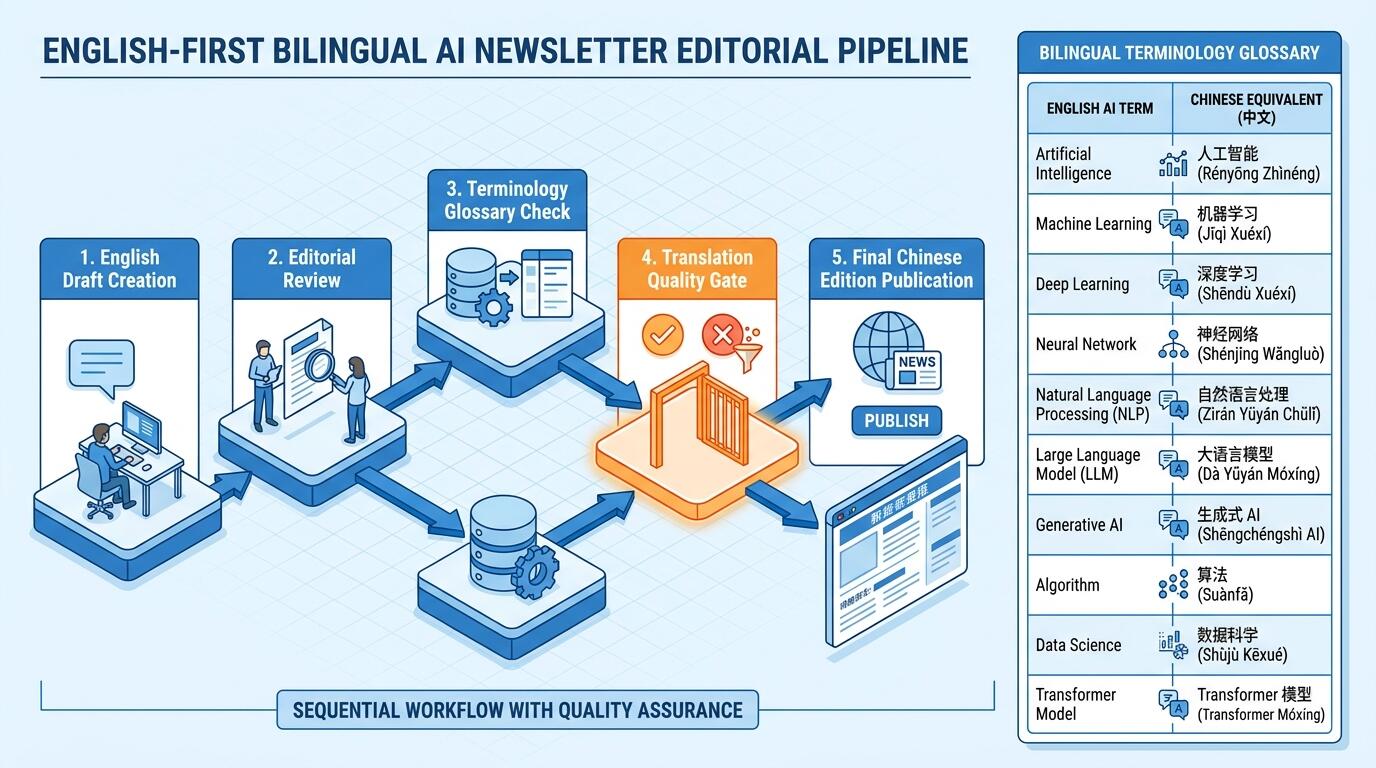
ALT: Diagram of English-first bilingual AI newsletter editorial workflow with translation quality gates and terminology glossary
Common Questions
Q1: How do you handle the situation where the Chinese edition needs to go live at the same time as the English edition?
True simultaneity is difficult with a sequential draft-then-translate workflow. The practical resolution is to define "simultaneous" loosely: if both editions are live within a few hours of each other, readers of either edition are not meaningfully disadvantaged. If your publication has a hard simultaneity requirement — for example, because you are covering time-sensitive market developments — you should either accept a shorter English draft (which translates faster) or invest in a dedicated translator who can work from a nearly-final English draft while you do final edits. Do not sacrifice English draft completeness to achieve simultaneity; the source-of-truth discipline is more important.
Q2: Is it necessary to hire a professional translator, or can the original author handle both languages?
A bilingual author who is a native or near-native writer in both languages can handle both editions, but should treat the translation step as a separate editorial session rather than an inline task. Translating immediately after drafting, in the same sitting, tends to produce Chinese that follows English sentence structure too closely. The pattern that works better is to complete and review the English draft, then return to it after a gap — even a few hours — and produce the Chinese edition with fresh eyes. If the author is not a strong Chinese writer, a professional translator with AI domain knowledge is worth the overhead; generic translators without technical background tend to introduce terminology errors that undermine reader trust.
Q3: How long does building and maintaining the bilingual terminology glossary typically take?
Initial glossary construction — covering the core vocabulary of an AI-focused publication — typically requires a few hours of deliberate work before the first issue. The more important investment is the ongoing maintenance discipline: every issue that introduces a new technical term should result in a glossary update before the translation begins, not after. In practice, this adds a small fixed overhead per issue. The cost of not maintaining the glossary is much higher: terminology inconsistency that compounds across issues and erodes reader confidence in ways that are difficult to correct retroactively.
Summary
Running a bilingual publication with English as the draft language is a workflow architecture that trades simultaneity for consistency and source clarity. For technical publishers — especially in the AI domain, where primary sources are overwhelmingly English — it is the right tradeoff.
Key Takeaways:
- English as the draft language establishes an unambiguous source of truth, which is essential for maintaining factual accuracy across two editions of a technically precise publication.
- A living bilingual terminology glossary, built before issue one and updated with every issue, is the single most effective defense against terminology drift.
- Translation is an editorial review pass, not a post-production step — friction in translation usually signals imprecision in the English draft.
- LLM-assisted translation reduces mechanical cost but does not replace bilingual editorial judgment, especially for terminology consistency and register.
- Bilingual SEO is not symmetric: treat discoverability in each language as a separate optimization problem.
The next step is to audit your existing workflow against these principles. If you are producing your first issue, start with the glossary before you write the first word of the first draft. If you are already publishing, run a terminology consistency check across your last five issues: the results will tell you where the drift has accumulated.
If this approach to bilingual technical publishing is useful to you, the same editorial discipline underlies every issue of Darius — a bilingual AI newsletter written from production experience, not editorial distance. Each issue covers five to ten curated AI developments with primary sources and first-hand engineering commentary. Visit the Darius newsletter to read current and archived issues and subscribe.
References
- KDP Community. "Can my next book be bilingual?"
https://www.kdpcommunity.com/s/question/0D52T000058YxFsSAK/can-my-next-book-be-bilingual?language=fr - Adobe Community. "Bilingual book design."
https://community.adobe.com/questions-671/bilingual-book-design-886701 - IEEE. IEEE Communications and Editorial Standards.
https://www.ieee.org