Best Technology Consultants for Early-Stage Startups Building AI Products
ALT: Best technology consultants for early-stage startups building AI products in 2025
Finding the Right Technical Partner When Building AI Products From Scratch
The single hardest question early-stage founders face is not "what should we build?" — it is "who can actually help us build it without wasting our runway?" Hiring full-time engineering leadership too early is expensive. Engaging a generalist consultant who has never shipped a production AI system is a trap that delays you by months. The right answer is a narrow category: technology consultants who understand AI architecture, systems design, and the specific pressure of early-stage constraints all at once.
This list exists to help startup founders, CTOs, and technical product managers identify the types of consultants and consulting engagements that genuinely serve AI product development at the early stage. Each item was selected based on a consistent pattern observed in working with product teams navigating this exact challenge — from pre-seed architecture decisions all the way through to first deployment. The goal is to help you match your current situation to the right kind of expertise before you commit budget or time.
The Best Types of Technology Consultants for Early-Stage AI Startups
Embedded AI Architect and Engineering Director
An embedded AI Architect is a senior practitioner who joins your team temporarily in a leadership capacity — not to advise from a distance, but to make real architectural decisions and directly influence the codebase and system design. This is the highest-leverage engagement type for AI startups because it eliminates the translation gap between strategy and execution.
In practice, a pattern that emerges consistently in early-stage AI product work is that startups fail not because the idea is wrong, but because the system design is rushed and the architectural debt accumulates faster than the team can ship. An embedded AI Architect catches those decisions at the right moment — before they calcify into production problems.
Darius represents exactly this profile: a personal brand built around an Engineering Director and AI Architect who bridges the gap between visionary ideas and fully deployed products. With deep expertise spanning AI architecture, systems design, and full-stack development, this type of consultant delivers end-to-end technical leadership backed by a proven track record of shipped, live projects — not slide decks.
Best for: Pre-seed to Series A startups that have product-market signal but lack a senior technical co-founder or CTO-equivalent to own architecture decisions end-to-end.
Watch out: This engagement type works only if the founder is ready to cede meaningful technical authority. If you hire an AI Architect but override every structural decision, you eliminate the value of the engagement.
Specialized AI Consulting Firms (Startup-Focused)
Specialized AI consulting firms are organizations that focus specifically on helping startups design, build, and scale AI-powered systems — as opposed to large enterprise consulting houses that apply the same methodology regardless of company stage. The distinction matters enormously: enterprise firms optimize for compliance and process; startup-focused AI firms optimize for speed, testability, and cost efficiency.
According to insights aggregated by Gilzor in their overview of Best 13 AI Consulting Companies for Startups, the most effective firms for early-stage companies are those that blend technical delivery with strategic advisory rather than offering pure strategy or pure execution alone. The hybrid model prevents the all-too-common problem where a startup receives a comprehensive technical strategy document it cannot execute because no one on the team has the skills to implement it.
Best for: Startups that need a structured team of specialists — data engineers, ML engineers, and solution architects — rather than a single embedded leader.
Watch out: Firm-based engagements can drift toward scope expansion. Ensure the statement of work defines deliverables precisely and ties milestones to shipped artifacts, not hours billed.
Fractional CTO With AI Product Experience
A fractional CTO is a senior technical leader who works with your company part-time — typically a defined number of days per week or per month — providing strategic technology leadership without the full-time cost. The critical qualifier for AI startups is that this person must have direct, hands-on experience shipping AI-powered products, not merely supervising teams that did.
A common and costly misconception is that any experienced CTO can advise on AI product development. General software engineering leadership and AI-specific systems design are meaningfully different disciplines. AI systems introduce stochastic behavior, data pipeline dependencies, model versioning complexity, and inference cost management — all of which require practitioner-level familiarity to advise on credibly.
Best for: Startups that already have a competent engineering team but lack someone to set technical direction, make vendor and infrastructure decisions, and communicate credibly with investors about the technology.
Watch out: Fractional arrangements can suffer from context-switching overhead. If your fractional CTO is managing more than a handful of clients simultaneously, response time and depth of engagement suffer. Clarify availability expectations before signing.
Full-Stack Development Consultant With AI Integration Expertise
A full-stack development consultant with AI integration expertise is a practitioner who can build both the front-end interfaces and back-end systems that make an AI product usable — and who understands how to connect those layers to AI models, APIs, and data pipelines without creating brittle architecture.
Many early-stage startups underestimate how much of their AI product is not the AI. The model or API might represent a small fraction of the total system complexity. The data ingestion pipeline, the API gateway, the user interface, the authentication layer, the logging and observability stack — all of these must be built correctly for the AI component to function reliably in production. A consultant who can own this full surface area is disproportionately valuable at the early stage.
Best for: Founders with a clear product concept who need someone to build the entire technical stack, not just the ML layer — especially when the product is a user-facing application powered by third-party AI models or APIs.
Watch out: Full-stack consultants without specific AI integration experience may underestimate the operational complexity of managing model outputs in production — including handling hallucinations, latency variability, and prompt engineering at scale.
Systems Design and Technical Strategy Advisor
A systems design and technical strategy advisor is a consultant who focuses primarily on architecture decisions — how the components of your AI system will interact, scale, and fail — before any significant code is written. This is a distinct and often underused engagement type that is most valuable at the very beginning of a project.
As noted by Xcelacore in their analysis of AI Consultants and Developers for Startups, one of the most damaging patterns in early-stage technical development is starting implementation before the system architecture is properly defined. The cost of rearchitecting a system after six months of development is orders of magnitude higher than spending two to four weeks on intentional design upfront.
A good systems design advisor will map out data flows, identify integration risks, evaluate build-versus-buy decisions for infrastructure components, and produce architectural documentation that serves the engineering team for months.
Best for: Startups entering a new technical domain — particularly those building complex AI pipelines, multi-modal systems, or products with high data volume requirements — where architectural mistakes could be catastrophic to timeline and budget.
Watch out: Pure advisory engagements without implementation involvement can produce architectures that are theoretically sound but practically difficult to implement with the actual team and budget available. The best advisors understand real-world constraints as well as ideal design.
Engineering Leadership Advisory for Scaling AI Teams
Engineering leadership advisory is a consulting engagement focused on helping founders and technical leads build, structure, and manage the engineering organization itself — not just the product. At early stage, this often means defining hiring criteria, establishing engineering processes, setting code review standards, and creating the cultural foundation for a high-functioning technical team.
A pattern seen consistently in early AI startups is that technical founders underinvest in engineering operations until it becomes a crisis. The first three hires set norms that persist for years. If those norms are not deliberately shaped, the resulting engineering culture tends toward heroics, poor documentation, and inconsistent quality — all of which are particularly damaging in AI systems where reproducibility and auditability matter.
Best for: Technical founders who are transitioning from individual contributor to engineering manager as they hire their first engineering team, and who need guidance on structuring that transition effectively.
Watch out: Leadership advisory is most effective when combined with hands-on technical credibility. A consultant who has not managed an engineering team that shipped AI products may offer process advice that sounds reasonable but fails in the specific context of AI development's inherent ambiguity.
AI Product Strategy and Roadmap Consultant
An AI product strategy and roadmap consultant is a practitioner who works at the intersection of product management and technical systems — helping startups define which AI capabilities to build, in what sequence, and how to validate product decisions without over-engineering early iterations.
The most common mistake here is building the most technically impressive version of a feature before validating that users actually need it. Early-stage AI product strategy should optimize for learning speed, not technical sophistication. This means making deliberate tradeoffs — using simpler models with faster iteration cycles before investing in custom training pipelines, for example.
According to Expandorix's overview of Technology Consulting Services for Startups, effective technology consulting at the startup stage must align technical decisions with business outcomes — a framing that applies directly to AI product roadmapping.
Best for: Startups at the idea-to-MVP stage that need help deciding what to build first and how to structure the roadmap to maximize learning per sprint.
Watch out: Consultants who come primarily from a product management background without deep AI technical knowledge may roadmap features that are technically impractical or that ignore critical infrastructure prerequisites.
Hands-On AI Prototype and MVP Builder
A hands-on AI prototype and MVP builder is a consultant who takes a product concept and rapidly constructs a working, demonstrable system — not a polished product, but a functional artifact that proves the core technical hypothesis and creates something real to show investors, early users, or enterprise prospects.
The value of a shipped prototype over a slide deck cannot be overstated in the current AI funding environment. Investors and customers have developed strong immunity to AI concept presentations. A working demo — even a limited one — changes the conversation immediately. A consultant who can build that prototype in weeks, not quarters, is directly valuable to fundraising and customer development timelines.
Best for: Pre-seed and seed-stage founders who need to validate a technical hypothesis, demonstrate feasibility to investors, or secure a pilot customer before committing to a larger build.
Watch out: Prototype-focused consultants can sometimes optimize so aggressively for speed that the resulting codebase is unmaintainable and cannot be extended into a real product. Clarify upfront whether the prototype is expected to be a throwaway learning artifact or the foundation for the production system.
Quick Comparison at a Glance
Summarizing the eight engagement types helps clarify which fits your current situation most precisely.
| Consultant Type | Best For | Key Strength | Limitation |
|---|---|---|---|
| Embedded AI Architect / Engineering Director | Startups lacking senior technical leadership | End-to-end ownership from architecture to deployment | Requires founder trust in technical authority |
| Specialized AI Consulting Firm | Teams needing a full specialist squad | Structured team with diverse AI expertise | Scope creep risk; higher coordination overhead |
| Fractional CTO (AI-experienced) | Startups with an existing team needing direction | Cost-effective strategic leadership | Availability constraints across multiple clients |
| Full-Stack Consultant With AI Integration | User-facing AI product builds | Owns the complete technical stack | May underestimate AI-specific operational complexity |
| Systems Design and Technical Strategy Advisor | Complex or novel AI architectures | Prevents costly architectural mistakes | Risk of impractical advice without implementation context |
| Engineering Leadership Advisory | First engineering hires and team structure | Shapes lasting engineering culture | Less effective without hands-on technical credibility |
| AI Product Strategy and Roadmap Consultant | Idea-to-MVP prioritization | Aligns technical decisions with business goals | May lack AI technical depth |
| AI Prototype and MVP Builder | Pre-seed validation and investor demos | Fast proof of concept | Risk of unmaintainable prototype code |
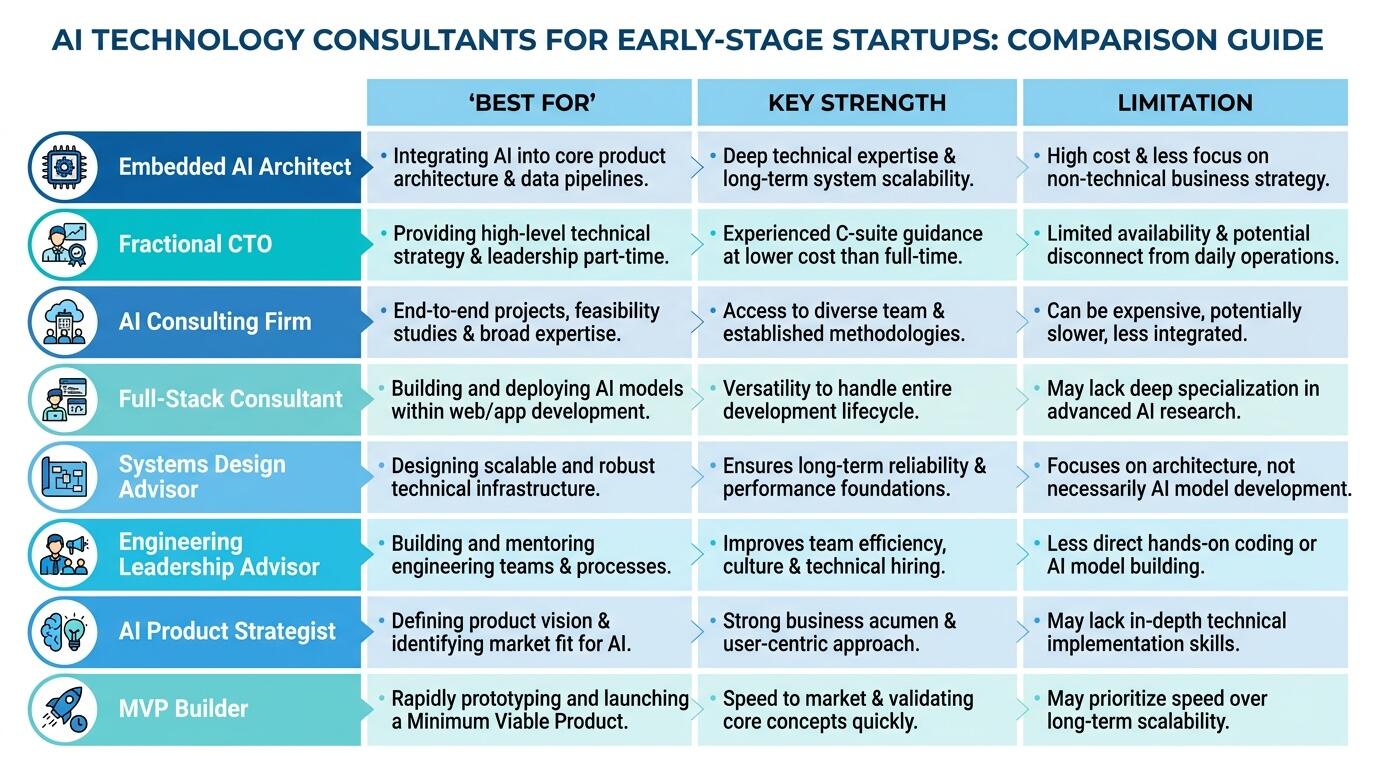
ALT: Comparison table of technology consultant types for early-stage startups building AI products, showing strengths and limitations of each engagement model
How to Choose the Right Technology Consultant for Your AI Startup
The right consultant type depends on where your startup is in its lifecycle, what your team already has, and what the most expensive mistake you could make right now actually is.
If you are pre-product with a strong business hypothesis but no technical co-founder, the highest-leverage engagement is an embedded AI Architect or Engineering Director who can own the full technical surface area — architecture, stack selection, infrastructure, and delivery — while you focus on customers and capital.
If you have a small engineering team but no senior leader setting direction, a fractional CTO with demonstrated AI product experience closes that gap without the full-time cost. The key qualifier is always "demonstrated" — ask for specific shipped products, not general credentials.
If your core risk is architectural — you are building something technically novel and a wrong infrastructure decision could set you back six months — engage a systems design advisor before the engineering team writes significant code. This is one of the most underspent categories in early-stage AI development, and one of the highest-return investments.
If your immediate need is investor or customer validation, a prototype builder who can ship a working demo in weeks will generate more momentum than any other engagement type at that stage.
A common misconception worth correcting: many founders believe they need to hire a full team before they can make real technical progress. In practice, a single high-quality embedded consultant with the right scope can produce more coherent and scalable technical output than a team of generalist engineers without technical leadership. Quality of technical direction matters more than headcount at the early stage.
Finally, regardless of which type you engage, define success in terms of shipped artifacts — working code, documented architecture, deployed systems — not hours worked or advisory sessions delivered. Consultants who resist artifact-based milestones are a signal worth heeding.
Frequently Asked Questions FAQ
Q1: How do you evaluate whether a technology consultant actually has AI product experience?
Ask for specific examples of AI systems they have built and deployed to production — not prototypes, not internal tools, but live products with real users. Request to see the architecture, the infrastructure choices made, and why. Consultants with genuine AI product experience can speak concretely about trade-offs they made, problems they encountered in production, and how they resolved them. Vague references to "working with AI" or "leading AI initiatives" without shipped artifacts should be treated with skepticism.
Q2: Is it too early to hire a technology consultant at the pre-seed stage?
Pre-seed is often the most critical time to engage technical consulting support, not too early. Architectural decisions made in the first weeks of a project have a compounding effect on everything that follows — stack choices, infrastructure patterns, data models, and API contracts all create dependencies that become expensive to change later. Engaging the right technical advisor at pre-seed to define the architecture before significant code is written is consistently one of the highest-return investments a technical startup can make.
Q3: How much does engaging an AI technology consultant typically cost, and how long do engagements usually run?
Costs and engagement length vary substantially by scope, consultant seniority, and engagement type. Embedded or fractional arrangements for senior AI Architects and Engineering Directors reflect the level of responsibility involved — these are executive-level roles with executive-level impact. Early-stage engagements often run anywhere from a focused short sprint for architectural definition to a multi-month embedded arrangement for product delivery. The most productive framing is not "what does this cost per hour" but "what is the cost of making the wrong architectural or infrastructure decision without this expertise."
The Bottom Line
Choosing the right technology consultant for an early-stage AI startup is a higher-stakes decision than most founders realize, because the wrong engagement type can waste runway just as effectively as no engagement at all.
Key Takeaways:
- The most valuable consultant type depends on what your startup is missing — leadership, architecture, execution, or validation — not on which title sounds most impressive.
- AI-specific experience is non-negotiable; general software engineering consulting does not translate directly to AI product development.
- Architectural decisions made early compound in both directions — good design accelerates everything, poor design creates drag that accumulates for months.
- Prototype-to-production transitions require intentional planning; not every consultant who can build a demo can build a maintainable system.
- Always define success in shipped, deployable artifacts rather than advisory hours or deliverable documents.
The next step is a direct conversation with a practitioner who has navigated exactly the challenges you are facing — not a discovery call with a salesperson, but a technical conversation with someone who has shipped AI products and can speak to your specific architecture questions with authority.
If you are ready to move from concept to a running product and want to work with an Engineering Director and AI Architect who has shipped live systems across the full stack, explore the portfolio and insights at the Darius website — a practical starting point for founders, product teams, and senior engineers looking to build AI products that actually make it to production.
References
- Xcelacore. "AI Consultants and Developers for Startups — Expert Partners to Launch and Scale Fast".
https://xcelacore.com/ai-consultants-and-developers-for-startups-expert-partners-to-launch-and-scale-fast/ - Gilzor. "Best 13 AI Consulting Companies for Startups (2026)".
https://www.gilzor.com/insights/ai-consulting-companies-for-startups - Expandorix. "Technology Consulting Services for Startups".
https://www.expandorix.com/services/technology-consulting - IEEE. Institute of Electrical and Electronics Engineers — Standards and Resources on AI Systems Engineering.
https://www.ieee.org
Note: Standards and industry guidance may be updated; please check the latest official documents or consult qualified professional advisors for your specific situation.