The Difference Between AI Prototypes and Production-Ready AI Systems
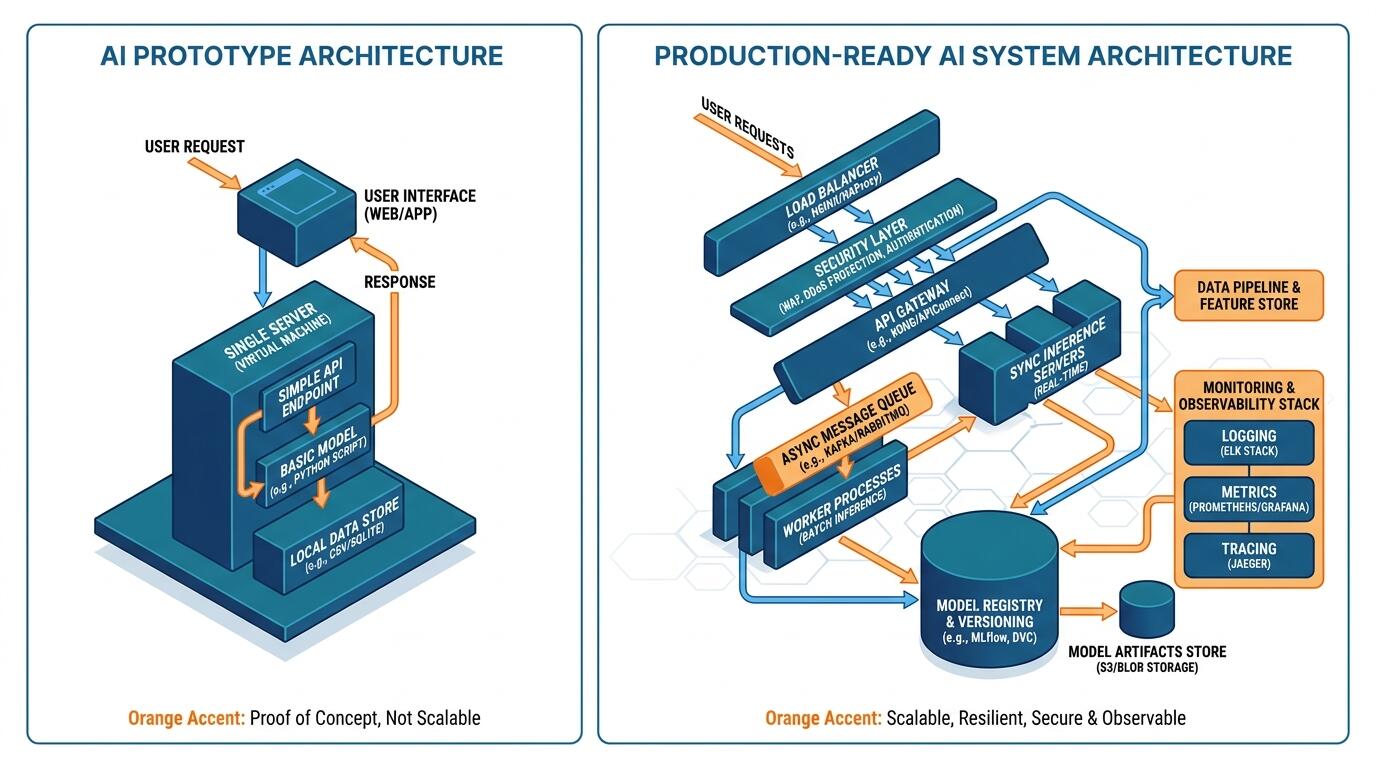
ALT: AI prototype versus production-ready AI system architecture comparison for engineering leaders
Why the Gap Between AI Prototypes and Production-Ready AI Systems Costs Teams More Than They Expect
The journey from a compelling AI demo to a system that reliably serves real users is one of the most underestimated challenges in modern software engineering. Teams routinely build impressive prototypes — fluent language model integrations, sharp image classifiers, convincing recommendation engines — only to discover that the path to production is not a sprint but a complete architectural rethink. The gap between an AI prototype and a production-ready AI system is not a matter of polish; it is a fundamental difference in engineering philosophy, operational discipline, and system design.
This article compares these two states of an AI product — the prototype and the production system — across the dimensions that matter most to engineering leaders, founders, and senior engineers who need to ship reliably. Understanding the distinction is the prerequisite for making sound architectural decisions and avoiding the costly rebuild cycles that a pattern consistently seen in teams who conflate the two.
Evaluation Criteria: What Separates a Prototype from a Production System
Evaluating the maturity of an AI system requires looking beyond model accuracy and demo appeal. The meaningful criteria are operational, architectural, and organizational.
Reliability and fault tolerance define whether a system continues to serve users when individual components fail — a non-negotiable in production but largely invisible in demos.
Scalability determines whether the system degrades gracefully under real-world load rather than collapsing at the first traffic spike. AI inference workloads are notoriously resource-intensive, making this criterion especially consequential.
Observability is the degree to which engineers can understand system behavior in real time — through logging, metrics, tracing, and alerting. Without it, debugging production failures becomes guesswork.
Data pipeline integrity covers the robustness of the processes that feed the model: ingestion, validation, transformation, and drift detection. Prototypes typically stub or simplify these; production systems cannot.
Security and compliance encompass authentication, authorization, data privacy, and audit trails — concerns that are almost always deferred during prototyping but become blocking issues before any serious deployment.
Maintainability and iteration velocity measure how quickly a team can safely update, retrain, or roll back a model without destabilizing the broader system. Production AI requires this capability continuously, not just at launch.
The Contenders: Anatomy of Each Approach
AI Prototypes — What They Are and What They Solve
An AI prototype is a time-bounded, hypothesis-driven artifact built to validate that a specific AI capability is feasible and valuable. Its purpose is exploration and communication, not operation. Prototypes are typically built by small teams — sometimes a single engineer or researcher — moving fast with minimal infrastructure overhead. They prioritize demonstrating the core AI behavior: a model that produces plausible outputs, a pipeline that runs end-to-end on sample data, or an interface that makes the AI's capability tangible to stakeholders.
Prototypes are genuinely valuable in their proper context. They compress decision cycles, surface data quality issues early, and align non-technical stakeholders around what an AI feature will actually do. The problem arises not from building prototypes but from mistaking them for something more. According to analysis published by Whitespectre, a common failure pattern is teams treating a working demo as evidence that production is merely a deployment step away — when in reality, the prototype has answered only the question of feasibility, leaving every operational question unanswered.
From a technical standpoint, prototypes typically share a common profile: hardcoded configuration, minimal error handling, no authentication, synchronous processing that cannot scale, and direct model calls without any abstraction layer. These characteristics are rational choices for fast validation but become active liabilities the moment real users and real data enter the picture.
Production-Ready AI Systems — What They Actually Require
A production-ready AI system is a fully engineered sociotechnical system designed to deliver consistent AI-driven value to real users under real conditions, indefinitely. "Production-ready" is not a binary state achieved at launch — it is a sustained operational posture maintained through robust architecture, disciplined engineering practices, and continuous monitoring.
Production AI systems are distinguished by several structural commitments that prototypes deliberately avoid. They encapsulate model inference behind stable API contracts, enabling model updates without cascading changes across the application. They implement asynchronous processing and queueing for workloads that cannot be handled synchronously at scale. They instrument every meaningful operation — latency, error rates, model confidence distributions, data drift signals — and route that telemetry to monitoring systems that can trigger alerts or automated responses.
Per industry guidance from the MLOps and platform engineering communities, a production AI system also treats model artifacts as versioned, deployable units with associated rollback procedures — not as static files dropped into a server directory. This enables safe iteration, A/B testing of model versions, and controlled canary rollouts, all of which are essential when model behavior directly affects user outcomes.
The operational surface of a production system extends well beyond the model itself. Data pipelines must validate incoming data against schemas and flag distributional shifts. Serving infrastructure must handle graceful degradation — falling back to a simpler model or a cached response — when primary inference is unavailable. Access control must be enforced at every boundary. These requirements are not optional enhancements; they are the minimum viable architecture for a system that earns user trust.
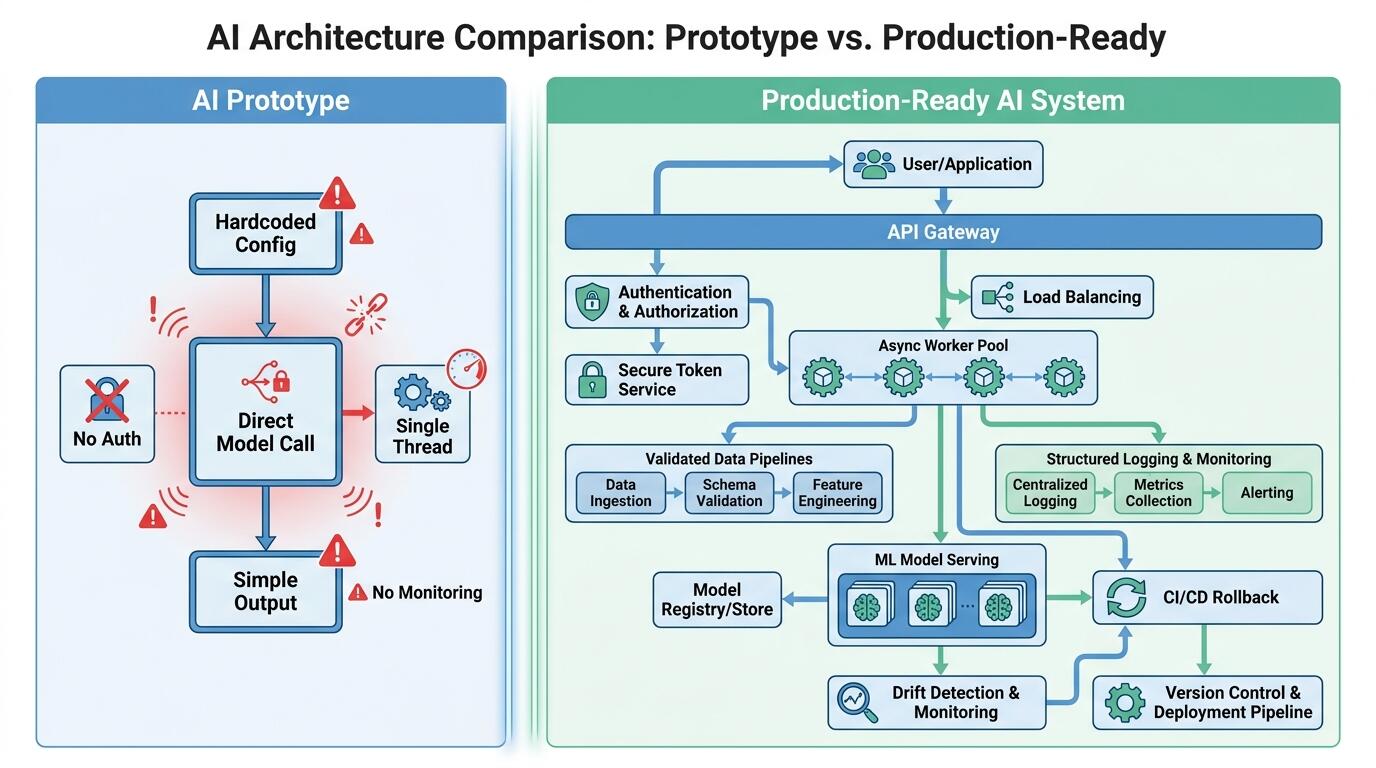
ALT: Side-by-side architecture diagram comparing AI prototype components with production-ready AI system infrastructure layers
Head-to-Head Comparison: AI Prototype vs. Production-Ready AI System
| Criterion | AI Prototype | Production-Ready AI System |
|---|---|---|
| Reliability & fault tolerance | Minimal — failures crash the process | Designed for graceful degradation and retry logic |
| Scalability | Single-instance, synchronous | Horizontally scalable, async processing, load-balanced |
| Observability | Ad hoc logging or none | Structured logging, metrics, distributed tracing, alerting |
| Data pipeline integrity | Stubbed or static datasets | Validated, monitored, schema-enforced pipelines with drift detection |
| Security & compliance | Absent or mocked | Authentication, authorization, encryption, audit trails |
| Maintainability | Hardcoded, tightly coupled | Abstracted, versioned, CI/CD-integrated with rollback capability |
| Time to build | Days to weeks | Weeks to months |
| Primary audience | Stakeholders, internal validation | End users in real-world conditions |
| Cost profile | Low — minimal infrastructure | Higher — reflects operational requirements |
The table reveals a pattern that experienced engineering leaders recognize immediately: every dimension where a prototype deliberately cuts corners is a dimension that must be fully engineered for production. The shortcuts are not mistakes in a prototype; they are appropriate trade-offs for the prototype's purpose. The mistake is assuming those trade-offs can be carried forward.
Interpreting the reliability and scalability rows together is instructive. A prototype that calls a language model synchronously on a single thread works perfectly in a demo where one person is clicking buttons deliberately. The same architecture collapses when fifty concurrent users submit requests, upstream model latency spikes, or an API rate limit is hit. The production equivalent introduces queuing, worker pools, timeout handling, and fallback logic — none of which is visible to the user but all of which determine whether the product survives contact with reality.
The observability gap deserves particular attention because it is the least glamorous and most consequential difference. A prototype with no structured logging leaves engineering teams flying blind in production. When model behavior degrades — because input data has shifted, because a dependency has changed, because user behavior differs from what was assumed — engineers need signals to detect, diagnose, and resolve the issue. Building observability into a system retroactively is dramatically more expensive than designing for it from the start, as noted consistently in the MLOps literature. The architectural patterns for reliable AI pipelines that experienced practitioners rely on treat observability as a first-class concern, not an afterthought.
Which Should You Choose? Matching the Approach to the Situation
The prototype versus production distinction is not a permanent judgment on a team's ambition — it is a sequencing question. The right question is not "should we build a prototype or a production system?" but "what are we trying to learn right now, and what level of engineering is proportionate to that learning goal?"
If you are validating whether an AI capability is technically feasible, build a prototype. Keep it explicitly scoped, time-boxed, and labeled internally as a validation artifact. Document the assumptions it makes and the corners it cuts, because that documentation becomes the engineering backlog for the production build.
If you are validating whether users will engage with the AI capability, a prototype or a limited-access beta with light production guardrails is appropriate. The key is ensuring that the infrastructure can be hardened without a full rewrite — which requires making at least some architectural decisions consciously, even in early stages.
If you are preparing to launch to external users — even in limited beta, you need meaningful production commitments: authentication, error handling, basic observability, and a data pipeline that does not depend on a manually updated CSV. The threshold for "production-ready" is not perfection; it is operational trustworthiness under real conditions.
If you have already launched and are experiencing reliability or scaling issues, the work ahead is architectural remediation — not feature development. This is the most expensive scenario and the one most commonly encountered in teams that shipped a polished prototype without a structural production readiness review. The full-process breakdown of building scalable AI systems from architecture review to production offers a structured lens for thinking through this remediation work.
Pros and cons, summarized:
AI prototypes are fast, cheap, and invaluable for validation — but they carry hidden technical debt that compounds rapidly once real users arrive. Production-ready AI systems require sustained engineering investment but deliver the reliability, scalability, and maintainability that a live product demands. The teams that navigate this transition most effectively treat the prototype as a disposable scaffold, not a foundation.
For founders and engineering leaders evaluating whether their current system is truly production-ready, a useful forcing function is to ask: what happens when this system fails silently? If the honest answer is "we would not know for hours," the system is not production-ready, regardless of how impressive the demo is.
Common Questions
Q1: How do you know when an AI prototype is ready to transition to a production system?
A prototype is ready for the production transition when it has validated the core AI hypothesis — that the model produces useful outputs on real data — and stakeholders have committed to serving real users. The trigger is not a quality threshold in the prototype itself but a business decision to operate the capability continuously. At that point, a structured production readiness review should assess reliability, observability, security, and data pipeline integrity before any external launch.
Q2: Is it ever acceptable to ship an AI prototype directly to production?
Shipping a prototype directly to production is rarely appropriate and carries significant operational risk. The closest acceptable scenario is a tightly controlled internal tool used by a small, technically sophisticated team who understand the system's limitations and can tolerate failures. For any external user-facing deployment, the gaps in error handling, security, and observability that define a prototype create unacceptable exposure — to user experience failures, data breaches, and silent model degradation that goes undetected.
Q3: How long and how costly is the transition from an AI prototype to a production-ready system?
The transition time and cost depend heavily on the complexity of the AI system, the quality of the prototype codebase, and the team's existing infrastructure. In practice, the production build often takes several times longer than the prototype — not because the AI logic is more complex, but because the surrounding systems (pipelines, monitoring, security, deployment automation) are built from scratch. Teams that plan the production architecture in parallel with prototype development consistently complete this transition faster and with fewer costly surprises than teams that treat it as a sequential step.
Key Takeaways
The single most important insight for engineering leaders is this: an AI prototype and a production-ready AI system are not points on the same spectrum — they are built for fundamentally different purposes, under different constraints, and with different success criteria. Conflating them is the primary source of the costly rebuild cycles and reliability failures that stall AI initiatives after initial excitement.
Three principles should guide practice in this domain. First, treat the prototype as a learning instrument with an explicit expiration date — its value is in the validated hypothesis it produces, not in the code itself. Second, design production AI systems for operational trustworthiness from the start, prioritizing observability, fault tolerance, and data pipeline integrity before launch rather than retrofitting them under pressure. Third, plan the transition explicitly — identify what the prototype leaves unresolved, convert those gaps into a structured engineering backlog, and sequence production work around the highest-risk items first.
The teams that ship reliable AI products consistently are those who understand that the hard work begins where the demo ends. As demonstrated through the work behind taking three product ideas from concept to live deployment, the distance between a compelling prototype and a system that earns sustained user trust is precisely where engineering judgment and architectural discipline create durable competitive advantage.
Ready to move beyond the prototype stage and build AI systems that hold up in the real world? Visit darius.wiki to explore technical insights, architecture guidance, and the engineering perspective of someone who has shipped production AI products end-to-end.
References
- Whitespectre. "Working Demo, So What? The Reality Gap Between AI Prototypes and Production."
https://www.whitespectre.com/ideas/ai-powered-prototype-to-production-process/ - NPGroup. "Why Your AI-Generated Prototype Isn't Ready for Production."
https://www.npgroup.net/blog/ai-generated-software-prototype-to-production/ - Harris, Desmond. "AI Prototypes vs Production-Ready Software." LinkedIn.
https://www.linkedin.com/posts/desmondharris_enterpriseai-aiengineering-softwareengineering-activity-7479615628275023872-6L2k - IEEE — Institute of Electrical and Electronics Engineers. Standards and technical resources on software and systems engineering.
https://www.ieee.org/ - The Linux Foundation. MLOps and open-source AI infrastructure community resources.
https://www.linuxfoundation.org/
Note: Standards and best practices in AI engineering evolve rapidly. Consult the latest official documentation and qualified technical advisors for guidance specific to your system and context.