How to Build an AI Product Roadmap That Engineering Can Actually Execute
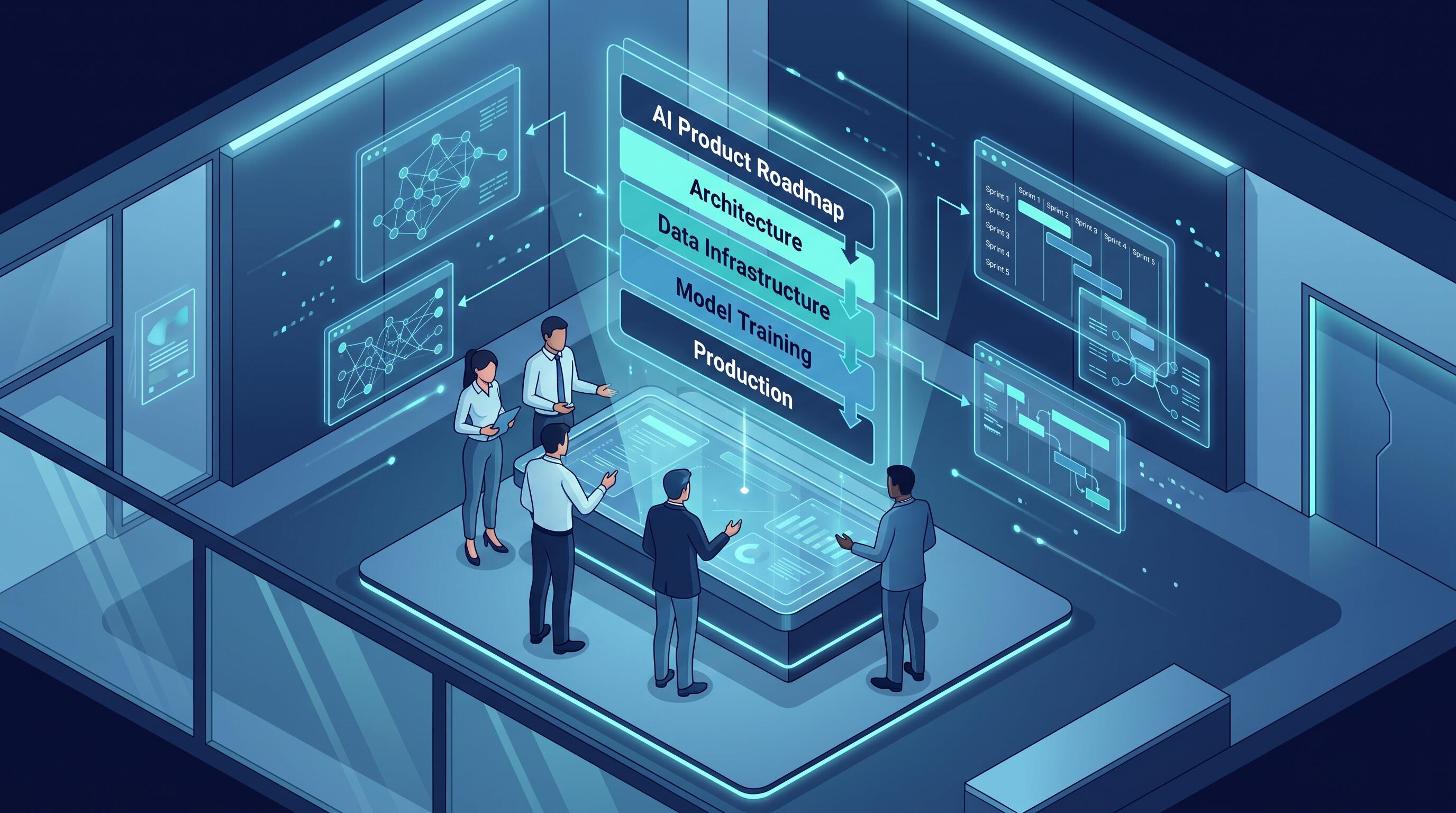
ALT: Building an executable AI product roadmap with engineering leadership and ai architecture strategy
Why Most AI Roadmaps Fail Before the First Sprint Even Starts
Key Conclusion: The gap between an AI product vision and a shipped product is almost always a planning failure, not a talent failure. Effective ai architecture thinking, strategic technical consulting, and mature engineering leadership must be embedded into the roadmap itself — not bolted on after the fact. When these three disciplines align from day one, teams don't just plan better; they execute faster, iterate smarter, and ship products that actually work in the real world.
Every founder has been in that meeting. The whiteboard is full of arrows, the slides are polished, and the AI product vision is genuinely exciting. Then the engineers get in the room, and the energy shifts. Timelines collapse. Dependencies nobody planned for surface overnight. The roadmap that looked crisp in a deck turns into a six-month negotiation between what the business wants and what's technically feasible.
This isn't a people problem. It's a process problem — specifically, a planning process that separates business strategy from technical reality. The best AI product roadmaps aren't built by product managers alone, then handed to engineers. They're built collaboratively, with engineering constraints and architecture decisions treated as first-class inputs from the very beginning.
This article breaks down exactly how to build an AI product roadmap that your engineering team can actually execute — without the chaos, the missed sprints, or the post-launch rewrites.
Who This Guide Is For
✅ Applicable Scenarios:
- Startup founders and CTOs who are in the early stages of planning an AI-powered product and want to avoid costly architectural mistakes before the first line of code is written
- Engineering managers and senior engineers navigating the complexity of translating a business vision into a technically feasible, sequenced delivery plan
- Product leaders at growth-stage companies who have already shipped a first version but are struggling to scale their AI infrastructure without runaway costs or performance degradation
❌ Not Applicable/Cautions:
- Teams looking for a plug-and-play template that requires zero customization — every AI product has unique architectural constraints, and a one-size-fits-all roadmap will fail you
- Organizations that are not yet ready to involve engineering leadership in strategic product decisions, since this approach requires genuine cross-functional collaboration to work
The Real Cost of Disconnected AI Planning
AI product development has a uniquely unforgiving failure mode. Unlike a traditional SaaS feature, a poorly planned AI component doesn't just ship late — it ships wrong. The model performs well in staging and fails in production. The data pipeline that seemed sufficient at prototype scale collapses under real user load. The inference costs that looked acceptable in a spreadsheet become a budget crisis once traffic arrives.
The market is accelerating fast. According to McKinsey's Global AI Survey, a growing majority of organizations have now embedded AI into at least one business function, yet a significant portion still report that AI initiatives fail to reach full-scale deployment. The number one reported barrier? Poor integration between AI strategy and operational execution.
This is precisely the gap that a well-structured AI product roadmap is designed to close. But most roadmaps are still built in silos: the business side defines the "what" and the "why," and then engineering is handed the "when" as a constraint rather than a collaborator.
The result is predictable. Engineers inherit decisions — about model selection, data architecture, third-party integrations, and deployment environments — that were made without the technical context required to make them wisely. Roadmaps blow up not because engineers are slow, but because the planning assumptions were never grounded in engineering reality.
What follows is a practical framework for building an AI product roadmap that bridges this gap. It's not theoretical. It's drawn from the hard lessons of actually shipping AI products end-to-end, from initial architecture design through to live production systems.
Building the Roadmap: A Step-by-Step Framework
Three-Step Quick Start
Step 1: Anchor the Roadmap to Architecture, Not Features
Before you write a single user story or populate a sprint backlog, your first move should be an architectural scoping session. Bring your engineering leadership into the room and ask one question: "What are the top three technical decisions that, if made wrong, will make everything else harder?" These are your architectural anchors — decisions around model selection, data infrastructure, and system integrations that constrain every subsequent decision. Block two to four hours for this session. The output is a short list of non-negotiable technical constraints that become the skeleton of the roadmap.
Step 2: Map Dependencies Before You Sequence Deliverables
Most roadmaps sequence deliverables by business priority. The right approach is to sequence by dependency. For an AI product, this means mapping out the full dependency chain: data collection and labeling before model training, model training before API exposure, API exposure before front-end integration. Use a simple dependency graph — even a whiteboard sketch works — to identify which workstreams are blocking and which are parallel. This single exercise typically reveals that the roadmap needs to be restructured significantly before any timelines are set.
Step 3: Build in Architecture Review Gates
Every sprint cycle should include a lightweight architecture review gate — a moment where engineering leadership explicitly checks whether the work completed is still aligned with the original architectural decisions, or whether new information requires a course correction. This isn't a heavyweight governance process. It's a fifteen-minute standing check that catches architectural drift before it compounds. Teams that skip this step routinely discover late in the delivery cycle that two parallel workstreams made incompatible assumptions.
Comparing Common Roadmap Approaches for AI Products
Not all roadmapping methodologies are equally suited to AI product development. The table below compares three common approaches across dimensions most relevant to engineering execution.
| Comparison Dimension | Traditional Agile Sprints | Dual-Track Development | Architecture-First Roadmapping |
|---|---|---|---|
| Engineering involvement in planning | Low to moderate | Moderate | High from day one |
| Handles AI-specific dependencies | Poorly | Moderately | Purpose-built for it |
| Supports architectural decision tracking | Minimal | Partial | Explicit and structured |
| Suitable for AI infrastructure scaling | Difficult | Moderate | Strong |
| Risk of late-stage rewrites | High | Moderate | Low |
| Recommended for AI products | Not ideal | Situationally | Yes |
Traditional agile sprints, originally designed for software feature development, struggle with AI products because they treat model training cycles, data pipeline work, and infrastructure provisioning as equivalent to feature development. They're not. Dual-track development helps by separating discovery from delivery, but it still often underweights the technical architecture layer. An architecture-first roadmapping approach is designed from the ground up to treat engineering constraints as primary inputs.
The Core Principles of an Executable AI Roadmap
Start With the Data, Not the Model
One of the most common and costly mistakes in AI product roadmapping is leading with model selection. Teams spend weeks debating whether to use a particular large language model or build a custom classifier, before anyone has seriously examined the state of the underlying data.
In practice, data infrastructure decisions drive the entire downstream architecture. What data do you have? What data do you need? How will it be collected, labeled, stored, and versioned? What's the latency requirement between data ingestion and model inference? These questions need answers before the model conversation even begins.
An executable AI roadmap includes a data readiness assessment as its first milestone. Not a data science exploration — a structured evaluation of whether the data infrastructure required to train, evaluate, and serve the intended models actually exists or has a realistic path to existence.
Separate Proof of Concept from Production Architecture
A prototype that impresses in a demo is not evidence that a system is ready for production architecture. This is a critical distinction that many AI product roadmaps fail to make explicit.
Proof-of-concept work is valuable. It validates that an approach is directionally correct. But it is deliberately built with shortcuts: hardcoded values, no error handling, minimal security, and no scalability. When roadmaps treat a successful PoC as a foundation for production development, teams discover that they need to rebuild almost everything — and the rebuild takes longer than the original build.
The roadmap should explicitly mark the transition from PoC to production architecture as a phase gate. At this gate, engineering leadership reviews the prototype, documents what needs to be rebuilt versus extended, and produces a realistic estimate for production hardening. This is where tools like Jira, Linear, or Notion combined with a proper technical design document process earn their value — not as bureaucracy, but as forcing functions for clarity.
Plan for Inference Costs as a First-Class Concern
One of the most frequently underestimated challenges in AI product development is the operational cost of running models at scale. This surfaces as a genuine crisis for many teams after launch, when real-world traffic patterns reveal that inference costs are significantly higher than the pre-launch estimates suggested.
Reducing AI infrastructure costs without sacrificing performance is a genuine engineering challenge, not just a financial one. The strategies that work — model quantization, caching inference results for common inputs, batching requests intelligently, using smaller specialized models where appropriate rather than defaulting to the largest available — all need to be designed into the architecture from the beginning. Retrofitting them after launch is expensive and disruptive.
An executable AI roadmap includes an inference cost model as part of the architecture documentation. This doesn't require precise numbers at the outset, but it does require the team to think explicitly about the cost structure of the system before the build begins.
Choose Agile Methodologies That Match AI's Iteration Cycles
Not all agile methodologies are equally suited to AI product teams. Standard two-week sprints work well for front-end feature development but can be misaligned with the longer iteration cycles required for model training and evaluation. Some teams find that a modified Kanban approach — with explicit work-in-progress limits for model training tasks — fits their rhythm better than sprint-based planning.
Recommended tools for product roadmap planning in AI contexts include Productboard or Linear for roadmap visualization, Weights & Biases or MLflow for model experiment tracking, and Notion or Confluence for architectural decision records. The specific tools matter less than the discipline of keeping roadmap artifacts, architectural decisions, and sprint work visibly connected.
Build in Cross-Functional Review from the Start
The most effective AI product roadmaps are living documents that all stakeholders — product, engineering, data science, and business — review together on a regular cadence. Not because collaboration is a virtue in the abstract, but because AI products surface unexpected tradeoffs constantly, and those tradeoffs require fast, informed decisions from people with different expertise.
Engineering leadership should own the architecture layer of the roadmap. Product leadership should own the feature prioritization layer. And both should be explicitly visible in the same document, so that a decision to accelerate a feature doesn't happen without awareness of the architectural implications.
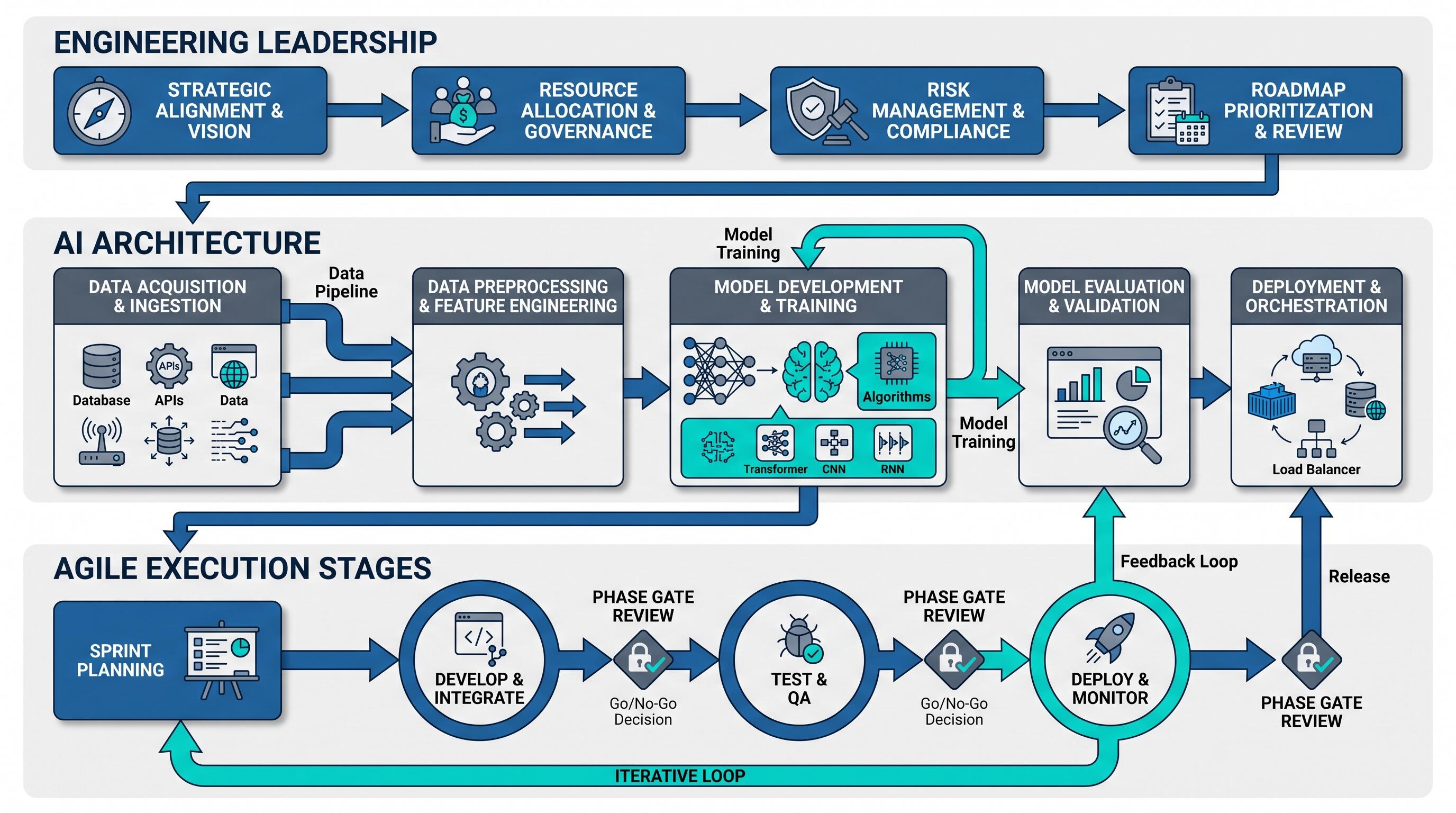
ALT: AI product roadmap framework showing engineering leadership, ai architecture layers, and agile execution stages for technical teams
Advanced Considerations: When Standard Approaches Break Down
When Your AI Product Spans Multiple Modalities
Text, image, audio, and structured data don't just require different models — they require different data pipelines, different evaluation frameworks, and often different deployment architectures. Roadmaps for multimodal AI products need to explicitly treat each modality as a separate infrastructure workstream, with integration points planned rather than assumed. The most common failure mode here is treating the integration layer as a minor task when it is, in practice, one of the most complex engineering challenges in the project.
When the Regulatory Environment Is Unclear
AI regulation is evolving rapidly across multiple jurisdictions. For products in healthcare, finance, or any consumer-facing context where automated decisions have material consequences, the roadmap must include regulatory review gates. This isn't primarily a legal concern — it's an architecture concern. GDPR compliance, data residency requirements, and model explainability obligations can all require significant architectural changes if they're discovered after the system is designed.
Common Misconception: "We'll Scale It Later"
The most persistent misconception in AI product development is that scalability can be safely deferred. This is sometimes true for simple CRUD applications. It is almost never true for AI systems, where the data pipeline architecture, model serving infrastructure, and feature engineering systems are deeply load-dependent. "We'll scale it later" typically means "we'll rebuild it later" — at a cost that dwarfs the savings from deferring the design work.
Frequently Asked Questions FAQ
Q1: How do you reduce AI infrastructure costs without sacrificing model performance?
The most effective approach combines architectural choices made early with operational strategies deployed continuously. At the architecture level, this means selecting the smallest model that meets your performance requirements rather than defaulting to the largest, and designing explicit caching layers for high-frequency inference patterns. At the operational level, it means monitoring inference cost per request as a first-class metric and using batching, quantization, and edge deployment where appropriate. Retrofitting these strategies post-launch is possible but significantly more expensive than designing for them from the start.
Q2: Are traditional agile methodologies a good fit for AI product development teams?
Traditional sprint-based agile methodologies are a partial fit, but rarely a perfect one. The core challenge is that model training cycles, data labeling work, and infrastructure provisioning don't naturally decompose into two-week deliverables. Many successful AI product teams use a hybrid approach: standard agile sprints for front-end and API development, combined with longer iteration cycles and Kanban-style tracking for data science and model development workstreams. The key is to make the methodology serve the work rather than forcing the work to conform to the methodology.
Q3: How long does it typically take to move from an AI prototype to a production-ready system?
This varies significantly based on architectural complexity, data readiness, and team size, so any specific number here would be misleading. What can be said confidently is that teams consistently underestimate the production hardening phase. Moving from a working prototype to a system that is secure, scalable, observable, and operationally maintainable often requires as much or more engineering effort than the prototype itself. An honest roadmap accounts for this explicitly rather than treating production hardening as a minor wrap-up task.
Summary
An AI product roadmap that engineering can actually execute shares three non-negotiable characteristics. First, it treats architecture as a strategic input, not an implementation detail — meaning engineering leadership shapes the roadmap before sprint planning begins, not after. Second, it makes dependencies visible before timelines are set, so that the sequencing of work reflects technical reality rather than business optimism. Third, it includes explicit phase gates for production hardening, inference cost modeling, and architectural drift review, preventing the compounding failures that surface late in delivery cycles when they're most expensive to fix.
The practical implication is clear: if you're building an AI product and your engineering team isn't in the room when the roadmap is written, the roadmap isn't real. It's a wish list. Getting to a real roadmap requires integrating the disciplines of ai architecture, technical consulting, and engineering leadership into the planning process itself — and doing so before the first sprint begins, not after the first crisis.
The teams that ship AI products consistently aren't necessarily smarter or better funded than the ones that struggle. They've simply learned to plan in a way that respects the unique constraints of AI systems — and they've built the cross-functional trust required to make fast decisions when reality diverges from the plan.
Ready to Build an AI Roadmap That Ships?
If you're looking to turn your next big idea into a live, production-ready product, Darius brings the end-to-end expertise in AI architecture, systems design, and full-stack development to make it happen. Explore real shipped projects, technical insights, and engineering strategies at https://www.darius.wiki. Whether you're a founder, engineer, or tech leader, Darius is ready to help you build smarter and ship faster.
References
- McKinsey & Company. "The state of AI in early 2024: Gen AI adoption spikes and starts to generate value".
https://www.mckinsey.com/capabilities/quantumblack/our-insights/the-state-of-ai-2024 - MIT Sloan Management Review. "Winning With AI: Pioneers Combine Strategy, Organizational Behavior, Technology".
https://sloanreview.mit.edu/projects/winning-with-ai/ - IEEE. "IEEE Standards for Artificial Intelligence Systems".
https://standards.ieee.org/initiatives/artificial-intelligence-systems/ - NIST. "AI Risk Management Framework (AI RMF 1.0)".
https://www.nist.gov/system/files/documents/2023/01/26/AI%20RMF%201.0.pdf - Martin Fowler. "Refactoring: Improving the Design of Existing Code — Patterns for Technical Roadmapping".
https://martinfowler.com/architecture/
Note: Standards and frameworks may be updated. Please consult the latest official documentation or seek professional advisory input before making architectural or strategic decisions.
About the Author
Darius is an Engineering Director and AI Architect specializing in transforming ideas into live, running products — with proven experience across AI architecture, systems design, and full-stack development, backed by 3 shipped live projects. Learn more at darius.wiki.
© Darius. All rights reserved. The content in this article is intended for informational purposes only and reflects the author's professional opinions and experiences. Nothing herein constitutes formal engineering, legal, or business advice. Reproduction or redistribution of this content without explicit permission is prohibited.