AI Orchestration Frameworks Compared: Which One to Use in Q2 2026
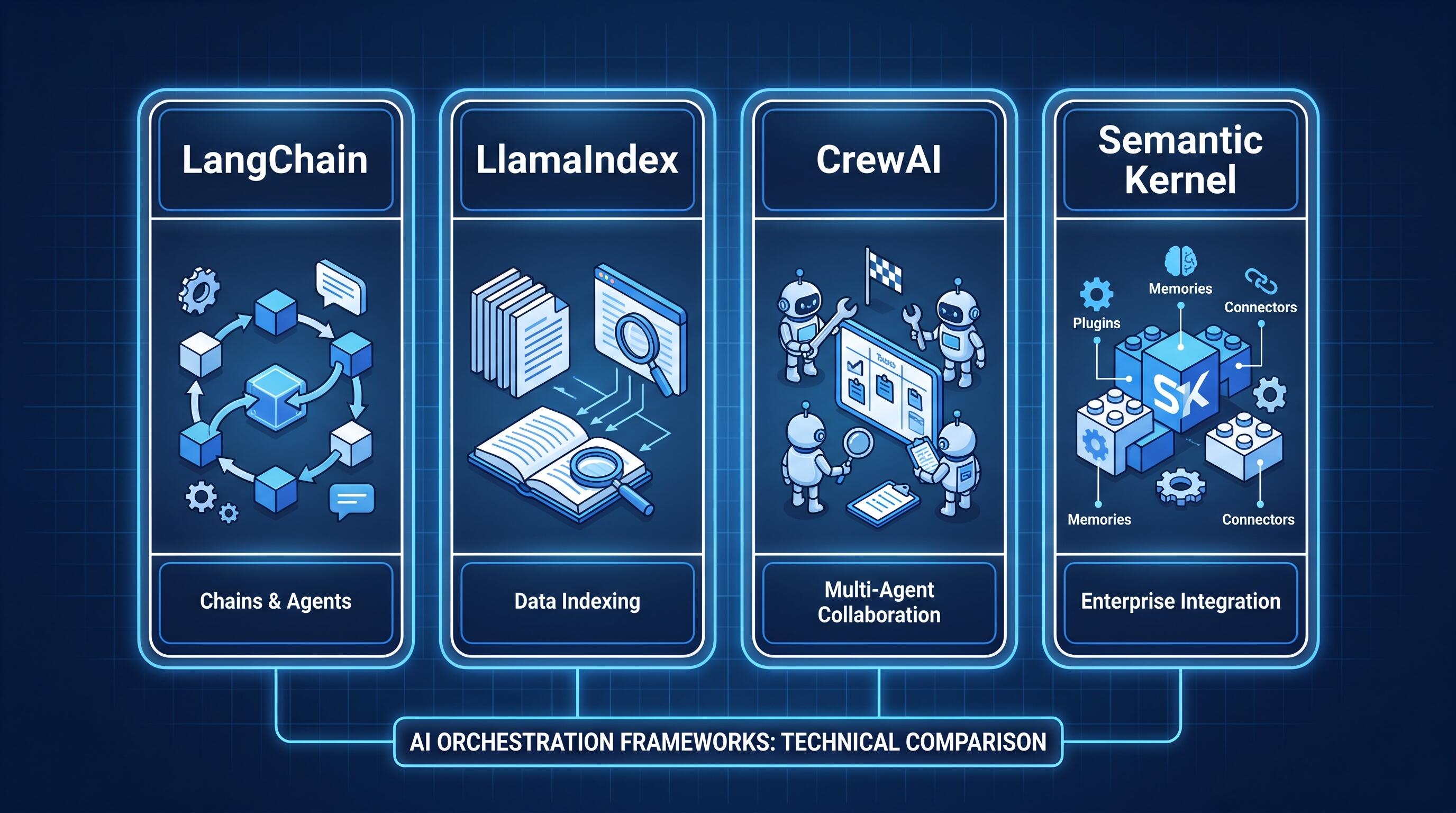
ALT: AI orchestration frameworks compared side-by-side for engineering leaders building full-stack AI solutions in Q2 2026
The State of AI Orchestration in 2026: What Every Engineering Leader Needs to Know
Key Conclusion: Choosing the right AI orchestration framework in Q2 2026 is not a minor implementation detail — it is a foundational architectural decision that determines how quickly your team ships, how well your ai solutions scale under production load, and how effectively your engineering leadership can maintain and evolve the system. For teams committed to full-stack development from prototype to live deployment, the wrong choice compounds technical debt at every layer.
The AI orchestration landscape has matured considerably from the early experimental days of chaining LLM calls together with ad-hoc glue code. What was once a niche concern for ML engineers has become a core infrastructure decision that product managers, startup founders, and engineering directors must weigh carefully. Three factors are driving this urgency: the proliferation of multi-agent architectures, the increasing complexity of retrieval-augmented pipelines, and the growing expectation that AI-powered products ship with the same reliability standards as traditional software.
This article cuts through the noise. It evaluates the leading orchestration frameworks available today — LangChain, LlamaIndex, CrewAI, and Microsoft's Semantic Kernel — across the dimensions that actually matter when you are trying to ship something real, not just demo something impressive. Whether you are a solo technical founder, a product manager evaluating build-versus-buy, or a senior engineer responsible for a team's architectural decisions, the goal here is to give you a clear, opinionated view of which tool fits which context.
Who This Comparison Is For — and When to Skip It
✅ Applicable Scenarios:
- Teams building production-grade AI agents, RAG pipelines, or multi-step reasoning systems that need to go live, not just POC
- Engineering leaders evaluating orchestration tooling before committing to a framework for a medium-to-long-term product roadmap
- Startup founders and product managers who need to communicate architectural tradeoffs to technical hires or external collaborators
❌ Not Applicable/Cautions:
- Teams building pure fine-tuning or model training pipelines — orchestration frameworks address inference-time coordination, not training workflows
- Organizations with strict on-premise security requirements who haven't yet evaluated the self-hosting story for each framework — some assumptions here favor cloud-native deployments
Why Framework Choice Is an Engineering Leadership Decision, Not Just a Dev Preference
The impulse to treat framework selection as a junior engineer's task — "just pick whatever has the most GitHub stars" — is one of the most expensive mistakes an engineering organization can make. Orchestration frameworks are not libraries you swap out in an afternoon. They shape your data pipeline architecture, your debugging workflows, your team's mental model of how agents coordinate, and ultimately your ability to iterate quickly without accumulating structural debt.
In the context of machine learning applications specifically, the best data pipeline architecture is one that separates concerns cleanly: ingestion, transformation, retrieval, and reasoning should be independently testable and independently scalable. Not every orchestration framework respects that separation. Some make it easy to prototype fast but hard to maintain. Others impose rigidity that slows early development but pays dividends at scale.
The AI agent framework space has seen significant consolidation and maturation. LangChain — the framework that effectively defined the category — has undergone major architectural revisions with LangGraph becoming the preferred pattern for stateful agents. LlamaIndex has sharpened its focus on data connectors and retrieval pipelines. CrewAI has emerged as the leading framework for role-based multi-agent coordination. Semantic Kernel has gained serious traction in enterprise environments, particularly those operating within Microsoft ecosystems. Each reflects a different philosophy about what "orchestration" means, and understanding those philosophies is the real work of framework selection.
For teams serious about shipping AI products, this is not an abstract debate. It directly affects best practices for shipping products fast without sacrificing quality — because a framework that fights your architecture slows every sprint, every debugging session, and every production incident response.
Framework Deep Dive: Evaluation, Comparison, and Selection Guidance
Three-Step Quick Start for Framework Evaluation
Step 1: Define Your Dominant Use Case Before Opening Any Documentation
Before evaluating any framework, write down — in one sentence — what your system needs to do at runtime. "Retrieve relevant documents and synthesize an answer" points you toward LlamaIndex. "Coordinate multiple specialized agents to complete a multi-step task" points toward CrewAI or LangGraph. "Integrate AI capabilities into an existing enterprise application with plugin architecture" points toward Semantic Kernel. This single sentence will eliminate at least one or two frameworks from consideration immediately, saving significant evaluation time.
Step 2: Run a Minimal Viable Integration Against Your Actual Data and Infrastructure
Do not evaluate frameworks using tutorial toy examples. Spend focused time building the smallest possible version of your real use case — your actual data sources, your actual model provider, your actual deployment target. Framework quality differences that are invisible in tutorials become obvious when you are connecting to a real vector database, handling real edge cases in document parsing, or debugging a real multi-agent coordination failure. This step surfaces integration friction early, when it is cheap to change direction.
Step 3: Stress Test the Observability and Debugging Story
One of the most underweighted criteria in framework evaluation is what happens when things go wrong in production. Before committing to a framework, deliberately introduce failures — a retrieval step that returns irrelevant results, an agent that enters a reasoning loop, a tool call that times out — and observe how easy it is to diagnose what happened. Frameworks with strong tracing and observability support (LangSmith for LangChain, built-in logging in Semantic Kernel) dramatically reduce the operational burden of running AI systems in production.
Framework Comparison: LangChain/LangGraph vs. LlamaIndex vs. CrewAI vs. Semantic Kernel
The following comparison focuses on the architectural and practical dimensions that matter most for engineering teams building production systems. All assessments are qualitative and based on publicly available framework documentation and community usage patterns as of early 2026.
| Comparison Dimension | LangChain / LangGraph | LlamaIndex | CrewAI | Semantic Kernel |
|---|---|---|---|---|
| Primary Strength | General-purpose agent orchestration with stateful graph execution | Data connectors, RAG pipelines, and retrieval optimization | Role-based multi-agent coordination and task delegation | Enterprise plugin architecture and .NET/Python cross-platform support |
| Learning Curve | Moderate to steep (LangGraph adds graph mental model) | Moderate (strong abstractions for retrieval) | Relatively low for multi-agent patterns | Moderate (steeper for teams unfamiliar with Microsoft ecosystem) |
| Multi-Agent Support | Strong via LangGraph | Limited natively; requires custom coordination | Core design philosophy | Supported via agent framework; less opinionated |
| RAG/Retrieval Depth | Good; many integrations | Excellent; purpose-built for this use case | Limited natively | Good; integrates with Azure AI Search |
| Production Observability | Strong (LangSmith tracing) | Moderate | Moderate; improving | Strong (Azure Monitor integration) |
| Enterprise/Cloud Integration | Cloud-agnostic; broad provider support | Cloud-agnostic | Cloud-agnostic | Deep Microsoft/Azure integration |
| Community & Ecosystem | Very large; most extensive ecosystem | Large; growing rapidly | Growing; strong momentum | Moderate; strong enterprise adoption |
| Ideal Team Profile | Full-stack AI teams needing flexibility | Teams with heavy document/data ingestion needs | Teams building agent workflows with distinct roles | Enterprises in Microsoft ecosystem |
Detailed Framework Analysis
LangChain and LangGraph: Flexibility at the Cost of Complexity
LangChain remains the most widely adopted framework in the ecosystem, and for good reason — its abstraction layer over model providers, tools, and memory systems is genuinely useful. The shift toward LangGraph as the preferred pattern for complex agents reflects an important architectural insight: most real-world agent behaviors are better modeled as graphs than as linear chains. If your system needs conditional branching, human-in-the-loop interrupts, or persistent state across long-running tasks, LangGraph provides the structural primitives to handle this correctly.
The honest tradeoff is complexity. LangChain's ecosystem is large enough that it can be difficult to know which abstraction to use, and the framework has a history of breaking changes that have frustrated teams who built deeply against earlier APIs. For engineering leaders making framework choices, this means the LangChain/LangGraph path requires investment in staying current with the framework's evolution — not just initial learning.
For teams already practicing strong full-stack development disciplines — clear separation of concerns, comprehensive testing, good documentation habits — LangGraph's complexity is manageable and its flexibility pays off. For teams moving fast with limited engineering capacity, that complexity can become a velocity tax.
LlamaIndex: The Right Tool When Your Problem Is Retrieval
If the core intelligence of your system depends on surfacing the right information from a large corpus — documents, databases, APIs, or structured data — LlamaIndex is frequently the best choice. Its data connectors are extensive, its indexing abstractions are well-designed, and its retrieval pipeline customization is deeper than what LangChain offers natively.
The framework's positioning has sharpened considerably. Rather than competing on general-purpose orchestration, LlamaIndex has doubled down on being the best tool for retrieval-augmented systems. This is an example of a framework making a strategically correct decision: by doing one thing exceptionally well rather than many things adequately.
For product teams building knowledge bases, document Q&A systems, or any AI solution where retrieval quality directly determines product quality, LlamaIndex deserves serious evaluation. The question to ask is whether your system's complexity lives primarily in the retrieval layer or the reasoning/coordination layer — the answer usually determines whether LlamaIndex or LangGraph is the better fit.
CrewAI: Multi-Agent Coordination as a First-Class Primitive
CrewAI emerged from a clear observation: most tutorials show single-agent systems, but most real-world AI workflows benefit from multiple specialized agents working in coordination. CrewAI's role-agent-task mental model is intuitive enough that non-engineers can participate meaningfully in system design conversations, which has real value for cross-functional product teams.
The framework is relatively younger than LangChain or LlamaIndex, and its production story — observability, error handling, deployment patterns — is still maturing. For teams willing to invest in a framework that is moving quickly, CrewAI offers a genuinely differentiated abstraction for multi-agent orchestration. For teams that need battle-tested infrastructure today, some caution is warranted.
One underappreciated aspect of CrewAI is how well it maps to best practices for structuring a product development team. The concepts of roles, responsibilities, and task delegation in CrewAI mirror how effective engineering teams actually operate — which can make it easier to design agent systems that reflect your team's existing workflow logic.
Semantic Kernel: Enterprise Integration Done Right
Semantic Kernel is the framework you choose when your deployment target is Azure, your organization already has Microsoft tooling deeply embedded, or your team is building in .NET alongside Python. Its plugin architecture is genuinely well-designed for the enterprise integration pattern — treating AI capabilities as composable components that slot into existing application architectures rather than replacing them.
For organizations evaluating what are the best engineering approaches for infrastructure projects with existing enterprise tooling, Semantic Kernel deserves serious consideration. It provides strong integration with Azure OpenAI, Azure AI Search, and the broader Microsoft ecosystem, which meaningfully reduces operational complexity for teams already in that environment.
The tradeoff is that Semantic Kernel feels constrained if you are working outside the Microsoft ecosystem. Its community is smaller than LangChain's, and the framework's opinionated architecture can feel limiting for teams that need to move in directions it didn't anticipate.
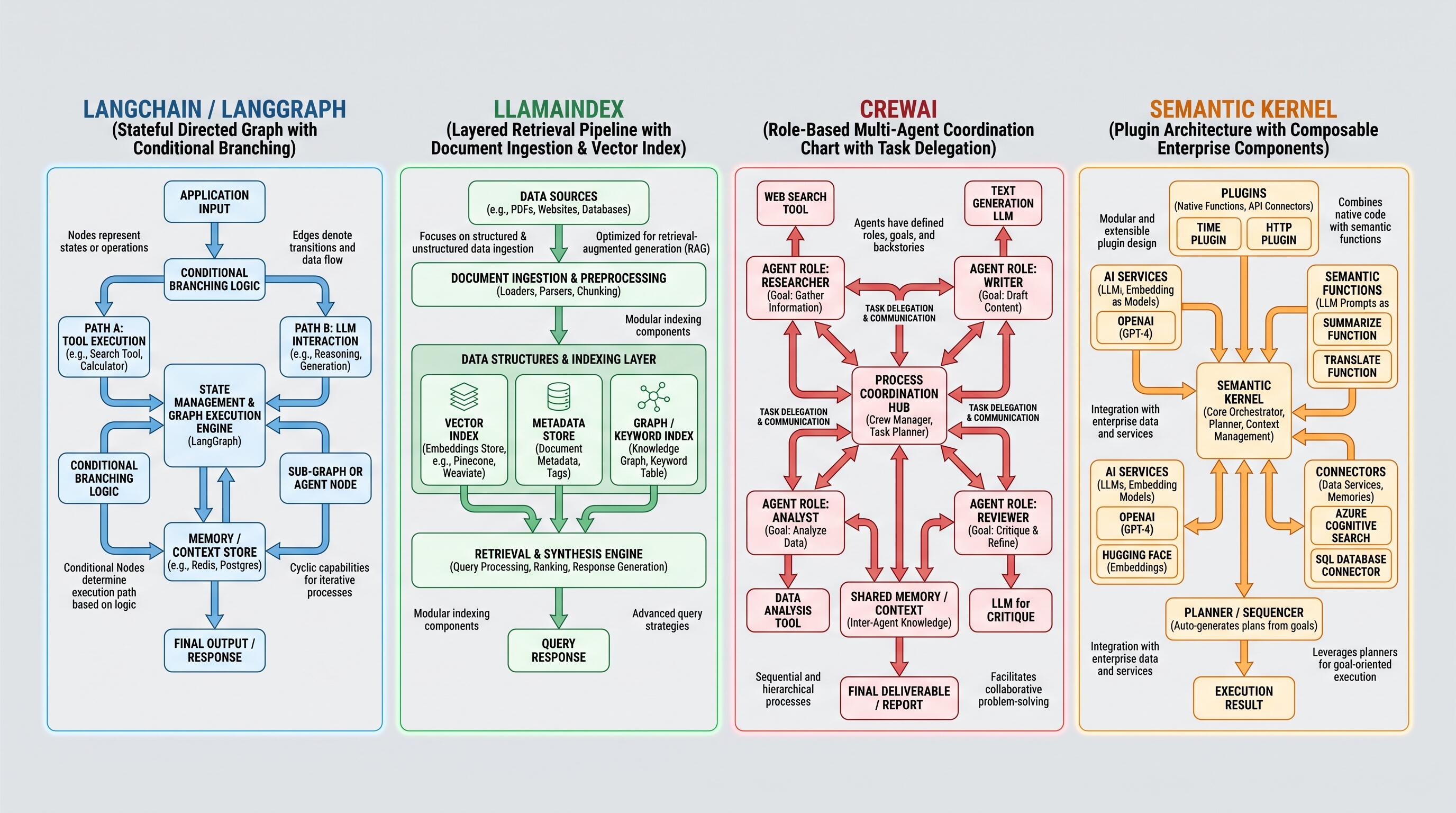
ALT: Architectural comparison of LangChain LangGraph LlamaIndex CrewAI and Semantic Kernel for production AI orchestration and full-stack engineering leadership decisions
Advanced Considerations: What the Benchmarks Don't Tell You
The Hidden Cost of Framework Lock-In
One of the most important — and most frequently underestimated — considerations in framework selection is migration cost. Teams that build deeply against a framework's abstractions often discover that switching later requires rewriting significant portions of their application logic. The best practices for prioritizing product roadmap features should include an explicit assessment of how much your AI architecture is coupled to a specific framework, and what it would cost to decouple it.
A useful mitigation strategy: design your system so that the framework handles coordination and tool invocation, but your core business logic and data transformation code remains framework-agnostic. This boundary discipline pays substantial dividends when frameworks evolve — as they inevitably do — or when you need to swap components to meet performance or cost requirements.
Misconceptions About Framework Maturity
A common misconception is equating GitHub star count or community size with production readiness. LangChain's enormous community reflects its early-mover advantage and broad applicability, but it does not mean every feature is production-hardened. Conversely, Semantic Kernel's smaller community reflects its enterprise focus, not immaturity — Microsoft's backing means it receives sustained investment and enterprise-grade support.
Evaluate production readiness based on: the quality of error handling and exception propagation, the availability of async execution patterns, the quality of documentation for deployment and operations (not just development), and the presence of actively maintained integration tests.
The Relationship Between Orchestration Frameworks and Model Provider Strategy
Orchestration frameworks are not neutral with respect to model providers. LangChain supports the broadest range of providers and makes it relatively straightforward to swap models. LlamaIndex has strong support for most major providers with some variation in feature parity. Semantic Kernel's tightest integration is with Azure OpenAI, though it supports others. CrewAI delegates model interaction to underlying LangChain or direct API calls depending on configuration.
If your organization's AI strategy requires flexibility — the ability to route different tasks to different models, or to switch providers as the competitive landscape shifts — this dimension deserves explicit weight in your evaluation.
Frequently Asked Questions FAQ
Q1: How do I decide which AI orchestration framework to use for a new project in 2026?
Start by characterizing your system's dominant complexity: is it primarily in retrieval (LlamaIndex), multi-agent coordination (CrewAI or LangGraph), enterprise integration (Semantic Kernel), or general-purpose flexibility (LangChain)? Then run a minimal viable integration against your real data and infrastructure before committing. The best framework is the one that reduces friction for your specific use case — not the one with the most features or the largest ecosystem. Invest early evaluation time in the observability and debugging experience, since that pays off consistently in production.
Q2: Is it possible to use multiple orchestration frameworks in the same system?
Yes, and it is more common than documentation typically suggests. A practical pattern is using LlamaIndex for the retrieval layer and LangGraph for the agent coordination layer — the two complement each other well. The key caution is that mixing frameworks increases cognitive overhead for your team and can create subtle integration issues at layer boundaries. If you choose a multi-framework architecture, establish clear interface contracts between layers and document the boundary decisions explicitly so new team members can understand the system without reverse-engineering it.
Q3: How long does it typically take to evaluate and select an orchestration framework before starting production development?
With a structured evaluation process — defining your use case, running minimal integrations, and stress-testing observability — a focused team can reach a confident framework decision within one to two focused working weeks. Avoid the common trap of spending months in evaluation paralysis. Build the simplest possible version of your real system in your top two candidates, compare the experience directly, and make a decision. The cost of a suboptimal framework choice is real but recoverable; the cost of delayed shipping is often larger.
Summary
Choosing an AI orchestration framework in Q2 2026 is a consequential architectural decision that shapes team velocity, system maintainability, and long-term technical debt profile. Three key points bear repeating.
First, match the framework to your dominant complexity. LlamaIndex for retrieval-heavy systems, LangGraph for stateful multi-step agents, CrewAI for role-based multi-agent workflows, Semantic Kernel for enterprise Microsoft ecosystem integration. Fighting a framework's design philosophy is expensive at every stage of development.
Second, evaluate production readiness explicitly, not just developer experience. Observability, error handling, async support, and deployment documentation quality are the dimensions that determine whether your ai solutions hold up under real-world conditions — and they are frequently underweighted in initial framework evaluations.
Third, treat framework selection as an engineering leadership responsibility. The architectural choices made early in a product's lifecycle shape what becomes possible — and what becomes prohibitively expensive — later. Teams that approach orchestration framework selection with the same rigor they apply to database selection or API design consistently ship better products faster.
The best practices for shipping products fast without sacrificing quality in the AI era require getting these foundational decisions right. A well-chosen orchestration framework is infrastructure that accelerates every subsequent decision; a poorly chosen one accumulates friction at every layer.
If you're looking to turn your idea into a live, running product — whether it's an AI-powered system or a full-stack application — Darius brings the architectural depth and hands-on engineering experience to make it happen. Explore real shipped projects, technical insights, and professional background at https://www.darius.wiki. Let's build something that actually ships.
References
- LangChain. "LangGraph: Build Stateful, Multi-Actor Applications with LLMs — Official Documentation".
https://langchain-ai.github.io/langgraph/ - LlamaIndex. "LlamaIndex Documentation: Data Framework for LLM Applications".
https://docs.llamaindex.ai/ - Microsoft. "Semantic Kernel: Open-Source SDK for Integrating AI into Applications — Official Documentation".
https://learn.microsoft.com/en-us/semantic-kernel/overview/ - CrewAI. "CrewAI Documentation: Framework for Orchestrating Role-Playing Autonomous AI Agents".
https://docs.crewai.com/ - ACM Digital Library. "Challenges and Best Practices in Deploying Large Language Model Applications to Production".
https://dl.acm.org/
Note: Standards may be updated, please check the latest official documents or consult professional advisors.
About the Author
Darius is an Engineering Director and AI Architect specializing in turning ideas into live, running products — with expertise spanning AI architecture, systems design, and full-stack development, backed by 3 shipped live projects. Learn more at darius.wiki.
© Darius. All rights reserved. The content in this article reflects the author's personal expertise and opinions and is intended for informational purposes only. No part of this article may be reproduced without proper attribution.