Prioritizing AI Features: An Engineering Leader's Framework for This Quarter
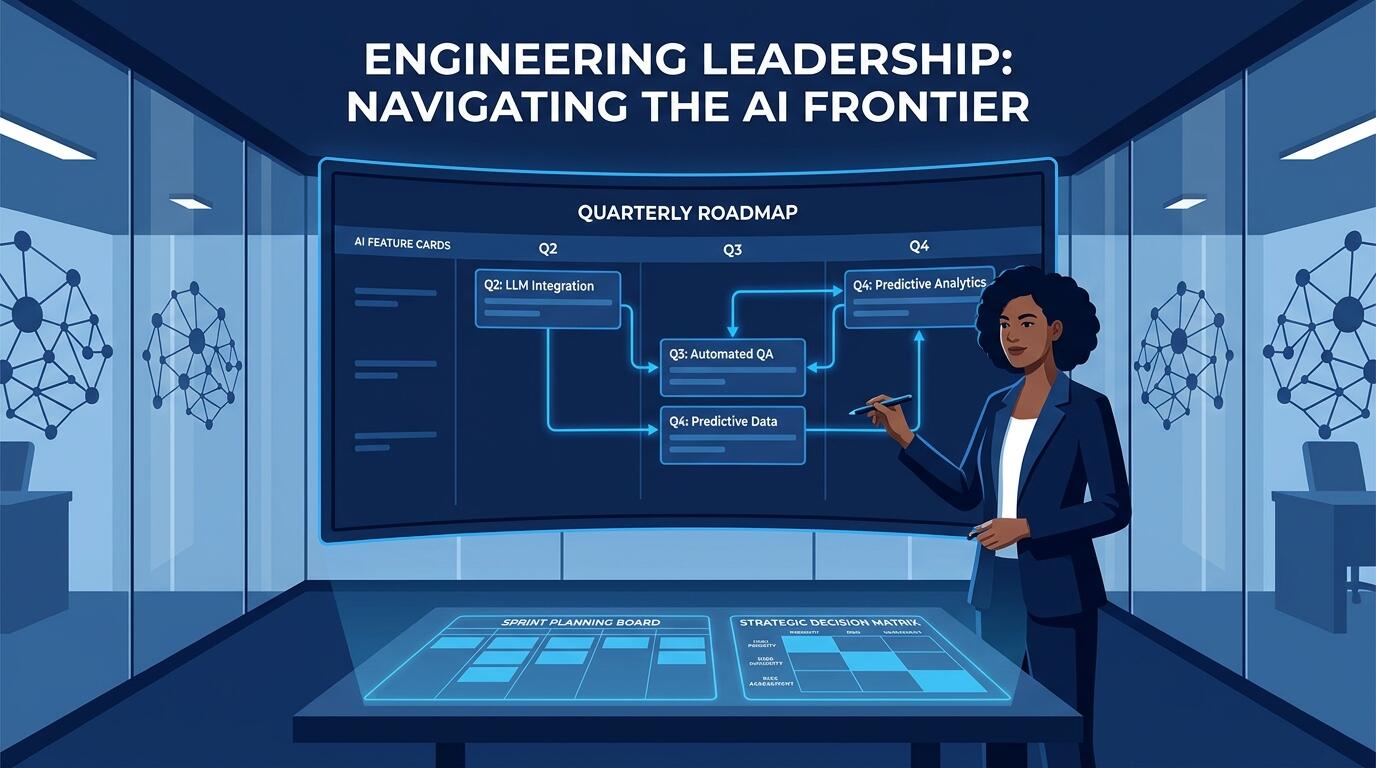
ALT: Engineering leader's framework for prioritizing AI features and roadmap decisions this quarter
Why AI Feature Prioritization Is the Most Consequential Decision You'll Make This Quarter
Prioritizing AI features is not a backlog hygiene exercise — it is a strategic bet on where your team's limited capacity, infrastructure investment, and user trust will be concentrated for the next ninety days. As AI capabilities have become genuinely accessible to engineering teams of every size, the challenge has shifted from "can we build this?" to "should we build this now, and does it actually belong on the roadmap?" The teams that answer that question well ship products that compound in value. The teams that don't burn sprint cycles on AI features that never reach production, never earn user adoption, or quietly undermine the reliability of systems that were working fine before.
This article lays out a practitioner's framework for making that call — one grounded in the realities of shipping live AI-powered systems rather than in idealized product theory.
The Current State of AI Roadmaps and How We Got Here
The state of AI feature development today is defined by a paradox: the barrier to prototyping an AI feature has never been lower, while the barrier to deploying one reliably has never felt higher. Foundation models, vector databases, and managed inference APIs mean a capable engineer can have a working demo in hours. Yet a pattern that consistently shows up in our work with clients is that demos proliferate while production deployments stall — caught between unresolved questions about latency, cost, evaluation, safety guardrails, and user experience.
This dynamic traces back to the rapid commoditization of large language model (LLM) access over the past few years. Engineering teams that previously needed specialized ML infrastructure can now call an API and get intelligent behavior. That accessibility created an explosion of AI feature ideas inside product organizations — and, predictably, an explosion of prioritization debt. Roadmaps filled with AI experiments, many of which share no coherent architectural foundation and compete directly for the same engineering attention.
According to research and practitioner commentary tracked by the engineering leadership community, a growing share of engineering organizations now report that their biggest AI challenge is not capability — it is deciding which AI investments to make and in what order. The question of sequencing matters enormously because AI features carry compounding dependencies: the observability infrastructure you build for one feature often determines whether the next feature can be evaluated honestly. Get the order wrong and you are not just delaying features — you are accumulating invisible technical debt in your AI systems.
The context in which prioritization decisions are made has also shifted. Engineering leaders are no longer operating in a world where AI is a future capability to plan for. It is a present-day delivery expectation, and the teams that treat it as such — building repeatable processes for evaluating, sequencing, and shipping AI features — are pulling ahead of those still treating every AI project as a one-off experiment.
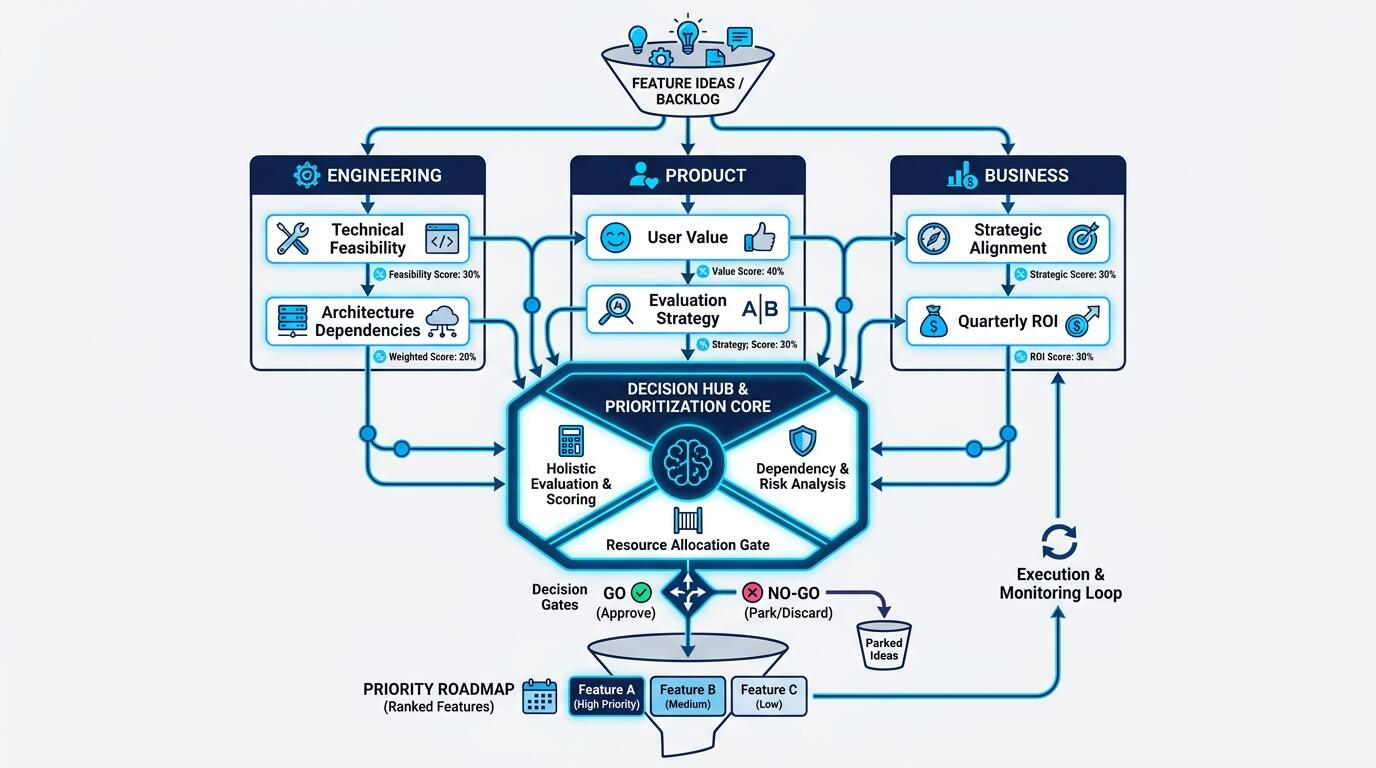
ALT: Visual framework for AI feature prioritization showing decision criteria across engineering, product, and business dimensions for quarterly planning
The Root Causes of Prioritization Failure in AI Roadmaps
Understanding why AI prioritization goes wrong is the prerequisite to doing it right. Three underlying mechanisms consistently explain the dysfunction we observe.
The Demo-to-Production Illusion
AI feature prototypes are uniquely seductive because the demo quality of a generative AI feature often dramatically exceeds its production quality. A language model that produces impressive outputs in a curated test session can behave inconsistently, expensively, or even harmfully in the long tail of real user interactions. Teams that prioritize based on demo impressiveness — rather than on a clear-eyed assessment of the path to production — systematically over-invest in features that stall at the deployment stage.
The mechanism here is not laziness or incompetence. It is a measurement gap. Prototypes are evaluated qualitatively, by people who want them to succeed, using inputs they control. Production systems are evaluated quantitatively, by metrics that reflect the full distribution of real usage. Without a defined evaluation strategy before a feature enters the roadmap, there is no principled basis for comparing it against other candidates.
Misaligned Value Attribution
Value attribution in AI features is structurally harder than in conventional software. A new UI feature has a relatively direct relationship to a user behavior you can measure. An AI feature often operates as an assistant or decision-support layer, where the causal chain between the feature and a business outcome runs through user behavior, trust, and workflow adoption — none of which resolve quickly.
This ambiguity creates a predictable organizational failure mode: AI features get prioritized based on perceived strategic importance ("we need to have AI") rather than demonstrated or reasoned user value. In a pattern we consistently see across early-stage AI product teams, the features that get built first are the ones that are most visible internally, not the ones most likely to move a meaningful metric for users.
Architectural Sequencing Errors
Architectural sequencing refers to the order in which infrastructure and feature work is scheduled relative to each other. In AI systems, this matters more than in conventional software because AI features share foundational components — embeddings pipelines, evaluation harnesses, prompt management systems, observability layers — that cannot be easily retrofitted after the fact. Teams that prioritize features without accounting for these shared dependencies end up building the same infrastructure multiple times, or shipping features they cannot confidently evaluate or iterate on.
As discussed in resources on engineering leadership frameworks from vision to execution, the highest-leverage work for engineering leaders is often not the features themselves but the systems that make feature delivery repeatable and measurable. In AI contexts, that insight is amplified significantly.
Evidence and Competing Approaches to AI Feature Prioritization
Different teams approach AI feature prioritization from meaningfully different angles, each with real trade-offs. Understanding the landscape of approaches helps leaders choose — or synthesize — the one that fits their context.
| Perspective / Approach | Strengths | Trade-offs | Best Fit |
|---|---|---|---|
| Impact-Effort Matrix (adapted for AI) | Familiar to most product teams; creates quick alignment | Effort is systematically underestimated for AI; ignores architectural dependencies | Early-stage teams needing a lightweight starting point |
| User Problem First (Jobs-to-be-Done) | Anchors AI features in genuine user need; reduces "AI for AI's sake" risk | Can under-weight infrastructure and evaluation work that enables future features | Product-led teams with strong user research capabilities |
| Infrastructure-First Sequencing | Builds durable foundations; reduces rework; improves evaluation fidelity | Can feel slow; risks over-engineering before product direction is validated | Teams planning to ship multiple AI features over multiple quarters |
| Technical Feasibility Gate | Prevents teams from committing to features that cannot reliably reach production | Can be overly conservative; may block valuable exploration | Teams that have been burned by demo-to-production gaps |
| Weighted Scoring (multi-criteria) | Balances competing priorities; creates an auditable decision record | Requires calibration effort; scores can be gamed by motivated teams | Engineering-led organizations with established prioritization processes |
In our experience working across AI product teams at various stages, the most effective approach is a hybrid that uses user problem framing to generate the candidate set, applies a technical feasibility gate to eliminate features that cannot realistically reach production this quarter, and then uses a lightweight weighted scoring model to sequence what remains. The scoring model should explicitly weight architectural dependencies — features that unlock future features should receive a multiplier.
The evidence for infrastructure-first thinking is particularly strong for teams shipping their second or third AI feature. The first feature is often a proving ground that reveals gaps in observability, latency management, and evaluation. Teams that treat those gaps as features in their own right — prioritizing them explicitly on the roadmap — consistently deliver subsequent features faster and with higher confidence. This is a principle central to designing scalable AI architecture for production: the decisions you make about shared infrastructure early determine your velocity ceiling for the rest of the year.
It is also worth noting the perspective from engineering leadership practitioners who observe, per commentary tracked across the engineering community, that AI is increasingly being used by leaders themselves to regain strategic focus — filtering noise, surfacing the highest-signal priorities, and reducing the cognitive load of roadmap decisions. Understanding LLM integration patterns that engineering teams actually use in production is directly relevant to making these prioritization calls with confidence rather than speculation.
Where This Is Heading and What It Means for Your Team
The trajectory of AI feature prioritization is moving toward greater rigor, not less. As AI features mature from novelty to expectation, product organizations are developing the institutional memory to evaluate them more honestly — which means the competitive advantage will increasingly belong to teams with repeatable prioritization and delivery processes, not just teams with access to the most capable models.
Several implications follow from this for engineering leaders planning their current quarter.
Evaluation criteria need to be defined before features enter the roadmap. A feature without a defined evaluation strategy is not a prioritization candidate — it is a research question. Treating it as the former creates false accountability and crowds out features that can be honestly measured.
Architectural dependencies deserve explicit roadmap representation. The infrastructure work that enables AI features — logging, evaluation pipelines, latency management, fallback handling — should appear as first-class roadmap items, not as hidden costs bundled into feature estimates. When these are invisible, they create surprise delays and scope creep that erode team trust.
Quarterly framing is the right cadence for AI feature planning. Annual plans are too rigid for a domain evolving as quickly as AI. Sprint-by-sprint planning is too reactive to maintain architectural coherence. The quarter is the natural unit — long enough to deliver meaningful infrastructure and features, short enough to course-correct as model capabilities and user feedback evolve.
Actionable takeaways for this quarter:
- Audit your current AI feature backlog against a feasibility gate: for each item, can you describe a production deployment path and an evaluation strategy? Items that fail this test should be parked as research spikes, not roadmap commitments.
- Identify the shared infrastructure your top three AI features all depend on. If that infrastructure does not exist yet, sequence it first.
- Assign explicit ownership to AI feature evaluation — not just to feature delivery. The person responsible for shipping the feature and the person responsible for measuring whether it worked should be named before the sprint starts.
Questions & Answers
Q1: How should engineering leaders balance AI feature exploration with production delivery commitments?
Exploration and delivery are not opposites — they require different accountability structures. Treat exploration work as time-boxed spikes with defined exit criteria: either the spike produces enough confidence to propose a production feature, or it produces a documented learning that informs future decisions. Production delivery commitments should be reserved for features with a defined evaluation strategy and a clear path through your existing architecture. Mixing the two without labeling them differently is the most common source of roadmap credibility problems in AI teams.
Q2: Are impact-effort matrices still useful for prioritizing AI features, or do they need to be replaced?
Impact-effort matrices remain a useful starting point, but they require an AI-specific modification: effort estimates must include the evaluation and observability work, not just the implementation work. A feature that looks like a two-week implementation can easily become a six-week delivery when you factor in the harness needed to evaluate it honestly and the observability instrumentation needed to monitor it in production. Teams that skip this adjustment systematically underestimate AI feature effort and damage their planning credibility over time.
Q3: How long does it typically take to establish a repeatable AI feature prioritization process?
Establishing a repeatable process is a quarter-length investment. The first cycle is the hardest — teams are simultaneously building the process and delivering against it. By the second quarter, teams that documented their first-cycle decisions and outcomes have enough institutional memory to make prioritization faster and more defensible. The most important artifacts to produce in the first cycle are the evaluation criteria for each shipped feature and a retrospective on where the effort estimates were wrong. Those two documents become the foundation of a calibrated process.
Wrapping Up
Prioritizing AI features well is one of the highest-leverage skills an engineering leader can develop right now. Three principles anchor everything in this framework.
First, a feature without an evaluation strategy is not a prioritization candidate. If you cannot describe how you will know whether the feature worked in production, it is not ready for the roadmap.
Second, shared AI infrastructure deserves first-class roadmap representation. The observability, evaluation, and latency management layers that underpin your AI features are not hidden costs — they are strategic investments that determine your delivery velocity for the rest of the year.
Third, the quarter is the right planning horizon. It is long enough to deliver real architectural progress and real user value, and short enough to respond to the rapid evolution of AI capabilities without locking yourself into commitments that become obsolete.
The teams pulling ahead in AI product development are not the ones with the most ambitious roadmaps. They are the ones with the most honest ones — built on clear evaluation criteria, explicit dependency sequencing, and a realistic account of what production delivery actually requires. If your team is navigating this challenge, the framework here is a starting point worth pressure-testing against your specific context.
If you are working through these decisions and want to pressure-test your AI roadmap against the realities of production delivery, explore shipped projects, technical insights, and a professional portfolio at the Darius website — or reach out to discuss how these frameworks apply to your specific product and team.
Sources & Citations
- Faros AI. "Engineering Leadership Framework: Vision to Execution".
https://www.faros.ai/blog/engineering-leadership-framework-vision-strategy-execution-guide - LinkedIn / Jossie Mann. "Leaders Using AI to Regain Focus and Make Better Decisions".
https://www.linkedin.com/posts/jossiemann_everyones-talking-about-ai-making-engineers-activity-7480281989980377088-MdSs - YouTube. "How Engineering Leadership Is Changing in 2025".
https://www.youtube.com/watch?v=p8Fo80ynHTE - IEEE (Institute of Electrical and Electronics Engineers). Standards and technical resources on software and systems engineering practices.
https://www.ieee.org/
Note: Standards and frameworks may be updated; please check the latest official documents or consult professional advisors.