Common AI Architecture Mistakes That Kill Startup Products
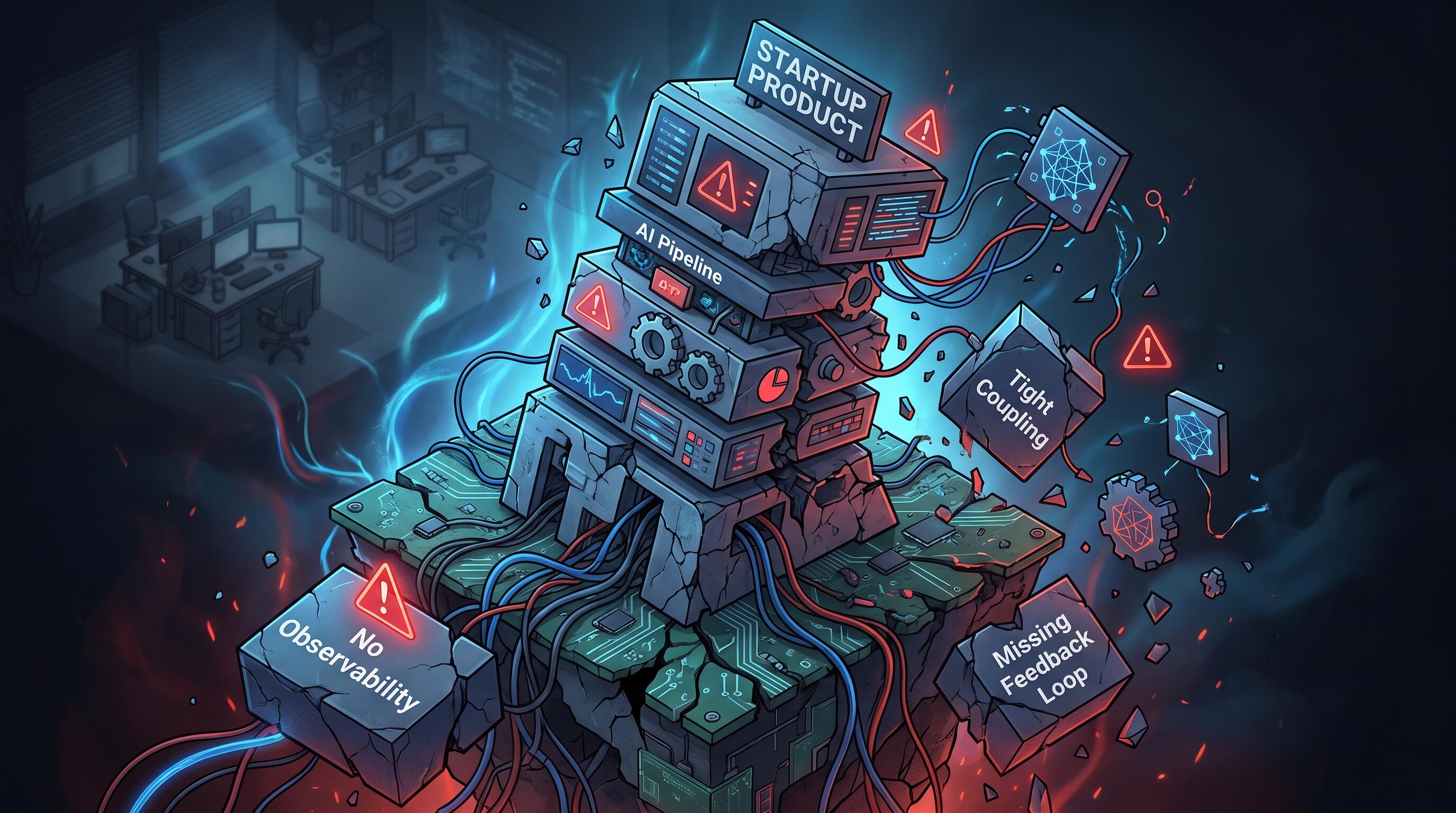
ALT: Common AI architecture mistakes that kill startup products and how to avoid them
Why AI Architecture Mistakes Are Quietly Destroying Startup Products
Key Conclusion: Most startup products don't fail because the idea is bad — they fail because the underlying ai architecture wasn't designed to survive contact with real users. From over-engineered pipelines to misaligned machine learning model choices, these structural flaws compound silently until the product collapses under its own weight. Good technical consulting and architectural foresight can prevent the vast majority of these failures before a single line of production code is written.
Building AI-powered products is genuinely exciting right now. The tooling has never been more accessible, the models have never been more capable, and the market appetite for intelligent systems has never been higher. But excitement has a way of accelerating the wrong decisions — and in the context of AI systems, the wrong architectural decision made in week two can become a multi-month refactor by week sixteen.
The hard truth is that most architectural failures aren't dramatic. They don't announce themselves with a crash or a runtime error. They accumulate quietly: latency that grows with scale, costs that don't match projections, models that behave unpredictably in edge cases, infrastructure that can't be monitored, debugged, or maintained. By the time founders and engineering leads recognize the pattern, they're already deep in technical debt.
This article breaks down the most common AI architecture mistakes that kill startup products — not from a theoretical standpoint, but from the perspective of someone who has designed, built, and shipped real production systems.
Who This Article Is For
✅ Applicable Scenarios:
- Early-stage startups building their first AI-powered product and trying to establish sound architectural foundations before scaling
- Product managers and founders evaluating technical decisions and wanting to understand the systemic risks of common architectural shortcuts
- Engineering leads inheriting an existing AI system and trying to diagnose why performance, reliability, or costs are degrading
❌ Not Applicable/Cautions:
- Teams already operating at hyperscale with dedicated ML platform engineering — your architectural constraints are different, though the failure modes overlap
- Projects purely focused on data science research or model experimentation with no near-term production deployment goals
The Hidden Cost of Bad AI Architecture in Startup Products
The modern startup ecosystem has made it dangerously easy to bolt an AI component onto a product without thinking through its architectural implications. Pre-trained models, hosted APIs, and low-code ML tools lower the barrier to entry — but they don't lower the barrier to failure. They just delay it.
What makes AI systems architecturally different from traditional software? A few things matter enormously here. First, AI systems have non-deterministic behavior — the same input doesn't always produce the same output. This means that traditional software testing assumptions break down, and observability requirements become significantly more demanding. Second, AI systems have data dependencies that evolve over time. A model trained on one distribution of data can degrade silently when real-world data drifts away from that distribution. Third, AI systems often involve external API costs and latency that behave differently at scale than they do in development.
Industry research from institutions like MIT and Stanford consistently highlights that a significant proportion of AI projects that reach prototype stage never make it to reliable production. The gap between a working demo and a shippable product isn't just an engineering effort gap — it's an architectural gap. Teams that prototype fast without designing for production are essentially building on sand.
This is where thoughtful systems design and genuine technical consulting expertise become force multipliers. Understanding these failure modes before you encounter them — and structuring your architecture to avoid or mitigate them — is the difference between shipping and stalling.
The Core Mistakes: A Practical Breakdown
Three Steps to Audit Your AI Architecture Before It's Too Late
Step 1: Map Every AI Decision Point and Its Failure Mode
Before you can fix architectural problems, you need to see them clearly. Start by mapping every place in your product where an AI model makes or informs a decision. For each one, ask: what happens when this model is wrong? What happens when it's slow? What happens when it's unavailable? This exercise typically takes a focused working session but reveals structural assumptions that are often invisible during development. Teams that skip this step frequently discover fragility only under production load.
Step 2: Trace Your Data Flow End-to-End, Including Feedback Loops
AI systems are only as good as the data flowing through them. Trace your data pipeline from raw input to model inference to output storage — and crucially, identify whether your architecture captures any feedback signal about model performance in production. Many startups build inference pipelines with no mechanism for capturing ground truth or user feedback, making it impossible to detect model drift or improve over time. This step often surfaces missing logging infrastructure and poorly defined data contracts between services.
Step 3: Stress-Test Your Cost and Latency Assumptions at 10x Scale
Most AI architectures look fine at development scale. The questions worth asking before you're there: what does your infrastructure cost and response time look like at ten times your current load? Run the numbers explicitly. Many startups discover that their API-dependent architecture, perfectly reasonable at low volume, becomes economically unviable at growth stage. This is the moment to make deliberate decisions about model hosting strategies, caching, batching, and hybrid approaches — before scale forces your hand.
The Most Common AI Architecture Mistakes, Compared
Understanding the failure modes in context helps teams make better decisions. Here's how three common architectural approaches stack up against the dimensions that matter most in production:
| Comparison Dimension | Fully API-Dependent Architecture | Self-Hosted Open-Source Models | Hybrid Architecture (API + Local) |
|---|---|---|---|
| Initial Development Speed | High — minimal infra setup | Low — significant setup overhead | Medium — balanced tradeoff |
| Cost at Scale | High and unpredictable | Controlled once established | Optimized per use case |
| Latency Control | Low — dependent on provider | High — full control | Medium to high |
| Data Privacy Compliance | Requires provider audit | Full control | Configurable by data type |
| Operational Complexity | Low initially, high at scale | High throughout | Medium, manageable with good design |
| Model Update Flexibility | Dependent on provider | Full control | Selective control |
The table above isn't a recommendation to avoid any one approach — it's a framework for making the choice with eyes open. The mistake isn't choosing API-first; the mistake is choosing API-first without understanding what you're trading away.
The Detailed Breakdown: Seven Mistakes That Kill AI Products
Mistake 1: Treating the AI Component as a Black Box
One of the most destructive patterns in startup AI development is treating the model — whether it's a third-party API or an internally hosted system — as a trusted black box. Teams build around it without instrumenting it, without logging its outputs, and without establishing any mechanism for detecting when it starts behaving differently.
The result is a product that can degrade without anyone noticing. A machine learning model that was accurate in testing might drift as real-world data shifts. Prompt-based systems can behave unpredictably when user inputs fall outside the patterns the model was tuned on. Without observability built into the architecture, these degradations are invisible until a user complains — or worse, until a critical business decision is made on unreliable output.
Mistake 2: Over-Engineering the Architecture Before Validating the Product
This is the mirror image of mistake one, and equally common. Teams with strong engineering backgrounds sometimes design for Google-scale from day one — distributed training pipelines, complex orchestration layers, custom model registries — before they've validated that the product solves a real problem for real users.
Over-engineered ai architecture creates two compounding problems. First, it slows down iteration. Every change requires navigating layers of abstraction that exist to solve scale problems you don't have yet. Second, it locks in assumptions about how the product will work before you've learned from actual usage. The architectural decisions that seem robust in isolation often become obstacles when the product needs to pivot.
Mistake 3: Ignoring Data Contracts Between Services
In systems design, a data contract is an explicit agreement about the structure, type, and semantics of data passed between components. In AI systems, this matters more than in traditional software because models are sensitive to input format and distribution in ways that aren't always obvious or well-documented.
Teams frequently build AI pipelines where the preprocessing step, the model inference step, and the postprocessing step are loosely coupled with implicit assumptions about data format. When any upstream service changes — a schema update, a new data source, a changed encoding — the model starts receiving malformed or out-of-distribution inputs. Failures of this kind are notoriously difficult to debug because they often manifest as degraded model output rather than explicit errors.
Mistake 4: Building With No Path to Model Improvement
A shipped AI product is not a finished AI product. Models need to improve over time as you collect real usage data, as the world changes, and as your understanding of the problem deepens. But many startup architectures have no mechanism for this.
If your architecture doesn't capture the information needed to evaluate model performance in production — user feedback signals, ground truth labels, output logging — you're building a system that can only degrade over time, never improve. This isn't a model problem; it's an architectural problem. The feedback loop must be designed in from the start.
Mistake 5: Misaligning Team Structure With Architectural Complexity
Recommended team structure for early-stage startups building AI products is a genuinely important question. The mistake here isn't purely technical — it's organizational. AI systems require a different set of skills than traditional software: someone who understands data pipelines, someone who understands model behavior, someone who can design infrastructure for inference at scale.
Startups often try to cover these needs with a single "AI engineer" who is expected to own everything from data preprocessing to model selection to deployment. This creates bottlenecks and architectural blind spots. Effective early-stage teams working on AI products benefit from explicitly partitioning these responsibilities, even when the team is small — ideally with an architect who can hold the end-to-end system view while specialists go deep in each layer.
Mistake 6: Underestimating Inference Latency as a Product Problem
Latency in AI systems isn't just a performance metric — it's a product quality issue. Users tolerate different latency thresholds depending on the use case, but the architectural implications of latency requirements are enormous and frequently underestimated at design time.
Teams building conversational AI interfaces, real-time recommendation systems, or AI-assisted workflows often discover too late that their model inference time makes the user experience feel broken. The solution space — caching, model quantization, asynchronous inference, streaming responses — requires architectural forethought. Retrofitting latency improvements into a system that wasn't designed with them in mind is one of the most expensive refactors a startup engineering team can undertake.
Mistake 7: Failing to Separate Concerns in the AI Pipeline
The principle of separation of concerns applies with particular force to AI systems. Mixing data ingestion, preprocessing, model inference, business logic, and output formatting into tightly coupled components makes the system extremely difficult to test, debug, modify, or scale independently.
A well-designed AI pipeline treats each stage as a discrete component with clearly defined inputs, outputs, and responsibilities. This isn't just architectural elegance — it's practical necessity. When a model needs to be updated, you don't want to retrain your data preprocessing logic. When your business logic changes, you don't want to modify the inference pipeline. These separations are the foundation of a system that can actually evolve as your product grows.
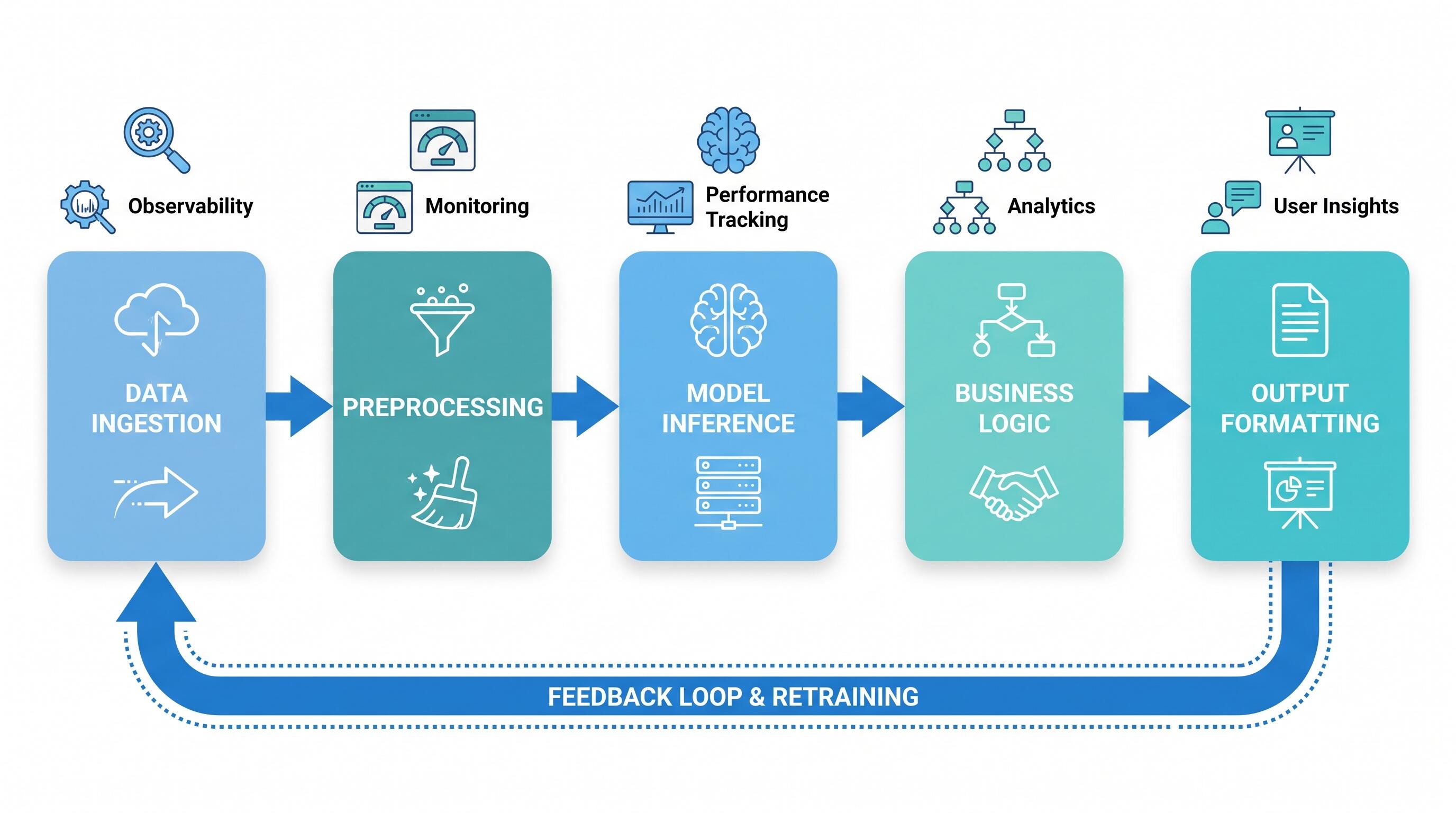
ALT: Diagram showing well-structured AI architecture pipeline for startup products with separated concerns and feedback loops
Advanced Considerations: When Good Architecture Still Isn't Enough
Even teams that avoid the seven mistakes above will encounter edge cases that push their architecture to its limits. Here are three scenarios worth thinking through in advance.
Handling Model Versioning in Production
Deploying a new model version isn't like deploying a new software release. A new model version can change the distribution of outputs across your entire user base simultaneously. Without shadow testing, canary deployments, or A/B model serving infrastructure, a bad model update can cause widespread product degradation before anyone notices. Model versioning needs to be treated as a first-class architectural concern, not an afterthought.
Managing Third-Party AI API Risk
Many startups build significant product functionality on top of third-party AI APIs. This creates a category of risk that traditional software dependency management doesn't fully address: the API's behavior can change in ways that aren't reflected in a version number. A model update from a provider can change output format, tone, capability, or reliability without a breaking change being declared. Architectural mitigations — abstraction layers, output validation, fallback strategies — are essential for any production system with meaningful API dependencies.
The Common Misconception: More Parameters Means Better Product
A persistent misconception in startup AI development is that deploying a larger, more powerful model is always better. In practice, the right model for a production system is the smallest, fastest model that meets the product's quality requirements. Larger models cost more, run slower, and introduce more operational complexity. The architectural discipline of matching model capability to actual product requirements — rather than reaching for the most impressive benchmark — is a hallmark of experienced AI system design.
Frequently Asked Questions FAQ
Q1: How should early-stage startups prioritize their AI architecture decisions?
Early-stage startups should prioritize architectural decisions that protect optionality. Focus on clean data contracts, observable inference pipelines, and separation of concerns — these investments make it easier to swap models, change providers, or pivot the product without rebuilding from scratch. Avoid over-committing to any single infrastructure approach before you've validated core product assumptions with real users. The goal of early-stage ai architecture is to enable rapid, safe iteration — not to solve scale problems you don't have yet.
Q2: Is it possible to retrofit good AI architecture into an existing poorly-designed system?
Retrofitting is possible but expensive, and the cost scales with how deeply the poor architectural decisions are embedded. The most practical approach is to identify the highest-risk failure modes first — typically observability gaps and tight coupling between components — and address those systematically rather than attempting a full rewrite. Technical consulting from someone with production AI systems experience can significantly accelerate this process by identifying which problems are structural and which are surface-level.
Q3: How much does addressing AI architecture mistakes typically cost in terms of engineering time?
The cost varies significantly based on how early the problems are caught. Architectural mistakes identified during design phase typically require hours to resolve through better decision-making. The same mistakes identified after the system is in production can require weeks or months of engineering effort to address safely. Teams that invest in architectural review early — whether through internal expertise or external machine learning and systems design consulting — consistently find that the upfront investment is a fraction of the remediation cost.
Summary
AI-powered products fail for many reasons, but a disproportionate share of startup product failures trace back to preventable architectural mistakes. The seven patterns covered in this article — from black-box model treatment to missing feedback loops to latency blindness — are not exotic edge cases. They are the common failure modes of teams building real products under real constraints.
Three core principles stand out from this analysis:
First, observability is not optional. If you can't measure your AI system's behavior in production, you can't improve it — and you can't detect when it degrades.
Second, design for evolution, not just deployment. The systems that survive contact with real users are the ones built with enough separation of concerns to change safely and quickly.
Third, architectural discipline is a product decision. The quality of your AI architecture directly determines the quality of the product your users experience.
The path forward is clear: audit your architecture against these failure modes before you're forced to by production incidents, invest in observability and feedback loops from the start, and match your model choices to your actual product requirements rather than your aspirations.
Call to Action
If you're looking to turn your idea into a live, running product — whether it's an AI-powered system or a full-stack application — Darius brings the architectural depth and hands-on engineering experience to make it happen. Explore real shipped projects, technical insights, and professional background at https://www.darius.wiki. Let's build something that actually ships.
References
- MIT Sloan Management Review. "Winning With AI: Pioneers Combine Strategy, Organizational Behavior, and Technology".
https://sloanreview.mit.edu/projects/winning-with-ai/ - Google Research. "Machine Learning: The High-Interest Credit Card of Technical Debt".
https://research.google/pubs/pub43146/ - Stanford HAI (Human-Centered Artificial Intelligence). "AI Index Report".
https://aiindex.stanford.edu/report/ - Martin Fowler (martinfowler.com). "Patterns of Distributed Systems".
https://martinfowler.com/articles/patterns-of-distributed-systems/ - NIST (National Institute of Standards and Technology). "AI Risk Management Framework".
https://www.nist.gov/artificial-intelligence/ai-risk-management-framework
Note: Standards and best practices in AI architecture may be updated. Please check the latest official documentation or consult professional advisors for guidance specific to your context.
About the Author
Darius is an Engineering Director and AI Architect specializing in turning ideas into live, running products — with expertise spanning AI architecture, systems design, and full-stack development, backed by 3 shipped live projects. Learn more at darius.wiki.
© Darius. All rights reserved. The content in this article reflects the author's personal expertise and opinions and is intended for informational purposes only. No part of this article may be reproduced without proper attribution.