What to Expect from an AI Architecture Consulting Engagement in 2026
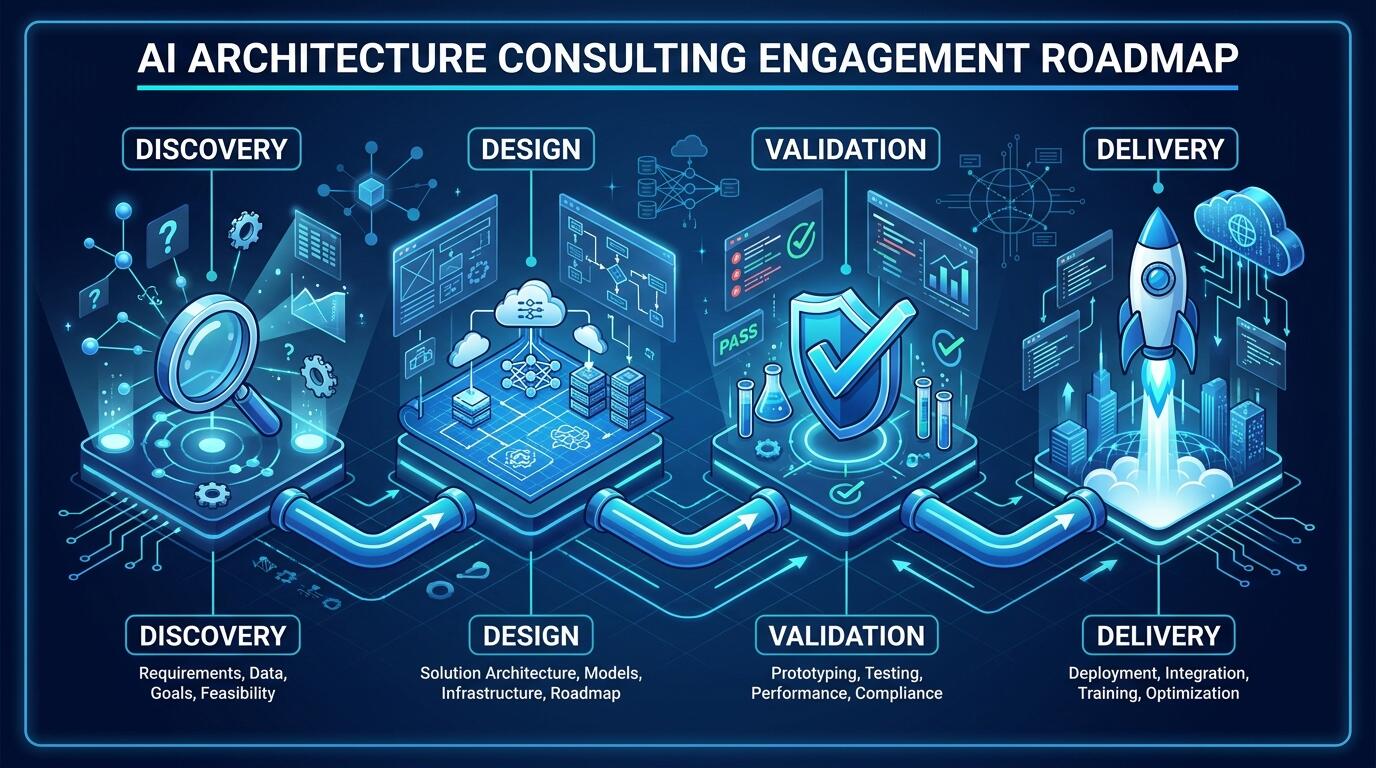
ALT: AI architecture consulting engagement phases and expectations for technical founders in 2026
Structured vs. Ad Hoc AI Consulting: What Kind of Engagement Actually Moves the Needle?
The single question most founders and engineering leaders ask before hiring an AI architect is this: what am I actually buying, and will it translate into something running in production? The direct answer is that a well-structured AI architecture consulting engagement — one that moves through discovery, design, validation, and delivery in a disciplined sequence — consistently outperforms loosely scoped advisory arrangements where recommendations never touch real code. In 2026, the gap between these two approaches has widened considerably, and knowing what separates them is the difference between a meaningful investment and an expensive slide deck.
This article compares three broad engagement models that founders and CTOs typically encounter when seeking AI architecture consulting support: the structured end-to-end engagement, the advisory retainer, and the project-based sprint. Each is evaluated on the criteria that matter most in practice — depth of technical output, speed to production, architecture ownership, flexibility, and measurable business alignment.
Evaluation Criteria: How to Judge an AI Architecture Consulting Engagement
Choosing the right AI consulting model requires judging each option on dimensions that map directly to business outcomes. Five criteria consistently surface when engineering leaders evaluate these engagements.
Depth of technical output refers to whether the engagement produces artifacts that engineers can actually build from — system diagrams, ADRs (Architecture Decision Records), data pipeline specifications, model selection rationale, and integration contracts — rather than high-level frameworks that leave the implementation team guessing.
Speed to production measures how quickly a consulting engagement closes the distance between concept and a live, running system. In 2026, time-to-market pressure on AI-powered products is intense; a model that extends the runway before the first deployment is a liability.
Architecture ownership captures who ends up holding the design. Engagements that transfer knowledge, documentation, and decision rationale to the internal team leave organizations capable of iterating independently. Those that keep expertise locked with the consultant create dependency.
Flexibility matters because product requirements evolve — often mid-engagement. The model that accommodates scope pivots without renegotiating every clause keeps the project moving.
Business alignment is the criterion most often neglected in purely technical consulting. An AI architecture engagement should connect technical choices to user outcomes, unit economics, and organizational constraints. Engagements that ignore this dimension tend to produce elegant systems that solve the wrong problem.
The Contenders: Three AI Architecture Consulting Models in Practice
The Structured End-to-End AI Architecture Engagement
A structured end-to-end AI architecture engagement is a consulting model in which a single expert or tight team works with a client from initial problem framing through live deployment, owning the architecture across every phase. This is the model Darius delivers — combining AI architecture, systems design, and full-stack development under one roof, with three shipped live projects as evidence that the approach produces running software, not just recommendations.
In practice, this engagement unfolds in recognizable phases: a discovery sprint that surfaces real constraints (data quality, latency requirements, team capabilities, budget), an architecture design phase that produces concrete, buildable specifications, a validation loop where assumptions are tested against actual infrastructure, and a delivery phase that includes hands-on implementation support. The through-line is continuity — the same expert who framed the problem is present when the system hits production, which eliminates the translation loss that plagues handoff-heavy models.
This model suits founders who need to move from idea to live product without assembling a large internal team first, and CTOs who need a trusted second opinion across the full technical stack before committing to a multi-year architecture.
The Advisory Retainer
An advisory retainer is an arrangement in which a consultant makes themselves available for regular sessions — typically recurring calls, async Q&A, and occasional document review — without taking direct responsibility for design outcomes or implementation. This model is widespread, and according to Alice Labs' analysis of AI consulting pricing in 2026, retainer arrangements are among the most common structures offered by independent AI consultants.
The advisory retainer works best when an organization already has strong internal engineering capability and needs external perspective to pressure-test decisions rather than make them. The consultant's role is to challenge assumptions, flag architectural risks, and point toward relevant patterns — not to produce the architecture itself. The limitation is accountability: when the system underperforms, there is no clear ownership trail.
A pattern seen consistently in this model is that value degrades over time if the client's team lacks the bandwidth to act on recommendations between sessions. The retainer becomes a recurring status call rather than a force multiplier.
The Project-Based Sprint
A project-based AI consulting sprint is a time-boxed engagement — typically two to eight weeks — focused on a specific, well-defined deliverable: a reference architecture for a new AI feature, a data pipeline audit, an LLM integration blueprint, or a production readiness review. According to Seidr Lab's 2026 guide to AI consulting, sprint-based engagements have grown in popularity as organizations seek faster validation cycles before committing to larger programs.
The sprint model's strength is focus. When the problem is genuinely narrow and well-scoped — "should we fine-tune or use RAG for this use case, and what does the serving infrastructure look like?" — a sprint can deliver a high-quality answer efficiently. Its weakness is that narrow scope rarely reflects reality. Production AI systems have dependencies that cross team boundaries, and a sprint scoped to one layer frequently produces recommendations that conflict with constraints discovered later.
Head-to-Head Comparison: AI Architecture Consulting Models Evaluated
| Criterion | Structured End-to-End | Advisory Retainer | Project-Based Sprint |
|---|---|---|---|
| Depth of technical output | High — produces buildable specifications across all layers | Moderate — depends on client team to translate guidance | Variable — high within scope, blind outside it |
| Speed to production | Fastest for greenfield or pivot scenarios | Slow — no delivery accountability | Fast for narrow, well-defined problems |
| Architecture ownership | Fully transferred with documentation | Retained by client, unstructured | Transferred within scope only |
| Flexibility to pivot | High — continuity allows mid-course correction | High — but guidance lag is common | Low — scope changes require renegotiation |
| Business alignment | Built in from discovery phase | Depends on consultant orientation | Often absent — technically scoped only |
| Knowledge transfer | Explicit — ADRs, diagrams, rationale documented | Implicit — exists only in session notes | Partial — deliverable-specific |
| Best fit | Founders, scaling teams, complex AI products | Internal teams needing a sounding board | Teams with isolated, well-scoped questions |
The most significant difference between models is where accountability sits. In a structured end-to-end engagement, the consultant is present when assumptions meet reality — when the data pipeline throughput turns out to be half the estimate, or when the chosen embedding model produces unacceptable latency at scale. Advisory and sprint models do not provide this continuity, which means the internal team absorbs the cost of surprises.
A second meaningful difference is knowledge transfer durability. Retainer conversations are ephemeral unless the client's team actively documents them; sprint deliverables are specific to the problem framed at kickoff. A structured engagement that produces living architecture documentation — updated as decisions evolve — becomes an organizational asset that outlasts the engagement itself.
The third distinction is business alignment at the design level. In our work with clients, the most expensive architectural mistakes are not technical errors — they are technically sound systems built for assumptions that were never validated against actual user behavior or business constraints. End-to-end engagements that include a discovery phase specifically designed to surface those constraints before design begins consistently avoid this failure mode.
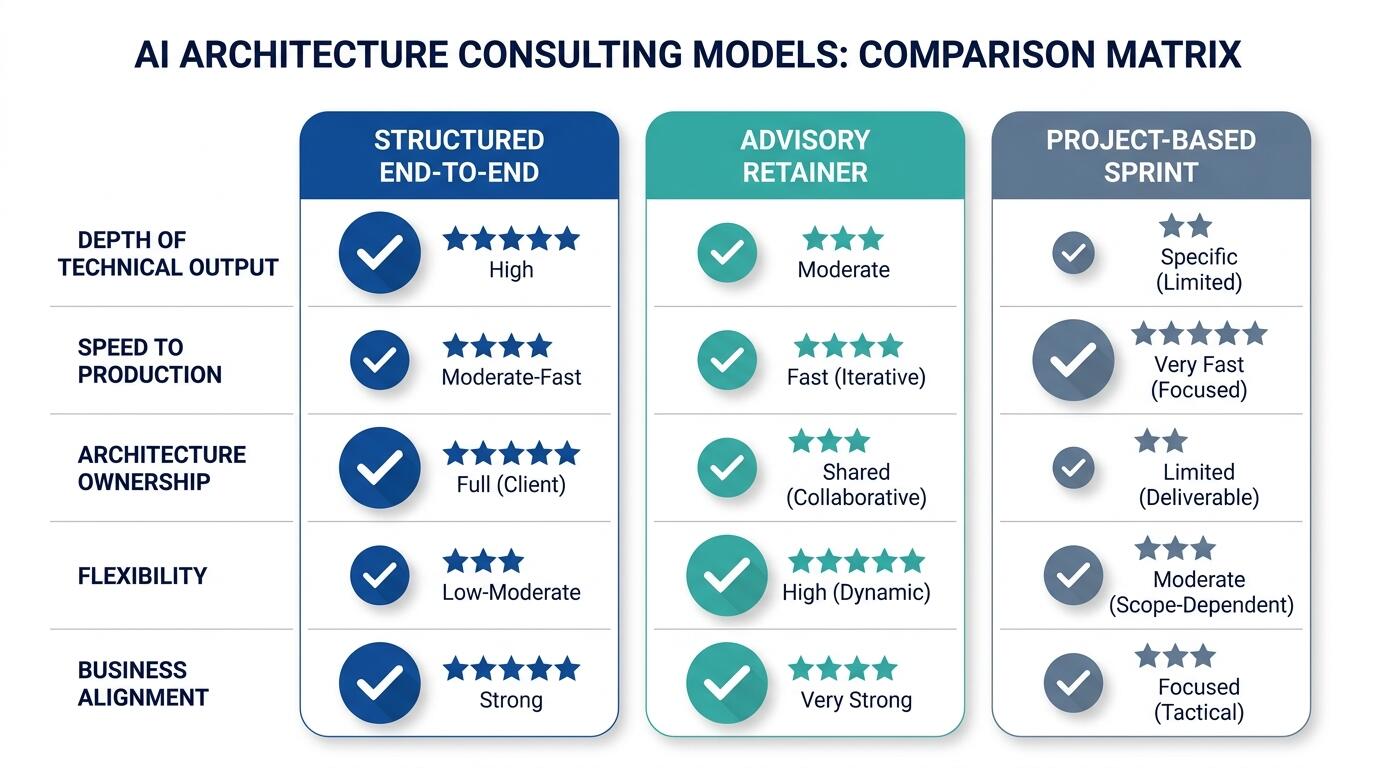
ALT: Comparison table of AI architecture consulting engagement models for startup founders and engineering leaders evaluating consulting options in 2026
Which Should You Choose? Scenario Recommendations for AI Architecture Consulting
The right consulting model follows directly from the organization's current position and what it needs to be true six months from now.
If you are an early-stage founder with a clear AI product vision but no internal engineering depth, the structured end-to-end engagement is the appropriate choice. You need someone who can own the architecture, make and document decisions, implement or closely supervise implementation, and hand you a running system with the rationale for every major choice. A retainer gives you advice you may not have the capacity to act on; a sprint solves a problem in isolation while leaving the surrounding system undefined.
If you are a CTO or VP Engineering at a scaling company with a capable internal team, but you are making a high-stakes architecture decision — migrating to a new AI serving infrastructure, choosing between fine-tuning and retrieval-augmented generation at scale, or designing a multi-tenant AI platform — a structured engagement with a senior external architect makes sense. The cost of a wrong decision at this stage dwarfs the cost of the engagement.
If you have a specific, genuinely isolated question and a team that can execute on the answer, a sprint is efficient and appropriate. The prerequisite is honest scoping: if the "isolated" question turns out to have upstream and downstream dependencies your team has not yet mapped, a sprint will underdeliver.
If you have strong internal architects who simply want a regular external perspective and challenge function, an advisory retainer is a reasonable fit. Set explicit expectations about what advisory means — documented recommendations, not just verbal guidance — and build in a mechanism for acting on what the retainer surfaces.
Pros and cons at a glance:
Structured end-to-end engagements offer the highest accountability, fastest path to production for complex systems, and the most durable knowledge transfer — at a higher investment relative to the other models, and with the requirement that the client engages actively during discovery and validation phases.
Advisory retainers offer flexibility and low commitment — useful for ongoing calibration, less useful when the organization needs architecture created rather than reviewed.
Project-based sprints offer focus and speed for well-scoped problems, with the significant caveat that AI system problems are rarely as well-scoped as they appear at kickoff. As a LinkedIn analysis of top AI consulting companies in 2026 notes, scoping discipline is one of the most consistent differentiators between consulting engagements that deliver value and those that stall.
Common Questions
Q1: How long does a typical AI architecture consulting engagement take from kickoff to first production deployment?
Duration varies with system complexity, but a structured end-to-end AI architecture engagement covering discovery, design, validation, and initial production deployment typically spans several weeks to a few months. The discovery and architecture design phases are the most time-sensitive: compressing them to save time consistently produces more expensive corrections later. A sprint engagement may deliver a design artifact in two to four weeks, but production readiness is a separate milestone that depends on implementation capacity.
Q2: Is an AI architecture consultant different from a general software architect?
An AI architecture consultant is a specialist whose expertise covers the systems design concerns unique to machine learning workloads — data pipeline reliability, model serving infrastructure, inference latency, embedding and retrieval system design, and the operational patterns (MLOps, LLMOps) required to keep AI components healthy in production. A general software architect may be highly skilled without having direct experience with these specific constraints, which tend to fail in ways that generic distributed systems experience does not anticipate.
Q3: What does an AI architecture consulting engagement cost in 2026, and what drives pricing?
AI consulting pricing in 2026 varies significantly by engagement model, consultant seniority, and scope. Retainer arrangements, project sprints, and end-to-end engagements each have different pricing structures — typically reflecting the level of accountability and deliverable depth the model provides. According to Alice Labs' analysis of AI consulting pricing, rates are driven primarily by the consultant's production track record, the complexity of the AI systems involved, and whether the engagement includes implementation support or design-only advisory. Qualitatively, engagements that include hands-on delivery typically carry higher investment and higher ROI.
Key Takeaways
Three points define the practical guidance in this article.
First, the model you choose determines accountability. Structured end-to-end engagements place a qualified expert on the hook for outcomes across the full system lifecycle; advisory and sprint models distribute that responsibility back to the client team. Match the model to your team's actual capacity to own what the consultant produces.
Second, discovery is not overhead — it is the highest-leverage activity in any AI architecture engagement. Organizations that skip or compress discovery in pursuit of faster design consistently encounter the same category of expensive surprises: systems optimized for assumptions that did not survive contact with production data or user behavior.
Third, knowledge transfer durability is a selection criterion worth weighting heavily. An engagement that leaves behind documented Architecture Decision Records, system diagrams, and decision rationale is worth more than one that leaves behind slides. The documentation becomes the architecture's institutional memory.
The next step is to be honest about where your organization sits: do you need advice, or do you need architecture built? Once that question is answered clearly, selecting the right engagement model is straightforward.
Explore the Darius portfolio, live shipped projects, and engineering insights at darius.wiki to see what a structured AI architecture engagement produces in practice. If you are ready to move from concept to a running system, reach out and let's build something that works — for real.
Sources & Further Reading
- Alice Labs. "AI Consulting Pricing in 2026: Rates, Models & What You Should Know".
https://alicelabs.ai/en/insights/ai-consulting-pricing-2026 - Seidr Lab. "What is AI Consulting? The 2026 Complete Guide for Mid-Market and Enterprise Teams".
https://seidrlab.com/blog/what-is-ai-consulting-2026-guide - LinkedIn Pulse. "Top AI Consulting Companies in 2026: AI Development Cost Comparison".
https://www.linkedin.com/pulse/top-ai-consulting-companies-2026-development-cost-comparison-kaitc - IEEE. Institute of Electrical and Electronics Engineers — Standards and Technical Resources on AI Systems Engineering.
https://www.ieee.org/ - NIST. National Institute of Standards and Technology — AI Risk Management Framework and AI Standards Resources.
https://www.nist.gov/
Note: Standards and industry guidance may be updated; verify the latest official documents or consult qualified professional advisors before making architecture or procurement decisions.