AI Agents Are Reshaping How Chinese Startups Compete — 5 Key Trends SME Leaders Can't Ignore
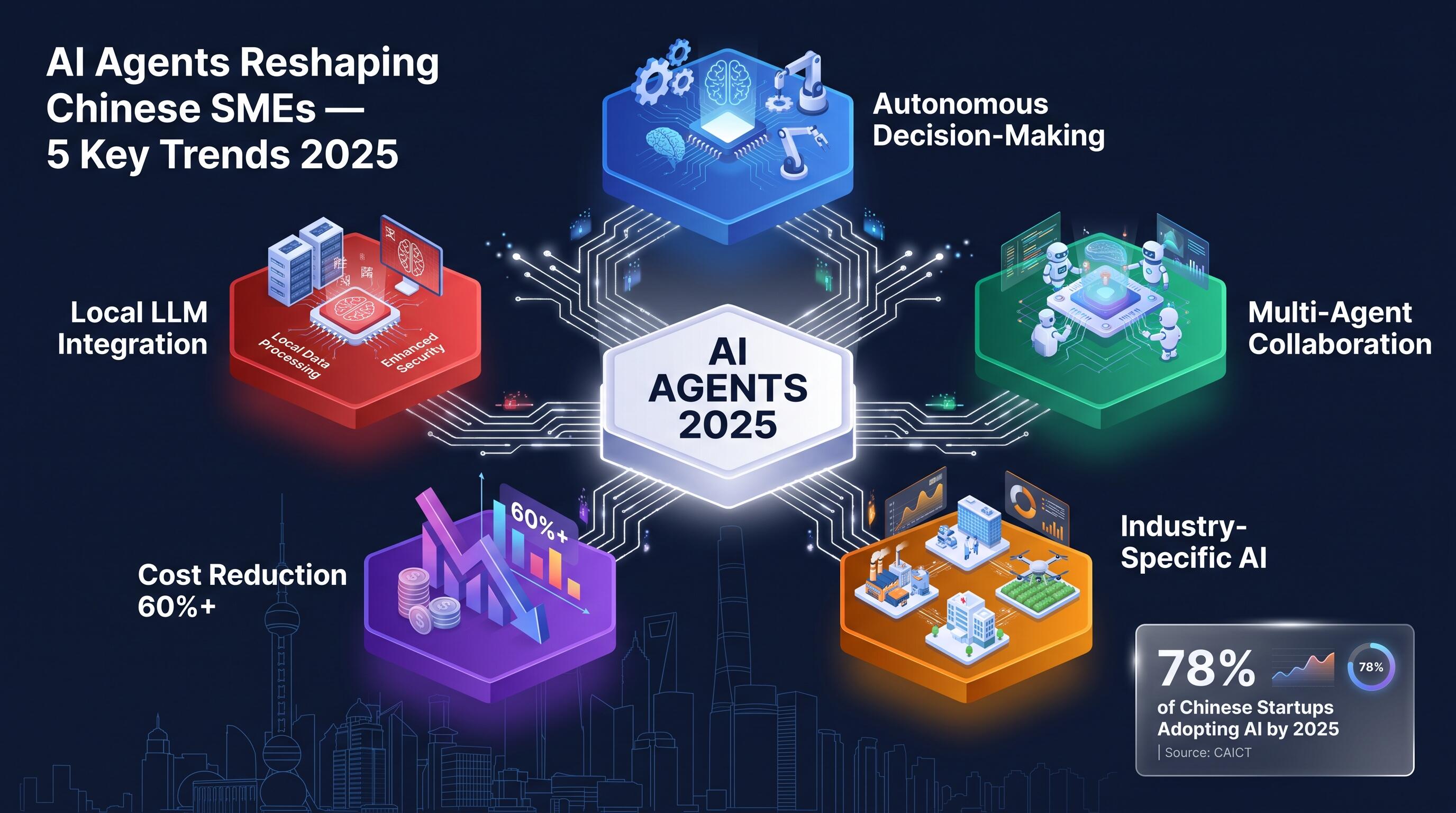
ALT: Visual overview of AI tools and AI agents transforming startup operations in the Chinese market
AI Agents Are Reshaping How Chinese Startups Compete — 5 Key Trends SME Leaders Can't Ignore
Quick Answer: AI tools — spanning chatbots, automation platforms, and autonomous agents — are fundamentally changing how startups and SMEs in China operate, compete, and scale. For business leaders navigating this landscape, the most effective approach involves identifying tools matched to specific operational needs, evaluating cost structures (free vs. paid tiers), and understanding how AI agents differ from traditional software before committing to any platform.
The Chinese startup ecosystem is moving fast. From manufacturing SMEs in Shenzhen to SaaS companies in Beijing, organizations across the country are adopting intelligent systems to automate workflows, generate content, and serve customers more efficiently. According to McKinsey's Global AI Report, companies that strategically deploy AI see measurably stronger productivity gains than those without a structured adoption plan.
- Key Finding 1: AI tools now span every business function — from customer service chatbots to developer coding assistants — giving SMEs access to enterprise-grade capabilities at lower cost.
- Key Finding 2: AI agents represent a significant leap beyond basic automation, capable of retaining memory across tasks and adapting their behavior dynamically.
- Key Finding 3: Platforms like Google AI offer flexible, scalable entry points for startups exploring generative AI without heavy upfront investment.
- Key Finding 4: Choosing the wrong tool category early can delay digital transformation and waste limited startup resources.
- Key Finding 5: A structured evaluation framework — matching tools to business stage, team size, and use case — is the single most effective approach for SMEs.
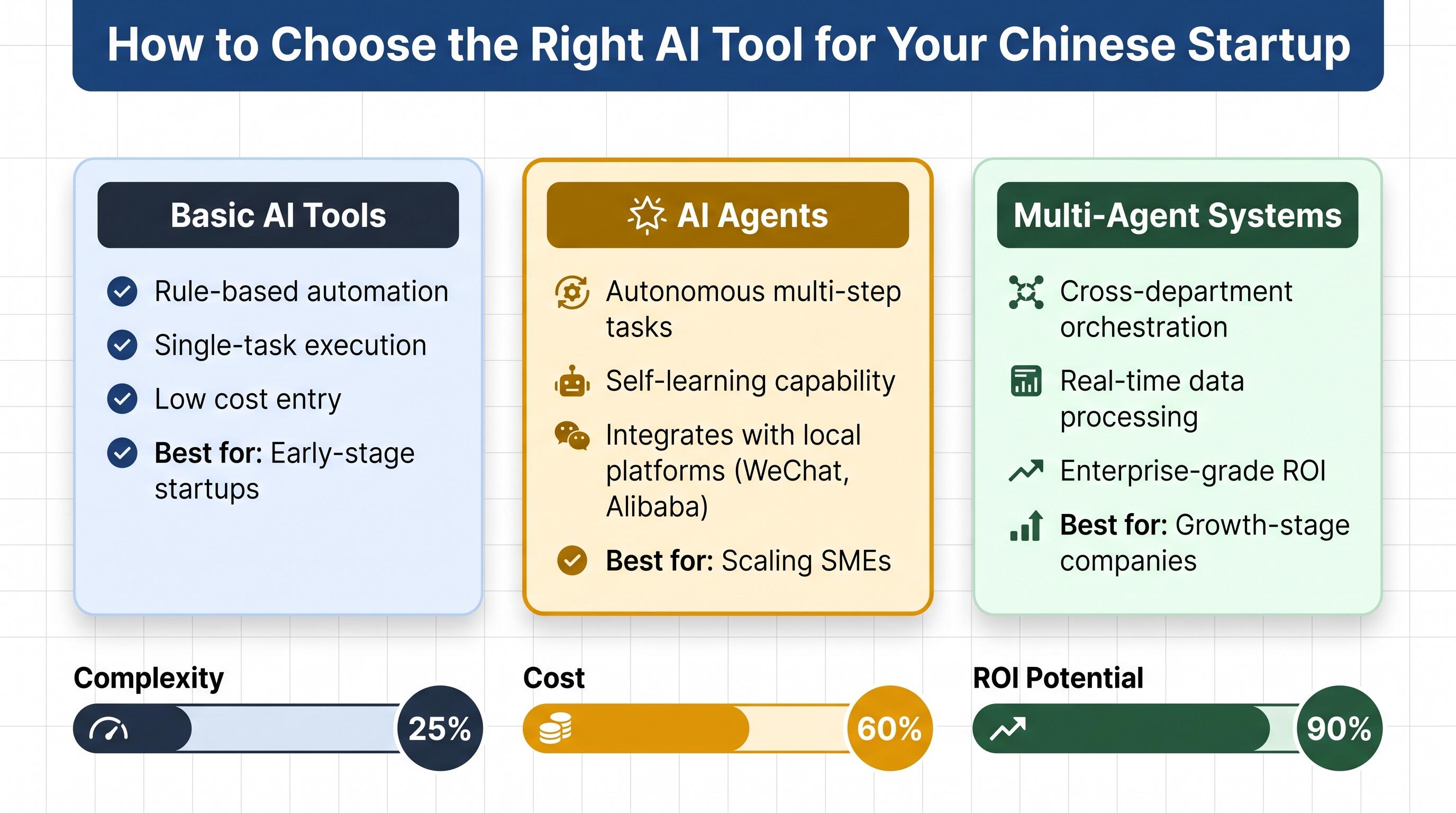
ALT: Comparison chart showing different AI tools categories suited for small and medium enterprises evaluating options
Understanding AI Tools: What Chinese SMEs Actually Need
The term AI tools covers an enormous range of software. In 2026, the landscape includes conversational chatbots, content generators, workflow automation systems, and sophisticated developer environments. According to Statista's AI software market data, global enterprise spending on AI software continues to climb, with Asia-Pacific representing one of the fastest-growing regions.
For Chinese startups and SMEs, the practical question is not "should we use AI?" but rather "which category of AI tool solves our most pressing bottleneck right now?"
Core AI Tool Categories
Three categories matter most for early-stage businesses:
- Chatbots and conversational AI — for customer support, lead qualification, and internal knowledge management
- Content and creative generation — for marketing copy, product descriptions, and multilingual communication
- Workflow automation — for connecting apps, reducing manual data entry, and streamlining approvals
Modern platforms have matured into robust systems capable of automating workflows, analyzing data, generating content, and enhancing customer interactions. Startups should evaluate tools based on integration capability, language support (particularly Chinese-language performance), and total cost of ownership rather than feature lists alone.
For broader context on how these tools fit within a digital strategy, explore our guide on [building a scalable digital infrastructure for SMEs].
AI Agents vs. Traditional AI Tools: A Critical Distinction
Many SME leaders conflate standard AI tools with AI agents, but the distinction matters enormously for investment decisions. Traditional AI tools respond to a single input and produce a single output. AI agents, by contrast, are autonomous software systems designed to pursue goals, make decisions, and complete multi-step tasks with minimal human intervention.
A key distinguishing feature is their ability to retain memory across tasks and adapt to changing states — making them far more dynamic than conventional software programs. For a growing e-commerce company, an AI agent might autonomously monitor inventory levels, draft supplier emails, and update product listings without requiring a human to initiate each step.
Research published by MIT Sloan Management Review highlights that agentic AI systems deliver the highest ROI when deployed in repetitive, rules-based workflows with clear success criteria — precisely the conditions common in SME operations.
The practical implication: SMEs should adopt standard AI tools first to build internal AI literacy, then graduate to agentic systems as processes become more defined and teams gain confidence.
How Google AI Fits Into a Startup's Tech Stack
Google AI, powered by its Gemini assistant, offers a compelling entry point for startups that need both accessibility and scalability. The platform provides tools for writing assistance, data analysis, brainstorming, video generation, and cloud integration — all accessible through flexible pricing tiers that include free-tier options.
For developers and technical founders, Google Cloud's AI services include free-tier access to Translation, Speech-to-Text, and Video Intelligence APIs — dramatically reducing the barrier to experimentation. This is particularly relevant for Chinese startups building multilingual products or cross-border e-commerce platforms that require robust language processing.
Gemini's architecture also allows businesses to move quickly from prompt to production, with API access enabling custom integrations. According to Google's official AI documentation, the platform's mission centers on enriching knowledge, solving complex challenges, and building practical technologies — a framework that aligns well with SME growth objectives.
For teams evaluating multiple platforms, see our comparison of [cloud AI platforms for growing businesses].
A Practical Framework for Choosing the Right AI Tool

ALT: Flowchart decision framework helping startups and SMEs select appropriate AI tools based on business needs
Selecting the right AI tool requires a structured approach rather than responding to marketing trends. The following framework guides SME leaders through a practical evaluation process:
| Evaluation Criteria | Questions to Ask |
|---|---|
| Business Stage | Is the team pre-revenue, scaling, or optimizing? |
| Use Case Clarity | Is there a specific, measurable problem to solve? |
| Integration Needs | Does the tool connect with existing systems? |
| Budget Constraints | Is a free tier sufficient for initial validation? |
| Data Privacy | Does the tool comply with relevant data regulations? |
For Chinese startups, the data privacy question deserves particular attention. Platforms operating within China's regulatory environment must align with PIPL (Personal Information Protection Law) requirements, which govern how AI systems can collect, process, and store user data.
According to Gartner's AI adoption research, organizations that define their AI use cases before selecting tools are significantly more likely to achieve their projected efficiency gains within the first year.
Conclusion
The window for Chinese startups and SMEs to build meaningful AI capability is open, but competitive advantage will favor those who approach adoption with discipline rather than urgency. Understanding the difference between standard AI tools, autonomous AI agents, and platform-specific ecosystems like Google AI equips business leaders to make decisions that align technology investment with actual business outcomes.
This guide has outlined the key categories, distinctions, and evaluation criteria most relevant to the Chinese market context. The most valuable next step for any SME leader is to identify one specific operational bottleneck and test a targeted AI solution against it before expanding further.
Ready to go deeper? Continue building your knowledge with our in-depth series on AI adoption strategies for growing businesses in Asia — covering implementation timelines, team training approaches, and cost benchmarking across tool categories.
Frequently Asked Questions
Q1: What are AI tools and how do they benefit Chinese startups?
A: AI tools are software applications that use artificial intelligence to automate tasks, generate content, analyze data, or enhance communication. For Chinese startups, they reduce operational costs, accelerate content production, and enable small teams to deliver outputs previously requiring larger headcounts. Platforms range from free-tier chatbots to enterprise automation suites, making them accessible at every stage of business growth.
Q2: How are AI agents different from standard AI tools?
A: AI agents are autonomous systems that pursue multi-step goals, make independent decisions, and retain memory across tasks — unlike standard AI tools, which respond to a single prompt and stop. For SMEs, agents are best suited to repetitive, structured workflows such as inventory management, customer follow-ups, or report generation, where consistent autonomous execution delivers measurable time savings.
Q3: Is Google AI suitable for small businesses in China?
A: Google AI, through its Gemini platform and Google Cloud services, offers free-tier access to powerful tools including translation, speech-to-text, and generative AI capabilities. While access to specific Google services from mainland China may require consideration of network infrastructure, businesses targeting international markets or operating internationally-facing products can leverage Google AI effectively within their tech stack.
Q4: What mistakes do SMEs commonly make when choosing AI tools?
A: The most common mistakes include selecting tools based on feature volume rather than use-case fit, underestimating integration complexity with existing systems, and skipping data privacy due diligence. SMEs in China should also verify that chosen platforms align with PIPL regulations before processing customer data through any AI system.
Q5: How should a startup begin its AI adoption journey?
A: Startups should begin by identifying one high-frequency, measurable operational bottleneck — such as customer inquiry response time or content production speed — and deploying a targeted AI tool against that specific problem. This builds internal AI literacy, generates concrete ROI data, and creates a foundation for expanding to more sophisticated AI agents as the organization matures.
Q6: What is the cost difference between free and paid AI tools for SMEs?
A: Free tiers on platforms like Google Cloud, and entry-level plans on productivity tools, are typically sufficient for validation and early-stage use. Paid plans — which can range from tens to hundreds of dollars monthly — unlock higher usage limits, advanced model access, and enterprise features like team management and priority support. SMEs should start with free tiers and upgrade only when specific limitations directly constrain business outcomes.