Agile Product Development Methodologies for AI Feature Teams This Quarter
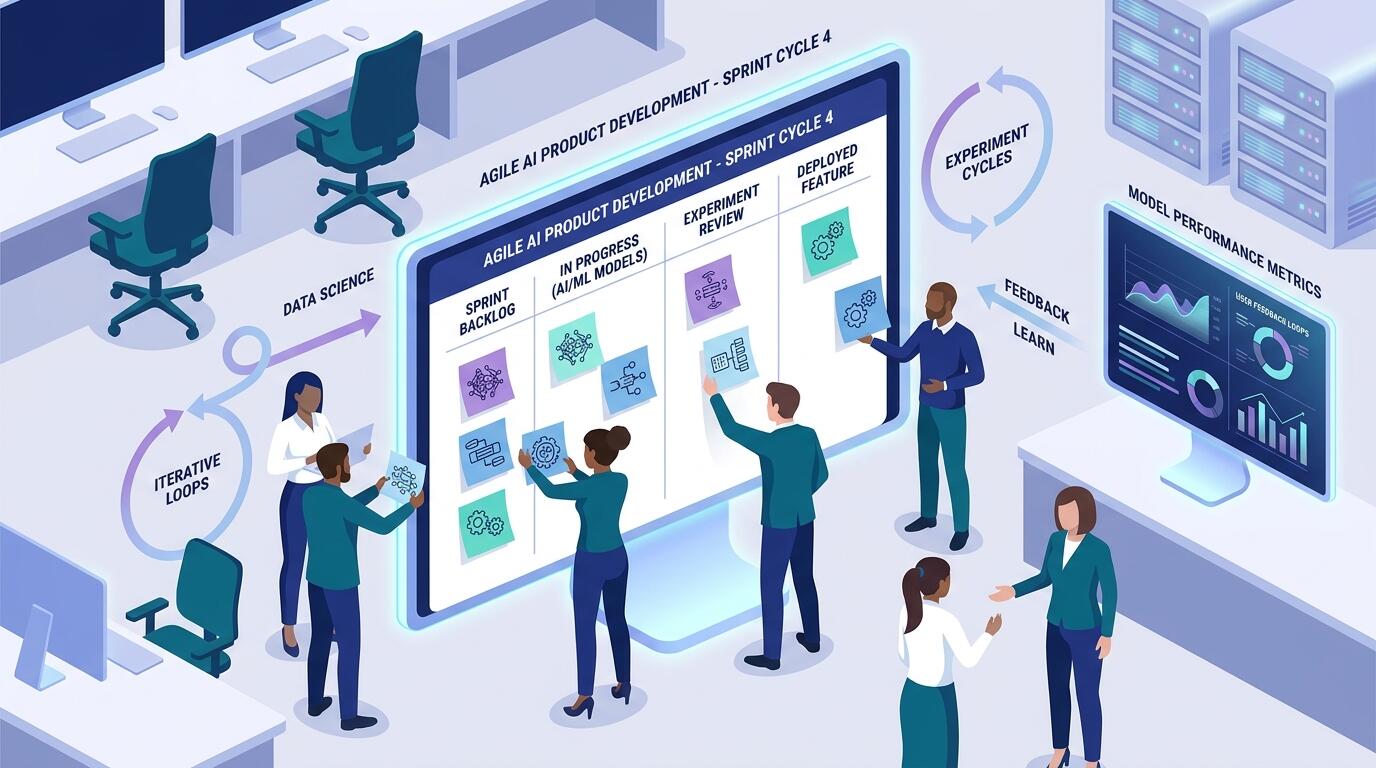
ALT: Agile product development methodologies guiding AI feature teams through iterative sprint planning and delivery
Why Traditional Agile Frameworks Struggle — and What AI Feature Teams Need Instead
The single question most engineering leaders are asking right now is whether standard agile practices — sprints, story points, two-week cadences — actually work when the thing you're building is non-deterministic by nature. The direct answer is: vanilla Agile was designed for software whose behavior you can specify in advance. AI features routinely violate that assumption, which is why teams using unmodified Scrum or Kanban for AI development consistently hit the same walls: missed sprint commitments, unclear definitions of done, and stakeholders who can't tell whether a model is "good enough" to ship.
This matters more acutely right now because AI feature development has moved from a specialized activity confined to research teams into the core delivery roadmap of mainstream product organizations. Founders and CTOs who built their engineering cultures around conventional iterative delivery are discovering that those cultures need a genuine upgrade — not a rebrand — to accommodate probabilistic work. The rest of this article breaks down what that upgrade looks like in practice.
The Current Landscape of Agile Delivery for AI-Powered Products
Agile product development is a family of iterative, incremental software delivery practices built on the principles articulated in the Agile Manifesto, which emphasizes individuals and interactions, working software, customer collaboration, and response to change over rigid upfront planning. Those principles remain sound. The structural implementations — Scrum's fixed sprints, SAFe's program increments, Kanban's flow-based pull system — were, however, conceived in a world where deterministic code was the primary output.
The AI feature landscape today looks quite different. Machine learning models, retrieval-augmented generation pipelines, recommendation engines, and LLM-integrated workflows are now standard line items on product roadmaps alongside conventional CRUD features. According to the Agile Alliance, one of the longest-running practitioner communities in this space, organizations are actively revisiting how their delivery frameworks accommodate data-dependent and experiment-driven work. The core tension is structural: a sprint exists to deliver defined scope; a model training run or prompt optimization cycle exists to discover what's possible within constraints that keep shifting.
In working with AI-forward product teams, a pattern emerges consistently. Teams that try to slot model experimentation into a standard sprint without modification end up gaming their velocity metrics — calling a training run a "story" and closing it at the end of the sprint regardless of quality. The number looks fine on the burndown chart. The product does not actually improve. This is the exact failure mode that motivates a more deliberate methodology.
The current market has produced several partial solutions: some teams run "ML sprints" with longer cadences, others maintain a separate research track that feeds a delivery track, and others have adopted adapted versions of frameworks like CRISP-DM (Cross-Industry Standard Process for Data Mining) layered on top of Scrum. Each of these contains real insight, but none has emerged as a dominant standard — which means the engineering director or CTO making decisions this quarter is largely working from first principles and peer exchange rather than a settled playbook. Understanding why the standard approach fails mechanically is the prerequisite for building something better.
The Root Causes: Why Conventional Agile Breaks Down on AI Work
Non-Deterministic Output Makes "Done" Slippery
The definition of done is the single most important shared agreement on any agile team. For a conventional feature, done typically means the code passes tests, meets acceptance criteria, and is deployed to production. For an AI feature, done is inherently probabilistic: a classification model might achieve acceptable precision on the evaluation set but degrade on a different slice of production data. A prompt chain might perform well on average but fail on a tail of edge cases that only surface at scale. Without a rigorously pre-negotiated evaluation standard — specific metrics, specific datasets, specific thresholds — AI feature teams have no stable definition of done, and sprints become open-ended experiments with artificial end dates.
Experiment Cycles Don't Map to Sprint Rhythms
Experiment-driven development is the natural working mode for AI features: form a hypothesis, run a controlled test, evaluate results, iterate. The problem is that experiment cycle time is rarely predictable enough to fit a fixed sprint boundary. A hyperparameter sweep might complete in hours or days depending on data volume and infrastructure. A prompt optimization cycle might take a week of qualitative human evaluation. Forcing these cycles into two-week boxes either truncates useful exploration or creates sprint theater — reporting completion when the team knows the work isn't actually finished.
Data Dependency Creates Upstream Blockers
AI features depend on data pipelines in a way that conventional software features typically don't. A story that reads "implement personalized recommendations" often cannot begin meaningfully until labeled training data exists, a feature store is populated, or a retrieval index is built. These upstream dependencies don't behave like typical API integrations or backend services — they change, they have quality issues that aren't discovered until training time, and they require collaboration with data engineering functions that may operate on entirely different planning rhythms. In a pattern seen consistently across AI product engagements, data readiness is the number-one cause of sprint disruption on teams that haven't explicitly accounted for it.
Stakeholder Communication Mismatches
Product stakeholders — founders, PMs, business leads — are accustomed to a reliable sprint-to-sprint velocity signal. "We completed 34 story points this sprint" is a meaningful update when story points correspond to shipped features. When a team is running AI experiments, a completed sprint might represent genuine progress — a model improving from 71% to 79% accuracy — but that progress is invisible to stakeholders who are looking at feature-level outcomes. This communication mismatch erodes trust and creates pressure to ship AI features before they're actually production-ready, which is one of the most reliable ways to damage user trust in AI-powered products.
Technical Debt Accumulates Differently
In conventional software, technical debt accumulates in the codebase. In AI systems, a parallel form of debt accumulates in the model layer: outdated training data, poorly documented prompt chains, evaluation datasets that no longer represent production distribution, and model versions that were never formally retired. Agile teams that don't build explicit model maintenance cycles into their planning end up with AI components that degrade silently over time, creating production incidents that are far harder to debug than a failing unit test.
Evidence and Approaches: Comparing Agile Adaptations for AI Feature Teams
Several adapted approaches have emerged that practitioners are actively using. The evidence base is primarily qualitative and practitioner-reported rather than large-scale empirical, but the patterns are consistent enough across teams to draw meaningful comparisons.
The "dual-track" model — running an exploration track alongside a delivery track — is the most commonly cited adaptation. Exploration tracks give data scientists and ML engineers the time-box flexibility to run experiments without disrupting the delivery team's sprint commitments. The integration point is a weekly or bi-weekly synchronization where experiment results are evaluated against shipping criteria. This approach works well for teams with clear separation between research and product engineering, but it creates coordination overhead and can produce a culture of "two speed" delivery that frustrates engineers who want to see their work shipped.
A second approach draws on Kanban-influenced flow management rather than fixed sprints for AI-specific work. Tasks are pulled based on capacity and experiment readiness rather than assigned to a sprint boundary. According to practitioners familiar with frameworks like those documented in the Scrum Alliance's guidance on hybrid delivery, Kanban's focus on limiting work in progress and making blockers visible maps well to the data-dependent nature of AI feature development. The trade-off is reduced predictability for stakeholders who expect a sprint-based forecast.
A third approach, increasingly discussed in ML engineering communities, is the experiment-as-sprint model: each sprint is treated as a formal experiment with a pre-registered hypothesis, a defined evaluation protocol, and a binary ship/iterate decision at the end. This approach brings the rigor of scientific method into the sprint structure and gives stakeholders a clear signal — did the experiment succeed? — rather than a velocity metric. It requires upfront investment in evaluation infrastructure that many early-stage teams don't yet have.
For teams evaluating which direction to move, the comparison below captures the practical trade-offs:
| Perspective / Approach | Strengths | Trade-offs | Best Fit |
|---|---|---|---|
| Dual-Track (Exploration + Delivery) | Protects delivery cadence; gives ML engineers flexibility | Coordination overhead; risk of "research theater" | Mid-to-large teams with distinct ML and product engineering functions |
| Kanban-Influenced Flow | Naturally accommodates variable cycle times; surfaces blockers visually | Lower predictability for stakeholders; requires mature WIP discipline | Teams where experiment duration is highly variable |
| Experiment-as-Sprint | Brings scientific rigor; creates clear ship/iterate signals | Requires upfront evaluation infrastructure; may feel slow to early-stage teams | Teams with established ML evaluation pipelines |
| Modified Scrum with Extended Spikes | Low ceremony; familiar to existing Scrum teams | Spike abuse is common; easy to game velocity | Teams transitioning from conventional Scrum with limited ML experience |
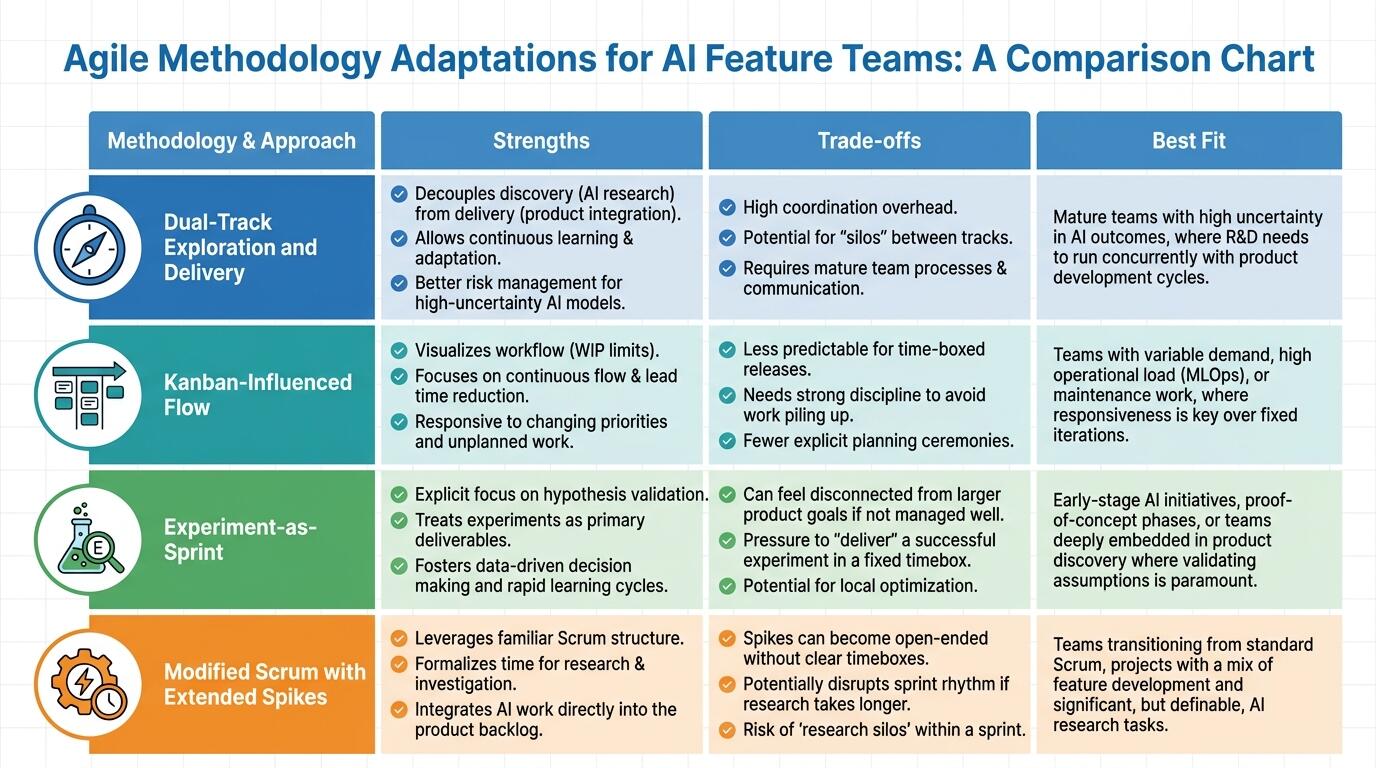
ALT: Comparison table of agile methodologies adapted for AI feature teams including dual-track and experiment-as-sprint approaches in product development
The right choice depends heavily on team size, ML maturity, and stakeholder tolerance for ambiguity. Teams that are shipping fast without sacrificing product quality consistently share one characteristic regardless of which framework they use: they have a pre-agreed, metrics-based definition of done for every AI feature before the sprint or experiment cycle begins.
It's also worth noting that the tooling ecosystem is still maturing. A review of the leading agile methodology tools available to teams today — as catalogued by practitioners tracking the space — suggests that purpose-built support for ML experiment tracking within sprint workflows remains limited, and most teams are stitching together conventional project management tools with dedicated ML experiment trackers like MLflow or Weights & Biases. The lack of integrated tooling means process discipline matters more, not less.
Where AI Feature Delivery Is Heading and What to Do Now
The trajectory is clear: AI feature development is becoming a standard competency for product engineering teams, not a specialized research activity. That means the adapted agile practices that early-adopter teams are working out today will become the baseline expectation within a relatively short horizon. Teams that wait to address the methodology gap will find themselves behind on both delivery speed and quality discipline.
For engineering leaders and CTOs making decisions this quarter, the highest-leverage actions are:
Define your AI-specific definition of done before the next sprint begins. This means agreeing on evaluation metrics, evaluation datasets, and minimum performance thresholds for every AI feature in the backlog. Without this, every other process improvement is cosmetic.
Build an explicit experiment log into your sprint review. Whether you're running dual-track or modified Scrum, the sprint review should include a structured read-out of experiment results — what was tested, what was learned, and what the ship decision is — alongside the traditional demo of shipped features. This keeps stakeholders informed and prevents the "invisible progress" problem.
Invest in evaluation infrastructure early. The teams that move fastest on AI features are invariably the ones that have automated evaluation pipelines. Manual evaluation is a bottleneck that compounds as the number of AI features grows. If you're starting an AI architecture engagement or scaling your AI capability, evaluation infrastructure should be a first-class deliverable, not an afterthought.
Treat data readiness as a first-class sprint dependency. Block AI feature stories on data readiness in the same way you would block on a third-party API being available. This makes the dependency visible and creates the right incentive to resolve it before sprint planning rather than discovering it mid-sprint.
Separate model maintenance from feature development in your planning. Model drift, data refresh cycles, and evaluation dataset maintenance are ongoing operational commitments that need to be represented in the backlog. Teams that don't account for this find that AI features become progressively more expensive to maintain as the system grows.
The larger implication is that agile methodology for AI feature teams is not a solved problem — it's an active area of professional practice that rewards engineers and leaders who engage with it seriously. Teams that treat it as a process checkbox will continue to struggle with the same failure modes. Teams that engage with it as a genuine design challenge — the way they would approach system architecture or API design — will build durable delivery capabilities that compound over time.
Frequently Asked Questions FAQ
Q1: How should AI feature teams adapt sprint ceremonies to account for experiment-driven work?
Sprint ceremonies — planning, standup, review, retrospective — remain valuable for AI feature teams, but their content needs to shift. Sprint planning should include a pre-agreed hypothesis and evaluation protocol for each AI experiment, not just a scope description. Sprint review should present experiment outcomes (metrics, learnings, ship decision) alongside demos. Retrospectives should explicitly examine whether experiment cycle times fit the sprint boundary and adjust cadence if they don't. The structure stays; the content adapts.
Q2: Are story points a reliable estimation unit for AI feature development work?
Story points are a poor fit for AI experimentation work because the effort required is genuinely uncertain before the experiment runs. A more effective approach is to estimate the time required to run a well-defined experiment — including data preparation, training or prompting cycles, and evaluation — rather than estimating complexity. Some teams replace story points entirely for ML work with t-shirt sizing on experiment duration, reserving story points for deterministic engineering tasks within the same sprint.
Q3: How long does it typically take to implement a methodology upgrade for an existing AI feature team?
Methodology upgrades don't have a universal timeline — they depend on team size, current process maturity, and how deeply the existing agile habits are embedded. In practice, the highest-impact changes (agreeing on a definition of done, adding an experiment log to sprint review, and blocking stories on data readiness) can be implemented within a single sprint cycle. Building full evaluation infrastructure and stabilizing a dual-track system typically takes several sprints to mature. Start with the definition of done — it yields the fastest improvement in sprint reliability.
Summary
Adapting agile product development methodologies for AI feature teams is one of the most practical engineering leadership challenges of the current period. The core insight is that standard Scrum and Kanban weren't designed for probabilistic, experiment-driven work — and the gap shows up predictably in missed commitments, ungameable velocity metrics, and AI features shipped before they're actually ready.
Key Takeaways:
- The definition of done is the single most important process artifact for AI feature teams — it must include explicit evaluation metrics and thresholds, agreed before work begins.
- Dual-track, Kanban-influenced, and experiment-as-sprint models each address different failure modes; the right choice depends on team structure and ML maturity.
- Data readiness is a first-class sprint dependency for AI work — treat it like any other blocking dependency and surface it at planning, not mid-sprint.
- Model maintenance (drift monitoring, data refresh, evaluation dataset upkeep) must be represented explicitly in the backlog or it will accrete as invisible technical debt.
- Evaluation infrastructure is a force multiplier — teams that invest in automated evaluation pipelines move faster and maintain quality more reliably than those relying on manual review.
The next step is to audit your current sprint process against these failure modes: check whether your AI features have a pre-agreed definition of done, whether your sprint reviews surface experiment outcomes, and whether model maintenance is tracked as a formal backlog item. If any of these are missing, that's where to start.
If this resonated with you, explore more insights and real-world engineering breakdowns at Darius's portfolio and wiki. Whether you're architecting an AI system from scratch, untangling a complex technical stack, or looking to turn an idea into a live product, Darius brings the hands-on experience of an Engineering Director and AI Architect who has done exactly that. Visit the site to dive deeper into frameworks, case studies, and thinking that helps you build and ship with confidence.
References
- Scrum Alliance. "Scrum Framework and Hybrid Delivery Guidance".
https://www.scrumalliance.org/ - IEEE. "IEEE Standards for Software and Systems Engineering".
https://www.ieee.org/ - ONES.com. "Agile Methodology: A Complete Framework Overview".
https://ones.com/blog/agile-methodology-a-complete-framework-overview/?primary_category=knowledge - Featurebase. "8 Best Agile Methodology Tools for Teams in 2026".
https://www.featurebase.app/blog/agile-methodology-tools
Note: Standards and frameworks may be updated; please check the latest official documents or consult professional advisors.