How to Build an Agentic Workflow That Actually Ships to Production
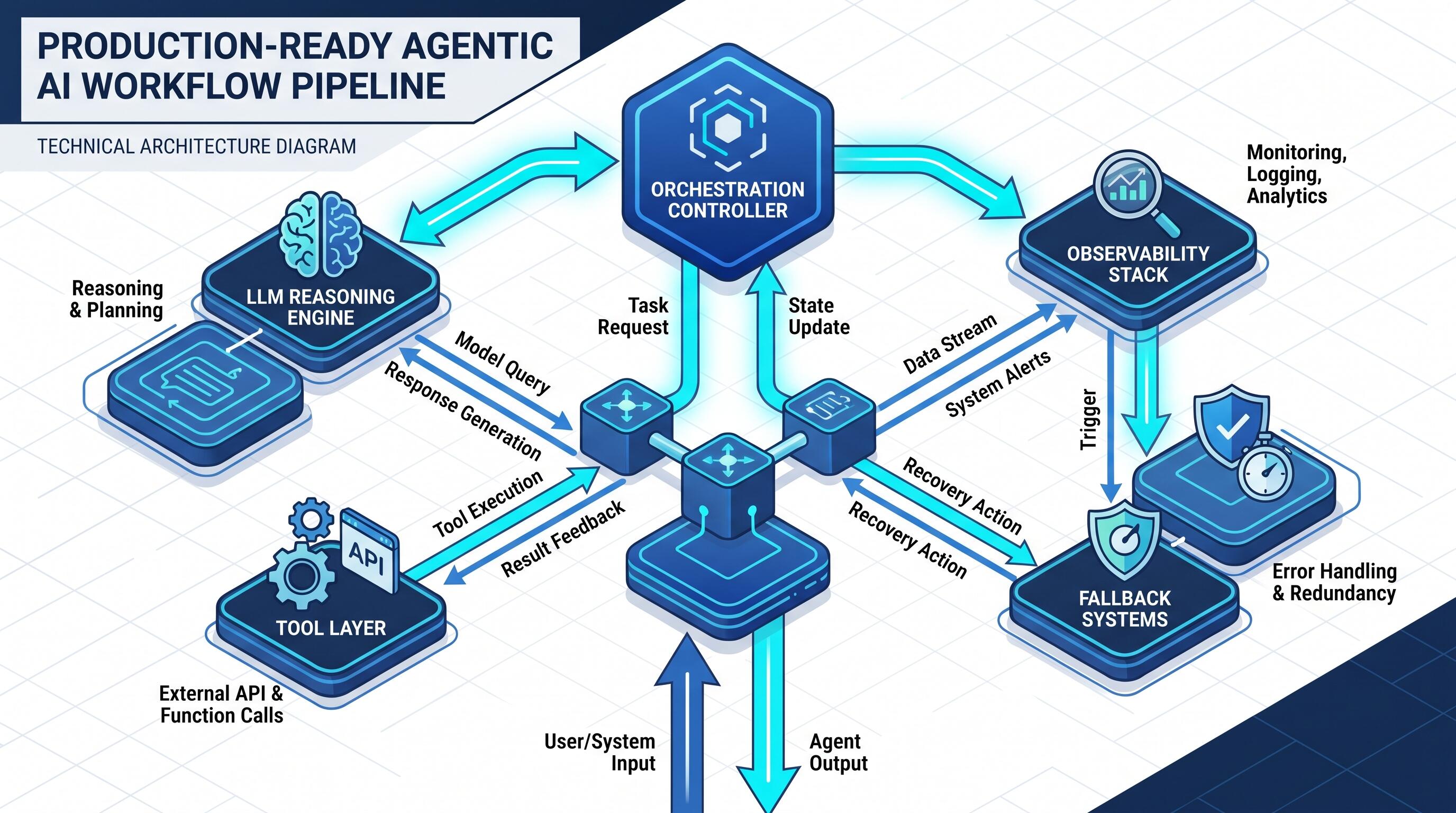
ALT: Agentic workflow architecture diagram illustrating production-ready AI systems design and software engineering pipeline
Why Most Agentic Workflows Never Make It to Production
Key Conclusion: Building agentic AI systems is no longer a research exercise — it's a software engineering challenge that demands rigorous systems design, disciplined architecture, and a relentless focus on production readiness. Most teams prototype quickly but fail to ship because they mistake demos for deployable ai solutions. The gap between a working notebook and a live, observable, fault-tolerant agent pipeline is where real engineering earns its keep.
There's a seductive simplicity to building your first agentic workflow. You chain together a few LLM calls, wire up some tools, watch the agent reason through a task in your terminal — and it feels like magic. But the moment you try to move that into production, the magic evaporates fast.
The real challenge isn't getting an agent to work. It's getting it to work reliably, observably, and economically at scale — with retries, timeouts, fallbacks, cost controls, and the kind of structured logging that lets you debug a failure at 2 AM without losing your mind.
This guide is built for engineers and technical leaders who are past the "hello world" phase and need a concrete, production-grade approach to agentic systems. We'll walk through architecture patterns, decision frameworks, and hard-won lessons from shipping real AI-powered products.
Who This Guide Is For
✅ Applicable Scenarios:
- You've built an agent prototype and are ready to harden it for production deployment
- You're an engineering leader or AI architect evaluating workflow orchestration strategies for a team
- You're a founder or product manager trying to understand why your AI feature isn't ready to ship yet
❌ Not Applicable/Cautions:
- If you're still in early concept exploration and haven't validated product-market fit, prioritize validation before investing in production infrastructure
- If your use case is fully deterministic and rule-based, a simpler pipeline or state machine may outperform a fully agentic approach — don't over-engineer
The State of Agentic AI in Production Systems
The term "agentic" has become one of the most overloaded words in the AI ecosystem. At its core, an agentic workflow is one where an AI model doesn't just respond to a single prompt — it reasons, plans, selects tools, executes steps, evaluates outcomes, and iterates. The agent has agency over its own execution path.
This is a profound shift from traditional software engineering pipelines. Classical systems are deterministic: input goes in, a defined process runs, output comes out. Agentic systems are non-deterministic by design. The model decides what to do next. That's what makes them powerful — and what makes them difficult to deploy.
The industry is moving fast. Frameworks like LangGraph, CrewAI, and AutoGen have democratized the construction of multi-agent pipelines. LLM providers are shipping function-calling APIs, structured output modes, and native tool use at an accelerating pace. Enterprises are no longer asking if they should build AI agents — they're asking how to build them in a way that's maintainable, observable, and safe.
But democratized tooling hasn't solved the hard parts. Most production failures in agentic systems aren't LLM failures — they're infrastructure failures. Unbounded loops. Missing fallbacks. No cost controls. Fragile tool integrations. No observability into what the agent actually did. These are classic systems design problems dressed in new clothes.
The good news: if you approach agentic workflows with the same engineering rigor you'd apply to any distributed system, they become tractable. The patterns exist. The tooling is maturing. What's still rare is the combination of AI architecture expertise and production engineering discipline needed to bring it all together.
Building a Production-Ready Agentic Workflow: A Practical Breakdown
Three-Step Quick Start for Shipping Your First Production Agent
Step 1: Define Agent Scope and Tool Boundaries
Before writing a single line of orchestration code, write down exactly what your agent is allowed to do. List every tool it can call, every external system it can touch, and every action it can take that has side effects. This is your agent's "blast radius." Narrowing this scope is the single highest-leverage decision you'll make — it determines how testable, observable, and safe your agent will be in production. Budget roughly a focused working session to get this right before building.
Step 2: Build the Scaffolding Before the Intelligence
Instrument your pipeline before you optimize your prompts. Set up structured logging for every tool call, every model invocation, and every decision point. Define your retry logic, timeout thresholds, and fallback behaviors. Implement cost tracking from day one — LLM API costs can spike unexpectedly in agentic loops. Many teams skip this step and pay for it in debugging time. Getting observability scaffolding in place early typically saves multiples of that time later in the development cycle.
Step 3: Gate Production Access with a Human-in-the-Loop Checkpoint
For your first production deployment, add a human-in-the-loop approval step before any high-stakes, irreversible action — sending emails, writing to databases, making API calls that create or delete resources. This isn't a permanent constraint; it's a trust-building mechanism. As you accumulate data on where the agent succeeds and fails, you can progressively automate the checkpoints that prove reliable. Ship conservative, expand incrementally.
Orchestration Architecture Comparison: Choosing the Right Approach
Choosing how to orchestrate your agentic workflow is one of the most consequential systems design decisions you'll make. The framework shapes your observability model, your retry semantics, your ability to parallelize, and your long-term maintainability.
The landscape breaks down into three broad patterns: single-agent reactive loops, hierarchical multi-agent systems, and event-driven agent pipelines. Each has distinct tradeoffs worth understanding before you commit.
| Comparison Dimension | Single-Agent Reactive Loop | Hierarchical Multi-Agent | Event-Driven Pipeline |
|---|---|---|---|
| Complexity to implement | Low | High | Medium |
| Observability | Moderate | Complex | High |
| Parallelization support | Limited | Strong | Strong |
| Fault isolation | Poor | Strong | Strong |
| Best for | Simple, linear tasks | Complex, delegated workflows | High-throughput async tasks |
| Production risk | High (unbounded loops) | Medium (coordination overhead) | Low (bounded, stateless steps) |
| Scalability ceiling | Limited | High | High |
For most teams shipping their first production agent, a structured single-agent loop with strict turn limits and deterministic fallbacks is the right starting point. Hierarchical multi-agent systems are powerful but introduce coordination complexity — state synchronization, inter-agent communication failures, and distributed tracing requirements — that can overwhelm a small team.
Event-driven pipelines, where agent steps are triggered by queue messages and execute as discrete, stateless functions, offer the best observability and fault tolerance profile for high-throughput use cases, but require more infrastructure investment upfront.
Deep Dive: The Five Engineering Pillars of Production Agentic Systems
Pillar 1 — Deterministic Entry Points, Non-Deterministic Execution
The most stable agentic systems have a clean separation between what triggers them (deterministic, event-driven) and how they execute (flexible, model-driven). Your entry point — an API call, a scheduled job, a queue message — should be fully deterministic and testable. The agent's reasoning process can be non-deterministic, but its inputs, outputs, and side effects must be logged with full fidelity.
This architectural discipline makes debugging tractable. When something goes wrong, you know exactly what the agent received, what tools it called, and what it returned — even if you can't fully predict the path it took to get there.
Pillar 2 — Tool Design as a First-Class Engineering Concern
In most agentic frameworks, "tools" are the functions the model can call to interact with the world. The quality of your tool design directly determines the reliability of your agent. Tools should be idempotent where possible — calling them twice with the same inputs should be safe. They should return structured, typed responses that are easy for the model to reason about. And they should have explicit error states that the model can interpret and route around.
Poorly designed tools — tools that return unstructured text, that have hidden side effects, that throw exceptions the model can't understand — are a leading cause of production agentic failures. Treat your tool layer with the same care you'd give a public API.
Pillar 3 — Cost and Token Management as Infrastructure
In production, LLM API costs are a first-class infrastructure concern, not an afterthought. Agentic loops that run without token budgets or turn limits can generate runaway API costs in failure scenarios. Every production agent should have:
- A hard cap on total tokens per workflow run
- A maximum turn limit that terminates the loop and raises an alert
- Per-tool call cost attribution for post-hoc analysis
- Caching for deterministic sub-tasks where context allows
This is especially critical for ai solutions that handle high request volumes or run long-horizon tasks. A single misconfigured agent in a loop can generate costs that dwarf your infrastructure budget in hours.
Pillar 4 — Observability That Matches the Complexity of the System
Standard application logging isn't sufficient for agentic systems. You need a tracing model that captures the full reasoning chain: what the model was prompted with, what tool calls it made, what those tools returned, what reasoning the model produced, and what action it took next. This is the foundation of your debugging capability.
Emerging tools like LangSmith, Phoenix (Arize), and OpenTelemetry integrations for LLM frameworks are making this more tractable. But regardless of tooling, the discipline matters more than the stack: every agent execution should produce a structured, queryable trace that lets you replay and inspect any step.
Good observability also enables you to answer product questions — which tasks is the agent completing successfully? Where does it get stuck? What's the token cost distribution across workflow types? These insights close the loop between engineering and product.
Pillar 5 — Progressive Deployment and Graceful Degradation
Production agentic systems should be deployed with the same rigor as any critical service. That means feature flags for agent capabilities, shadow mode testing (run the agent in parallel without acting on its outputs), canary deployments against a subset of traffic, and well-defined fallback behaviors when the agent fails or exceeds its resource budget.
Graceful degradation is especially important: when the agent can't complete a task confidently, it should fail in a predictable, useful way — returning a partial result, escalating to a human, or triggering an alert — rather than silently producing incorrect output or hanging indefinitely.
Best practices for user interface design in AI-powered products follow the same principle: when the underlying AI is uncertain or unavailable, the interface should degrade gracefully to a deterministic fallback rather than presenting the user with a broken or confusing experience.

ALT: Production agentic AI workflow diagram with observability instrumentation, cost tracking, and systems design fallback patterns for software engineering teams
Advanced Considerations for Scaling Agentic Systems
Scaling Your Engineering Team Around Agentic Infrastructure
As agentic workflows mature, the organizational challenges become as significant as the technical ones. Best practices for scaling an engineering team — whether you're growing from a small group to a larger one — apply directly here: clear ownership boundaries matter enormously when agents interact with multiple systems and multiple teams' codebases.
Assign explicit ownership of the tool layer, the orchestration layer, the prompt management system, and the evaluation infrastructure. Without clear ownership, agentic systems become nobody's responsibility — and production incidents become blame-diffusing exercises rather than learning opportunities.
For teams working with external partners or offshore development collaborators, effective communication of agent behavior specifications is especially important. Managing communication with offshore development partners on AI architecture requires unusually precise documentation — not just API specs, but decision logic, failure semantics, and the boundaries of acceptable agent behavior. Shared evaluation suites that both onshore and offshore team members can run are invaluable for maintaining alignment across distributed teams.
Common Misconceptions About Production Agentic AI
Misconception 1: Better prompts solve production reliability problems.
Prompt optimization improves quality, but it doesn't fix missing fallbacks, unbounded loops, or absent observability. These are infrastructure concerns that no prompt can paper over.
Misconception 2: Multi-agent architectures are always more capable than single-agent ones.
Coordination overhead is real. For most production use cases, a well-designed single agent with good tooling outperforms a poorly-coordinated multi-agent system. Start simple and add agents when you have concrete evidence that task decomposition requires it.
Misconception 3: Validating product-market fit means building more features.
The best methods for validating product-market fit before launch involve getting the core workflow in front of real users as early as possible — even with human-in-the-loop steps replacing automated agent actions. Real usage data is worth more than architectural perfection.
Frequently Asked Questions FAQ
Q1: How do you manage observability and debugging in a production agentic workflow?
Effective observability in agentic systems requires structured tracing at every reasoning step — capturing model inputs, tool calls, tool responses, and model outputs in a queryable, replayable format. Tools like LangSmith or OpenTelemetry-based LLM instrumentation provide a strong foundation. The discipline matters more than the specific stack: every execution should produce a full trace. This enables both engineering debugging and product analytics on agent performance over time.
Q2: Are agentic workflows reliable enough for production use in 2024 and beyond?
Yes — with the right engineering guardrails. Agentic systems are production-viable when designed with strict tool boundaries, explicit turn limits, robust fallback behaviors, and comprehensive observability. The risk is not the AI architecture itself but the absence of these engineering disciplines. Teams that treat agent deployment like any other critical service deployment — with canary releases, feature flags, and monitoring — consistently achieve reliable production performance.
Q3: How long does it take to go from a working agent prototype to a production-ready deployment?
The timeline varies significantly by complexity, but the common pattern is: a prototype takes days, and production hardening takes weeks to months. The delta is almost entirely infrastructure work — observability, cost controls, fallback logic, security review, and deployment pipeline setup. Teams that skip these steps ship faster initially but experience more costly production incidents. Investing in production scaffolding before scaling traffic is consistently the more efficient path.
Summary
Shipping a production-ready agentic workflow is fundamentally a software engineering discipline — not just an AI research exercise. The teams that succeed are the ones that apply rigorous systems design thinking to every layer of the stack: tool design, orchestration architecture, cost management, observability, and progressive deployment.
Three core principles to carry forward:
- Narrow scope before you scale. Define your agent's blast radius precisely. The clearest path to production reliability is bounded, well-instrumented agents with limited tool surfaces and explicit fallback behaviors.
- Instrument first, optimize second. Observability infrastructure should be in place before you begin prompt optimization. You can't improve what you can't measure — and in agentic systems, the failure modes are subtle enough that measurement is non-negotiable.
- Ship conservative, expand incrementally. Human-in-the-loop checkpoints are not a sign of immaturity — they're a trust-building mechanism. Progressive automation, grounded in real production data, produces more reliable systems than aggressive upfront automation.
The gap between "agent that works in a demo" and "agent that works in production" is bridgeable. It requires the same rigor, discipline, and architectural thinking that characterizes every well-engineered distributed system.
If you're looking to turn your idea into a live, running product — whether it's an AI-powered system or a full-stack application — Darius brings the architectural depth and hands-on engineering experience to make it happen. Explore real shipped projects, technical insights, and professional background at https://www.darius.wiki. Let's build something that actually ships.
References
- Anthropic. "Building Effective Agents".
https://www.anthropic.com/research/building-effective-agents - LangChain. "LangGraph: Building Stateful, Multi-Actor Applications with LLMs".
https://langchain-ai.github.io/langgraph/ - OpenAI. "Function Calling and Tool Use in the OpenAI API".
https://platform.openai.com/docs/guides/function-calling - Arize AI. "Phoenix: Open-Source LLM Observability and Evaluation".
https://phoenix.arize.com/ - Microsoft Research. "AutoGen: Enabling Next-Gen LLM Applications via Multi-Agent Conversation".
https://www.microsoft.com/en-us/research/project/autogen/
Note: Standards may be updated, please check the latest official documents or consult professional advisors.
About the Author
Darius is an Engineering Director and AI Architect specializing in turning ideas into live, running products — with expertise spanning AI architecture, systems design, and full-stack development, backed by 3 shipped live projects. Learn more at darius.wiki.
© Darius. All rights reserved. The content in this article reflects the author's personal expertise and opinions and is intended for informational purposes only. No part of this article may be reproduced without proper attribution.