How Turnitin Detects AI Writing in 2026 — And How to Stay Safe
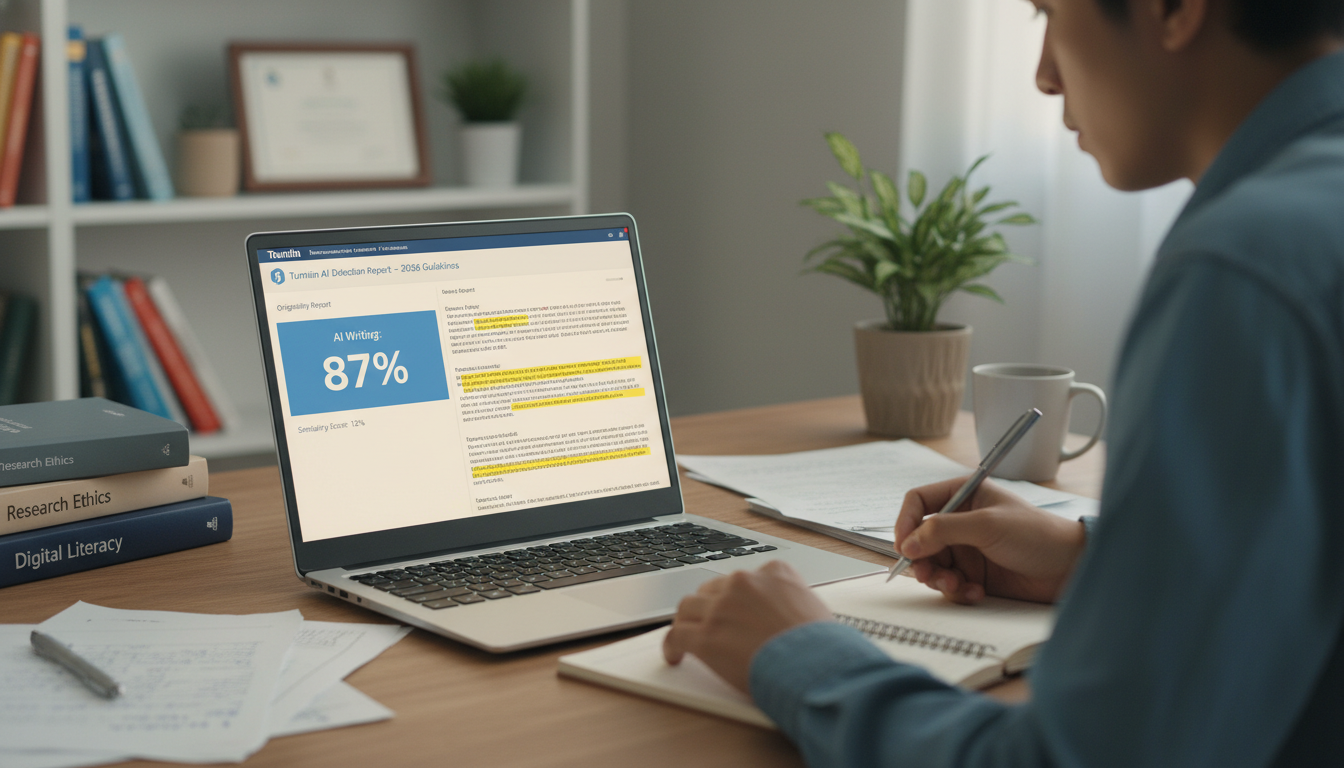
ALT: Student reviewing Turnitin AI detection report on laptop, understanding how to stay safe in 2026
What Every Student Needs to Know About Turnitin's AI Detection in 2026
Key Conclusion: In 2026, Turnitin's AI detection technology has become significantly more sophisticated, capable of identifying AI-generated writing patterns with reported accuracy rates above 98%. Understanding how Turnitin detects AI writing — including probabilistic language modeling, sentence-level scoring, and stylistic fingerprinting — is essential for every student who wants to submit work that is both academically credible and genuinely their own.
The stakes have never been higher for students navigating academic integrity policies in 2026. Turnitin, one of the world's most widely used plagiarism and AI detection platforms, has rolled out a new generation of detection capabilities that go far beyond simple text matching. Whether you are writing a research paper, a literature review, or a short-answer assignment, understanding how Turnitin's AI detection works — and how to approach your academic writing responsibly — is now a foundational skill for every university and college student.
This guide breaks down exactly how Turnitin detects AI-generated content, what the technology is actually measuring, and how tools like Verla can support you in producing genuinely academic, human-quality work that meets the standards your institution expects.
Who This Guide Is For — And When It Applies
✅ Applicable Scenarios:
- Undergraduate and postgraduate students submitting essays, dissertations, or coursework through Turnitin-enabled platforms
- International students working in a second language who want to understand how their writing is evaluated for AI signals
- Students using AI-assisted writing tools and wanting to ensure their final submissions remain authentic and academically credible
- Academic support staff and tutors advising students on responsible AI use under evolving institutional policies
❌ Not Applicable/Cautions:
- This guide does not constitute official academic integrity advice; always consult your institution's specific AI use policy before submitting any assignment
- The detection thresholds and accuracy rates cited here reflect publicly available 2025–2026 data and may change as Turnitin continues to update its models
How Turnitin's AI Detection Technology Has Evolved — A 2026 Background
When Turnitin first introduced AI writing detection in April 2023, it focused primarily on identifying content generated by large language models such as ChatGPT and GPT-4. At launch, the tool used a probabilistic model that assigned a percentage score to submitted text, indicating how likely it was that a given passage was AI-generated rather than human-authored.
By 2026, that foundation has been dramatically expanded. According to Turnitin's published documentation, the platform now analyzes writing at multiple granular levels — not just whether a document "sounds" AI-generated, but how individual sentences, paragraphs, and stylistic patterns compare to the statistical distributions characteristic of large language model outputs.
The scale of adoption is significant. Turnitin serves over 16,000 institutions globally, and as of 2025, the platform had processed more than 200 million student submissions through its AI detection pipeline. This means the model is continuously refined against an enormous dataset of both human and AI-generated academic writing — making it progressively better at detecting even lightly edited AI content.
Three major capability upgrades have defined Turnitin's 2026 detection suite:
1. Sentence-Level AI Probability Scoring
Rather than returning a single document-level percentage, Turnitin now highlights individual sentences flagged as likely AI-generated. This allows instructors to see exactly which portions of a submission raise concerns, making it far harder for students to mask AI-generated sections by mixing them with human-written paragraphs.
2. Stylistic Consistency Analysis
AI-generated writing tends to maintain a statistically uniform register, vocabulary diversity, and sentence rhythm. Turnitin's 2026 model detects abrupt shifts in stylistic complexity — for example, a sudden jump from highly fluent, well-structured prose to uneven, conversational phrasing — as a signal that content may have been edited or assembled from multiple sources, including AI tools.
3. Cross-Submission Pattern Recognition
Turnitin can now compare writing patterns across multiple submissions from the same student over time. If a student's early assignments show one stylistic fingerprint and later submissions show a statistically different one, the system may flag this inconsistency for human review by an instructor.
For a comprehensive look at how academic integrity policies are adapting to AI tools at universities worldwide, resources from institutions like the International Center for Academic Integrity provide valuable institutional context.
Understanding the Detection Mechanics — And How to Protect Your Academic Integrity
Three Steps to Submitting Confidently in a Turnitin-Monitored Environment
Step 1: Understand What Turnitin Is Actually Measuring
Before you write a single word, spend 10–15 minutes reviewing Turnitin's publicly available guidance on AI detection. The tool is not measuring whether you used an AI tool at any point — it is measuring whether the final submitted text exhibits the statistical properties of AI-generated output. Understanding this distinction is the first step to producing work that is clearly, demonstrably yours. Knowing that sentence-level patterns, vocabulary entropy, and stylistic consistency are all evaluated helps you write with deliberate authorial voice.
Step 2: Build Your Assignment Around Your Own Thinking First
Before using any writing aid — AI or otherwise — spend 20–30 minutes outlining your own argument, selecting your own sources, and drafting your own thesis statement. Academic writing that originates in your genuine intellectual engagement with a topic will naturally carry stylistic markers of human authorship: varied sentence structure, first-person reasoning, discipline-specific vocabulary drawn from your reading, and evidence of genuine critical thinking. This foundational step makes any subsequent editing or assistance far more likely to result in a submission that reads as authentically human.
Step 3: Use Academic-Grade Tools That Are Designed for Scholarly Standards
If you use an AI writing assistant, choose one that is specifically trained on academic texts and designed to produce citation-ready, scholarly output rather than generic content. Verla, for example, is trained on over 10 million scholarly texts and aligned with the academic standards of Harvard, Cambridge, and Tsinghua University. The difference between a general-purpose AI chatbot and a purpose-built academic assistant matters enormously — not just for detection purposes, but for the quality and credibility of your final submission.
Comparing Approaches: How Different Writing Strategies Perform Under Turnitin's 2026 Detection
Understanding how different writing approaches fare under Turnitin's current detection model helps students make informed, strategic choices about how they prepare their submissions.
| Comparison Dimension | Unedited AI Output | Lightly Edited AI Text | Academic-Grade AI + Student Voice |
|---|---|---|---|
| Sentence-Level AI Score | Very High (70–99%) | Moderate to High (30–70%) | Low to Very Low (0–20%) |
| Stylistic Consistency Flag | Frequently Triggered | Sometimes Triggered | Rarely Triggered |
| Citation Quality | Generic or Absent | Inconsistent | Scholarly, Discipline-Appropriate |
| Cross-Submission Pattern Risk | High | Moderate | Low |
| Alignment with University Standards | Poor | Partial | Strong |
| Recommended for Submission | ❌ | ❌ | ✅ |
The table above illustrates a fundamental point: the problem is not AI assistance per se — it is AI-generated content that has not been meaningfully integrated with a student's own academic voice, critical analysis, and scholarly sourcing.
The Deeper Mechanics: What Turnitin's Model Is Actually Detecting
Perplexity and Burstiness — The Two Core Signals
To truly understand how Turnitin detects AI writing, students need to be familiar with two technical concepts from computational linguistics: perplexity and burstiness.
Perplexity refers to how predictable a sequence of words is, given a language model's understanding of how language typically flows. AI-generated text tends to have low perplexity — meaning the word choices are highly predictable and statistically "safe." Human writers, by contrast, make unexpected word choices, use idiosyncratic expressions, shift between formal and informal registers, and occasionally produce syntactically complex or unconventional sentences. Turnitin's model essentially asks: is this text more predictable than human writers typically are?
Burstiness refers to the variation in sentence complexity and length within a document. Human writing tends to be "bursty" — alternating between short, punchy sentences and longer, more elaborated ones. AI-generated text from large language models tends to produce uniformly medium-length sentences with a consistent syntactic structure, which registers as unusually low burstiness in analysis.
When Turnitin's model evaluates a submission, it is effectively assessing both of these signals simultaneously. A document with very low perplexity and very low burstiness is statistically much more likely to have been generated by an AI language model than authored by a human student.
Why "Paraphrasing" AI Output Does Not Reliably Work
One of the most common misconceptions students hold is that running AI-generated text through a paraphrasing tool or manually rewording it will reliably fool Turnitin's detection. In 2026, this strategy is significantly less effective than many students assume.
Turnitin's current model does not rely solely on surface-level phrasing. It evaluates the underlying statistical structure of the text — the distribution of word choices, the syntactic patterns, and the logical flow between ideas. Paraphrasing changes the words but often preserves the underlying structure, which means the low-perplexity, low-burstiness signature of AI-generated content can persist even after significant surface-level rewording.
The only reliable way to produce text that does not trigger AI detection is to write from genuine intellectual engagement — to be the actual author of your ideas, argument, and analytical voice, even if you use tools to support your research, citation management, or structural planning.
What a "High AI Score" Actually Means — And Does Not Mean
It is important to understand that Turnitin's AI detection score is a probabilistic indicator, not a definitive verdict. Turnitin itself is explicit that a high AI score should prompt instructor review and conversation, not automatic academic misconduct proceedings. Highly formulaic writing — even when entirely human-authored — can sometimes register elevated AI probability scores. This is particularly relevant for international students writing in a second language, who may rely on more standardized phraseology and conventional academic templates.
If you receive a high AI score on a submission, the appropriate response is to engage transparently with your instructor, provide evidence of your drafting process (notes, outlines, previous drafts), and be prepared to discuss your work in a verbal or written follow-up. Institutions are increasingly developing nuanced policies that account for these complexities — but students need to be proactive.
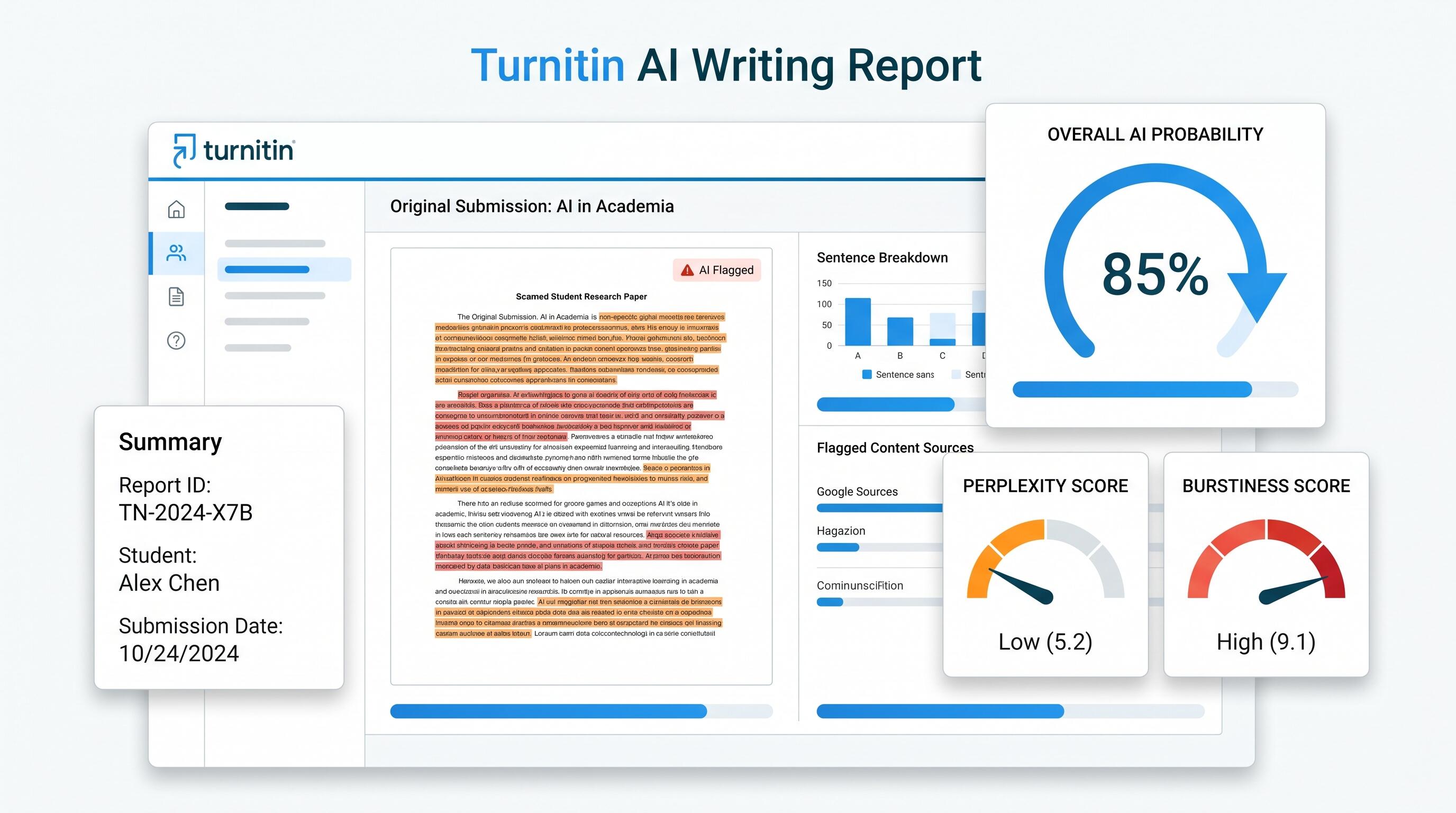
ALT: Turnitin AI detection score breakdown showing perplexity and burstiness analysis on a student research paper submission in 2026
Advanced Considerations: Edge Cases, Misconceptions, and Institutional Variation
Special Situations Students Should Know About
STEM and Technical Assignments: Students in mathematics, engineering, and the natural sciences sometimes assume that formulaic, equation-heavy writing is less likely to be detected. This is partially true for highly technical notation, but the prose sections of STEM reports and lab write-ups are subject to the same detection logic as humanities essays. Writing clear, analytically grounded prose in your own voice remains essential even in technical disciplines.
Translated Academic Writing: International students who draft in their first language and then use translation tools face a specific risk. Machine-translated academic text often carries the statistical signatures of AI-generated content even if the original ideas were entirely the student's own. If translation assistance is part of your workflow, make sure to revise the translated output substantially to restore your own syntactic and stylistic fingerprint.
Collaborative Projects: Group assignments submitted through Turnitin can sometimes produce mixed AI signals if different group members have very different writing styles. Ensure that collaborative submissions are edited for consistency of voice and that any AI-assisted sections are clearly disclosed in accordance with your institution's policy.
Common Misconceptions Clarified
- "Turnitin can tell exactly which AI tool I used." False. Turnitin detects statistical patterns characteristic of AI-generated text in general — it does not identify the specific tool used.
- "A score below 20% means I'm safe." Misleading. Turnitin does not publish a universal "safe" threshold. Interpretation depends on institutional policy and instructor judgment.
- "Adding my own citations after generating AI text makes it original." False. Citation addition does not change the underlying prose patterns that Turnitin evaluates.
Frequently Asked Questions FAQ
Q1: How does Turnitin distinguish between AI-generated and human-written text?
Turnitin uses a machine learning model trained on large datasets of both human-authored academic writing and AI-generated content. It analyzes statistical properties including perplexity (how predictable word choices are) and burstiness (variation in sentence structure and length). Human writing tends to score higher on both measures, while AI-generated text is characteristically more uniform and predictable. Turnitin reports that its current model achieves over 98% accuracy in identifying AI-generated text while maintaining a very low false-positive rate, according to the company's published technical documentation.
Q2: Is it against the rules to use AI writing tools for university assignments?
This depends entirely on your institution's specific academic integrity policy, which varies widely. Many universities now permit the use of AI tools for brainstorming, research assistance, and grammar checking, while prohibiting the submission of AI-generated text as one's own work. Some institutions require disclosure of AI tool use. There is no universal rule — students must consult their own institution's published guidelines and, when in doubt, ask their instructor or academic integrity office directly before using any AI assistance in their coursework.
Q3: How much does it cost to use Verla, and how quickly can I get a citation-ready submission?
Verla operates on a flexible pay-as-you-go credit system, meaning you only pay for what you actually use — there are no subscriptions or minimum commitments. The platform is designed to deliver complete, citation-ready academic submissions efficiently, with most standard assignments processed in minutes rather than hours. Because Verla is trained on over 10 million scholarly texts and aligned with Harvard, Cambridge, and Tsinghua University standards, the output is designed to meet the academic quality bar your institution expects, not just to pass a word count.
Summary
Navigating Turnitin's 2026 AI detection capabilities is genuinely manageable — but only if students approach their academic writing with clarity, intentionality, and the right tools.
Three key points to take away from this guide:
1. Detection is statistical, not magical. Turnitin measures perplexity and burstiness — the predictability and uniformity of your prose. Writing that reflects your genuine engagement with a topic, your own analytical reasoning, and your chosen academic voice will naturally score lower on AI detection signals.
2. Surface-level workarounds are increasingly ineffective. Paraphrasing, synonym substitution, and light editing of AI-generated text do not reliably eliminate the statistical fingerprints that Turnitin's 2026 model detects. The only durable strategy is authentic intellectual authorship.
3. The right AI tool makes all the difference. Purpose-built academic AI tools that are trained on scholarly texts and aligned with real university standards — like Verla — are fundamentally different from general-purpose chatbots. They are designed to support your genuine academic work, not replace your thinking.
Your next step is straightforward: the next time you face a challenging assignment, start with your own ideas, build your argument from credible sources, and use academic-grade tools to support your writing process — not shortcut it.
Ready to take the stress out of your assignments? Visit Verla at https://verla.io/ and experience the power of an AI academic assistant trained on over 10 million scholarly texts — built to match the standards of Harvard, Cambridge, and Tsinghua University. With Verla's flexible pay-as-you-go credit system, getting a complete, human-like, citation-ready submission is just a few clicks away.
References
- Turnitin. "Turnitin's AI Writing Detection Capabilities".
https://www.turnitin.com/solutions/ai-writing - International Center for Academic Integrity (ICAI). "The Fundamental Values of Academic Integrity".
https://academicintegrity.org/resources/fundamental-values - UNESCO. "ChatGPT and Artificial Intelligence in Higher Education: Quick Start Guide".
https://www.iesalc.unesco.org/en/2023/04/14/chatgpt-and-artificial-intelligence-in-higher-education-quick-start-guide/ - Stanford University Human-Centered AI Institute. "AI in Education: Understanding the Landscape".
https://hai.stanford.edu/education - MIT Academic Integrity. "Using Generative AI Tools: Academic Integrity Guidance".
https://integrity.mit.edu/
Note: Detection thresholds, institutional policies, and Turnitin platform capabilities may be updated. Always check the latest official documentation from Turnitin and your institution's academic integrity office for current guidance.
About Verla
Verla is an AI-powered academic assistant designed to help students ace every assignment effortlessly. Powered by an academic-grade model trained on 10M+ scholarly texts and aligned with Harvard, Cambridge, and Tsinghua University standards, Verla delivers complete, human-like, citation-ready submissions through a flexible pay-as-you-go credit system.
© Verla (https://verla.io/). All rights reserved. This article is produced for informational and content marketing purposes only. The content herein does not constitute formal academic advice. All academic work submitted by users remains the responsibility of the individual user.
About Verla
Verla is an AI-powered academic assistant designed to help students ace every assignment effortlessly. Powered by an academic-grade model trained on 10M+ scholarly texts and aligned with Harvard, Cambridge, and Tsinghua University standards, Verla delivers complete, human-like, citation-ready submissions through a flexible pay-as-you-go credit system.
© Verla (https://verla.io/). All rights reserved. This article is produced for informational and content marketing purposes only. The content herein does not constitute formal academic advice. All academic work submitted by users remains the responsibility of the individual user.